Weekly Cantata

Weekly Cantata

Tag Archives: Thomas Hobbs

Trinity 11, 1723: Bach on a roll

14 Sunday Aug 2016

Posted by cantatasonmymind in 1723 Trinity season special series, Bach's life, Cantatas, Leipzig, Trinity

≈ Leave a comment

Tags

11th Sunday after Trinity, according to Lutheran Church year, Agnès Mellon, Bach Collegium Japan, BWV 105, BWV 136, BWV 179, BWV 234, BWV 236, BWV 46, Collegium Vocale Gent, Masaaki Suzuki, Miah Persson, Peter Kooij, Philippe Herreweghe, Thomas Hobbs
8ea433d635c0bd84d61c155e0969f602c9c37beb
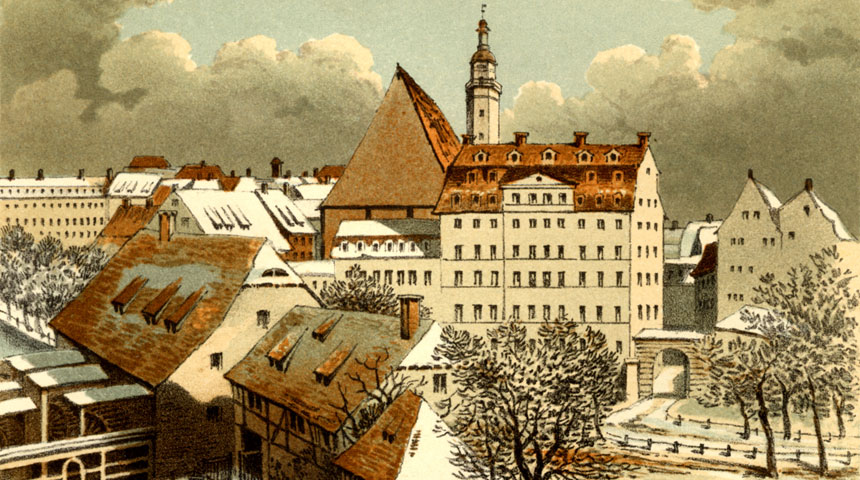
Mendelssohn’s sketch of the Thomasschule (St. Thomas School) and, behind it, the Thomaskirche (St. Thomas Church) in Leipzig.

Thank you for following this blog, and thank you for reading this long post all the way to the end!

For Trinity 11 (August 8 in 1723), we’re listening to Cantata 179 Siehe zu, daß deine Gottesfurcht nicht Heuchelei sei, with a superb opening chorus and one of the most beautiful soprano arias Bach ever wrote.
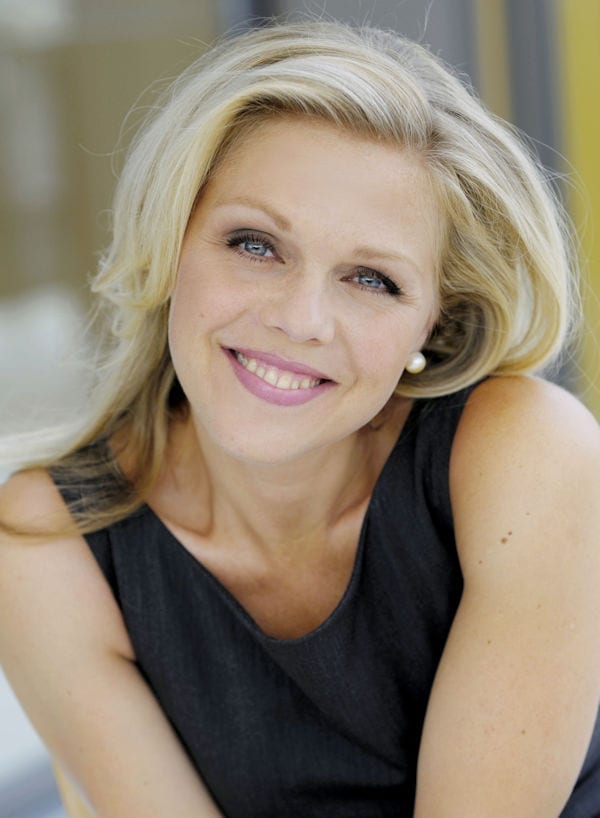
MiahPersson_MonikaRittershaus
Miah Persson. Photo by Monika Rittershaus.

I prefer Bach Collegium Japan’s recording of this cantata. It’s a special recording, with Miah Persson singing the soprano aria. She’s having quite a career now, so I think we’re lucky to have her beautiful voice and sensitive interpretation on this recording from 1999. You can find it on Youtube or Spotify. Please consider purchasing this recording on jpc.de, Amazon, or iTunes. Soloists on this recording are Miah Persson, soprano; Makoto Sakurada, tenor; and Peter Kooij, bass.

Please find the score here (it’s fun to read along with the recording, especially in the opening chorus, to see what Bach does with the fugue) and the German text with English translation here.

It is now more than two months since Bach started his new job in Leipzig, and he is about three weeks into writing a brand new composition every week, and I’m sorry if I sound too casual here, but he’s on a roll. He must now have a vision of what it is he really wants to do for these churches (see the tiny preludes to his Passions he incorporates in cantatas 105 and 46), and he must have the classes at the St. Thomas School organized, and his singers sufficiently trained, so that he can now have them sing a new and challenging opening chorus every week.  Just listening to the opening choruses alone, starting with the one of cantata 136 for Trinity 8, I marvel at what he comes up with every time. Every single one of them is stunning, but at the same time completely different from the one of the previous Sunday. This time Bach chooses to write a perfect “old style” (Palestrina-style) motet fugue as opening chorus.

As always, to fully understand the cantata and not miss any of Bach’s hidden messages, it is important to look at the Gospel reading for the day. In this case it is the parable of the Pharisee and the Publican (or Pharisee and the Tax Collector), a story Jesus tells as an illustration on how to pray: the Pharisee is full of himself, telling God how good he is, while the Publican in his own prayer merely asks for mercy, and tells God how bad he is.  This concept of “how to be a good Christian before God” was very important to Bach and apparently his librettist got the message loud and clear. He or she uses the opportunity to first write a strong protest against fake religion and hypocrisy in “Christianity today” in movements 1 to 3 (probably having certain people in Leipzig in mind), after which he/she states that all Christians should take the humbleness of the publican as example in movements 4 to 6. For another example of how Bach interprets this Bible story, read my post about Cantata 113, written for this same 11th Sunday after Trinity, in 1724.

The most special feature of the fugue in the opening chorus is that since the text talks about beautiful outer appearance versus a bad character, Bach uses a mirror-fugue, which he used as well in fugues 5-7 from the Art of the Fugue (the theme of six bars is first introduced by the basses, and then is answered by the tenors in an “inversion:” every step up from the basses becomes a step down in the tenor part.)

To understand how Bach built this intricate fugue I am sharing the excellent music example and diagram by Dutch Bach writer Eduard van Hengel, with his permission:

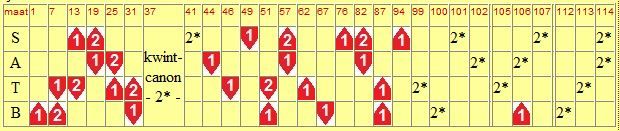
179_diagram1
179-diagram2

Even though the text here is in Dutch, the diagram speaks for itself, with this quick explanation of the numbers and symbols:

1 = The theme (or first half-sentence of the text: Siehe zu, dass deine Gottesfurcht nicht Heuchelei sei). Note the ascending line on the word “Gottesfurcht” (fear of God/love of God) and the descending line on the word “Heuchelei” (hypocrisy).

2 = The counter-subject (or second half-sentence of this text: und diene Gott nicht mit falschem Herzen). Note here that there is a chromatic line every time the word “falschem” appears in the text: for the chromatic line the composers needs accidentals that are not part of the key the piece is written in, which in the “old polyphony” would be seen as “falsch” (not right, off-key).

Upward arrow = fugue theme regular

Downward arrow = fugue theme inversed (mirror fugue)

2* = a more compact (only 4 bars instead of 6 bars long) theme which is derived from the first counterpoint/counter-subject on the words und diene Gott nicht mit falschem Herzen, still with the chromatic line on falschem Herzen.

The numbers at the top are measure (“maat”) numbers.

Bach himself must have greatly valued this cantata. About 15 years later, he used no less than three movements from this cantata for use in his short masses, or Lutheran masses.**

The opening chorus was later “recycled” as the first movement (Kyrie) in the Mass in G Major, BWV 236. Keep listening, or scroll to 18:00 and you’ll discover that the tenor aria Quoniam (sung here by Thomas Hobbs) was, with some changes and a much slower tempo, recycled from the tenor aria in this cantata 179. In cantata 179 the tenor aria gets a colorful accompaniment of two oboes and first violins in unison. The second violins and violas fill in the meaningless middle part (representing the “nothingness, emptiness”). When recycling this later for the Quoniam in the Mass in G Major, Bach uses only one solo oboe for the accompaniment, and completely leaves out all strings (confirming that with a different text, the meaningless middle part is not relevant anymore).

This cantata’s wonderful soprano aria (with two oboi da caccia and basso continuo) was later reworked into the Qui Tollis for the Mass in A Major, BWV 234 (with two flutes and only high strings as continuo). This was actually how I first knew and loved this soprano aria, I didn’t know cantata 179 until I started listening to it for this blog. Please click on this link and listen to the amazing Agnès Mellon sing the Qui Tollis from the Mass in A Major.

Wieneke Gorter, August 14, 2016, links updated August 15, 2023.

** These are called “short” or “Lutheran” masses because they consisted of only the Kyrie and Gloria part of the traditional Catholic mass. Bach wrote four of them (BWV 233-236), and they are all made up of existing movements from cantatas, but reworked and compiled in a very smart way and they are all absolutely beautiful. You can purchase an album with Herreweghe’s recording of all of them on jpc.de, iTunes, or Amazon.

Trinity 10: my favorite counter-tenor in the spotlight

30 Saturday Jul 2016

Posted by cantatasonmymind in 1723 Trinity season special series, Cantatas, Leipzig, Trinity

≈ Leave a comment

Tags

according to Lutheran Church year, Bach, BWV 105, BWV 244, BWV 46, cantatas, Collegium Vocale Gent, Damien Guillon, Hana Blazikova, Kooy, Lutheran Church year, Mass in B Minor, Peter Kooy, Philippe Herreweghe, St. Matthew Passion, Thomas Hobbs, Which cantata which Sunday, Which cantata which week

For this Sunday, Trinity 10, August 1, 1723 Bach wrote cantata 46 Schauet doch und sehet, ob irgend ein Schmerz sei.

This is another exquisite cantata, worth listening to (or worth watching for a bit, see link below for a wonderful video of the opening chorus by Herreweghe live at the Saintes Festival).

I recommend Herreweghe’s recording from 2012, on the same album already discussed in my previous post for cantata 105.

Purchase this recording on Amazon (the album also includes last week’s cantata 105, and two more cantatas from the 1723 Trinity season).

Listen to this Herreweghe recording from 2012 on Spotify.

Or, listen to this same recording on YouTube, via playlist I created (if this shows up as a visual on your screen,  and clicking on the main “play button” results in a “this video cannot be played” message, click on the icon on the top left where it says 1/6, and it should work):

Or watch these same performers in a live video of the opening chorus only from the Festival de Saintes.

Please find the text here, and the score here.

I especially enjoy this cantata because of the beautiful opening chorus, the dramatic bass aria (with terrific tromba da tirarsi playing by Alain de Rudder), and the alto aria.

You’ll recognize the first part of the opening chorus. Bach must have liked this enough to re-use it later as the Qui Tollis in his Mass in B minor. The illustration of the “Schmerz” with two recorders and two oboi da caccia in the orchestra is beautiful.

Last week, with cantata 105, Bach started using features that preluded his passions. In the alto aria in this cantata 46, there is again a reference to the St. Matthew Passion. The pastoral character of the music, as well as the text reference to Küchlein (chicks) make me think of the Sehet Jesus hat die Hand alto aria. I am a huge fan of counter-tenor Damien Guillon. In 2011, I heard him sing for the first time in a live performance of the St. Matthew Passion by Herreweghe in Europe, and have been collecting his recordings since then. He appears on recordings with his own ensemble Le Banquet Celeste, cantata recordings by Herreweghe from 2011 and later, and on several recordings of Marcel Ponseele’s ensemble Il Gardellino. Watch an interview with him (with English subtitles) on YouTube:

Wieneke Gorter, July 30, 2016, links updated August 10, 2023.

Belated Trinity 9

30 Saturday Jul 2016

Posted by cantatasonmymind in 1723 Trinity season special series, Cantatas, Leipzig, Trinity

≈ Leave a comment

Tags

according to Lutheran Church year, Bach, Barbara Schlick, BWV 105, BWV 162, BWV 244, BWV 245, BWV 46, BWV 67, cantatas, Damien Guillon, Hana Blazikova, Lutheran Church year, Peter Kooij, Peter Kooy, Philippe Herreweghe, Thomas Hobbs

In the previous episode of this special 1723 Leipzig Trinity series we saw how Trinity 8 marked the start of the shorter cantata, containing only around 6 movements instead of 10 to 14 movements. However, that weeks’ cantata was probably still based on earlier compositions. This means that cantata 105 Herr, gehe nicht ins Gericht could be considered the start of the true Leipzig cantata.

Two striking “Leipzig only” features make an appearance in this cantata: clear references to Bach’s future Passions (see below), and the “corno da tirarsi” (slide horn).

Only three cantatas (Trinity 10’s cantata 46, as well as 162 and 67) show the full name corno da tirarsi written in the manuscript, but there are 27 cantatas from Leipzig requiring a corno in which that part is not playable on a natural horn, so must have been written for this corno da tirarsi as well. Cantata 105 is included in that group. Bach is the only composer who ever mentioned this instrument in writing, and most probably his principal brass player Gottfried Reiche was the only one who ever played it. After Reiche’s death in 1734 Bach did not write for this instrument anymore, and for repeat performances of any cantatas containing a corno da tirarsi part, Bach rewrote it for other instruments. Read more about this in Olivier Picon’s article on the “corno da tirarsi” from 2010. 

Herreweghe has recorded this cantata 105 Herr, gehe nicht ins Gericht twice: first in 1992 (with soloists Barbara Schlick, Gerard Lesne, Howard Crook, and Peter Kooij), and again in 2012 (with soloists Hana Blazikova, Damien Guillon, Thomas Hobbs, and again Peter Kooij).

Though that first recording from 1992 is excellent, and the soprano aria on that recording has more character to my taste, I recommend the 2012 recording for the following reasons:

  1. At the time of the 1992 recording, no corno da tirarsi was available, which means that the tenor aria on that recording has an oboe accompaniment. The recording from 2012 does feature a corno da tirarsi in this aria.
  2. The “Herr, Herr” exclamations are more prominent in the opening chorus of the 2012 recording, and the tempo of the opening chorus is also a bit faster, which I like.
  3. The 2012 album, which includes three other cantatas, focuses on 1723 Trinity cantatas only, which of course is extra special for this blog’s special 1723 Trinity series.

Listen to this 2012 recording by Herreweghe on Spotify.

Listen to this 2012 recording on YouTube, by way of a playlist I created (it is possible that this only works for readers in the USA):

Support the artists and purchase this recording on Amazon. (it’s always worth it, but this time you’ll get three more cantatas in that same album that will be discussed on this blog in the coming weeks!)

Read the German text with English translations here, and find the score here.

Listen for the “Herr, Herr” exclamations in the opening chorus. They will appear in the opening chorus of the St. John Passion in early 1724. The exquisite soprano aria has no bass instrument in the continuo. Bach will later use that feature more often in other Leipzig cantatas, to either show purity or uncertainty, and it is a strong feature of the Aus Liebe aria from the St. Matthew Passion. And last but not least: when I listen to the bass arioso from this cantata 105, I am strongly reminded of the bass arioso Am Abend da es kühle war from the St. Matthew Passion. The music is not 100% the same, but very similar, and there are also references in the text.

Other stunning features of this cantata 105: the strings accompanying the soprano aria illustrate the “shivering” and “quavering” in the text, and those same “uncertain” strings turn up again in the orchestra part of the closing chorale.

Wieneke Gorter, July 30, 2016, links updated August 2, 2023.

Glorious soprano arias and unusual instrumentation

08 Sunday May 2016

Posted by cantatasonmymind in After Easter, Cantatas, Leipzig

≈ Comments Off on Glorious soprano arias and unusual instrumentation

Tags

Bach, BWV 183, bwv 44, Carolyn Sampson, Christiane Mariana von Ziegler, Dorothee Mields, Exaudi, Gerd Türk, Harnoncourt, oboe d'amore, oboe da caccia, Peter Jelosits, Peter Kooy, Phlippe Herreweghe, Robin Blaze, Rudolf Lutz, Thomas Hobbs, violoncello da spalla

BWV183titlepage

The title page of cantata 183 in Bach’s handwriting: Dominica Exaudi // Sie werden eüch in den Bann tun // à 4 Voci, 2 Hautb d’Amore, 2 Hautb da Caccia, 2 Violini, Viola, Violoncello piccolo e Continuo // di Joh. Sebas. Bach. Staatsbibiothek zu Berlin – Preußischer Kulturbesitz

There are two cantatas for this Sunday Exaudi, aka the Sunday after Ascension, or in the practical reality of the man who had to write the music and rehearse the choir: the Sunday in between Ascension and the three-day-long feast of Pentecost. Because they refer to the same Gospel text, the cantatas share the title Sie werden euch in den Bann tun, but except for the fact that they each contain a glorious soprano aria, they have nothing in common.

I discuss both cantatas in this blog post. Keep reading for Cantata 183, but let’s first look at the one Bach wrote in 1724: Cantata 44 Sie werden euch in den Bann tun.

The soprano aria from this cantata, Es ist und bleibt der Christen Trost, sung by the amazing Peter Jelosits on the Harnoncourt recording from 1975 is among the most happiest music memories of my childhood. I suspect my mom loved it so much that she played it more often than just on this Sunday. I didn’t realize how well this aria is engraved in my brain until I surprised myself during a choir carpool, singing the entire thing from memory, illustrating a story about how some of these boy sopranos could sing very complicated arias.

Es ist und bleibt der Christen Trost,
The consolation of Christians is and remains
Dass Gott vor seine Kirche wacht.
God’s watchful care over his church.
Denn wenn sich gleich die Wetter türmen,
For even though at times the clouds gather,
So hat doch nach den Trübsalstürmen
yet after the storms of affliction
Die Freudensonne bald gelacht.
the sun of joy has soon smiled on us.

If you would like to listen to the entire cantata, I recommend Herreweghe’s recording from 2013. The opening tenor/bass duet is the best here, with bass Peter Kooij singing out much more than on their 1993 recording of this same cantata, and his and Thomas Hobbs’ voice matching better than his and Christoph Prégardien’s (as much as I love Prégardien’s voice!).

Also, Herreweghe’s interpretation of the soprano aria on this 2013 recording is the most musical and the most cheerful, not in the least because it has the highest tempo of all recordings I listened to. That this proves a bit of a challenge for the always fabulous soprano Dorothee Mields is only audible in the text: after she comes out of the expertly executed but super tricky long runs, she slips back into the edition she probably studied from, which uses the more modern “für seine Kirche”  instead of the edition they’re performing from, which uses the archaic “vor seine Kirche,” so it ends up being a mix of the two texts. While this bugs me a little bit, a retake of the recording would probably have been at the expense of the magic that happens in this aria, so it is probably a good thing that they left it in.

Purchase the Herreweghe recording of cantata 44 on Amazon or on iTunes. (This album also features the beautiful recording of cantata 73 discussed here).

Find the entire German text of cantata 44 with English translations here, and the score here.

  • Thomas Hobbs, tenor (photo by B Ealovega)
  • Peter Kooij, bass

Cantata 183 from 1725 is noteworthy because it uses a text by Christiane Mariana von Ziegler and features a striking instrumentation: two oboi d’amore and two oboi da caccia in the bass recitative; a violoncello piccolo in the tenor aria; again the two oboe pairs in the alto recitative; two oboi da caccia in the soprano aria; all these instruments in the closing chorale.

My absolute favorite recording of this cantata is the one by Bach Collegium Japan. They struck gold with this recording, thanks to the combination of  Badiarov playing the violoncello piccolo da spalla, fabulous oboe players, and terrific vocal soloists: soprano Carolyn Sampson, countertenor Robin Blaze, tenor Gerd Türk, and bass Peter Kooij. I think the entire album (also featuring the recording of cantata 85 discussed here) is very inspired, and it has become one of my favorite Bach cantata CDs.

Listen to this Bach Collegium Japan recording of cantata 183 on Spotify.

Purchase this Bach Collegium Japan recording of cantata 183 (and 85!) on Amazon or on iTunes.

Find the German text with English translation of Cantata 183 here, and the score here.

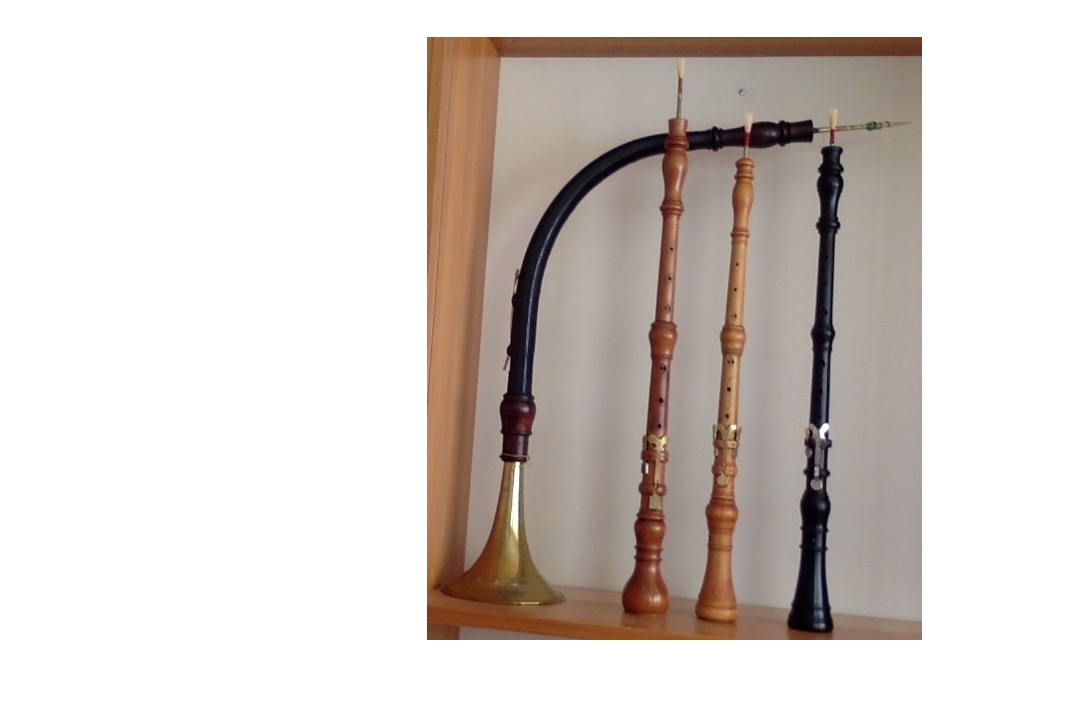
Why is this scoring for the oboes so unusual? In Bach’s time there were “regular” oboes (to the right on this photo), oboes d’amore (with a bell-like widening in the wood at the end, second from left), and oboes da caccia (or “hunting” oboes, completely curved, and with a trumpet-like brass bell at the end, far left).

Oboes
From left to right: oboe da caccia, oboe d’amore, oboes. Photo courtesy of Marianne Richert Pfau; instruments built after 18th century examples by Sand Dalton, Harry van Dias, and Paul van der Linden, respectively.

Bach often used the oboe da caccia, but only on a handful of occasions would he write for two da caccias. And even if he would write for two da caccias or two d’amores and “regular” oboes in the same cantata (or passion) they would not all be playing at the same time. On most occasions there were between one or two oboe players in the orchestra, sometimes three, alternating between the different instruments from one movement to the next. The only times Bach needed four oboists in one cantata, playing two da caccias and two d’amores at the same time, was in cantata 2 of the Christmas Oratorio (1734) and in this cantata 183. So there must have been some good oboe playing visitors in town around this time of Ascension and Pentecost in 1725.

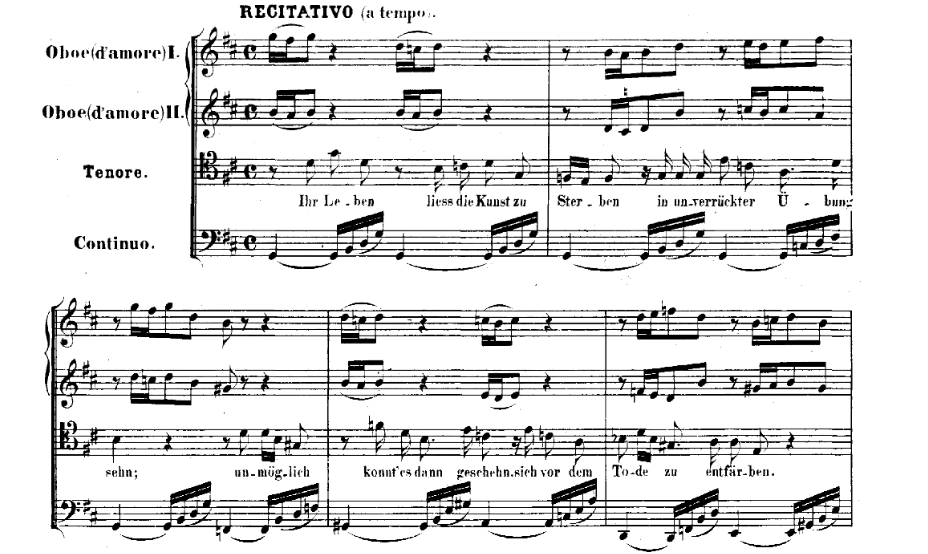
The four oboes can be heard clearly in the alto recitative, where Bach has each of them repeat the four-note theme from the “ich bin bereit”-text in the vocal part:

Screenshot 2016-05-08 10.16.33

When I hear this, I immediately have to think of the tenor recitative in Bach’s beautiful  Trauer Ode, cantata 198, this time reduced to a 3-note theme and without the da caccias:

Screenshot 2016-05-08 10.28.17

Or listen to this recitative from cantata 198 on YouTube

It is of course not exactly the same composition, but I wonder if Bach had to think back of this cantata from 1725 when he wanted to illustrate life  and death in one and the same piece of music in the Trauer Ode of 1727.

After this alto recitative comes the most glorious soprano aria, richly scored with the two oboes da caccia playing the oboe part in unisono, as well as parts for violin 1, violin 2, and viola. Harnoncourt says that even though both da caccia have this aria written in, he says it is “clearly not intended to be chorally played” and on their recording they decide to have this part covered by only one oboe da caccia. Perhaps the original full score was not available to Harnoncourt at the time he made that decision, because it clearly says: “tutti gli Oboi in unisono:”

Screenshot 2016-05-08 12.34.13
excerpt from the soprano aria from cantata 183, with Bach’s indication for “all the oboes in unisono,” Staatsbibiothek zu Berlin, Preußischer Kulturbesitz

One would almost think Bach dreamt of all four oboes playing this, also the d’amores, but when his copyists double-checked with him, he decided that was just silly, it would overpower the poor boy who had to sing this, and they only wrote it into the parts for the da caccias (it says “Arie Tacet” in the parts for the oboi d’amore).

To learn more about Cantata 183, I wholeheartedly recommend you study with Rudolf Lutz of the J.S. Bach Foundation a little bit. Find a link to his fabulous (English spoken!) lecture and improvisation about this cantata in my blog post from May 24, 2020.

Wieneke Gorter, May 8, 2016, updated May 23, 2020.

72 and 73

24 Sunday Jan 2016

Posted by cantatasonmymind in Cantatas, Epiphany, Leipzig

≈ Comments Off on 72 and 73

Tags

Bach Collegium Japan, Bist du bei mir, Collegium Vocale Gent, Dorothee Mields, Eduard van Hengel, Leichenglocken, Lutheran Church year, Masaaki Suzuki, Monika Mauch, Montreal Baroque, Peter Kooy, Phlippe Herreweghe, Rachel Nicholls, Robin Blaze, Thomas Hobbs

ChristCleansing

Christ cleansing a leper, Jean-Marie Melchior Doze, 1864

For this third Sunday after Epiphany, we find no less than four gems in Bach’s treasure trove: cantatas 73, 111, 72, and 156. I decided to highlight 73 and 72, because of the interesting references between the two. As far as we can tell, Bach loved these cantatas too: He performed cantata 73 at least one more time, and transcribed the opening chorus of cantata 72 into the Gloria of his Mass in G minor.

From the chronology of performances in Leipzig, it looks as if Bach wrote cantata 73 in 1724 and cantata 72 two years later. However, some scholars argue that (a large part of) cantata 72 was probably already written around 1715, since most of the poetry is from a collection Bach used when working in Weimar at that time. But whether 72 was first or 73 was first, it doesn’t matter that much for the appreciation of these two beautiful cantatas.

I have a soft spot for cantata 73 because I love the way Herreweghe performs this, have listened to the 1990 recording many times since it came out, and then to the (better!) 2013 recording. The best parts are the opening chorus and the bass aria (sung by Peter Kooy on both recordings) and I’m grateful for Eduard van Hengel’s Bach website (in Dutch) where I learned a lot about the many possible bits of reference in this cantata to other works.

Listen first to Cantata 72 Alles nur nach Gottes willen by Bach Collegium Japan/Masaaki Suzuki on Spotify

soloists: Rachel Nicholls (one of the most “boy soprano”-like voices of the soprano soloists in that series, I love it), Robin Blaze (counter-tenor), Peter Kooy (bass)

If you only have access to YouTube, you could listen to Montreal Baroque’s recording or to Gardiner’s recording instead.

What to listen for in cantata 72:

The most important words from the Bible text for this third Sunday after Epiphany (the story of Jesus cleansing a leper, from the gospel of Matthew):

Da er aber vom Berg herabging, folgte ihm viel Volks nach. Und siehe, ein Aussätziger kam und betete ihn an und sprach: Herr, so du willst, kannst du mich wohl reinigen. Und Jesus streckte seine Hand aus, rührte ihn an und sprach: Ich will’s tun; sei gereinigt!

(When He had come down from the mountain, great multitudes followed Him. And behold, a leper came and worshiped Him, saying, Lord, if You are willing, You can make me clean. Then Jesus put out His hand and touched him, saying, I am willing; be cleansed.)

In the opening chorus: The illustration of the word “Alles” (Everything): one can hear all the instruments in the orchestra, and when the voices come in, they first jump an octave over two quarter notes, signifying all the possible notes in the chord, and then run up in 16th notes, singing every single note in the chord.

In the alto aria: nine times the words “Herr, so du willt” – make sure to remember this melody!

In the bass aria: the text is set in the third person, but it is almost as if Jesus himself is speaking here, and this is where the text moves to the “Ich will’s tun” (I will do it / I am willing) words from the gospel.

In the soprano aria*: the happy and sweet elaboration on the “Ich will’s tun” – which here turns into “my Jesus will do it!”

The closing chorale: the same text and tune Bach uses throughout cantata 111 for this same Sunday in 1725, as well as in the St. Matthew Passion (but in that case with different harmonies in the last four lines!)

***

Next, listen to cantata 73 Herr, wie du willt, so schick’s mit mir in a fantastic recording by Collegium Vocale Gent/Philippe Herreweghe, from 2013, on Spotify soloists: Dorothee Mields (soprano), Thomas Hobbs (tenor), Peter Kooy (bass)

or their 1990 recording here on YouTube soloists: Barbara Schlick (soprano), Howard Crook (tenor) and Peter Kooij (bass).

Please note: these are two different Herreweghe recordings. The newest one, on Herreweghe’s own label, features a different soprano and tenor soloist than on his earlier recording of this same cantata (Virgin Classics, 1990, with soprano Barbara Schlick and tenor Howard Crook). I like this new one better. The entire CD is wonderful, and also features fabulous counter-tenor Damien Guillon in the other cantatas on the disc. If you like this recording, please consider supporting the artists by purchasing it on Amazon.

What to listen for in cantata 73:

In the opening chorus: the first four notes of the original chorale Herr, wie du willt, so schick’s mit mir in Leiden und Sterben, used as a four-note “Leitmotiv,” first appearing staccato in the horn in the orchestra:

Screenshot 2016-01-22 23.47.40
and at the very end of the movement, homophonically in the choir, repeated three times, not something Bach normally does in cantata opening choruses:
Screenshot 2016-01-22 23.54.06

In the bass aria: now the “Herr, wie du willt” from the chorale text turns in to “Herr, so du willt” from the gospel text. And to accentuate this, Bach again gives this text its own “Leitmotiv”-like melody. However, it might not have been a new melody. It is very similar to “Bist du bei mir” from Anna Magdalena’s music book. She wrote this aria in her book much later, but it was copied from an opera aria by Stölzel from 1717. Perhaps this opera aria was already being hummed in the Bach household in 1724, we will never know. Later in the bass aria in cantata 73, the “Herr, so du willt”-melody from the alto aria of cantata 72 returns!

What I love especially in this bass-aria is the illustration of “Leichenglocken” (death bells) by pizzicato strings and a somewhat “tolling” movement in the vocal part. My mother (a walking Bach encyclopedia who played a cantata on the turntable / CD player every Sunday) would always point features like this out to me. Bach used it in many other cantatas, for example in (cantata number/movement number): 8/1, 95/5, 105/4, 127/3, 161/4, 198/4. [Thanks again to Eduard van Hengel, I didn’t have to look this up myself].

* While overall I like Bach Collegium Japan’s recording of cantata 72 best, and I love how Rachel Nicholls sings the soprano aria, I would like to mention that on Montreal Baroque’s recording of this work, the soprano aria by Monika Mauch is excellent and worth listening to. How she makes everything calm on the words “sanft und still” is very special.

More links:
German text with English translation for cantata 72
Score for cantata 72
German text with English translation for cantata 73
Score for cantata 73

Wieneke Gorter, January 24, 2016; links updated January 25, 2020, and January 23, 2021.

Newer posts →

Recent Posts

  • “Missa Miniatura” by CONTINUUM/Elina Albach Even More Moving in 2025
  • Bachfest Leipzig 2025
  • Bach Cantatas for Christmas – 1724 and 1734 editions
  • Fourth Sunday of Advent – more insight into Cantata 62 helped me better understand Bach’s Christmas Oratorio
  • Saint Ambrose and Luther in Milan – Second Sunday of Advent

Archives

  • August 2025
  • July 2025
  • December 2024
  • November 2024
  • June 2024
  • January 2024
  • December 2023
  • October 2023
  • September 2023
  • August 2023
  • April 2022
  • February 2022
  • January 2022
  • December 2021
  • November 2021
  • June 2021
  • May 2021
  • April 2021
  • February 2021
  • January 2021
  • December 2020
  • November 2020
  • October 2020
  • September 2020
  • August 2020
  • July 2020
  • May 2020
  • April 2020
  • March 2020
  • February 2020
  • January 2020
  • December 2019
  • November 2019
  • May 2018
  • April 2018
  • March 2018
  • February 2018
  • January 2018
  • December 2017
  • November 2017
  • October 2017
  • September 2017
  • August 2017
  • July 2017
  • June 2017
  • May 2017
  • April 2017
  • March 2017
  • February 2017
  • January 2017
  • December 2016
  • November 2016
  • October 2016
  • September 2016
  • August 2016
  • July 2016
  • June 2016
  • May 2016
  • April 2016
  • March 2016
  • February 2016
  • January 2016

Enter your email address to follow this blog and receive notifications of new posts by email.

Join 338 other subscribers

Categories

  • 1723 Trinity season special series
  • Advent
  • After Easter
  • Ascension
  • Bach's life
  • Cantatas
  • Chorale cantatas 1724/1725
  • Christmas
  • Easter
  • Epiphany
  • Following Bach in 1725
  • Köthen
  • Leipzig
  • Septuagesima
  • Travel
  • Trinity
  • Weimar

Meta

  • Create account
  • Log in
  • Entries feed
  • Comments feed
  • WordPress.com

Website Built with WordPress.com.

  • Subscribe Subscribed
    • Weekly Cantata
    • Join 158 other subscribers
    • Already have a WordPress.com account? Log in now.
    • Weekly Cantata
    • Subscribe Subscribed
    • Sign up
    • Log in
    • Report this content
    • View site in Reader
    • Manage subscriptions
    • Collapse this bar
 

Loading Comments...