Weekly Cantata

Weekly Cantata

Category Archives: 1723 Trinity season special series

Trying to find some beauty in ugliness

13 Sunday Nov 2016

Posted by cantatasonmymind in 1723 Trinity season special series, Cantatas, Leipzig, Trinity

≈ Leave a comment

Tags

Bachstiftung, Gustav Leonhardt, Leipzig, Max van Egmond, Patrick Henrichs, slide trumpet, trumpet

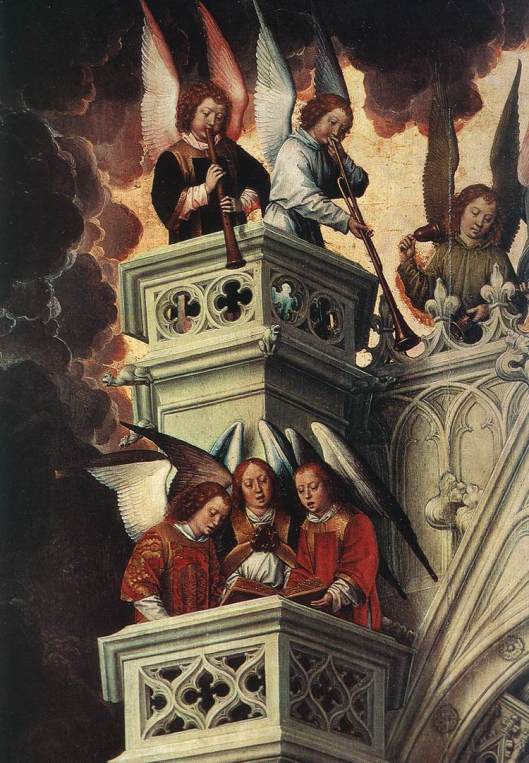
trumpetsmemling

The least gruesome detail of Hans Memling’s “The Last Judgment”, a triptych painted between 1467 and 1471. National Museum, Gdansk, Poland.

This week I’ve been trying harder than ever in my life to find islands of beauty in a sea of ugliness. I found some: I witnessed communities coming together, had a very uplifting choir rehearsal, attended a concert at my daughter’s music school where the director gave a heart-felt speech, and the choir director had included We Shall Overcome in their part of the program. I have talked with my children about what it means to “stand up” for the millions who will suffer discrimination in the next four years in this country.  I realize I have many different readers of this blog, and that some of you might not share my political opinion. But I would urge you to be there for each other. And whomever you had been meaning to contact, whether it is a friend you should have apologized to four weeks ago, someone you know who is having a hard time, a relative you haven’t called in too long, or your representative in the House or Senate, write that letter, make that phone call. Don’t put it off.

In today’s cantata 90 Es reißet euch ein schrecklich Ende (A terrible end shall sweep you away), written for November 14, 1723, the 25th Sunday after Trinity, it is not easy to find beauty either, at least not the soul-soothing kind, since it is based on the Bible story of The Last Judgement, which is an ugly concept in my opinion. However this story was important in Bach’s time, and it was thus appropriate to let the Trinity season go out with a bang: two weeks in a row of impressive cantatas, including some of the most magnificent (and difficult!) arias for bass and trumpet in all of his work.

While Bach’s audience (the congregations of the St. Thomas and St. Nicholas churches in Leipzig) got plenty of tenor drama in the fall of 1723, it had been a long time (August 1, 1723 to be exact) since they had last heard an operatic aria for bass, with the majestic trumpet as accompanying instrument.

Since this emotional week also calls for some nostalgia, I’m going with the Leonhardt recording of this cantata, because I grew up listening to Max van Egmond sing these bass arias. The trumpet player on that recording however barely makes it, so if you would like to listen to a better player in that particular aria, and also see a close-up of the instrument, watch this video (of the bass aria only) by the Bach Foundation, with Patrick Henrichs on trumpet.

Find the text here, and the score here.

Wieneke Gorter, November 13, 2016, Links updated November 24, 2019.

Bach in Vienna / Robin Blaze going wild

06 Sunday Nov 2016

Posted by cantatasonmymind in 1723 Trinity season special series, Cantatas, Leipzig, Trinity

≈ Leave a comment

Tags

24th Sunday after Trinity, Bach Collegium Japan, BWV 105, BWV 60, Eduard van Hengel, Gerd Türk, Jason Victor Serinus, John Eliot Gardiner, Masaaki Suzuki, Peter Kooy, Robin Blaze, San Francisco Classical Voice, St. John Passion, St. Matthew Passion, Trinity 24

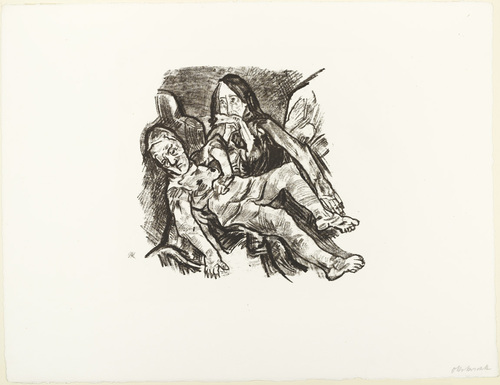
kokoschka_pieta

Pietà (It is enough) / Pietà (Es ist genug), plate 11 from a series of 11 lithographs O Ewigkeit, Du Donnerwort by Oskar Kokoschka, 1914/1916. Museum of Modern Art, New York.

In Vienna, they were all talking about Bach’s cantata 60 O Ewigkeit, Du Donnerwort. The astonishing harmonization in the closing chorale as well as the structure of a “dialogue” between Fear (alto) and Hope (tenor) made it one of the most unusual among his cantatas, and apparently something worth discussing. In the first half of the 20th century, that is. In 1935  Alban Berg used the “modern” harmonization from the closing chorale Es ist genug in the final movement of his violin concerto To the Memory of an Angel–an instrumental Requiem for Manon Gropius, daughter of Bauhaus architect Walter Gropius and Mahler’s widow, Alma Schindler.

Several years before, the same Alma Schindler had a short-lived affair with Czech painter Oskar Kokoschka. After they broke up, Kokoschka processed his torment by making a series of 11 lithographs to illustrate the cantata. The dialogue between Fear (the alto) and Hope (the tenor) in the cantata became a dialogue between Alma and himself, in pictures only: click here to see the entire series. Many thanks to Eduard van Hengel for pointing this out.

Listen to Bach Collegium Japan’s recording of this cantata on Spotify, with countertenor Robin Blaze and tenor Gerd Türk. Find the German text with English translations here, and the score here.

Bach wrote this cantata 60 O Ewigkeit, Du Donnerwort for the 24th Sunday after Trinity in 1723, the Sunday normally linked to the Gospel story of the Raising of Jairus’ Daughter. However, in 1723–as now in 2016–this day fell on the first Sunday in November: All Hallows Sunday, All Saints Sunday, however you want to call it, but the Sunday on which the congregation would have commemorated all who had passed away that year. None of the commentaries I have read mention this, but I think it is important, because I feel this cantata is much more about how horrible it might be to die, or the thoughts one has when sitting at a loved one’s deathbed, than it is about the Raising of Jairus’ Daughter.

Of all the recordings I listened to, I like Bach Collegium Japan’s the best, because of Robin Blaze’s interpretation of the alto part. I always love his voice, but he is usually quite understated in his singing. He explains this well in this interview on San Francisco Classical Voice. I sometimes wish he would indeed sing with Kate Bush and “let go” a little, so I was thrilled to hear that in this cantata he actually does go a bit wild, for his standards at least, and that Suzuki lets him do it. His conviction in the opening chorale is already terrific (also note the wonderful blend with the horn doubling his part), but the way he sings the text “Und martert diese Glieder” (and tortures these limbs) in movement 2 is amazing, spot-on, and unrivaled by any others I listened to.

As we have seen before in the course of these 1723 Trinity Season cantatas (read for example my post on cantata 105) there are elements of Bach’s passions already present in this cantata. The agitated singing of the tenor in the stunningly beautiful duet (movement 3) resembles the Ach, mein Sinn! tenor aria from the St. John Passion. The repeated tremolo in the violins in movement 1 is something Bach often uses to illustrate fear, and this will show up again in the tenor arioso O Schmerz! Hier zittert das gequälte Herz in his St. Matthew Passion.

For further reading, including all the amazing harmonies in this piece which impressed the Viennese composers of the early 20th century,  as well as other insights, I can highly recommend Gardiner’s journal entry about this cantata (start reading on page 5).

Wieneke Gorter, November 6, 2016, updated November 21, 2020

1723 Trinity Special Series: the Final Weeks!

30 Sunday Oct 2016

Posted by cantatasonmymind in 1723 Trinity season special series, Cantatas, Leipzig, Trinity

≈ Leave a comment

95thesen_facsimile_colour

Luther’s Theses, marking the start of the Reformation on October 31 in 1517.

Fear not: I am by no means announcing the end of this blog and am very much looking forward to sharing Bach’s beautiful Advent and Christmas cantatas with you starting on Sunday November 27.

This is just a heads-up about the impending end of my Trinity 1723 Special Series. Bach made his 1723 Trinity Season go out with a bang, and I plan to do the same! Spectacular (and somewhat crazy) cantatas are coming up in the next three weeks, but there’s no cantata from 1723 for today, so this is your chance to catch up on the previous episodes of this special series, which started on Sunday May 29 of this year with this post.  If you don’t have time to read all the episodes, I recommend these two highlights: cantata 147 for the Feast of the Visitation, and cantata 105 for Trinity 9.

Why is there no cantata for today from 1723? It was October 31, also known as Reformation Day, the day on which the Lutheran Church celebrates Martin Luther publishing his 95 Theses against the Catholic Church in 1517. It wasn’t until 1725 that Bach wrote a cantata for that particular day.

Wieneke Gorter, Sunday October 30, 2016.

A pretty soprano aria for Trinity 22

23 Sunday Oct 2016

Posted by cantatasonmymind in 1723 Trinity season special series, Cantatas, Leipzig, Trinity

≈ Leave a comment

Tags

Bach, Leipzig, Nuria Rial

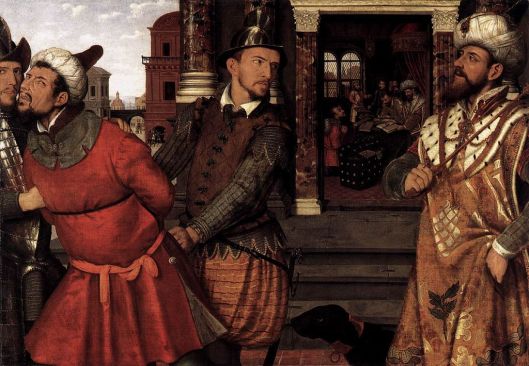
parable_of_the_unfaithful_servant

Parable of the Unmerciful Servant by an unknown master from Northern Germany, ca. 1560. Gemäldegalerie, Berlin.

For this 22nd Sunday after Trinity, October 24 in 1723, Bach wrote cantata 89 Was soll ich aus dir machen, Ephraim?

Apart from providing you with the title of the cantata, the stunning painting, and a pretty YouTube video, you’re on your own this week for reading and listening more about this, as I’ve been busy producing these two fabulous concerts.

To find an overview of the recordings, links to the text & translations, and links to the score of this cantata, please visit this page of the “Bach Cantata Bible” by Aryeh Oron.

For a very beautiful interpretation of the soprano aria (fifth movement) from this cantata, please watch this video of the Bach Stiftung, with soprano Nuria Rial, in Trogen, Switzerland. I first heard the fabulous Nuria Rial sing on the German radio in December 2010 and have been a fan since. Watch her sing Cavalli arias at the Utrecht Early Music Festival in the summer of 2016.  I’ll talk about her again on the first Sunday of Advent, in about a month 🙂

Wieneke Gorter, October 23, 2016

Tenor drama

16 Sunday Oct 2016

Posted by cantatasonmymind in 1723 Trinity season special series, Cantatas, Leipzig, Trinity

≈ Leave a comment

Tags

Bach, Damien Guillon, Dorothee Mields, John Eliot Gardiner, La Petite Bande, Leipzig, Paul Agnew, Peter Kooy, Phlippe Herreweghe, St. John Passion, Thomas Hobbs

bwv109_tenormanuscript

Excerpt from the start of the tenor recitative from cantata 109, with “piano” and “forte” marked. Staatsbibliothek zu Berlin, Preußischer Kulturbesitz

For this 21st Sunday after Trinity, Bach wrote cantata 109 Ich glaube, lieber Herr, hilf meinem Unglauben! in 1723.

For overall best performance, I recommend Herreweghe’s recording from 2013, with counter-tenor Damien Guillon and tenor Thomas Hobbs.

Listen to this recording on YouTube. To support the artists, please consider purchasing the entire album on Amazon — a good deal if you like this blog, as it also includes three cantatas I discussed here earlier this year: cantata 44, cantata 73, and cantata 48.

Read the German texts with English translations here, and find the score here.

I love Herreweghe’s interpretation of  the opening and closing chorus as well as Damien Guillon’s singing in the alto recitative and aria.

However, there is an extremely dramatic and unusual recitative and aria for tenor in this cantata which I like better on the Gardiner recording. The recitative is unusual because Bach has two voices/persons speak: the uncertain/fearful voice, marked “piano” in his manuscript (see picture above), and the certain/faithful voice, marked “forte” in the manuscript. According to Gardiner, this feature never appears anywhere else in Bach’s recitative writing.

Just as with the “Storm on the lake” aria from cantata 81, only Gardiner and the fabulous Paul Agnew are able to properly convey the drama of the text and context of this tenor recitative and aria. If at first you think this might be a bit over the top, it is most probably exactly what Bach had in mind. A bit of opera to properly bring out the agony of the text.

Listen to these two movements by Gardiner and Agnew on YouTube: the recitative here, and the aria here.

Bach might have been preparing the Leipzig congregations for the St. John Passion he was planning for Good Friday 1724, as this tenor aria is very similar in dramatic intensity and music to the Ach mein Sinn aria from that passion. Those who know the St. John Passion well might hear other resemblances in this cantata 109.


Wieneke Gorter, October 16, 2016

A Weimar cantata for Trinity 20

09 Sunday Oct 2016

Posted by cantatasonmymind in 1723 Trinity season special series, Cantatas, Leipzig, Trinity

≈ 2 Comments

Tags

Bach, Bach Collegium Japan, Leipzig, Makoto Sakurada, Peter Kooy, St. Matthew Passion, Trinity 20, Yoshikazu Mera, Yumiko Kurisu

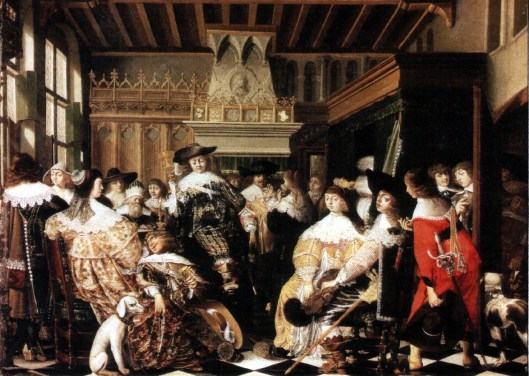
Vornehme Hochzeitsgesellschaft

Vornehme Hochzeitsgesellschaft (Distinguished Wedding party) by Wolfgang Heimbach, 1637. Kunsthalle Bremen, Germany.

I’m in the middle of St. Matthew Passion concert weekend now with California Bach Society. To read more about the connection between this blog and Bach’s Great Passion, please see my post from last week.

This week, while doing dishes, packing dinners, promoting our concerts on Facebook, and making spreadsheets for the youth choir logistics, I listened to several recordings of the 1723 cantata for this Sunday: cantata 162 Ach! ich sehe, itzt, da ich zur Hochzeit gehe, and can safely say I recommend Bach Collegium Japan’s recording of this cantata. It has the most sensitive playing in the instrumental opening and the best interpretation of the bass aria and the soprano aria in my opinion.

Listen to the recording of cantata 162 by Bach Collegium Japan on Spotify. Soloists: Soprano: Yumiko Kurisu, Counter-tenor: Yoshikazu Mera, Tenor: Makoto Sakurada, Bass: Peter Kooy.

Read the text here, and find the score here.

Bach wrote this cantata in Weimar, and performed it there on October 25, 1716. For the performance in Leipzig on October 10, 1723, he added a corno da tirarsi to the instrumentation (the Bach Collegium Japan recording is based on the Weimar version, and thus doesn’t feature the corno da tirarsi).

A very short explanation of the cantata, thanks to Eduard van Hengel: Cantata 162 is based on the Gospel text for this Sunday: Jesus compares the heavenly kingdom with the wedding of a King’s son. Many guests decline the invitation, and several of those who do come are sent away because they are not properly dressed. Since the relationship between Jesus and the soul of the believer is compared to the bond between groom and bride, the believers will be at first concerned that they will not be allowed to join the wedding (cantata movements 1-3), but can then rejoice in their conviction that Jesus, through his suffering, will provide the proper dress for them (cantata movements 4-6).

To read more in Dutch, please go to Eduard van Hengel’s website; to read more in English, find Gardiner’s notes about this cantata here.

Wieneke Gorter, October 9, 2016. Updated October 21, 2023.

The Opening Chorus’ Silver Lining

01 Saturday Oct 2016

Posted by cantatasonmymind in 1723 Trinity season special series, Cantatas, Leipzig, Trinity

≈ Leave a comment

Tags

19th Sunday after Trinity, Bach, BWV 48, Collegium Vocale Gent, Damien Guillon, Leipzig, Philippe Herreweghe, Thomas Hobbs, Trinity 19, tromba da tirarsi, trumpet

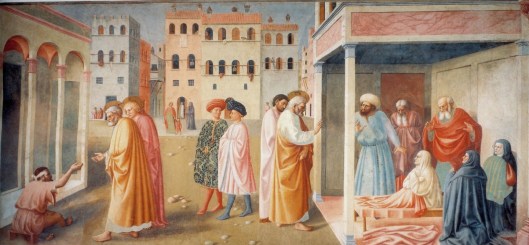
genezing_lamme_masolino

Healing of the Cripple (on left) and Raising of Tabitha (on right) by Masolino da Panicale, 1424-25. Fresco in the Brancacci Chapel, Santa Maria del Carmine, Florence, Italy.

My head has been in the St. Matthew Passion. For a few weeks already. Yes, that is pretty strange for me, having grown up in a house where Bach’s music was played often, but only on the Sundays and holidays for which it was written (read more about that in this blog post). However, it can happen when one sings in a Bach Choir in the United States. While in The Netherlands all 180 (!) St. Matthew Passion concerts happen in the weeks before Easter, here in the USA the piece is presented much less often, and the only classical music performances with a strong seasonal tie are those of Handel’s Messiah in the weeks before Christmas.

But working on the St. Matthew Passion and this Weekly Cantata blog at the same time has been a blessing, as the two areas of study influence each other. Nine months of research for this blog have inspired me to read more about the St. Matthew Passion and study the music in more detail. In that process I have learned many new things about the piece I thought I already knew so well. And experiencing the composition Bach’s sons referred to as their father’s Great Passion on a deeper level has, I believe, improved my understanding of Bach’s cantata writing.

Let’s just look at the opening chorus of this week’s cantata 48 Ich elender Mensch, written for the 19th Sunday after Trinity (October 3 in 1723).

I listened to Bach Collegium Japan (with Robin Blaze and Gerd Türk), Koopman (with Bernhard Landauer and Christoph Prégardien), Gardiner (with William Towers and James Gilchrist), Harnoncourt (with Paul Esswood and Kurt Equiluz), and Herreweghe (with Damien Guillon and Thomas Hobbs), and find Herreweghe’s interpretation the most moving. Herreweghe is also the only one who uses a tromba da tirarsi in the opening chorus, and I  love that sound. Listen to Herreweghe’s recording on YouTube or on Spotify. Please consider supporting the artists by purchasing the recording on Amazon: click here for USA, here for UK, here for Germany, or here for France.

Please find the German text with English translation here and the score here.

The main music is hauntingly beautiful (It’s not just the Herreweghe sopranos that give me goose bumps this time – the altos and tenors move me to tears, and none of this could happen without the basses providing that wonderful foundation for everyone to build on) but extremely downcast. It is clearly full of Elend (misery), in reference to the Gospel text of the day.* The same holds for the main music and words of the opening chorus of the St. Matthew Passion. It is clearly full of klagen (lamenting), and paints the picture of the Via Crucis, Jesus on his way to the cross.

However, in the midst of all the misery, a J.S. Bach opening chorus almost always provides a preview of the salvation that is to come later in the piece, or that is implied in the Gospel. In the opening chorus of the St. Matthew Passion he does this by superimposing the German Agnus Dei – the chorale O Lamm Gottes Unschuldig (O Lamb of God, unspotted), sung by a treble choir in G major, over the lamenting E minor of the two other choirs and orchestras. The repeated  auf unsre Schuld (for our sins) of Choir I is answered by the treble chorus with: All Sünd hast du getragen (you took away all sins).

The congregation in Leipzig, where the St. Matthew Passion was first performed on the afternoon of Good Friday in 1727, would have sung this German Agnus Dei earlier that day at the conclusion of the morning service. Back to this week’s cantata for October 3, 1723: in that Sunday service, the congregation might have sung the chorale Herr Jesu Christ, ich schreie zu dir:

Herr Jesu Christ ich schreie zu dir
Mit ganz betrübter Seele:
Dein Allmacht laß erscheinen mir
Und mich nicht also quäle.
Viel grösser ist die Angst und Schmerz.
So anficht und turbirt mein Herz,
Als daß ich kan erzählen.
Lord Jesus Christ, I cry to you
With a soul that is wholly troubled:
Let your almighty power appear to me
And do not punish me in this way.
Far greater is the anguish and pain
That challenge and confuse my heart
Than I can explain

The congregation might thus have heard those words in their head, when two bars after the soprano entrance the tromba da tirarsi starts playing this melody, later followed by two oboes in unison. In this way, these three instruments accompany every choral passage with a new line from the chorale, and the chorale thus starts forming the frame of the opening chorus.

After this preview message in the opening chorus that Jesus might be able to offer salvation, we have to wait until the tenor aria for the all-around convincing message that everything will be OK, in music as well as in text:

Vergibt mir Jesus meine Sünden,

If Jesus forgives me my sins,
So wird mir Leib und Seele gesund.
then my body and soul will become healthy.
Er kann die Toten lebend machen
He can make the dead live
Und zeigt sich kräftig in den Schwachen,
and shows himself to be mighty in those who are weak,
Er hält den längst geschloßnen Bund,
he keeps the covenant made long ago
Daß wir im Glauben Hilfe finden.
that in faith we find support.

Wieneke Gorter, October 1, 2016, links updated October 15, 2020.

* The Gospel story for this 19th Sunday after Trinity was the miracle of Jesus healing a cripple. From the time the Gospel was written through Bach’s time, unfortunately, having a disability or illness was seen as carrying a sin. When Jesus heals the man, he also takes his sins away.

No cantata for Trinity 18 in 1723

24 Saturday Sep 2016

Posted by cantatasonmymind in 1723 Trinity season special series, Cantatas, Leipzig, Trinity

≈ Leave a comment

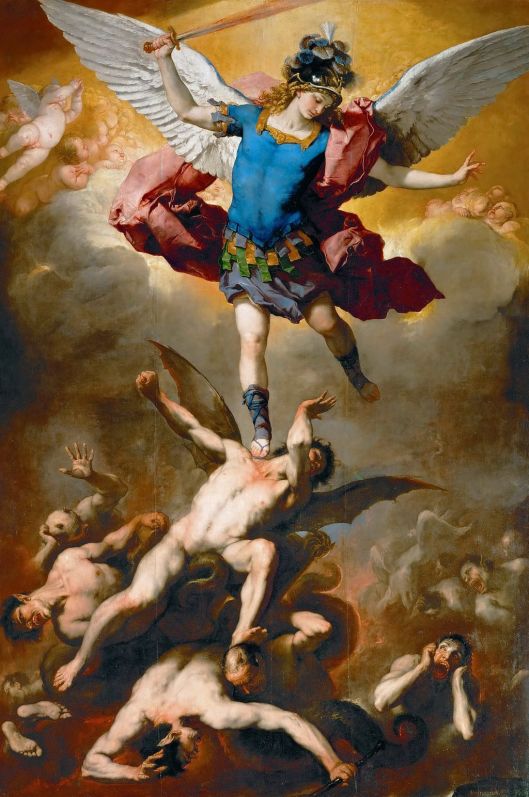
giordano_archangel_michael

Archangel MIchael Hurls the Rebellious Angels into the Abyss, by Luca Giordano, ca. 1666. Kunsthistorisches Museum, Vienna

There is no cantata left to us for this week in 1723, the 18th Sunday after Trinity. It seems to be a pattern for the Trinity season of 1723 that in the week of a big holiday (St. Michael’s in this case), the cantata for the Sunday of that same week is missing. This happened as well around the holidays of St. John on June 24 and the Visitation of Mary on July 2. It is unclear what music Bach performed on the feast day of St. Michael, September 29, 1723. It might have been a cantata by Telemann, but the researchers are not sure.

Wieneke Gorter, September 24, 2016

A detour to 1725

18 Sunday Sep 2016

Posted by cantatasonmymind in 1723 Trinity season special series, Cantatas, Leipzig, Trinity

≈ Leave a comment

Tags

according to Lutheran Church year, Bach, Bach Collegium Japan, BWV 148, BWV 76, BWV 83, cantatas, Gerd Türk, Gottfried Reiche, John Eliot Gardiner, Mark Padmore, Masaaki Suzuki, Maya Homburger, Natsumi Wakamatsu, Pieter Dirksen, Pisendel, Robin Blaze, Toshio Shimada

sleeping_girl
Sleeping girl in a landscape, after Bernhard Keil, 17th century. Gemäldegalerie Alte Meister, Kassel, Germany.

In the first version of this post, I argued that cantata 148 Bringet dem Herrn Ehre seines Namens for the 17th Sunday after Trinity was written in 1723, dismissing the statements of several scholars it was probably written in 1725. I agreed with them that this cantata is a bit “out of place” between the somber but extremely beautiful and compelling cantatas of Trinity 16 and Trinity 19, and that the text looks very similar to a poem by Picander, the librettist with whom Bach did not collaborate before 1725. However, I was not convinced by their third argument that  Bach’s writing in the  opening chorus would be too “new” for 1723, and at first I didn’t see how Bach could have practically written the cantata in 1725.

I suggested that Bach was too busy in 1725, coming back from a trip to Dresden right before this cantata had to be performed on September 23 of that year. But when I discussed this idea with Eduard van Hengel, he reminded me that Bach would have had plenty of time to compose a cantata well ahead of his trip to Dresden, since–as far as we know–he had not written a new cantata since August 26. So that was argument number 4 for placing this cantata in 1725 instead of 1723.

Argument number 5 presented itself to me while I did my research for cantata 83, reading Pieter Dirksen’s article on Bach’s writing for violin in his first Leipzig cycle of cantatas. Dirksen points out that Bach’s new compositions from 1723 don’t feature virtuoso parts for violin at all. He suggests the reason for this is that Bach’s orchestra in Leipzig (including Bach himself*) was missing a violinist who could play technically challenging music.

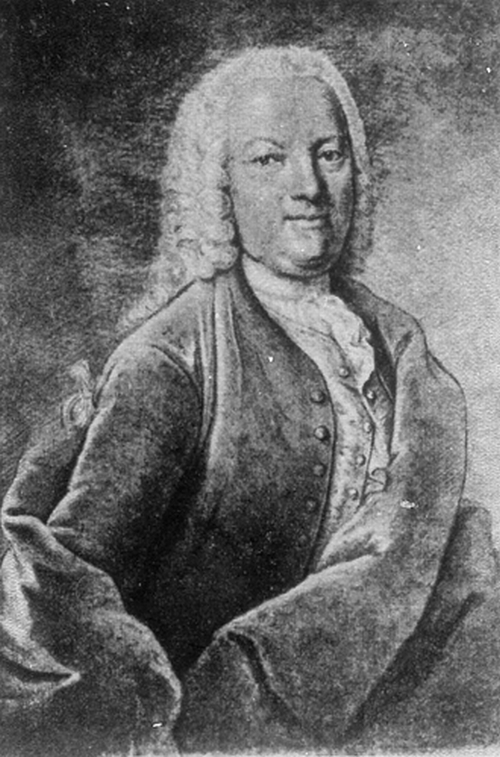
Johann Georg Pisendel

After reading Dirksen’s article on Bach’s connection with the Dresden violinist Johann Georg Pisendel,** and knowing that soon after Trinity 17 it would be Michaelmas, I got excited: the cantata 148 story was coming full circle! I was now no longer seeing Bach juggling ink and parchment on the coach back from Dresden to Leipzig on Saturday September 22, 1725, but instead I was imagining a friend in that coach with him: Johann Georg Pisendel.

If it is true that Pisendel visited Leipzig for the Purification of Mary holiday in 1724, as Dirksen suggests, it is not far-fetched to assume he would do so again for the feast of Michaelmas in 1725 (on September 29, so only six days after Trinity 17 in 1725). St. Michael’s Fair was a huge event in Leipzig, drawing visitors from as far as England and Poland, increasing the city’s population to 30,000, and thus also increasing the “audiences” for Bach’s music in the churches.

For this cantata, I prefer the recording by Bach Collegium Japan, with soloists Robin Blaze (countertenor), Gerd Türk (tenor), Toshio Shimada (trumpet), and Natsumi Wakamatsu (violin). Listen to this recording on Spotify or support the artists and purchase the album on Amazon.com, Amazon.de, or Amazon.fr.

Find the German texts with English translations here, and the score here.

The text of cantata 148 Bringet dem Herrn Ehre seines Namens talks about the importance of coming to church on Sunday, and listening to the music in the church (tenor recitative and aria), but it also talks about taking a day of rest (alto aria).

While the opening chorus is exceptional,  it doesn’t sound very polished or “finished.” Gardiner, while otherwise excited about it, is not satisfied with the ending, and suggests that “perhaps Anna Magdalena called from the kitchen that dinner was on the table and the soup was getting cold.” What can I say? Only a male writer would say this!

The virtuoso violin part shows up in the tenor aria. On this recording of Bach Collegium Japan, played by Natsumi Wakamatsu, it moves me to tears. The tenor aria on the Gardiner recording is good too, with tenor Mark Padmore, and violinist Maya Homburger. You can find that one here. Whoever played this violin part in 1725, this person was not resting on Sunday …

©Wieneke Gorter, originally written September 18, 2016; revised February 4, 2017, links updated and picture of Pisendel added October 2, 2020.

*In his article Dirksen explains in detail how Bach went through the trouble of making the violin solo of cantata 76  relatively easy to play for an intermediate violinist, and suggests Bach was a good violinist, but perhaps not such a virtuoso as many believe him to be. Dirksen’s article appears on pages 135-156 of Bachs 1. Leipziger Kantantenjahrgang: Bericht über das 3. Dortmunder Bach-Symposion 2000 — Dortmund: Klangfarben Musikverlag, 2002.

**Pisendel had been friends with Bach since 1709 and several scholars think that it was for this Italian-trained virtuoso that Bach wrote his most complicated violin music. It is assumed that Bach had Pisendel in mind when writing the violin part of the “Laudamus te” of his Mass in B Minor.

The Herreweghe sopranos

11 Sunday Sep 2016

Posted by cantatasonmymind in 1723 Trinity season special series, Cantatas, Leipzig, Trinity

≈ Leave a comment

Tags

Bach, cantatas, Collegium Vocale Gent, Dominique Verkinderen, Dorothee Mields, Hana Blazikova, John Eliot Gardiner, Mark Padmore, Peter Kooy, Phlippe Herreweghe, Trinity 16

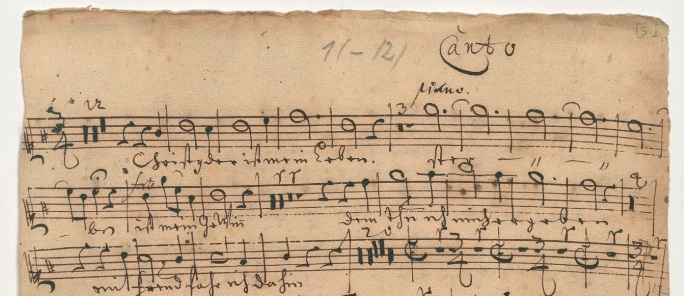
bwv95_sopraan

The soprano part of cantata 95 Christus, der ist mein Leben. Staatsbibliothek zu Berlin – Preußischer Kulturbesitz

After all his experimenting with the form of the cantata last week, Bach keeps exploring how he can build a cantata based on chorale melodies and chorale texts. As a result, this week’s cantata 95 Christus, der ist mein Leben again takes a unique place in Bach’s cantata collection: it features no less than four different chorales, all part of the Sterbe-lieder (Deathbed songs) that were very popular in Leipzig at the time: Christus, der ist mein Leben; Mit Fried und Freud, ich fahr dahin; Valet will ich dir geben; and Weil du vom Tod erstanden bist.

I recommend Herreweghe’s recording of this cantata. Listen to this recording on YouTube, or on Spotify. Support the artists and purchase this recording on Amazon. (Or find them in the Amazon stores  for  Germany and France)

Soloists: soprano Dorothee Mields, counter-tenor Matthew White, tenor Hans Jörg Mammel, bass Thomas E. Bauer. Choir sopranos: Dorothee Mields, Hana Blazikova, Dominique Verkinderen.

In the manuscript of the soprano part pictured above, it is interesting to note the dynamic markings for the text “Sterben ist mein Gewinn.” Dynamics are not very common in Bach manuscripts, but, as Alfred Dürr points out, Leipzig had a strong tradition of singing softly and slowly on the word “Sterben,” and singing loudly on “ist mein Gewinn,” going back at least to 1629. In that year, then Thomaskantor Johann Hermann Schein wrote this note for his singers:

“da singen sie adagio mit einem sehr langsamen Tactu, weiln in solchen versiculis verba emphatica enthalten” (here you should sing adagio in a very slow tempo, because verses like these contain emphatic words)

How Herreweghe’s sopranos sing this Sterben ist mein Gewinn in the first chorale takes my breath away, and this is the most important reason why I prefer this recording. Having grown accustomed to the boy choirs of the Leonhardt and Harnoncourt recordings in the 1970s, my parents, sister, and I were blown away by Herreweghe’s Collegium Vocale Gent when their first CDs started coming out in the late 1980s and early 1990s.

My mother was especially taken by the sound and blend of the sopranos, and “Herreweghe sopranos” became a household term in our family. After attending a performance by a different group, we would often say to each other: “it was nice, but they are not Herreweghe sopranos….,” and sigh a little.

This cantata is all about longing for life after death, and over the course of the cantata these statements are made: I will be happy to die (opening movement), because life on earth is worthless (soprano recitative). Saying goodbye to that will be freeing (soprano chorale), so please can I die as soon as possible (tenor recitative and aria), because death is only a sleep (bass recitative) from which I will wake up to join Jesus, who has gone before me (closing chorale).

The outstanding tenor aria features Bach’s signature “death bells” in the pizzicato strings. Bach uses these “Leichenglocken”  also in cantatas 73, 8, 105, 127, 161, and 198. For an alternative recording of this movement, with gorgeous singing by Mark Padmore, listen to the Gardiner recording on Spotify.

The concept of death being only a short period of sleep after which the dying person wakes up to meet Jesus in the afterlife was an extremely important part of 18th-century Lutheran faith. When dealing with death on a daily basis, it was comforting to believe that death would ultimately lead to paradise. And by stressing this concept, Bach also refers to the Gospel for this 16th Sunday after Trinity. It is the story of the miracle at Nain: a young man who has died  is carried out of the city and then woken up by Jesus.

Wieneke Gorter, September 11, 2016, updated October 7, 2025

← Older posts
Newer posts →

Recent Posts

  • “Missa Miniatura” by CONTINUUM/Elina Albach Even More Moving in 2025
  • Bachfest Leipzig 2025
  • Bach Cantatas for Christmas – 1724 and 1734 editions
  • Fourth Sunday of Advent – more insight into Cantata 62 helped me better understand Bach’s Christmas Oratorio
  • Saint Ambrose and Luther in Milan – Second Sunday of Advent

Archives

  • August 2025
  • July 2025
  • December 2024
  • November 2024
  • June 2024
  • January 2024
  • December 2023
  • October 2023
  • September 2023
  • August 2023
  • April 2022
  • February 2022
  • January 2022
  • December 2021
  • November 2021
  • June 2021
  • May 2021
  • April 2021
  • February 2021
  • January 2021
  • December 2020
  • November 2020
  • October 2020
  • September 2020
  • August 2020
  • July 2020
  • May 2020
  • April 2020
  • March 2020
  • February 2020
  • January 2020
  • December 2019
  • November 2019
  • May 2018
  • April 2018
  • March 2018
  • February 2018
  • January 2018
  • December 2017
  • November 2017
  • October 2017
  • September 2017
  • August 2017
  • July 2017
  • June 2017
  • May 2017
  • April 2017
  • March 2017
  • February 2017
  • January 2017
  • December 2016
  • November 2016
  • October 2016
  • September 2016
  • August 2016
  • July 2016
  • June 2016
  • May 2016
  • April 2016
  • March 2016
  • February 2016
  • January 2016

Enter your email address to follow this blog and receive notifications of new posts by email.

Join 336 other subscribers

Categories

  • 1723 Trinity season special series
  • Advent
  • After Easter
  • Ascension
  • Bach's life
  • Cantatas
  • Chorale cantatas 1724/1725
  • Christmas
  • Easter
  • Epiphany
  • Following Bach in 1725
  • Köthen
  • Leipzig
  • Septuagesima
  • Travel
  • Trinity
  • Weimar

Meta

  • Create account
  • Log in
  • Entries feed
  • Comments feed
  • WordPress.com

Website Built with WordPress.com.

  • Subscribe Subscribed
    • Weekly Cantata
    • Join 156 other subscribers
    • Already have a WordPress.com account? Log in now.
    • Weekly Cantata
    • Subscribe Subscribed
    • Sign up
    • Log in
    • Report this content
    • View site in Reader
    • Manage subscriptions
    • Collapse this bar
 

Loading Comments...