Weekly Cantata

Weekly Cantata

Category Archives: Advent

Fourth Sunday of Advent – more insight into Cantata 62 helped me better understand Bach’s Christmas Oratorio

21 Saturday Dec 2024

Posted by cantatasonmymind in Advent, Cantatas, Chorale cantatas 1724/1725, Leipzig

≈ 1 Comment

Tags

Advent, Alex Potter, Bach, BWV 248/5, Carine Tinney, Cecilia Bernardini, Chorale Cantatas, Christmas, Christmas Oratorio, Daniel Johannsen, Johann Martin Schamel, l500b300, Lydia Vroegindeweij, Netherlands Bach Society, Rodrigo Lopez-Paz, Tomáš Král, Weihnachtsoratorium

Adoration of the Shepherds by Dutch painter Gerard van Honthorst, 1622. Pommersches Landesmuseum (Pomerania State Museum), Germany.

In my post for the first Sunday of Advent about Cantata 62 Nun komm, der Heiden Heiland, I explained how Bach’s chorale cantatas were most likely influenced by Johann Martin Schamel‘s annotations in his publication “Evangelischer Lieder-Commentarius.” Still, in that post, I gave just a few examples of how Bach used Schamel’s explanations.

Only after I wrote that post, I realized that Lydia Vroegindeweij had already created a “Read and Listen” guide for this cantata on her Luther 500 / Bach 300 website, shining a very clear light on the relation between Schamel’s explanations and Bach’s music. However, that article was in Dutch. So over the past few weeks, I translated Lydia’s Dutch text into English, and then Lydia transformed that text into a beautiful web page, with listening examples for every single movement of the cantata. Please find that brand-new English “Read and Listen” guide for Cantata 62 here.

In the process of translating and re-reading, I became more familiar with Luther’s and Schamel’s key themes for Advent and Christmas, especially these three:

  1. The importance of light: the light comes from the manger (as pictured in the painting above), from within, and is a metonym for Christ, always conquering the darkness. It is mentioned again and again.
  2. Jesus is always there, he is living in the hearts of the people, he is always with them as if he were a family friend, a house guest. In other words, he is already here and one doesn’t have to wait for him.
  3. Christ’s divine character and human character exist simultaneously, in one and the same person.

During that same time, I was rehearsing and performing cantatas 1, 2, 5, and 6 of Bach’s Christmas Oratorio as a chorus member, as well as attending an excellent performance by the Netherlands Bach Society of cantatas 1, 4, 5, and 6. Singing these texts and reading them in a program booklet with my newly acquired knowledge, I became much more conscious how strongly Luther’s and Schamel’s way of thinking are also present in the text and music of Bach’s Christmas Oratorio.

The theme of the inner light is especially present in one of my favorite parts of the Christmas Oratorio, the fifth cantata, written for the Sunday after New Year. Please find a live video recording here of the Netherlands Bach Society’s performance of this cantata in Utrecht on December 13, 2024, the same production I attended two days earlier in Naarden.

Following the chorus that talks about the sighting of the star, Bach and his librettist present an alto recitative (performed here by Alex Potter), which at first still refers to the star, but then turns to Jesus / to the core of the faith, and explains that Jesus is the light:

Wohl euch, die ihr dies Licht gesehen,
Happy are you who have seen the light,
Es ist zu eurem Heil geschehen!
It has appeared for your salvation!
Mein Heiland, du, du bist das Licht,
My saviour, you, you are the light
Das auch den Heiden scheinen sollen,
Which shall shine on the Gentiles also
Und sie, sie kennen dich noch nicht,
And they, they do not know you yet,
Als sie dich schon verehren wollen.
Though they would already worship you
Wie hell, wie klar muss nicht dein Schein,
How bright, how clear must your radiance be,
Geliebter Jesu, sein!
Beloved Jesus!

Rodrigo Lopez-Paz. Photo by Eduardus Lee, courtesy of the Netherlands Bach Society.

More illustrations of this special light follow in the bass aria (performed here by baritone Tomáš Král and oboist Rodrigo Lopez-Paz)

Erleucht auch meine finstre Sinnen,
Illuminate also my gloomy thoughts
Erleuchte mein Herze
Illuminate my heart
Durch der Strahlen klaren Schein!
With the rays of your clear light!
Dein Wort soll mir die hellste Kerze
Your word will be the brightest candle for me
In allen meinen Werken sein;
In all my deeds;
Dies lässet die Seele nichts Böses beginnen.
This lets my soul begin nothing evil

In the terzetto (performed here by violinist Cecilia Bernardini, soprano Carine Tinney, alto Alex Potter, and tenor Daniel Johannsen), we also see the theme of “Jesus who dwells in the heart” appear. In this trio, the alto interrupts the tenor and soprano with the very strong statement “er ist schon wirklich hier!” (he really is already here!). The tenor and soprano represent the people who think the Messiah is yet to come, singing:

Ach, wenn wird die Zeit erscheinen?
Ah, When will the time appear ?
Ach, wenn kömmt der Trost der Seinen?
Ah, When will he who is the comfort of his people come ?

While the alto voice represents the Lutheran doctrine that Jesus is always with you, that he dwells in your heart, singing:
Schweigt, er ist schon würklich hier!
Be silent, he is really already here!

The text of the closing chorale combines the theme of Jesus dwelling in the heart with that of the inner light:

Zwar ist solche Herzensstube
Indeed such a room in my heart
Wohl kein schöner Fürstensaal,
Is certainly no fine royal palace
Sondern eine finstre Grube;
But rather a dark pit;
Doch, sobald dein Gnadenstrahl
Yet, as soon as the rays of your mercy
In denselben nur wird blinken,
Only gleam within there
Wird es voller Sonnen dünken.
It will seem filled with sunlight.

Wieneke Gorter, December 21, 2024.

Saint Ambrose and Luther in Milan – Second Sunday of Advent

07 Saturday Dec 2024

Posted by cantatasonmymind in Advent, Cantatas, Chorale cantatas 1724/1725, Leipzig

≈ 3 Comments

Tags

Advent, Ambrose of Milan, Christmas, Hilliard Ensemble, Josquin des Prez, martin-luther, Saint Ambrose, Sant'Ambrogio, Sant'Ambrogio Basilica, Veni redemptor gentium

In the absence of a chorale cantata for this second Sunday of Advent*, I wanted to read more about Ambrose of Milan, whose “Veni redemptor gentium” inspired Luther to write his “Nun komm, der Heiden Heiland.” What would Luther have heard about the 4th-century legend when he visited Milan in 1510 on his way to Rome? Always the travel planner, I also wondered if there are there any traces of Ambrose to see in the Milan of today.

Milan’s patron saint

Ambrose of Milan

I learned that Ambrose has been Milan’s patron saint for centuries and is still celebrated today. What’s more, the Christmas season in Milan doesn’t officially start until his Saint’s Day, which happens to be … today, December 7. It is on December 7 that the Scala opens its season, with broadcasts of the opera performance throughout the city. And it is on December 7 that the largest Christmas Market opens, and that the bishop preaches in the Sant’Ambrogio Basilica. If you are from Northern Italy or have visited Milan around this time of year you will laugh at me, but I truly didn’t know this when I decided to write a post about Ambrose and his hymn earlier this week, I only found out today.

Sarcophagus of Stilicho in the Sant’Abrogio Basilica in Milan. 4th century.

Ambrose was a theologian and statesman who served as Bishop of Milan from 374 to 397, and is considered one of the most influential ecclesiastical figures of the 4th century. He is the founder of the Sant’Ambrogio Basilica in Milan, which still stands today. His literary works have been acclaimed as masterpieces of Latin eloquence, and as Bishop he did fundamental work for later church-state relations. Ambrose is also remembered as the teacher who converted and baptized the Christian theologian St. Augustine of Hippo.

What Luther would have learned more than a thousand years later

While we know Luther as the most important reformer and founder of Protestantism, he started out as an Augustine monk, and studied Theology in Erfurt. We can assume that Luther already knew Ambrose’s hymns, as they were in use in the churches. However, Luther would likely also have studied Ambrose’s and Augustine’s sermons. For example, Ambrose’s sermon “Exposition of the Gospel According to Luke” was widely circulated. In “Luther’s Theology of Music,” Miikka E. Anttila writes: “Ambrose believed that a psalm softens anger, offers a release from anxiety, and alleviates sorrow. He also pointed out that a child who refuses to learn other things takes pleasure in contemplating a psalm.” These ideas we also find in Luther’s writings.

In 1510, Luther was sent to Rome along with another monk to settle a dispute. There are many legends about Luther’s time in Rome, but I’m more intrigued by his stop in Milan on the way to Rome. In that city, Leonardo da Vinci had finished his Last Supper in 1498. Architect Donato Bramante had constructed the Cloisters of Sant’Ambrogio also in 1498 and a year later finished work on the Santa Maria della Grazie. Also it had been as recently as 1489 that Josquin des Prez, Luther’s favorite composer** had worked in Milan.

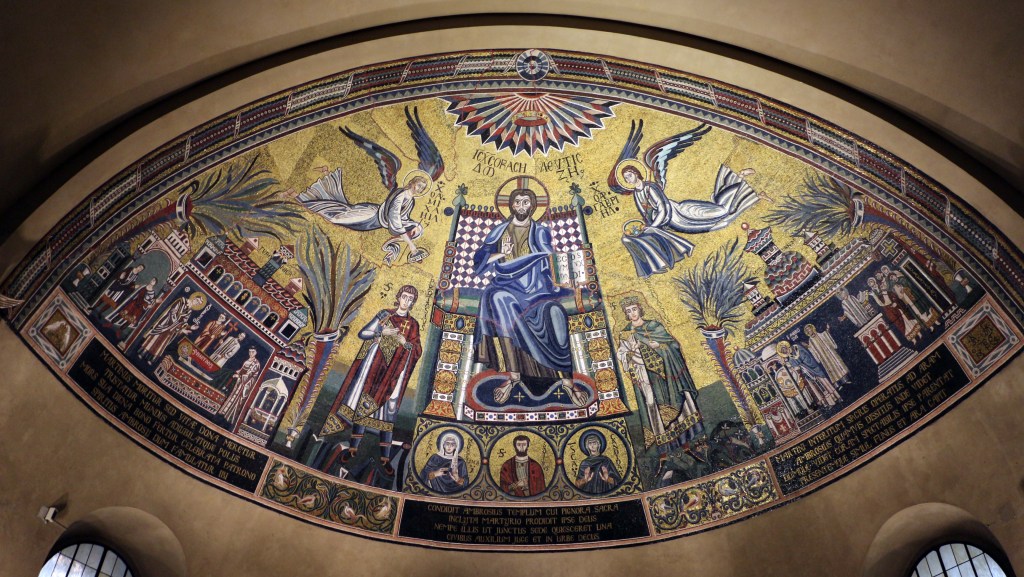
20th-century restoration of a mosaic from the 4th through 13th century in Sant’Ambrogio Basilica in Milan.

Did Luther visit Sant’Ambrogio Basilica? Did he see this mosaic, which was restored in the 13th century? Did he hear the many legends about Ambrose that made him even more of a hero to him? And: did he happen to hear this incredible polyphony of Josquin des Prez (The Hilliard Ensemble, recorded 1983) somewhere in Milan, and was it thus that he fell in love with Josquin’s music? This is Josquin des Prez’ Ave Maria Virgo Serena, one of the few works by Josquin of which scholars nowadays are certain it was written by him, composed around 1485, during Josquin’s service at the court of Milan, and wildly popular in the 16th century.

As I often say, we will probably never know, but it is nice to contemplate these scenarios, and Milan is now definitely on my “want to go” list.

Wieneke Gorter, December 7, 2024.

*Bach didn’t write a cantata for the second, third, or fourth Sunday of Advent in Leipzig, because the time between the first Sunday of Advent and Christmas was a time of introspection, similar to Lent. Regarding music performed during church services, this meant only strict liturgical singing (= the congregation singing chorales and responses), nothing else.

**Luther wrote: “God has preached the gospel through music, too, as may be seen in Josquin’s, all of whose compositions flow freely, gently, and cheerfully, are not forced or cramped by rules, and are like the song of the finch.”

Further Reading

Find Encyclopedia Brittanica’s entry on Saint Ambrose here.

Find more stories on Saint Ambrose here, and architectural and historical information on the Basilica here.

Find tourist information on Saint Ambrose and the festivities in Milan everywhere on the internet. I started here.

Find the full Latin text of Saint Ambrose’s hymn and Luther’s German adaptation on this website (in Dutch).

Find Yakub E. Kartawidjaja’s PhD thesis “Music in Martin Luther’s Theology” here.

Detail from the Agnus Dei, an original mosaic from the 4th century at the Sant’Ambrogio Basilica in Milan.

First Sunday of Advent 1724: Bach helps commemorate and explain a 200-year-old hymn text

30 Saturday Nov 2024

Posted by cantatasonmymind in Advent, Cantatas, Chorale cantatas 1724/1725, Leipzig

≈ Leave a comment

Tags

Advent 1, Antonia Frey, bachhaus-eisenach, Bachstiftung, baroque-music, Benedikt Kristjánsson, BWV 62, choral-music, erfurter-enchiridion, erfurter-handbuchlein, evangelischer-lieder-commentarius, history, J.S. Bach Foundation, J.S. Bach Stiftung, Jan Kobow, johann-martin-schamel, John Eliot Gardiner, l500b300, Lisa Andres, Lydia Vroegindeweij, martin-luther, Rudolf Lutz

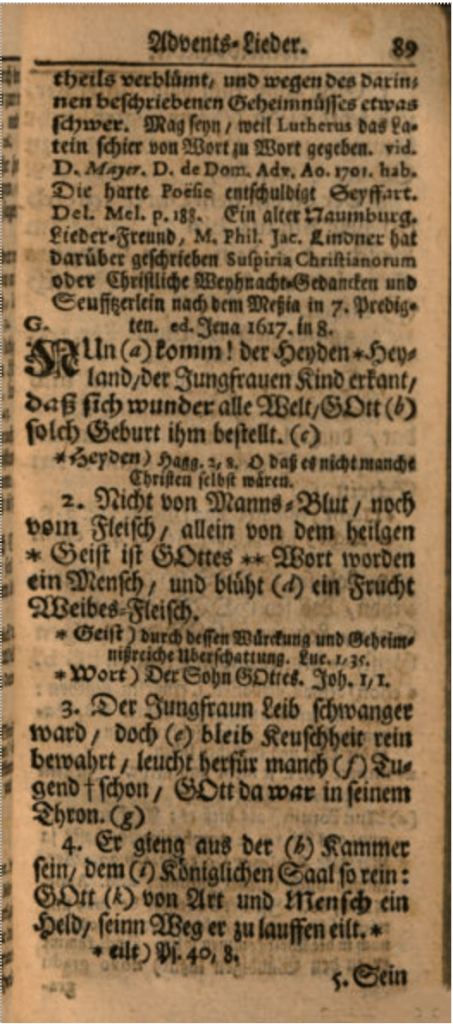
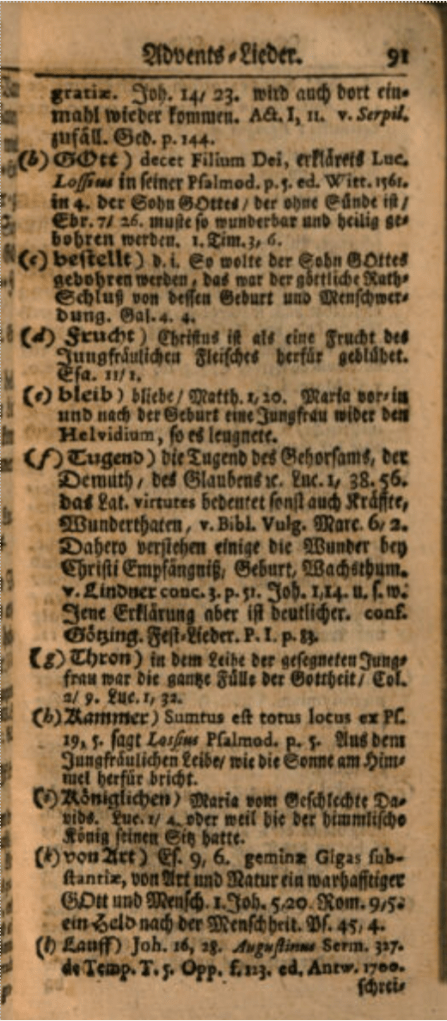
Evangelischer Lieder-Commentarius (Evangelical Hymn Commentary) by Johann Martin Schamel from 1724: an annotated hymnal, published to commemorate the bi-centenary of Luther’s first hymnals. From left to right: the title page; page 89 with the first four verses of Luther’s hymn “Nun komm, der Heiden Heiland,” with lower-case letters and asterisks referring to footnotes; page 91 with the footnotes.

Please open this post in your internet browser (just click on the title at the top) to see the images placed the correct way – thank you!

Today’s cantata – Happy 1st Advent!

Warning: If you don’t feel like reading science journalism, and just came here to listen to a beautiful cantata, I got you: here is Cantata 62 Nun komm, der Heiden Heiland in an excellent new live performance by the J.S. Bach Foundation under the direction of Rudolf Lutz. I especially love the opening chorus as well as the tenor aria, sung from memory by Benedikt Kristjánsson (read more about him in my post about the Bachfest in Leipzig this past summer). Other soloists are Lisa Andres, soprano; Antonia Frey, alto; and Peter Harvey, bass.

Find the German text with English translation here, and the score here.

A special exhibition in Eisenach

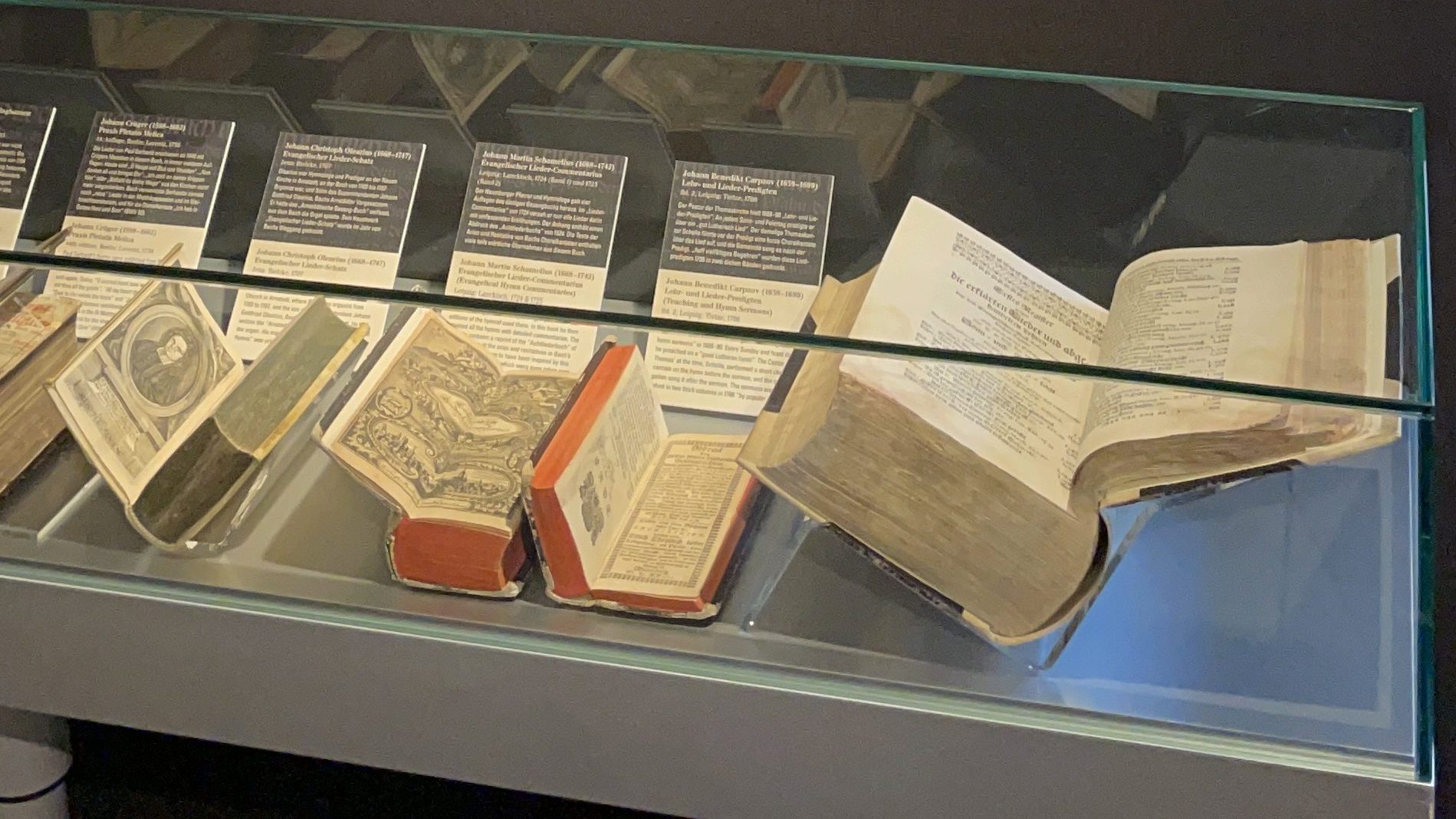
A month ago, I traveled to Eisenach (Bach’s birthplace in Germany) to catch the last days of a special exhibition at the Bachhaus on the double anniversary of Luther’s hymns (500 years) and Bach’s chorale cantatas (300 years) and the connection between the two. I got to see in real life many hymnals that were in use during Bach’s time. What struck me right away was how small and narrow they are! They were truly meant to be held in one hand (so one could leaf through it with the other hand). This is of course exactly what Luther envisioned when he published the very first German-language hymnals in 1524: that churchgoers could read and sing along during the church service, and also easily use the hymnals at home and at school. This photo gives a good idea of their size compared to a larger book:

Luther’s “Nun komm, der Heiden Heiland”

“Nun komm, der Heiden Heiland” in the Erfurter Enchiridion from 1524.

While most of the hymnals were displayed as in the photo above, the two oldest and rarest, on loan from libraries in Regensburg and Strasbourg, were hidden behind thick felt flaps to protect them from the light. One of these, Luther’s Erfurter Enchiridion (Erfurter Handbook) from 1524, lay opened to his Advent hymn “Nun komm, der Heiden Heiland,” the hymn Bach used two hundred years later, for Cantata 62 Nun komm, der Heiden Heiland for the first Sunday of Advent. Luther based this hymn on the then still well-known “Veni redemptor gentium” from the 4th century, closely translating the latin, and only slightly altering the melody.

Publications commemorating the bi-centenary of Luther’s hymnals in 1724 likely influenced Bach

Bach scholars have always wondered why Bach wrote an entire cycle of cantatas based on hymns. Some offer that his first cycle of cantatas (1723/1724) must have been too complicated for his audience (the Leipzig churchgoers) and that Bach, or possibly his employers, thus came up with something extremely familiar (the hymns) as a common thread for the second cycle of cantatas. Others say that the ability of the boy sopranos must have been so bad, judging by letters Bach later wrote to complain about this, that he switched to chorale cantatas so the choir sopranos would only have to sing the well-known chorale melody while the altos, tenors, and basses would sing more complicated parts.

While none, a combination, or part of these hypotheses might be true, recent research by Dutch theologian Dr. Lydia Vroegindeweij provides us with a third theory: Bach was very likely influenced by a strong movement in Lutheran Germany in the first quarter of the 18th century for the preservation and clarification of the original Lutheran hymns. His choice of 1724 as the year to start a cycle of chorale cantatas would thus not have been a coincidence at all, but a way to help commemorate the centenary of Luther’s first hymnals. The most important figures in this movement operated in Bach’s circle of friends and colleagues and of course Bach was a great admirer of Luther, having Luther’s entire oeuvre of writings in his library. So he would have been more than interested to support the efforts to preserve and better explain Luther’s hymns.

Specifically, Lydia makes a strong case that Bach and/or his anonymous librettist must have consulted Johann Martin Schamel’s Evangelischer Lieder-Commentarius (see the caption heading this post) for the recitative and aria texts for several if not all of his chorale cantatas. She has pointed out that many chorale cantata texts correspond to Schamel’s explanations, use the exact same words, or even follow Schamel’s suggestion to combine Luther’s psalm in question with another one (as is the case in Cantata 38, read more here).

As Lydia explains in a podcast she now has on a Dutch radio station, Luther’s hymn “Nun komm, der Heiden Heiland” especially needed clarification, because in an effort to make the text rhyme and stay as close as possible to the original “Veni redemptor gentium,” Luther had made the text so compact that it had puzzled many hymnologists and clergy.

How does Bach illustrate Schamel’s explanations of this particular hymn?

In the first stanza (the literal text of the opening chorus), Schamel puts (a) after the word “Nun” (now) and explains [freely translated]: “As if it meant: Oh come now, you promised! Instead, it is the poetic style, and is not meant as if the Savior had yet to come into the world. But he comes to believers daily, again and again, each time as a new step of grace.” This concept of “again and again” and the “steps” are clearly present in the music of the opening chorus of Cantata 62.

Lydia says: “Schamel substantiates this with a reference to John 14:23. This corresponds with Luther’s own explanation of this verse in the Calov Bible [which Bach was also familiar with, and added to his own library in 1733]. There Luther also talks about daily contact, and about Jesus who would like to live with people in their houses and share a meal with them.”

The emphasis in this cantata is placed more on the sacred miracle of the human birth and less on the “coming”. This “Wunder” (miracle/wonder) is even more celebrated in the tenor aria. Lydia says: “The aria emphasizes that God encompasses the whole world with that kind of miracle and that we can only admire that grace.”

And the prize for the best interpretation of the tenor aria goes to …

When two years ago Lydia and I searched for the best interpretation of the tenor aria, i.e. the one that really emphasizes the “wonder,” our prize went to Jan Kobow on the Gardiner recording from 2000. Listen to it here. Kobow does a beautiful job expressing the wonder, not only in the first phrase, but also in the B-section when he sings “o, Wunder”. He also makes a striking contrast between those wondrous and quiet-making aspects of the miracle and the stronger, more convinced text of “Herrscher.”

However, now that I’ve heard and seen Benedikt Kristjánsson sing on the recording with the J.S. Bach Foundation, his singing strikes me as the perfect illustration of “God encompasses the whole world with that kind of mystery.”

Further reading

If you would like to do your own reading and interpreting of Schamel’s commentary, you can find it here (in German). If you would like to subscribe to Lydia’s newsletter, you can do so here. Also, please don’t forget to subscribe to my blog – just fill in your email address here below, and you will receive an email every time I post a new story. Thank you!

Wieneke Gorter, November 30, 2024.

About Weekly Cantata

I am a bilingual writer, publicist, choral singer, art and nature lover, foodie, happy wife, and blessed mother of two. I started this blog in 2016, inspired by my late mother’s love for Bach’s cantatas. After 23 years in the San Francisco Bay Area, I’m now back in the Netherlands.

If you are on social media, please follow me:

  • Facebook
  • Instagram

Please subscribe!

Please subscribe to this blog! Simply fill in your email address and you’ll receive an email every time I’ve published a new post. Thank you!

First Week of Advent 2023

07 Thursday Dec 2023

Posted by cantatasonmymind in Advent, Cantatas, Leipzig

≈ 3 Comments

Tags

All of Bach, Christmas, Harnoncourt, J.S. Bach Foundation, music, Netherlands Bach Society, Nuria Rial, Seppi Kronwitter, Shuann Chai, Shunske Sato, Zsuzsi Tóth

Photo of Shunske Sato by Elvira Demerdzhy

During this first week of Advent, I often talk about Nuria Rial’s rendition of the soprano aria from Cantata 36 with the J.S. Bach Foundation. However, this year let’s put the spotlight on the violin part of that aria, and watch the incomparable Shunske Sato work his magic in this movement from Cantata 36 Schwingt freudig euch empor on All of Bach, with soprano Zsuzsi Tóth. Never did I enjoy a “da capo” this much. To read more about this cantata, the third one Bach wrote (or adapted) for the first Sunday of Advent, read my blog post from 2017 here.

That I had to think about Sato’s playing this week is no coincidence. Today I witnessed his amazing musicianship, sense of timing, and sense of humor in a terrific concert with equally talented pianist Shuann Chai here in Amsterdam. They played two Beethoven violin sonatas and it was such a treat that I can’t wait for their CD to come out in 2024 with all ten of the sonatas. Another reason I’m excited about their recording project is that Shuann will be playing on two original fortepianos from 1800 and 1820, respectively. Please read more about their endeavor here and please consider donating. They are currently at 64% of their funding so they can use all the help they can get.

Shunske Sato and Shuann Chai, Photo by Marco Borggreve.

If you are on Instagram, please follow my account at @weeklycantata (or click on the instagram icon here below). Please consider subscribing to this blog (type your email in the box below and then click “subscribe”), so you will receive an email each time I publish a story.

Wieneke Gorter, December 7, 2023.

About Weekly Cantata

I am a bilingual writer, publicist, choral singer, art and nature lover, foodie, happy wife, and blessed mother of two. I started this blog in 2016, inspired by my late mother’s love for Bach’s cantatas. After 23 years in the San Francisco Bay Area, I’m now back in the Netherlands.

If you are on social media, please follow me:

  • Facebook
  • Instagram

Please subscribe!

Please subscribe to this blog! Simply fill in your email address and you’ll receive an email every time I’ve published a new post. Thank you so much / Vielen Dank / Dankuwel / Merci mille fois / 감사합니다 / 谢谢 / ありがとう / Mille grazie / Muchas gracias / Muito obrigado / Tusen takk / Tack så mycket / Terima kasih / شكراً جزيلاً / תודה רבה

Designed with WordPress.com

Wishing you beauty, love, and contemplation for Advent

28 Sunday Nov 2021

Posted by cantatasonmymind in Advent, Cantatas, Chorale cantatas 1724/1725, Following Bach in 1725, Leipzig, Weimar

≈ Leave a comment

Tags

Advent 1, BWV 36, BWV 61, BWV 62, J.S. Bach Foundation, J.S. Bach Stiftung, Nuria Rial, Rudolf Lutz

In German-speaking countries, people wish each other either a “schönen” (beautiful, pleasant), “lieblichen” (lovely, love-filled), or a “besinnlichen” (thoughtful, contemplative) Advent. I wish you all of that: beauty, love, and contemplation for the next four weeks.

On this first Sunday of Advent, I present to you again the J.S. Bach Foundation (J.S. Bachstiftung) with soprano Núria Rial, this time in Cantata 36 Schwingt freudig euch empor. In 1731, Bach transformed a secular birthday cantata from 1725 into this work for Advent. Enjoy watching these two videos by the J.S. Bach Foundation to get better acquainted with this composition:

Fabulous explanation by Rudolf Lutz of cantata BWV 36 “Schwingt freudig euch empor” (in German with English subtitles)

Video registration of their concert in Trogen, Switzerland, in 2007: J.S. Bach – Cantata BWV 36 “Schwingt freudig euch empor” (J.S. Bach Foundation)

If you would like to read, listen, or watch more, here’s a little overview of my previous posts for the first Sunday of Advent:

In Weimar, in 1714, Bach wrote Cantata 61 Nun komm, der Heiden Heiland. This one I remember the best from my childhood, because my mother loved Seppi Kronwitter’s singing of the soprano aria on the Harnoncourt recording. Read about it here. More about Bach’s prolific Advent cantata writing in Weimar next week.

In Leipzig, in 1724, Bach wrote Cantata 62 Nun komm, der Heiden Heiland. My most recent writing about this cantata is from 2020, not for this blog, but for that of California Bach Society. Find it here. My post from 2017 about this cantata is here.

Read my post about Cantata 36 Schwingt freudig euch empor here. 

Wieneke Gorter, November 28, 2021.

By the way: the video of the J.S. Bach Foundation’s 15th Anniversary concert with Núria Rial is still available here on YouTube. It is a registration of the performance in Trogen, held one day after the one I attended in Basel.

Light in Dark Times (and a compelling melody for Bach)

13 Sunday Dec 2020

Posted by cantatasonmymind in Advent, Cantatas, Chorale cantatas 1724/1725, Leipzig, Weimar

≈ Leave a comment

Tags

Advent, Advent 3, Annunciation, Bernhard Landauer, BWV 172, BWV 186a, BWV 36, BWV 37, BWV 49, BWV 61, BWV 739, Caroline Weynants, Claude Eichenberger, Eva Oltiványi, Il Gardellino, J.S. Bach Foundation, J.S. Bach Stiftung, Johann Crüger, Johannes Kaleschke, Klaus Häger, Lieven Termont, Makoto Sakurada, Manuel Walser, Marcel Ponseele, Nuria Rial, Philipp Nicolai, Rudolf Lutz, Sybilla Rubens, Theo Jellema

Today is the Third Sunday of Advent. I continue to recommend La Festa Musicale’s beautiful series of Advent Chorales on YouTube. Their offering for this Sunday is Johann Crüger’s 1640 setting of Wie schön leuchtet der Morgenstern (How beautifully shines the morning star). With an almost overwhelming number of performances appearing online over the past weeks, I really wanted to offer some new writing today. There is so much to tell about this particular chorale and all the ways Bach used it in his cantatas. And it helps that today is a rainy Sunday here in the San Francisco Bay Area.

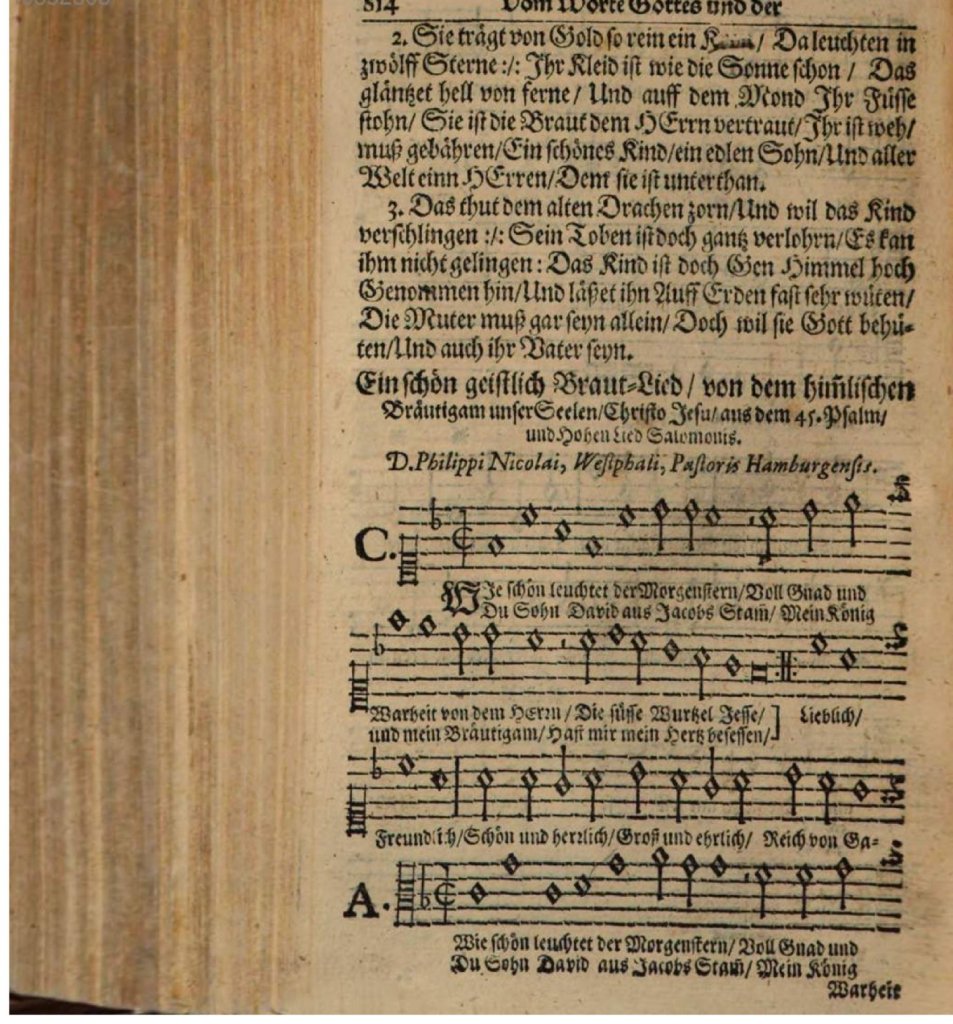
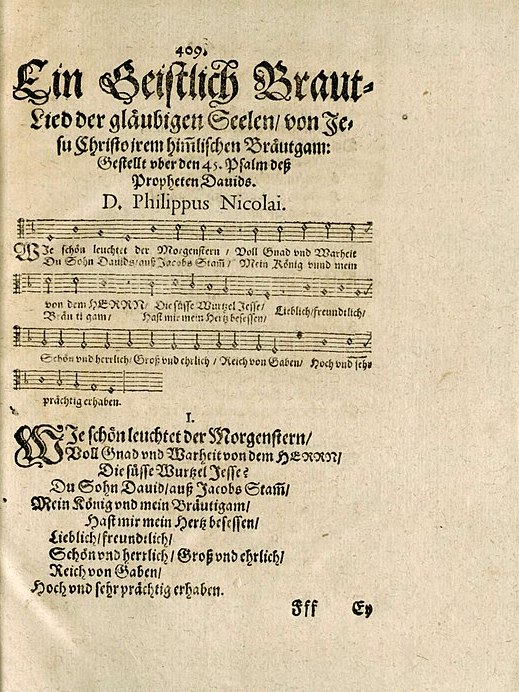
When Crüger wrote his setting in 1640, the chorale melody already existed. The chorale is generally attributed to Philipp Nicolai (1556–1608), but the melody of Nicolai’s hymn might have been based on an existing hymn (with different text) from Wolff Köphel’s 1538 Psalter hymnal. Nicolai wrote the hymn in 1597, when the town where he preached was ravaged by the plague. During that time, as Eduard van Hengel suggests, Nicolai must have had to bury dozens of members of his congregation each day. He published it two years later, as part of a hymnal meant to provide comfort in those trying times, called Freudenspiegel des ewigen Lebens (Mirror of Joy of the Life Everlasting). This publication also featured the famous Wachet auf ruft uns die Stimme (Wake up, the voice calls us).

  • Wie schön leuchtet der Morgenstern in Nicolai’s hymnal from 1599
  • Nicolai’s hymn in a later hymnal which Bach might have used

Wie schön leuchtet der Morgenstern was most likely a compelling chorale for Bach. He used it in many cantatas (see below), but the melody first appears in an organ work. In fact, the score of this organ fantasia on Wie schön leuchtet der Morgenstern (BWV 739) is the oldest surviving manuscript by Bach. Paper analysis has shown that the piece must have been notated between 1703 and 1709. (Thanks to the Netherlands Bach Society for providing this information on their website).

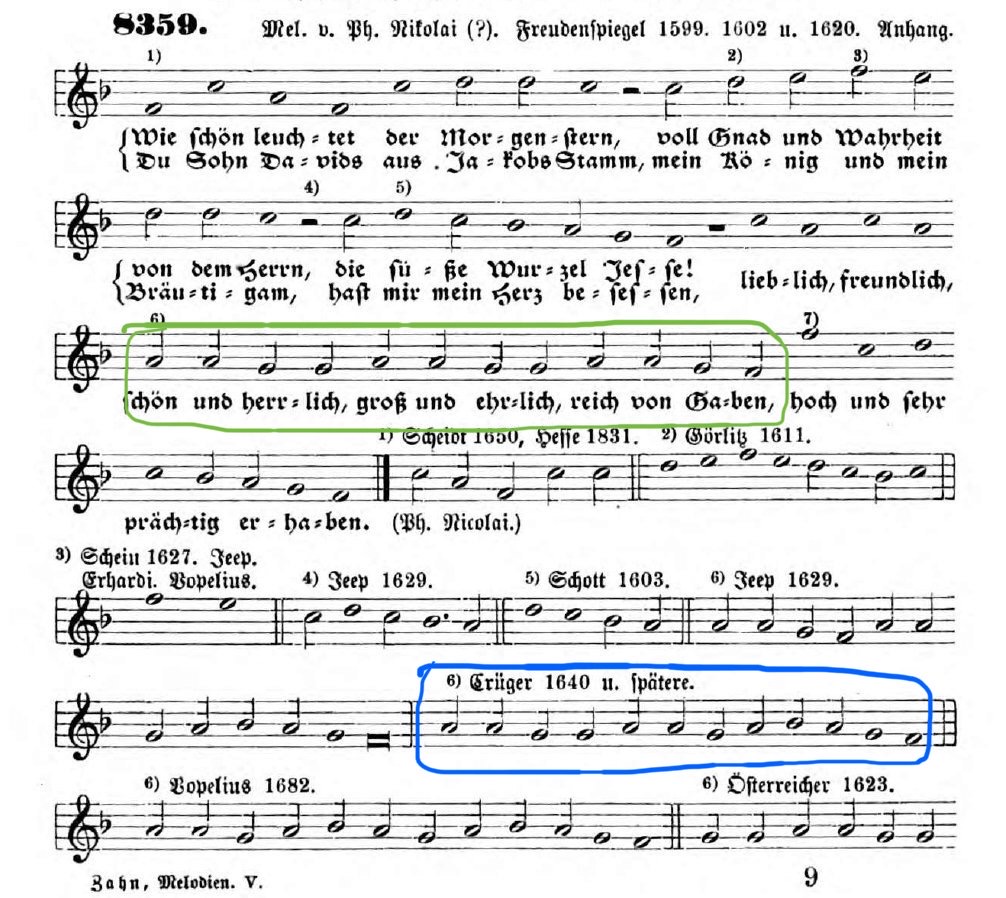
After that, in cantata movements, Bach would either use the original melody (Nicolai’s, see picture above), or Crüger’s version of it. The difference appears in the third line of text, and can be seen in this image, at superscript number 6. Green is Nicolai’s version, blue is Crüger’s.

In these two cantatas, Bach used Crüger’s version:

Cantata 1 Wie schön leuchtet der Morgenstern, written for the Annunciation of Mary, March 25, in 1725. It is one of my favorites because of the two French horns in the opening chorus. This was the last of Bach’s 1724/1725 continuous series of chorale cantatas, and to me, it communicates a similar Advent sparkle as Cantata 62 from that same series.* Per the standard format for these cantatas, Bach featured the first verse of the chorale in the opening movement, and the last verse in the final movement. Watch a live performance of this cantata by the J.S. Bach Foundation here. Soloists are Eva Oltiványi, soprano; Makoto Sakurada, tenor; and Manuel Walser, bass. To understand why it might make sense that the theme of Advent is celebrated on the feast of the Annunciation, please find my blog post from 2018 about Cantata 1 here.

Cantata 36 Schwingt freudig euch empor (Soar joyfully up), an extra-long cantata in two parts, written for the first Sunday of Advent in 1731. The cantata was based on a secular cantata from 1725** but for this First Advent occasion, Bach included several movements based on two Advent chorales: Nun komm, der Heiden Heiland (Come now, Savior of the Gentiles) in the soprano-alto duet, the second tenor aria, and the closing chorale; and the sixth verse of Wie schön leuchtet der Morgenstern in the chorale at the end of Part I of the cantata.

Bach used Nicolai’s version of Wie schön leuchtet der Morgenstern in the following cantata movements, each time in a different way:

  • The penultimate movement of Cantata 172 Erschallet, ihr Lieder, erklinget, ihr Saiten! (Ring out, you songs, resound, you strings!) for Pentecost in 1714 (verse 4)
  • The closing chorus from Cantata 61 Nun komm, der Heiden Heiland for the First Sunday of Advent in 1714 (last 4 lines of verse 7)
  • The chorale for soprano and alto (3rd movement) from Cantata BWV 37 Wer da gläubet und getauft wird (Whoever believes and is baptized) for the feast of Ascension in 1724 (verse 5)
  • The aria for bass with chorale for soprano (6th movement) from Cantata 49 Ich geh und suche mit Verlangen for the 20th Sunday after Trinity in 1726 (verse 7)

As far as we know, Bach wrote only one cantata for this Third Sunday of Advent. It is the one listed in the BWV catalog as Cantata 186a, Ärgre dich, o Seele, nicht, first performed in Weimar on Sunday December 13, 1716. Read my blog post from 2016 and 2017 about this cantata here.

Wieneke Gorter, December 13, 2020.

*Find my first blog post about Cantata 62 here and a more detailed explanation of how it fits into the series of chorale cantatas here.

**Read more about the history of Cantata 36 in my post from 2017 here.

The First Sunday of Advent

29 Sunday Nov 2020

Posted by cantatasonmymind in Advent, Cantatas, Chorale cantatas 1724/1725, Leipzig, Weimar

≈ Leave a comment

Tags

Bachstiftung, BWV 36, BWV 61, BWV 62, California Bach Society, Collegium Vocale Gent, Harnoncourt, J.S. Bach Foundation, J.S. Bach Stiftung, Nuria Rial, Philippe Herreweghe, Seppi Kronwitter

Hello everyone. I hope you are all safe and well. Thank you for reading this blog, and a warm welcome to all of you who started following recently. Bach wrote three cantatas for this Sunday:

In Weimar, in 1714, Bach wrote Cantata 61 Nun komm, der Heiden Heiland. This one I remember the best from my childhood, because my mother loved Seppi Kronwitter’s singing of the soprano aria on the Harnoncourt recording. Read about it here.

In Leipzig, in 1724, Bach wrote Cantata 62 Nun komm, der Heiden Heiland. My most recent writing about this cantata is from last week, not for this blog, but for that of California Bach Society. Find it here.

Since the release of Herreweghe’s recording in 1997 I have been in love with the opening chorus of Cantata 62. For me, nothing says “Christmas is coming” more strongly to me than this music. And yes, Bach wrote two Advent cantatas with the same title. You better not mix them up when you have been engaged to sing the bass solos. Read a story about that here. If you would like to learn more about this opening chorus, or even sing along to it yourself, I encourage you to sign up for California Bach Society’s free workshop on this cantata this coming Saturday, December 5, at 11 am Pacific Time, on Zoom.

Nuria Rial

In 1731, Bach transformed a secular birthday cantata from 1725 into Cantata 36 Schwingt freudig euch empor. Read about it here. My favorite interpretation of the soprano aria is by Nuria Rial. I first heard Nuria Rial sing on the German radio station WDR3, exactly one month after my mother passed away in 2010. I was staying at my parents’ house in the Netherlands with my kids. My mother had always preferred the German classical music station over the Dutch one, especially for their Early music programming, so WDR3 was pre-programmed into my parents’ fancy equipment. The radio host played a piece from this album, and I was mesmerized. After it was over I went on Facebook and told all my singer friends (that’s why I still know what day it was). But I didn’t find out about her live recording of the soprano aria from Cantata 36 with the J.S. Bach Foundation until 2014.

Wieneke Gorter, November 28, 2020

Two Weimar cantatas for the fourth Sunday of Advent

21 Saturday Dec 2019

Posted by cantatasonmymind in Advent, Bach's life, Cantatas, Christmas, Leipzig, Weimar

≈ Leave a comment

Tags

Advent, Advent 4, Alfredo Bernardini, All of Bach, Bachvereniging, BWV 132, BWV 147, BWV 147a, Christmas, Dominik Wörner, Hana Blazikova, J.S. Bach Foundation, J.S. Bach Stiftung, Jakob Pilgram, Jan Kobow, Julia Doyle, Margot Oitzinger, Netherlands Bach Society, Rudolf Lutz, Tim Mead, Weimar, Wolf Matthias Friedrich

For the fourth Sunday of Advent, Bach wrote two cantatas in Weimar: Cantata 132 Bereitet die Wege, bereitet die Bahn in 1715, and Cantata 147a Herz und Mund und Tat und Leben in 1716.

Bach rewrote Cantata 147, the same way he did that with cantatas 70 and 186, into a cantata for another time of the year in Leipzig, in this case the feast of the Visitation on July 2, 1723. Read more about that here in my post from 2016. I have now updated that post with a link to the wonderful live performance of Cantata 147 by the J.S. Bach Foundation, with with Hana Blažiková, soprano; Margot Oitzinger, alto; Jakob Pilgram, tenor; and Wolf Matthias Friedrich, bass.

Cantata 132 was not transformed into a cantata for another time in the church year in Leipzig, so today’s performances of this cantata still reflect the Advent cantata from Weimar. Watch a beautiful live performance of this cantata by the Netherlands Bach Society here on YouTube. Soloists are Julia Doyle, soprano; Tim Mead, alto; Jan Kobow, tenor; and Dominik Wörner, bass.

Find the German text with English translations here, and the score here.

As I already pointed out in my Advent Calendar earlier this week, the text of the joyful opening aria refers to the story of John the Baptist, who was believed to have come to prepare the way for Jesus, and includes the Isaiah quote as it appears in the scripture: “Messias kömmt an!” (The Messiah is coming). Bach gives this text to the soprano three times, and to give it extra emphasis, each time omits all instrumental accompaniment on those three words.

The rest of the cantata stays close to the story of John the Baptist. The bass aria refers to the Pharisees interrogating John, but then Bach’s text writer (Salomo Franck, who was also the Weimar court librarian) projects the question “Wer bist du?” (Who are you?) onto the believer: ask your conscience: are you a true person or a false person?

As a child, I was enormously impressed by this bass aria, even more than by the wonderful soprano aria at the beginning of the piece. I loved how Max van Egmond sings the “Wer bist du?” text on the Leonhardt recording from 1983. You can find that recording, and read more about those childhood memories, in this blog post from 2016. I had no idea at the time that in those very cool opening notes Bach is quoting this organ piece by Buxtehude. I only learned that this week, by watching the “extra videos” the Netherlands Bach Society provides along with their live recordings on All of Bach.

If you are not following this blog yet, please consider signing up (on the left of this text if you are on a desktop computer, at the bottom of this post when you are reading on a smartphone). This way you won’t miss any posts about the many cantatas Bach wrote for all three Christmas Days (yes there were three in his time), New Year’s Day, and the Sundays after those feast days.

Wieneke Gorter, December 21, 2019.

Third Sunday of Advent

14 Saturday Dec 2019

Posted by cantatasonmymind in Advent, Bach's life, Cantatas, Leipzig, Weimar

≈ Leave a comment

Tags

Advent 3, BWV 186a, English Baroque Soloists, John Eliot Gardiner, Katherine Fuge, Richard Wyn Roberts

To find the Weekly Cantata Advent Calendar, please click here.

As I mentioned last week, when Bach worked in Weimar, he wrote a cantata for each of the 4 Sundays in Advent. For Sunday December 13, 1716, the third Sunday of Advent, he wrote the one listed in the BWV catalog as Cantata 186a, Ärgre dich, o Seele, nicht. No original music score is left of this cantata. However, thanks to Bach’s librettist, Weimar court poet Salomo Franck, who published the full libretto for this cantata in a poetry volume in 1717, we do have the original text of 186a.

And, it is not hard to make an educated guess as to what the music would have been. Read all about it in my blog post from 2016 and 2017.

To listen to a beautiful soprano/alto duet that appeared for sure in the Weimar and the Leipzig versions of this cantata, click here. Katharine Fuge, soprano, and Richard Wyn Roberts, alto, with the English Baroque Soloists, John Eliot Gardiner (Live recording. Ansbach, 2000).

Wieneke Gorter, December 11, 2019.

To find the Weekly Cantata Advent Calendar, please click here.

Second Sunday of Advent

07 Saturday Dec 2019

Posted by cantatasonmymind in Advent, Bach's life, Cantatas, Leipzig, Weimar

≈ Leave a comment

Tags

Advent 2, BWV 70, J.S. Bach Foundation, J.S. Bach Stiftung

Tomorrow is the second Sunday of Advent.

When Bach worked in Weimar, he wrote a cantata for each of the 4 Sundays in Advent. However in Leipzig, music (other than chorale singing) was not allowed in the churches in the period between the first Sunday of Advent and Christmas Day. In order to still use (and show off?) the Weimar Advent cantatas in Leipzig he reworked and expanded most of them for other times of the church year in Leipzig.

He truly mastered this rewriting process with cantata 70, Wachet! betet! betet! wachet!, originally written for 2nd Advent in Weimar in 1716, but now dramatically expanded for the 26th Sunday after Trinity, November 21, 1723. 

Read much more about the reworking process and about this particular cantata in this Weekly Cantata post from 2016, which now includes a new link to the excellent live video performance by the J.S. Bach Foundation.  

Wieneke Gorter, December 7, 2019.

← Older posts

Recent Posts

  • “Missa Miniatura” by CONTINUUM/Elina Albach Even More Moving in 2025
  • Bachfest Leipzig 2025
  • Bach Cantatas for Christmas – 1724 and 1734 editions
  • Fourth Sunday of Advent – more insight into Cantata 62 helped me better understand Bach’s Christmas Oratorio
  • Saint Ambrose and Luther in Milan – Second Sunday of Advent

Archives

  • August 2025
  • July 2025
  • December 2024
  • November 2024
  • June 2024
  • January 2024
  • December 2023
  • October 2023
  • September 2023
  • August 2023
  • April 2022
  • February 2022
  • January 2022
  • December 2021
  • November 2021
  • June 2021
  • May 2021
  • April 2021
  • February 2021
  • January 2021
  • December 2020
  • November 2020
  • October 2020
  • September 2020
  • August 2020
  • July 2020
  • May 2020
  • April 2020
  • March 2020
  • February 2020
  • January 2020
  • December 2019
  • November 2019
  • May 2018
  • April 2018
  • March 2018
  • February 2018
  • January 2018
  • December 2017
  • November 2017
  • October 2017
  • September 2017
  • August 2017
  • July 2017
  • June 2017
  • May 2017
  • April 2017
  • March 2017
  • February 2017
  • January 2017
  • December 2016
  • November 2016
  • October 2016
  • September 2016
  • August 2016
  • July 2016
  • June 2016
  • May 2016
  • April 2016
  • March 2016
  • February 2016
  • January 2016

Enter your email address to follow this blog and receive notifications of new posts by email.

Join 338 other subscribers

Categories

  • 1723 Trinity season special series
  • Advent
  • After Easter
  • Ascension
  • Bach's life
  • Cantatas
  • Chorale cantatas 1724/1725
  • Christmas
  • Easter
  • Epiphany
  • Following Bach in 1725
  • Köthen
  • Leipzig
  • Septuagesima
  • Travel
  • Trinity
  • Weimar

Meta

  • Create account
  • Log in
  • Entries feed
  • Comments feed
  • WordPress.com

Website Built with WordPress.com.

  • Subscribe Subscribed
    • Weekly Cantata
    • Join 158 other subscribers
    • Already have a WordPress.com account? Log in now.
    • Weekly Cantata
    • Subscribe Subscribed
    • Sign up
    • Log in
    • Report this content
    • View site in Reader
    • Manage subscriptions
    • Collapse this bar
 

Loading Comments...