For this Sunday, Trinity 10, August 1, 1723 Bach wrote cantata 46 Schauet doch und sehet, ob irgend ein Schmerz sei.
This is another exquisite cantata, worth listening to (or worth watching for a bit, see link below for a wonderful video of the opening chorus by Herreweghe live at the Saintes Festival).
I recommend Herreweghe’s recording from 2012, on the same album already discussed in my previous post for cantata 105.
Purchase this recording on Amazon (the album also includes last week’s cantata 105, and two more cantatas from the 1723 Trinity season).
Listen to this Herreweghe recording from 2012 on Spotify.
Or, listen to this same recording on YouTube, via playlist I created (if this shows up as a visual on your screen, and clicking on the main “play button” results in a “this video cannot be played” message, click on the icon on the top left where it says 1/6, and it should work):
I especially enjoy this cantata because of the beautiful opening chorus, the dramatic bass aria (with terrific tromba da tirarsi playing by Alain de Rudder), and the alto aria.
You’ll recognize the first part of the opening chorus. Bach must have liked this enough to re-use it later as the Qui Tollis in his Mass in B minor. The illustration of the “Schmerz” with two recorders and two oboi da caccia in the orchestra is beautiful.
Last week, with cantata 105, Bach started using features that preluded his passions. In the alto aria in this cantata 46, there is again a reference to the St. Matthew Passion. The pastoral character of the music, as well as the text reference to Küchlein (chicks) make me think of the Sehet Jesus hat die Hand alto aria. I am a huge fan of counter-tenor Damien Guillon. In 2011, I heard him sing for the first time in a live performance of the St. Matthew Passion by Herreweghe in Europe, and have been collecting his recordings since then. He appears on recordings with his own ensemble Le Banquet Celeste, cantata recordings by Herreweghe from 2011 and later, and on several recordings of Marcel Ponseele’s ensemble Il Gardellino. Watch an interview with him (with English subtitles) on YouTube:
Wieneke Gorter, July 30, 2016, links updated August 10, 2023.
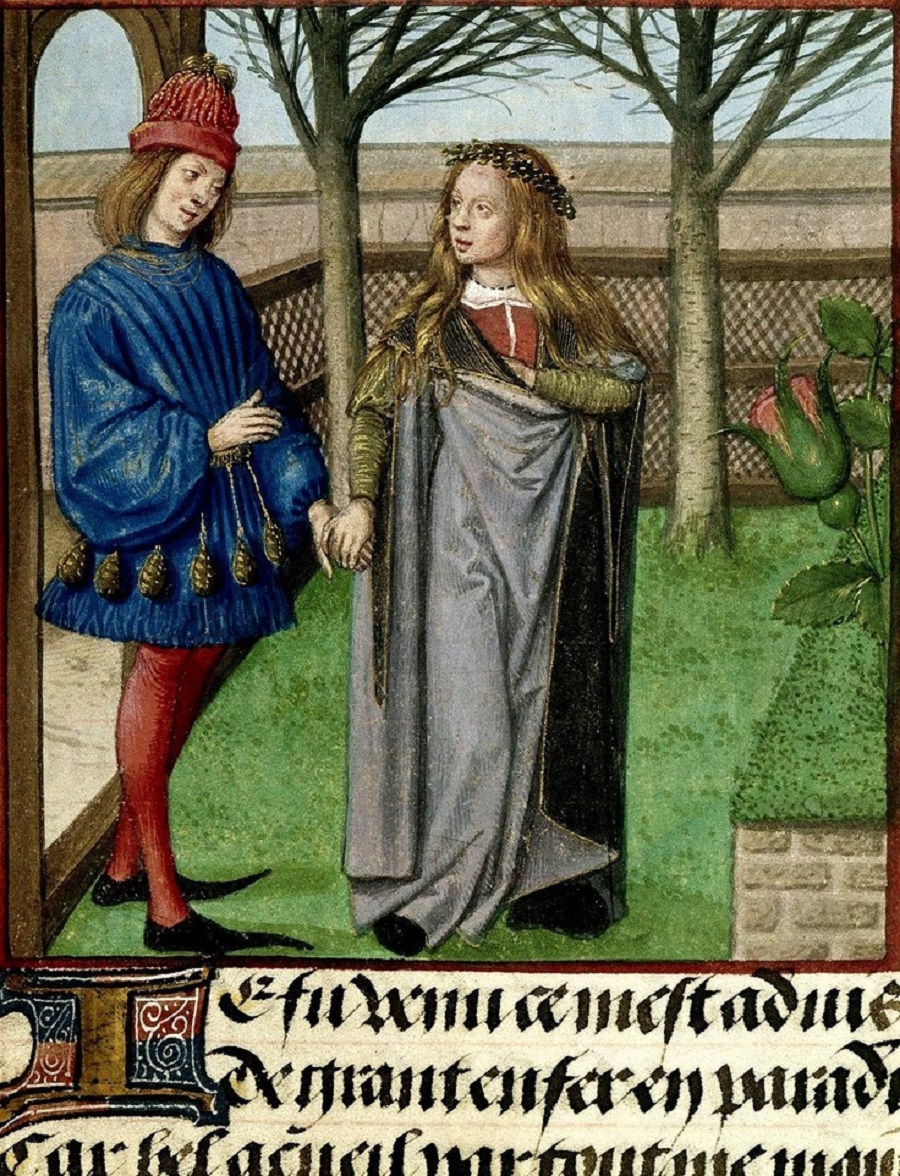
Roman de la Rose, Netherlands (Bruges), c. 1490-c. 1500
Only three episodes into this special 1723 Leipzig Trinity season series, I’m already taking a detour to Weimar. It’s Bach’s fault, because, after the two newly written cantatas he presented on May 30 and June 6, 1723, he “recycled” his Weimar cantata for this third Sunday after Trinity: cantata 21 Ich hatte viel Bekümmernis, written in 1714, or possibly in 1713.
We dont’ know for sure why Bach chose to use an “old” composition this early in his first season (though probably nobody except his own family knew it was not new), but I think that he couldn’t wait to impress the Leipzig Council and congregation with a composition that was one of his all-time favorites. He had written and performed it at least twice in Weimar, then presented it in Hamburg or Köthen in 1720* and would perform it many more times in Leipzig on future third Sundays after Trinity. Another reason I believe it was Bach’s plan all along to present this cantata 21 on Trinity 3 in Leipzig: it seems to me that when writing the masterful fugue in the opening chorus of cantata 76, Bach must have had the fugue in no. 6 of cantata 21 on his mind.
Whether it was thanks to the multiple performances during Bach’s lifetime, or to Mattheson mentioning it (however unfavorably!) in his writings, cantata 21 was known among Bach’s colleagues and students throughout the 18th and 19th centuries, and is still one of the most well-known and most frequently performed cantatas today.
Instead of talking about the music, I would like to shine some light on the history of this cantata, and show you that it was not a stand-alone masterpiece that Bach created out of nothing. Most of the findings here below are from books by Alfred Dürr and Christoph Wolff.
There are parts of this cantata that fit extremely well within the style of the 1714 Weimar cantatas. To hear cantata 21 in this context, if you have time, before you listen to the sinfonia (no. 1) of cantata 21, I invite you to first listen to the sinfonia of cantata 12. They are remarkably similar. Next, just for the fun of it, you might want to listen to the “love” duet from Weimar Pentecost cantata 172 (beautifully sung by soprano Dorothee Mields and countertenor Alex Potter during a streamed concert from 2021)
Soprano (Soul)
Komm, laß mich nicht länger warten, Come , let me wait no longer,
Komm, du sanfter Himmelswind, come, you gentle wind of heaven,
Wehe durch den Herzensgarten! blow through the garden of my heart
Alto (Holy Spirit)
Ich erquicke dich, mein Kind. I refresh you, my child
Liebste Liebe, die so süße, Dearest love, who are so delightful,
Aller Wollust Überfluß, abundance of all joys,
Ich vergeh, wenn ich dich misse. I shall die, if I have to be without you
Nimm von mir den Gnadenkuß. Take from me the kiss of grace.
Sei im Glauben mir willkommen, Welcome in faith to me,
Höchste Liebe, komm herein! Highest love, come within!
Du hast mir das Herz genommen. You have taken my heart from me
Ich bin dein, und du bist mein! I am yours, and you are mine!
and compare it to the “love” duet from cantata 21:
Soprano (Soul):
Komm, mein Jesu, und erquicke,
Bass (Jesus):
Ja, ich komme und erquicke
Come, my Jesus, and restore
Yes, I come and restore
Und erfreu mit deinem Blicke.
Dich mit meinem Gnadenblicker,
and rejoice with your look
you with my look of grace
Diese Seele,
Deine Seele,
This soul
Your soul
Die soll sterben,
Die soll leben,
that must die
that must live
Und nicht leben
Und nicht sterben
and not live
and not die
Und in ihrer Unglückshöhle
Hier aus dieser wunden Höhle
and in its den of misfortune
here from this den of wounds
Ganz verderben.
Sollst du erben
wholly perish.
you shall be given
Ich muß stets in Kummer schweben,
Heil! durch diesen Saft der Reben,
I must always be suspended in misery
Salvation! throught this juice of the grape
Ja, ach ja, ich bin verloren!
Nein, ach nein, du bist erkoren!
Yes, oh, yes, I am lost
No,oh, no, you are chosen
Nein, ach nein, du hassest mich!
Ja, ach ja, ich liebe dich!
No, ah, no, you hate me!
Yes, oh, yes,I love you!
Ach, Jesu, durchsüße mir Seele und Herze,
Entweichet, ihr Sorgen, verschwinde, du Schmerze!
Jesus, sweeten my soul and heart.
Give way, worries, vanish, pain!
Komm, mein Jesus, und erquicke
Ja, ich komme und erquicke
Come, Jesus, and restore
Yes, I come and restore
Mit deinem Gnadenblicke!
Dich mit meinem Gnadenblicke
with your look of grace
you with my look of grace.
Of course none of these are officially meant to speak of earthly love. But still, both these duets are extremely cute, musically completely similar to opera love duets from that time, and their texts could at least partly be interpreted as such love duets, so I can imagine the Weimar poet and the young Bach must have enjoyed writing these.
To really appreciate “the making of” the opening chorus (no. 2) of cantata 21, it’s worth listening to a magnificent Vivialdi violin concerto and one of Bach’s lesser known organ prelude and fugues, to hear where Bach found the theme for the Ich hatte viel Bekümmernis fugue:
In the spring of 1713, the half-brother of Bach’s employer in Weimar, prince Johann Ernst, “a great lover of music and an incomparable violinist” (according to a testimony by Philipp David Kräuter, a student of Bach in Weimar) went on a study trip, and spent a long time in the Netherlands. Upon his return, he had brought “much fine Italian and French” music with him. One of the pieces was Vivaldi’s Concerto in D minor Opus 3, no. 11 for two violins from Book II of L’Estro armonico (RV 565), published in Amsterdam in 1711.
Listen to this Vivaldi concerto in the award-winning interpretation by the fabulous Rachel Podger with Brecon Baroque on Spotify, or on YouTube
Maybe Bach, an accomplished violinist himself, and the prince played this together after the prince returned in July 1713. Bach rewrote this Vivaldi concerto into an organ concerto (BWV 596), but also used the theme in his organ prelude and fugue in B minor, BWV 544, written in Weimar as well. It is in this piece in particular that I can hear the relation with cantata 21 Dürr wants to point out in his book.
About recordings of cantata 21: While Bach Collegium Japan deserves a medal for taking the trouble to research all the different versions and record the ones from 1720 and 1714 on their volume 6 , and the true 1723 Leipzig version (with trombones added in no. 9 and solo/tutti distinctions in the choruses) on their volume 12, I still like Herreweghe’s recording of this cantata the best, mainly because of the strong, crisp choruses and the music always having long lines and strong sense of direction. Listen to Herreweghe’s interpretation of this cantata on Spotify or on YouTube.
Update from 2021: find an absolutely stunning performance of the 1720 version (with only soprano and bass soloists) on the YouTube channel of the J.S. Bach Foundation here.
Read the German text with English translations of cantata 21 here, and find the score here.
If you don’t want to miss an episode of this 1723 Trinity season series, please consider signing up to receive an email every time I’ve posted a new story.
Please feel free to share this on Facebook, or forward to anyone you think might enjoy coming along for this ride. Thank you!
Wieneke Gorter, June 12, 2016. Updated June 19, 2021.
*Bach visited Hamburg in November 1720, to apply for an organist and cantor post there. It turned out, however, that the post needed to be “bought” and the job went to a lesser talented but wealthy candidate. Most scholars are confident there was a performance of this cantata in 1720 in either Köthen or Hamburg, based on the surviving manuscripts of the parts. Because it was the Hamburg-based writer Mattheson who criticized the cantata in a letter in 1725, it is probable that the performance took place in Hamburg during Bach’s visit there.
According to Bach Collegium Japan’s leader Masaaki Suzuki, the 1720 performance featured only a soprano and a bass, with the soprano also singing all the arias and recitatives we know nowadays as written for tenor.
Fragment from Bach’s manuscript of cantata 12 in the Staatsbibliothek zu Berlin – Preußischer Kulturbesitz
For this third Sunday after Easter, I’m jumping back in time to Weimar, 1714, and Bach’s monthly cantata cycle there. Cantata 12 Weinen, Klagen, Sorgen, Zagen was the second cantata Bach wrote in Weimar after having been promoted to Konzertmeister in 1714.*
There are several very good recordings of this cantata, but I would recommend listening to the one by Collegium Vocale/Herreweghe, or to the one by Cantus Cölln/Konrad Junghänel, and then listen again to the tenor aria on the American Bach Soloists recording (keep reading until the end to learn why).
I love the Collegium Vocale/Herreweghe recording for the excellent timing and phrasing, the sound of the alto section in the choir, and Marcel Ponseele’s oboe playing. Listen to cantata 12 by Herreweghe on YouTube
2020 update: if you can afford to financially support the artists (especially important now, while they have no income from performances!) please consider purchasing their recordings instead of just listening on YouTube.
Cantus Cölln/Konrad Junghänel’s recording is one on a part, more similar to what it would have sounded like from the small organ loft in the Himmelsburg, and soprano Johanna Koslowsky’s singing always gives me goose bumps, no matter how many times I’ve listened to it. Listen to cantata 12 by Cantus Cölln.
Find the German texts with English translation of this cantata here and the score here.
The beautiful but sad openingsinfonia would probably have served as an “entrada” for the Duke and his entourage. It is very similar to the one of cantata 21 Ich hatte viel bekümmernis, also written in Weimar.
Several of Bach’s Weimar cantatas were lost when the castle’s chapel burnt down in 1774. Most of the Weimar cantatas we still have today survived only because Bach performed those again in Leipzig, sometimes several times. If he did this because he was proud of these cantatas, then Weinen, Klagen, Sorgen, Zagen must have been his greatest pride, since he later transformed its opening chorus into the Crucifixus for his Mass in B Minor.
Both the sinfonia and opening chorus convey enormous sadness, while it is “Jubilate” Sunday, and only three weeks after Easter. This has to do with the Gospel reading for this Sunday: Jesus’ speech to his disciples explaining that he will leave them, that they will go through immense suffering, but that their sorrow will turn into joy, comparing it to a woman going through childbirth.
So this cantata first conveys the feelings of the disciples, knowing they will soon be without Jesus, and the “tribulations” Jesus predicts for them. But then it explores the journey “from sadness to joy.”
First of all, the entire score can be seen as uplifting, even though the general atmosphere is downcast. As many scholars have pointed out, the score ascends, movement by movement, in intervals of a third, alternating a minor key with its relative major: f, A flat, c, E flat, g, B flat. Gardiner says that this is the “escape ladder” Bach lowers into the pit of sorrow.
The “sorrow to joy”-theme is also cleverly portrayed in the texts, thanks to Salomo Franck, the Duke’s librarian, acting as librettist for all cantatas Bach wrote in Weimar. Many consider Franck’s poetry superior to most of the texts Bach had to work with in his Leipzig years. The alto aria is a good example: after the Gospel quote in the recitative “Wir müssen durch viel Trübsal” (we have to go through tribulation) comes an upbeat aria illuminating how “Kreuz und Krone” (cross and crown) and “Kampf and Kleinod” (conflict and jewel) are always connected.
While I love everything about this cantata, my absolute favorite part is the tenor ariaSei getreu.
The text of the tenor part refers to the Gospel text “A little while, and ye shall not see me: and again, a little while, and ye shall see me, because I go to the Father” and plays on that concept of “little while” – Franck decided it was not any longer than a period of rainy weather (which in Germany can be a few weeks in a row of course) …
Sei getreu, alle Pein Be faithful, all pain
Wird doch nur ein Kleines sein. will only be a little while.
Nach dem Regen After the rain
Blüht der Segen, blessing blossoms, Alles Wetter geht vorbei. all bad weather passes by. Sei getreu, sei getreu! Be faithful, be faithful!
And it gets better! Bach offers additional consolation by way of his music: through this aria, a trumpet plays the melody of “Jesu, meine Freude.” Everyone in attendance in the Himmelsburg would immediately have recognized the melody, and would have heard these words in their head:
Jesu, meine Freude, Jesus, my joy,
Meines Herzens Weide, My heart’s delight
Jesu, meine Zier, Jesus, my treasure
Ach wie lang, ach lange Ah how long,ah how long
Ist dem Herzen bange must my heart be anxious
Und verlangt nach dir! And full of longing for you!
Gottes Lamm, mein Bräutigam, Lamb of God, my bridegroom
Außer dir soll mir auf Erden, Besides you there is in on earth
Nichts sonst Liebers werden. Nothing else that is dearer to me.
My all-time favorite recording of this particular aria is the one by American Bach Soloists, with Benjamin Butterfield singing tenor, and Stephen Escher playing the chorale melody on a cornetto. On most recordings (Herreweghe, Cantus Cölln, Gardiner) the part is played on a Baroque trumpet, on some (Koopman) on a Baroque oboe. The softer, more human sound of the cornetto combined with Escher’s fabulous playing makes this the most moving interpretation of this aria I’ve ever heard. Listen for yourself: find American Bach Soloists’ recording of Sei getreu on YouTube.
singer with cornetto player, anonymous, 16th century
2020 update: Since I wrote this in 2016, Vox Luminis released a wonderful recording of this cantata. They use a slide trumpet in the tenor aria, which is a beautiful middle between the Baroque trumpets of the Herreweghe, Cantus Cölln, and Gardiner recordings and the cornetto of the American Bach Soloists recording.
Find Vox Luminis’ recording of Cantata 12 on YouTube, on Amazon, or on iTunes.
Wieneke Gorter, April 16, 2016, updated April 27, 2020.
Christ cleansing a leper, Jean-Marie Melchior Doze, 1864
For this third Sunday after Epiphany, we find no less than four gems in Bach’s treasure trove: cantatas 73, 111, 72, and 156. I decided to highlight 73 and 72, because of the interesting references between the two. As far as we can tell, Bach loved these cantatas too: He performed cantata 73 at least one more time, and transcribed the opening chorus of cantata 72 into the Gloria of his Mass in G minor.
From the chronology of performances in Leipzig, it looks as if Bach wrote cantata 73 in 1724 and cantata 72 two years later. However, some scholars argue that (a large part of) cantata 72 was probably already written around 1715, since most of the poetry is from a collection Bach used when working in Weimar at that time. But whether 72 was first or 73 was first, it doesn’t matter that much for the appreciation of these two beautiful cantatas.
I have a soft spot for cantata 73 because I love the way Herreweghe performs this, have listened to the 1990 recording many times since it came out, and then to the (better!) 2013 recording. The best parts are the opening chorus and the bass aria (sung by Peter Kooy on both recordings) and I’m grateful for Eduard van Hengel’s Bach website (in Dutch) where I learned a lot about the many possible bits of reference in this cantata to other works.
soloists: Rachel Nicholls (one of the most “boy soprano”-like voices of the soprano soloists in that series, I love it), Robin Blaze (counter-tenor), Peter Kooy (bass)
The most important words from the Bible text for this third Sunday after Epiphany (the story of Jesus cleansing a leper, from the gospel of Matthew):
Da er aber vom Berg herabging, folgte ihm viel Volks nach. Und siehe, ein Aussätziger kam und betete ihn an und sprach: Herr, so du willst, kannst du mich wohl reinigen. Und Jesus streckte seine Hand aus, rührte ihn an und sprach: Ich will’s tun; sei gereinigt!
(When He had come down from the mountain, great multitudes followed Him. And behold, a leper came and worshiped Him, saying, Lord, if You are willing, You can make me clean. Then Jesus put out His hand and touched him, saying, I am willing; be cleansed.)
In the opening chorus: The illustration of the word “Alles” (Everything): one can hear all the instruments in the orchestra, and when the voices come in, they first jump an octave over two quarter notes, signifying all the possible notes in the chord, and then run up in 16th notes, singing every single note in the chord.
In the alto aria: nine times the words “Herr, so du willt” – make sure to remember this melody!
In the bass aria: the text is set in the third person, but it is almost as if Jesus himself is speaking here, and this is where the text moves to the “Ich will’s tun” (I will do it / I am willing) words from the gospel.
In the soprano aria*: the happy and sweet elaboration on the “Ich will’s tun” – which here turns into “my Jesus will do it!”
The closing chorale: the same text and tune Bach uses throughout cantata 111 for this same Sunday in 1725, as well as in the St. Matthew Passion (but in that case with different harmonies in the last four lines!)
Please note: these are two different Herreweghe recordings. The newest one, on Herreweghe’s own label, features a different soprano and tenor soloist than on his earlier recording of this same cantata (Virgin Classics, 1990, with soprano Barbara Schlick and tenor Howard Crook). I like this new one better. The entire CD is wonderful, and also features fabulous counter-tenor Damien Guillon in the other cantatas on the disc. If you like this recording, please consider supporting the artists by purchasing it on Amazon.
What to listen for in cantata 73:
In the opening chorus: the first four notes of the original chorale Herr, wie du willt, so schick’s mit mir in Leiden und Sterben, used as a four-note “Leitmotiv,” first appearing staccato in the horn in the orchestra:
and at the very end of the movement, homophonically in the choir, repeated three times, not something Bach normally does in cantata opening choruses:
In the bass aria: now the “Herr, wie du willt” from the chorale text turns in to “Herr, so du willt” from the gospel text. And to accentuate this, Bach again gives this text its own “Leitmotiv”-like melody. However, it might not have been a new melody. It is very similar to “Bist du bei mir” from Anna Magdalena’s music book. She wrote this aria in her book much later, but it was copied from an opera aria by Stölzel from 1717. Perhaps this opera aria was already being hummed in the Bach household in 1724, we will never know. Later in the bass aria in cantata 73, the “Herr, so du willt”-melody from the alto aria of cantata 72 returns!
What I love especially in this bass-aria is the illustration of “Leichenglocken” (death bells) by pizzicato strings and a somewhat “tolling” movement in the vocal part. My mother (a walking Bach encyclopedia who played a cantata on the turntable / CD player every Sunday) would always point features like this out to me. Bach used it in many other cantatas, for example in (cantata number/movement number): 8/1, 95/5, 105/4, 127/3, 161/4, 198/4. [Thanks again to Eduard van Hengel, I didn’t have to look this up myself].
* While overall I like Bach Collegium Japan’s recording of cantata 72 best, and I love how Rachel Nicholls sings the soprano aria, I would like to mention that on Montreal Baroque’s recording of this work, the soprano aria by Monika Mauch is excellent and worth listening to. How she makes everything calm on the words “sanft und still” is very special.