Weekly Cantata

Weekly Cantata

Tag Archives: John Eliot Gardiner

Instrumental solos that bring me to tears and a bit of farmers’ music

07 Saturday Oct 2017

Posted by cantatasonmymind in Cantatas, Chorale cantatas 1724/1725, Leipzig, Trinity

≈ Leave a comment

Tags

17th Sunday after Trinity, Agnès Mellon, BWV 114, BWV 148, flute, Gérard Lesne, Gustav Leonhardt, John Eliot Gardiner, John Elwes, Marc Hantaï, Peter Kooy, Trinity 17
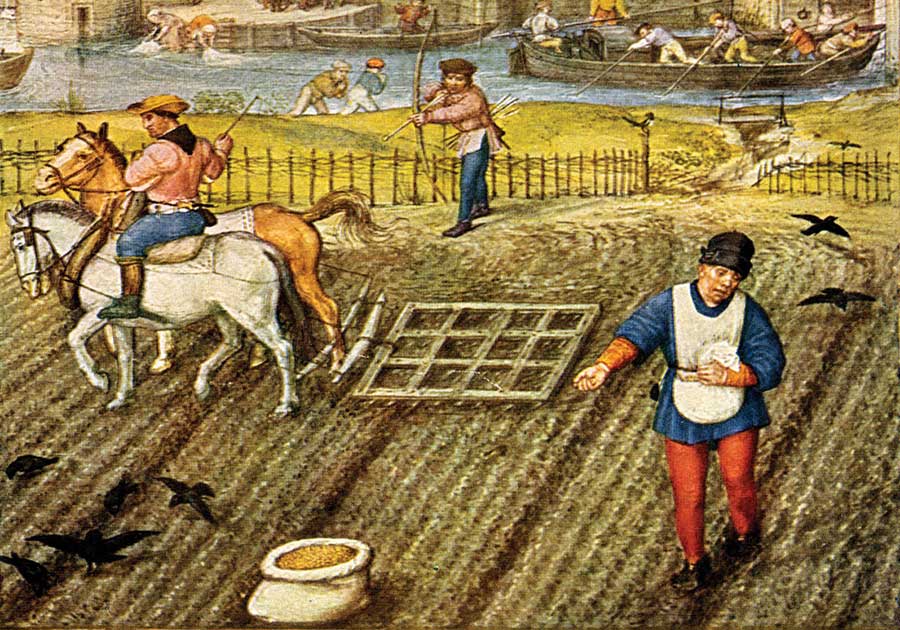
feudalism

Six weeks ago, I noticed that Bach’s cantatas for the 11th Sunday after Trinity all give me a good kind of stomach ache. This week, it seems that all instrumental solos for the 17th Sunday after Trinity make me cry. It happened last year when I was listening to the violin solo in cantata 148, and it happened to me again this year with the hauntingly beautiful flute solo in the tenor aria of cantata 114 Ach, lieben Christen, seid getrost, from 1724.

It is an exceptional aria, ten minutes long, and extremely demanding for the tenor as well as the flutist. Bach must have been proud of it, because later, in January 1725, he turned this composition into a much faster paced, condensed piece of drama for tenor and oboe d’amore in Cantata 124 Meinen Jesum laß ich nicht.

The first recording I listened to set the standard for the rest: a fabulous flutist, most probably Marc Hantaï, and tenor John Elwes on a live audio recording from 1988 by La Chapelle Royale under the direction of Gustav Leonhardt.  I absolutely adore Frans Brüggen’s flute playing on the Leonhardt recording from 1980, but don’t enjoy Kurt Equiluz’ singing as much. Mark Padmore’s singing on the Gardiner recording is to die for, but flutist Rachel Beckett’s decisions on where to breathe are not as sensitive as Marc Hantaï’s, and with Hantaï’s interpretation already in my head, I found it distracting. The same goes for Wilbert Hazelzet’s playing on the Koopman recording, with tenor Christoph Prégardien.
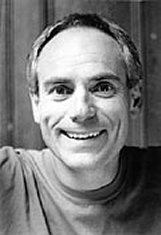
elwes-john-2
John Elwes
marchantaii
Marc Hantaï

This La Chapelle Royale/Gustav Leonhardt recording is also a nice monument from the past for me, since it has all the soloists I was in love with at the time: soprano Agnès Mellon, countertenor Gérard Lesne, and bass Peter Kooy. When you watch the YouTube recording on a screen, you can read along in the score. And that is interesting in this case, especially in the opening chorus and the soprano aria.

Find the German text with English translation of this cantata here.

Starting at the beginning, reading along with the opening chorus, you can see that the joyful figure that is at first only in the continuo (orchestra bass) part, spreads through all the other parts, a message from Bach that the consolation in the text of the chorale is more important than the punishment. The punishment is still present though, in the repeated staccato notes in some of the instrumental parts, and, at 2 minute 24 seconds, visually only, in the score: there are the three whip lashes diagonally from top to bottom over the page in the instrumental parts, illustrating the word “Straf” (punishment) the chorus sings there. Or see this image, courtesy of Eduard van Hengel:
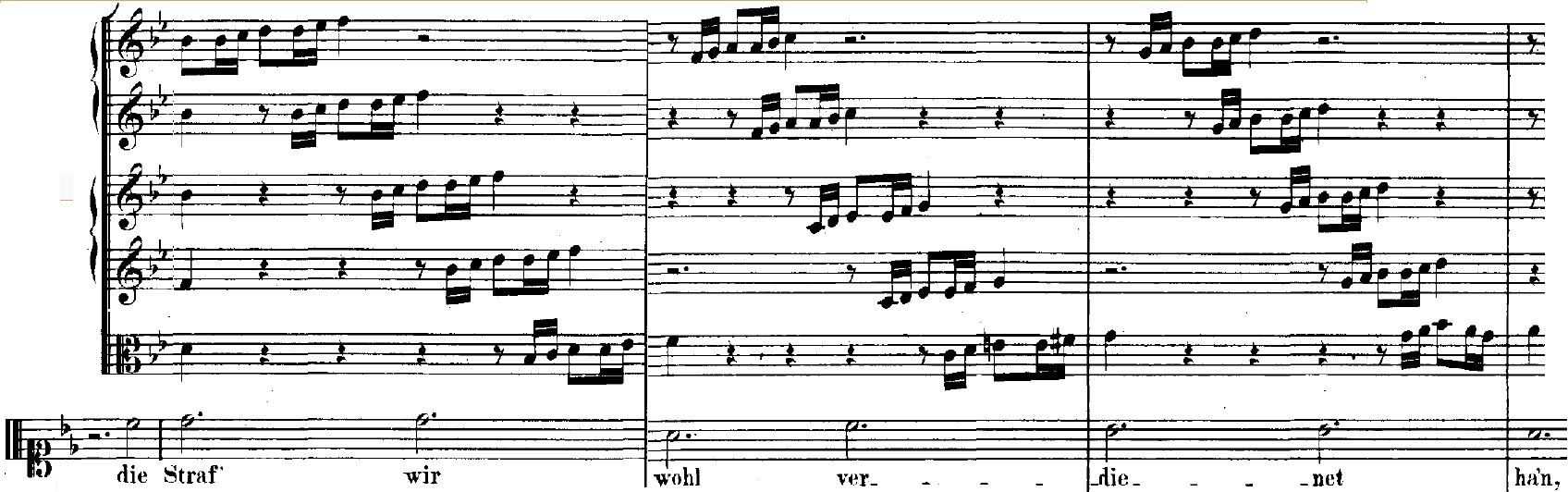
114-120straf20gr

When reading along with the soprano aria, at 15 minutes 5 seconds, you can see or hear how in the continuo part, Bach illustrates the flick of the wrist of the farmer who sows the seeds.  If you have time, I encourage you to also listen to Gardiner’s remarkable take on this soprano aria. In his notes accompanying his live recording, he explains that the text “The grain of wheat will bear no fruit unless it fall into earth” can be seen as a warning to the farmer to get his timing right when sowing his winter cereals. Gardiner, a sheep farmer in his spare time and always eager to point out connections to the seasons in Bach’s music, is obviously really excited to bring out this text: he has the entire soprano section sing it, with much more fervor and much better enunciation than Agnès Mellon on the Chapelle Royale/Leonhardt recording. He also explains in his notes that they took Bach’s indication “continuo unisono” to mean that the organ should double the cello part. Since they always use church organs for their recordings, it sounds impressive. I truly appreciate hearing this movement performed this way.

Then go back to the Chapelle Royale/Leonhardt recording, and listen to Gérard Lesne, my first countertenor love*, spookily illustrating the approach of death, with similar chromatic lines as in last week’s arias.

©Wieneke Gorter, October 6, 2017, links updated October 2, 2020

*Read all about my love for Gérard Lesne in this post
Something with this Sunday & Robin Blaze’s art of singing a chorale melody

27 Sunday Aug 2017

Posted by cantatasonmymind in Cantatas, Chorale cantatas 1724/1725, Leipzig, Trinity

≈ Leave a comment

Tags

alto, Bach, Bach Collegium Japan, BWV 113, BWV 179, cantatas, flute, Gerd Türk, John Eliot Gardiner, Leipzig, Masaaki Suzuki, Peter Kooij, Robin Blaze, Trinity, Trinity 11, Yukari Nonoshita

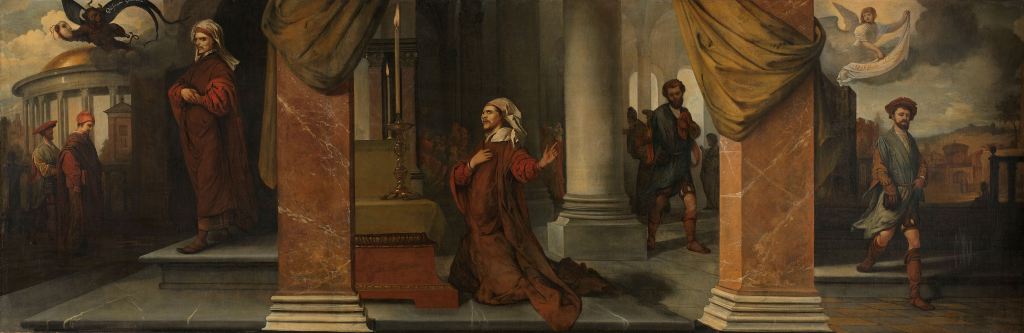
The Pharisee and the Publican by Barent Fabritius, 1661. Oil on canvas. Rijksmuseum, Amsterdam, the Netherlands.

In 1723, Bach wrote an exceptional cantata for this Sunday, the 11th after Trinity. I liked that cantata 179 so much that I gave my blog post last year the title “Bach on a roll” and I’ve been listening to it again this week. In 1724, Bach wrote cantata 113 Herr Jesu Christ, du höchstes Gut for this same Sunday. Both these cantatas truly move me. I feel as if Bach was especially humbled by this particular Sunday.

The only recording that does Cantata 113 Herr Jesu Christ, du höchstes Gut justice and gives me the good kind of stomachache is the one by Bach Collegium Japan, because of Peter Kooij’s and Robin Blaze’s terrific singing, beautiful oboe and flute playing, and the fact that Yukari Nonoshita and Robin Blaze make the duet into a lovely piece of music (instead of struggling through it, the way it seems to be on some other recordings). Listen to this recording by Bach Collegium Japan on Spotify, or on Youtube. Soloists on this recording are: Yukari Nonoshita, soprano; Robin Blaze, alto; Gerd Türk, tenor; and Peter Kooij, bass. Please consider supporting the artists by purchasing this recording on jpc.de or iTunes.

Find the text and translation here, and the score here.

That Bach might have might have felt a special touch or inspiration on this 11th Sunday after Trinity makes sense when you look at the Gospel reading for the day. It is the parable of the Pharisee and the Publican (or Pharisee and the Tax Collector), a story Jesus tells as an illustration on how to pray: the Pharisee is full of himself, telling God how good he is, while the Publican in his own prayer merely asks for mercy, and tells God how bad he is. This concept of how to be a good Christian before God, to be true, not fake, was very important to Bach.

In cantata 113 the chorale melody turns up much more often than in most of the other 1724/1725 chorale cantatas. It is even present in some of the arias that don’t have the chorale text. For the first time since starting this series of chorale cantatas, Bach doesn’t use the chorale melody as a cantus firmus in the opening chorus. Instead, he writes a simple four-part harmonized setting of the chorale melody. But, then there’s the unusual twist: Bach changes the usual 4/4 beat in which a chorale is normally sung to a 3/4, which allows him to write long suspensions in the vocal lines, thus intensifying the pleading character of the music (and the good stomach ache I get when I listen to it).

Robin Blaze. Photo by Dorothea Heise.

In the aria that follows, Bach makes up for the missing cantus firmus from the opening chorus. Any late-comers to that church service on Sunday August 20, 1724 would not have missed what chorale this cantata was based on: the alto sings the text as well as the melody of the chorale’s second stanza in long notes, against strings playing in unison.

Singing a chorale melody like this is not easy, and most recordings were unsatisfying to me because of this aria (as well as the duet). But Robin Blaze knows how to do it: sing with a brilliant sound, clearly placing each note, but also sustaining the sound throughout every note, and keeping it moving, while not forgetting word accents. It is a special art, and he masters it. I can listen to that five times in a row and not tire of it.

The bass aria could -as far as the music is concerned- easily have been inserted into the Christmas Oratorio, with the pretty oboe accompaniment. Note the word illustrations on “Zittern” (trembling) and “zerbräche” (would break), expertly sung by Peter Kooij. If this is all not pretty enough, Bach presents his talented flute player again, and gives him a beautiful but unbelievably challenging part, more virtuoso than ever before,  in the tenor aria “Jesus nimmt die Sünder an.” And then there is the duet.

Wieneke Gorter, August 27, 2017, updated August 15, 2023.

Shaking things up at the start of the second Leipzig cycle

18 Sunday Jun 2017

Posted by cantatasonmymind in Cantatas, Chorale cantatas 1724/1725, Leipzig, Trinity

≈ Leave a comment

Tags

John Eliot Gardiner, Paul Agnew, Wilke te Brummelstoete

Last_judgement_Bosch
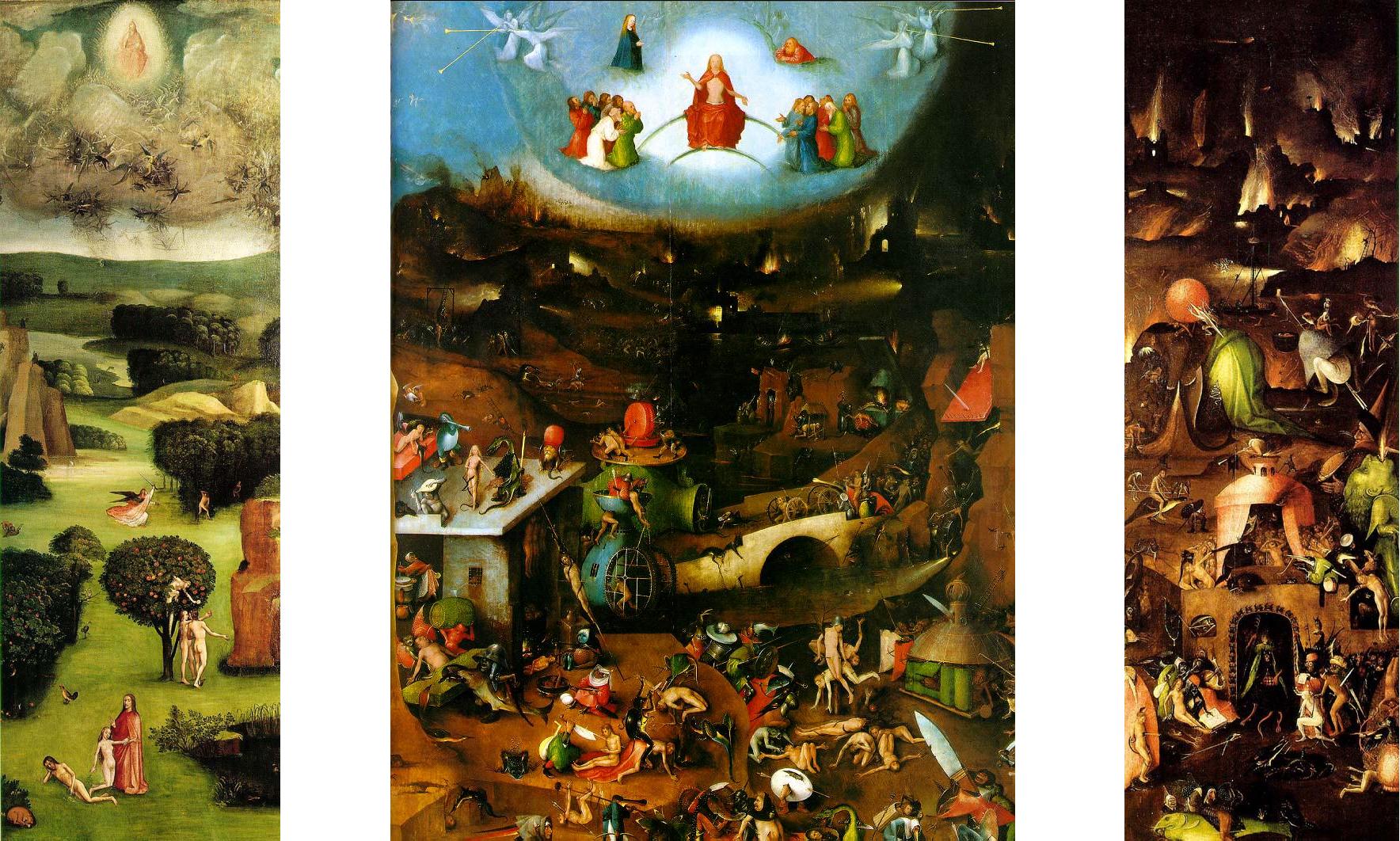
Last Judgement by Hieronymus Bosch, created between 1482 and 1516. Flames, as mentioned in the tenor aria, everywhere on the middle and right panel, “Posaunen” (trumpets) in the middle panel, as mentioned in the bass aria, and God hovering above the clouds (left panel, at top) as mentioned in the chorale at the end of Part I : “So lang ein Gott im Himmel lebt und über alle Wolken schwebt.”

On this First Sunday after Trinity (or “Trinity 1” for short) in 1724, Bach started his second cycle of cantatas in Leipzig.* He was well aware of the importance of this occasion, and wrote one of his most dramatic cantatas for this day: cantata 20 O Ewigkeit, du Donnerwort. The cantata features a wealth of opera-style writing for the soloists, and such a stately French overture, that one wonders if the use of this style was ironic: see, if you behave in this rich, arrogant way, things will end horribly for you. A lesson like this would be fitting for this cantata, because the Gospel  reading for this Trinity 1 Sunday was that of Lazarus and Dives: The poor leper Lazarus lies in front of the rich man Dives’ house, asking him for food every day. Dives ends up in hell when he dies because he didn’t share his blessings/wealth with those in need.

Over the course of writing this blog, whenever a cantata contains significant operatic writing, I tend to give the prize for best recording/interpretation to Gardiner, because he and Harnoncourt seem to be the only ones not shy to “overdo” it in these cases. This time it is no different. I especially love Paul Agnew in the tenor aria and Wilke te Brummelstoete and Paul Agnew together in the duet, where they illustrate the “chattering of teeth” perfectly.  Bass Dietrich Henschel does a good job too, though I’m not sure I prefer him over Peter Kooy on the Herreweghe recording. Listen to Gardiner’s recording of cantata 20 O Ewigkeit, du Donnerwort : here on YouTube

Find the text here, and the score here.

Bach marked this “second beginning” in Leipzig in several different ways, for himself as well as for others:

First of all,  on this Sunday he starts an entire series of new** cantatas, which we now call his chorale cantatas. For nine and a half months, including the entire Christmas season, he would write every cantata according to this same template: the opening movement is a chorale fantasia on the first stanza of an existing Lutheran hymn or chorale, with the tune appearing as a cantus firmus. The last movement has the last stanza of the same hymn as text, in a four-part harmonization of the tune. The text of those choral, outer movements was used verbatim, while the text of the solo, inner movements was paraphrased, but still based on the inner stanzas of the same hymn.

If you believe in the theory that Bach lost his soprano soloist sometime in the spring of 1724, and was having trouble training a new one, this concept of a chorale cantata would have been a brilliant move to solve this problem. This way, Bach still presented a series of impressive cantatas (arguably more impressive than his 1723/1724 cycle), while limiting the rehearsal hours needed with the choir boys. In many of these cantatas, as is the case for today’s cantata 20 O Ewigkeit, du Donnerwort, the choir boys would only have to sing the chorale melody in the opening chorus, and there would be no soprano recitative or aria among the inner movements at all. If in later cantatas in this series the boys would get assigned something a bit more complicated, it would still be based on the chorale melody they already knew by heart, so it would require much less rehearsal time with them.

As if with this dramatic cantata 20 Bach didn’t already make enough of a splash, he most probably intended for the first four chorale cantatas of this 1724 Trinity season to form a set, or at least to present some kind of order,  if you look at the composition form of the opening movement, and which voice has the cantus firmus of the chorale tune in that chorus:

  1. Cantata 20 O Ewigkeit, du Donnerwort: French Overture, with cantus firmus in the soprano
  2. Cantata 2 Ach Gott, vom Himmel sieh darein: Chorale motet, cantus firmus in alto.
  3. Cantata 7 Christ unser Herr zum Jordan kam: Italian concerto, cantus firmus in tenor.
  4. Cantata 135 : Ach Herr, mich armen Sünder: Chorale fantasia, cantus firmus in bass.

We know that Bach liked to use order and symmetry when he wanted to impress other people with a composition. But perhaps he was also thinking of his legacy. When he started composing cantatas at the Weimar court in 1714, albeit on a monthly instead of weekly basis, his first four cantatas formed a similar portfolio of composition styles in the opening choral movements:

  1. Cantata 182 Himmelskönig, sei wilkommen: Choral fugue
  2. Cantata 12 Weinen, klagen, sorgen, zagen: Passacaglia
  3. Cantata 172 Erschallet, ihr Lieder, erklinget, ihr Saiten!: Concerto
  4. Cantata 21 Ich hatte viel Bekümmernis: Motet.

This symmetry with his Weimar days must have been lost on others, even his fellow musicians, since they heard all these Weimar cantatas in Leipzig over the course of the 1723/1724 cycle, but not in this order they were created in Weimar.

In today’s cantata, cantata 20 O Ewigkeit, du Donnerwort, there are more links to other compositions nobody or only a few fans would have noticed: In the music as well as the text, Bach makes some pretty strong references to the first and the last cantata of the 1723 Trinity season. References to the first one (cantata 75, discussed here on this blog) appear in the decision to go back to this long, two-part format, the use of the trumpet as symbol for the heavens, and the illustration in the music of the word “Flammen” (flames). References to the last one (cantata 70, discussed here on this blog) present themselves in the selection of the chorale that talks about the Day of Judgement, and the operatic writing for the soloists, especially the bass and tenor.

After having followed Bach’s weekly compositions during the Trinity season of 1723, I feel it could be interesting to see this cantata 20, the first of the 1724 Trinity season, as the immediate successor of cantata 70, the last of the 1723 Trinity season. I realize that by doing so, I would ignore a few gems from early 1724, and an entire St. John Passion, but I do believe that as educator of his fellow Lutherans, Bach found Trinity season the most important part of the church year, and perhaps sometimes in his mind indeed ignored all the other stuff in between.

During the Trinity season, the theology moves away from the stories about the life of Christ, and instead focuses on the Lutheran doctrine, how one behaves before God, and on doing good deeds. So with this cantata, and the series that was to come, I think Bach wanted to make sure the Leipzig congregations were fully aware that the Trinity season was starting. The text “Wacht auf, wacht auf” (Wake up, wake up!) in the bass aria is testament to this, but also the writing of the opening chorus and the alto-tenor duet: it all makes you sit up and pay attention.

Wieneke Gorter, June 19, 2017.

*Bach had made his Leipzig debut on Trinity 1, 1723, with cantata 75 Die Elenden sollen essen. Read more about that fabulous cantata in this blog post.

**During this period, there will be no repeats of existing cantatas at all. It is stunning to realize that Bach made this huge commitment to himself, knowing how often during the 1723/1724 cycle he “recycled” music from Köthen and cantatas from Weimar.

A better week for cantata 198 than for 86

21 Sunday May 2017

Posted by cantatasonmymind in After Easter, Cantatas, Leipzig

≈ Leave a comment

Tags

5th Sunday after Easter, Bach, BWV 198, BWV 86, BWV 87, Christoph Prégardien, John Eliot Gardiner, Katharine Fuge, Kati Debretzeni, Klaus Mertens, Leipzig, Netherlands Bach Society, Robin Blaze, Robin Tyson, Rogate Sunday, roses, Shunske Sato, Stephan Loges, Steve Davisilim, Westerland

imgp4873-1-w
 Rosa centifolia ‘Major’, dated as far back as the 16th century in the Netherlands. Courtesy of http://rudolfshistorischer-rosen-park.blogspot.com/ , a website I found when looking for roses that would have existed in Germany in Bach’s time

This week I don’t feel a lot of connection with the Bach cantata from 1724 for this Sunday (the 5th after Easter, or Rogate Sunday), cantata 86 Wahrlich, wahrlich, ich sage euch. When I came home from the funeral of one friend, I learned that another friend had passed away suddenly the day before. Because these were both very strong, kind, beautiful, and inspiring women, and I can’t believe they are gone, I feel much more inclined to listen to cantata 198, Lass, Fürstin, Lass nun einen Strahl, which Bach wrote for the funeral of a well-loved Queen than to a cantata which promotes that “God always knows best.”

But I’ll still write about cantata 86. The only connection I have with it this week are the roses in the text of  the alto aria. It is my favorite movement of this cantata, because of the splendid violin solo. The interpretation of that violin solo I like best of all the recordings I listened to* is the one by Kati Debretzeni on the Gardiner recording. You can find that recording here on Amazon or here on iTunes. Soloists on the Gardiner recording are Katharine Fuge, soprano; Robin Tyson, counter-tenor; Steve Davisilim, tenor; and Stephan Loges, bass.

For better interpretations of the bass and tenor solos, I recommend listening to the Koopman recording with tenor Christoph Prégardien and bass Klaus Mertens. You can find that recording on YouTube, Amazon, or iTunes.

2020 update: read my blog post of May 15, 2020, to find links to the live video recording by The Netherlands Bach Society, with Robin Blaze, coutertenor, and Shunske Sato, violin.

For the text and translations of cantata 86, please visit this page, and for the score, please go here.

Why the connection with roses? About one week ago, on Friday May 12, I went to drop off a card for a friend who was dying. I learned she was in her last days on Tuesday, but it took me until Friday morning to find the right words, finish writing the card, and to drop it off. When I walked to her door I noticed a hedge of sweet pink roses in the front yard. I felt peace from seeing the roses, and from the knowledge that she liked roses, but I also felt miserable and angry that she would be taken away from all this, from her family, her life, her home. The next day, we heard she passed away during that night.

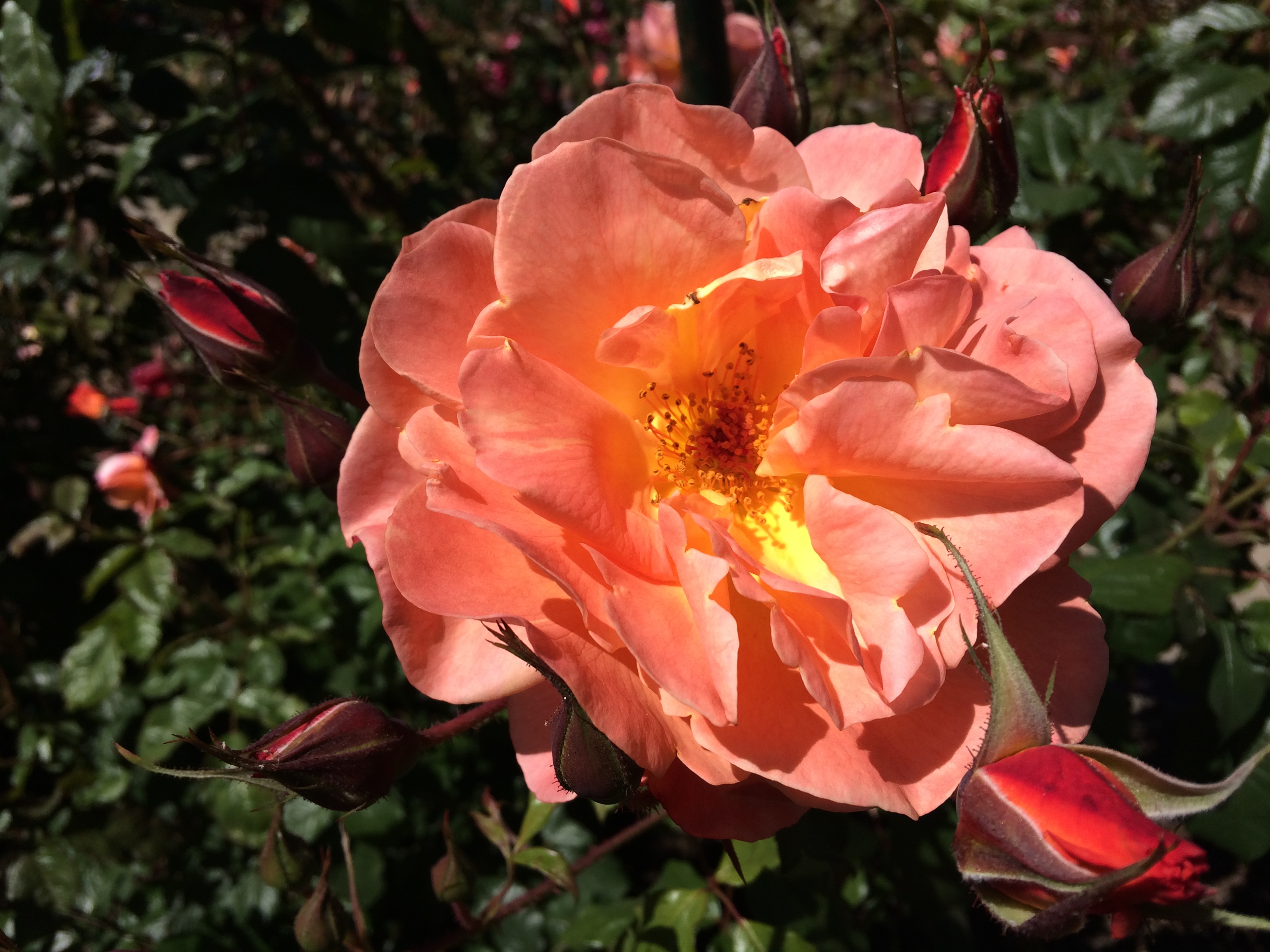
This past Friday was the day of her funeral. I didn’t know how it would go, how my kids would handle it (my oldest and her oldest are friends), and tried to find some strength for myself, so I would be able to be there for them. I realized that I associate this woman’s kindness and warmth with the pinkish apricot color of my favorite rose in the Berkeley rose garden, Westerland. So I decided to walk through the rose garden to experience the color and scent of this amazing flower, and it helped. This is what she looked like that day: Westerland

What to listen for in cantata 86:

In the opening movement, notice how Bach accentuates the fact that Jesus is speaking important, timeless words by setting these words in the form of an archaic motet. While the motet has multiple voices, the way it was done in the Renaissance, Bach can still make it clear that the words come from Christ’s mouth only, by giving all the other “voice parts” to instruments instead of to other singers.

In the alto aria, hear how the words “brechen” (to pick [roses]) and “stechen” (to prick) are illustrated by short notes and “broken” chords in the voice part, and broken chords in the violin part.

In the soprano aria, hear how low in the soprano range this is set — it could just as well have been sung by an alto. Bach has not given significant solos to a soprano since Easter of this year, 1724, and actually pretty sporadically since the start of the new year. Many scholars suggest that during that spring of 1724, Bach might have lost his boy soprano soloist (due to him leaving the school or due to his voice changing, we don’t know), and documents suggest that he was frustrated with the low quality of the boy sopranos of the St. Thomas School in general. They believe that this is why he started the chorale cantatas (cantatas of which each movement is based on a different verse of one and the same chorale tune) after Pentecost of that year. Keep following this blog and you’ll learn more about that soon 🙂

Wieneke Gorter, May 21, 2017, updated May 15, 2020.

*I did all this listening last year, when I actually ended up writing about cantata 87, the one Bach wrote for this same Sunday, but then in 1725. Read that post here.

My favorite sopranos for the third Sunday before Lent

18 Saturday Feb 2017

Posted by cantatasonmymind in Cantatas, Leipzig, Septuagesima

≈ Leave a comment

Tags

BWV 144, BWV 84, Dorothee Mields, John Eliot Gardiner, Leipzig, Miah Persson, Phlippe Herreweghe, Septuagesima

workers_vineyard
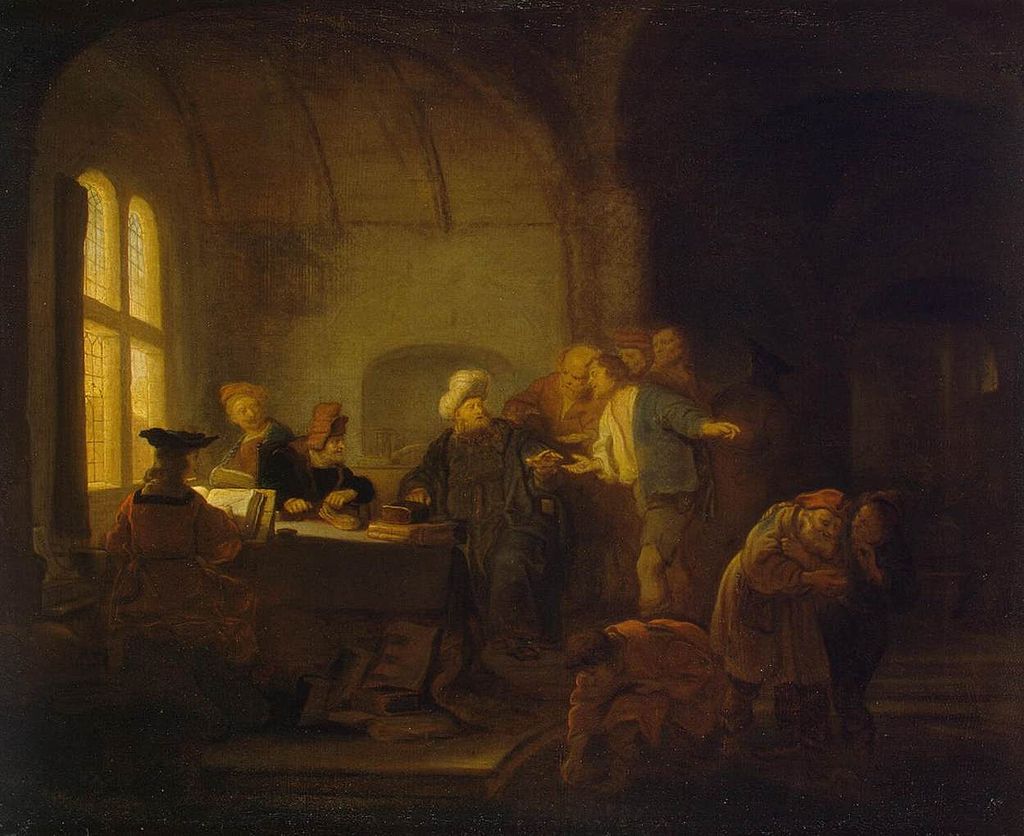
Parable of the workers in the vineyard by Salomon Koninck. Between 1647 and 1649. Hermitage Museum.

On the third Sunday before Lent in 1724, Bach performed Cantata 144 Nimm, was dein ist, und gehe hin. Read all about this short but wonderful work in my blog post from 2016, in which I discuss an unrivaled recording by Gardiner with mezzo soprano Wilke te Brummelstoete and soprano Miah Persson.

In that cantata from 1724 Bach wrote one soprano aria on the concept of “Genügsamkeit” (being satisfied with what you have), but three years later, he dedicated an entire solo work for soprano to this theme: Cantata 84 Ich bin vergnügt mit meinem Glücke (I am content in my good fortune), featuring the delightful aria Ich esse mit Freuden mein weniges Brot (It is with joy that I eat my meager piece of bread). We can probably take this as proof that Genügsamkeit was very important to Bach.

Find the German texts with English translations of Cantata 84 here, and the score here.

dorothee-mields-100_v-ardaustauschformat
Dorothee Mields

I myself count among my blessings that Herreweghe’s recording of this cantata features one of my favorite sopranos, Dorothee Mields. Read more about her in my post about the Herreweghe sopranos.

I listened to many recordings of this cantata, and I still (2020) love this interpretation the best. Mields is a terrific chamber musician together with the instrumentalists throughout this cantata, listen to the interplay between her and oboist Marcel Ponseele. I feel her voice sounds the most natural in aria “Ich esse mit Freuden mein weniges Brot.” The way she starts “Ein ruhig gewissen” the first time that comes around is just to die for as far as I’m concerned. I also like Herreweghe’s tempos the best of all the recordings I’ve listened to.

Enjoy Dorothee Mields’ singing and her being a terrific chamber musician together with the instrumentalists on Herreweghe’s recording of cantata 84 Ich bin vergnügt mit meinem Glücke on YouTube or on Spotify. The cantata appears on Herreweghe’s album Christus der ist mein Leben from 2007, which also includes two other fabulous cantatas: 95 and 161. If you like these recordings, please consider purchasing (the MP3 of) this album on Amazon.de or on Amazon.com. Or purchase the album on iTunes or whatever platform you prefer. Thanks for supporting the artists!

Wieneke Gorter, February 18, 2017, last updated January 27, 2024.


Bach in Vienna / Robin Blaze going wild

06 Sunday Nov 2016

Posted by cantatasonmymind in 1723 Trinity season special series, Cantatas, Leipzig, Trinity

≈ Leave a comment

Tags

24th Sunday after Trinity, Bach Collegium Japan, BWV 105, BWV 60, Eduard van Hengel, Gerd Türk, Jason Victor Serinus, John Eliot Gardiner, Masaaki Suzuki, Peter Kooy, Robin Blaze, San Francisco Classical Voice, St. John Passion, St. Matthew Passion, Trinity 24

kokoschka_pieta

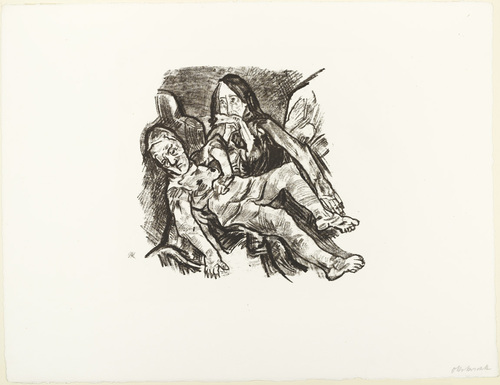
Pietà (It is enough) / Pietà (Es ist genug), plate 11 from a series of 11 lithographs O Ewigkeit, Du Donnerwort by Oskar Kokoschka, 1914/1916. Museum of Modern Art, New York.

In Vienna, they were all talking about Bach’s cantata 60 O Ewigkeit, Du Donnerwort. The astonishing harmonization in the closing chorale as well as the structure of a “dialogue” between Fear (alto) and Hope (tenor) made it one of the most unusual among his cantatas, and apparently something worth discussing. In the first half of the 20th century, that is. In 1935  Alban Berg used the “modern” harmonization from the closing chorale Es ist genug in the final movement of his violin concerto To the Memory of an Angel–an instrumental Requiem for Manon Gropius, daughter of Bauhaus architect Walter Gropius and Mahler’s widow, Alma Schindler.

Several years before, the same Alma Schindler had a short-lived affair with Czech painter Oskar Kokoschka. After they broke up, Kokoschka processed his torment by making a series of 11 lithographs to illustrate the cantata. The dialogue between Fear (the alto) and Hope (the tenor) in the cantata became a dialogue between Alma and himself, in pictures only: click here to see the entire series. Many thanks to Eduard van Hengel for pointing this out.

Listen to Bach Collegium Japan’s recording of this cantata on Spotify, with countertenor Robin Blaze and tenor Gerd Türk. Find the German text with English translations here, and the score here.

Bach wrote this cantata 60 O Ewigkeit, Du Donnerwort for the 24th Sunday after Trinity in 1723, the Sunday normally linked to the Gospel story of the Raising of Jairus’ Daughter. However, in 1723–as now in 2016–this day fell on the first Sunday in November: All Hallows Sunday, All Saints Sunday, however you want to call it, but the Sunday on which the congregation would have commemorated all who had passed away that year. None of the commentaries I have read mention this, but I think it is important, because I feel this cantata is much more about how horrible it might be to die, or the thoughts one has when sitting at a loved one’s deathbed, than it is about the Raising of Jairus’ Daughter.

Of all the recordings I listened to, I like Bach Collegium Japan’s the best, because of Robin Blaze’s interpretation of the alto part. I always love his voice, but he is usually quite understated in his singing. He explains this well in this interview on San Francisco Classical Voice. I sometimes wish he would indeed sing with Kate Bush and “let go” a little, so I was thrilled to hear that in this cantata he actually does go a bit wild, for his standards at least, and that Suzuki lets him do it. His conviction in the opening chorale is already terrific (also note the wonderful blend with the horn doubling his part), but the way he sings the text “Und martert diese Glieder” (and tortures these limbs) in movement 2 is amazing, spot-on, and unrivaled by any others I listened to.

As we have seen before in the course of these 1723 Trinity Season cantatas (read for example my post on cantata 105) there are elements of Bach’s passions already present in this cantata. The agitated singing of the tenor in the stunningly beautiful duet (movement 3) resembles the Ach, mein Sinn! tenor aria from the St. John Passion. The repeated tremolo in the violins in movement 1 is something Bach often uses to illustrate fear, and this will show up again in the tenor arioso O Schmerz! Hier zittert das gequälte Herz in his St. Matthew Passion.

For further reading, including all the amazing harmonies in this piece which impressed the Viennese composers of the early 20th century,  as well as other insights, I can highly recommend Gardiner’s journal entry about this cantata (start reading on page 5).

Wieneke Gorter, November 6, 2016, updated November 21, 2020

Tenor drama

16 Sunday Oct 2016

Posted by cantatasonmymind in 1723 Trinity season special series, Cantatas, Leipzig, Trinity

≈ Leave a comment

Tags

Bach, Damien Guillon, Dorothee Mields, John Eliot Gardiner, La Petite Bande, Leipzig, Paul Agnew, Peter Kooy, Phlippe Herreweghe, St. John Passion, Thomas Hobbs

bwv109_tenormanuscript

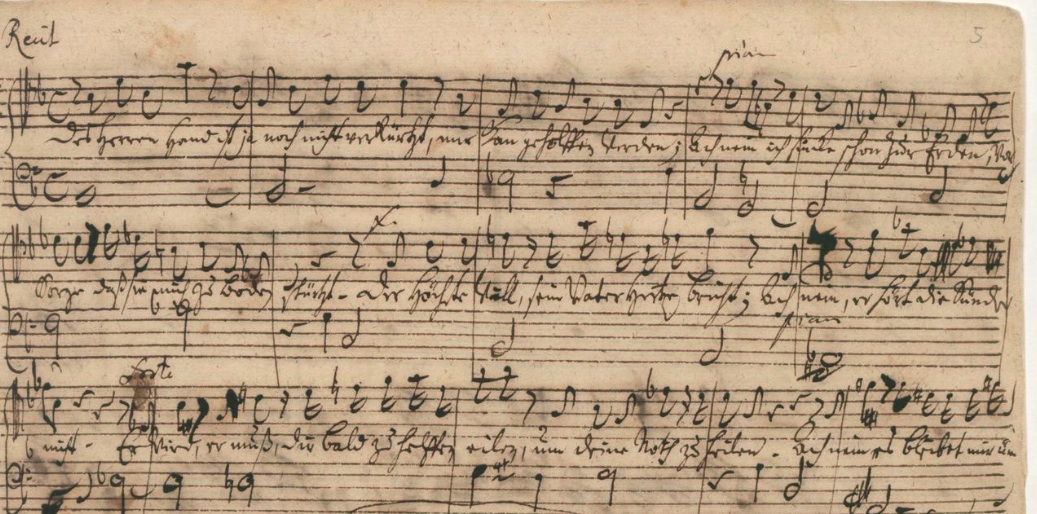
Excerpt from the start of the tenor recitative from cantata 109, with “piano” and “forte” marked. Staatsbibliothek zu Berlin, Preußischer Kulturbesitz

For this 21st Sunday after Trinity, Bach wrote cantata 109 Ich glaube, lieber Herr, hilf meinem Unglauben! in 1723.

For overall best performance, I recommend Herreweghe’s recording from 2013, with counter-tenor Damien Guillon and tenor Thomas Hobbs.

Listen to this recording on YouTube. To support the artists, please consider purchasing the entire album on Amazon — a good deal if you like this blog, as it also includes three cantatas I discussed here earlier this year: cantata 44, cantata 73, and cantata 48.

Read the German texts with English translations here, and find the score here.

I love Herreweghe’s interpretation of  the opening and closing chorus as well as Damien Guillon’s singing in the alto recitative and aria.

However, there is an extremely dramatic and unusual recitative and aria for tenor in this cantata which I like better on the Gardiner recording. The recitative is unusual because Bach has two voices/persons speak: the uncertain/fearful voice, marked “piano” in his manuscript (see picture above), and the certain/faithful voice, marked “forte” in the manuscript. According to Gardiner, this feature never appears anywhere else in Bach’s recitative writing.

Just as with the “Storm on the lake” aria from cantata 81, only Gardiner and the fabulous Paul Agnew are able to properly convey the drama of the text and context of this tenor recitative and aria. If at first you think this might be a bit over the top, it is most probably exactly what Bach had in mind. A bit of opera to properly bring out the agony of the text.

Listen to these two movements by Gardiner and Agnew on YouTube: the recitative here, and the aria here.

Bach might have been preparing the Leipzig congregations for the St. John Passion he was planning for Good Friday 1724, as this tenor aria is very similar in dramatic intensity and music to the Ach mein Sinn aria from that passion. Those who know the St. John Passion well might hear other resemblances in this cantata 109.


Wieneke Gorter, October 16, 2016

A detour to 1725

18 Sunday Sep 2016

Posted by cantatasonmymind in 1723 Trinity season special series, Cantatas, Leipzig, Trinity

≈ Leave a comment

Tags

according to Lutheran Church year, Bach, Bach Collegium Japan, BWV 148, BWV 76, BWV 83, cantatas, Gerd Türk, Gottfried Reiche, John Eliot Gardiner, Mark Padmore, Masaaki Suzuki, Maya Homburger, Natsumi Wakamatsu, Pieter Dirksen, Pisendel, Robin Blaze, Toshio Shimada

sleeping_girl
Sleeping girl in a landscape, after Bernhard Keil, 17th century. Gemäldegalerie Alte Meister, Kassel, Germany.

In the first version of this post, I argued that cantata 148 Bringet dem Herrn Ehre seines Namens for the 17th Sunday after Trinity was written in 1723, dismissing the statements of several scholars it was probably written in 1725. I agreed with them that this cantata is a bit “out of place” between the somber but extremely beautiful and compelling cantatas of Trinity 16 and Trinity 19, and that the text looks very similar to a poem by Picander, the librettist with whom Bach did not collaborate before 1725. However, I was not convinced by their third argument that  Bach’s writing in the  opening chorus would be too “new” for 1723, and at first I didn’t see how Bach could have practically written the cantata in 1725.

I suggested that Bach was too busy in 1725, coming back from a trip to Dresden right before this cantata had to be performed on September 23 of that year. But when I discussed this idea with Eduard van Hengel, he reminded me that Bach would have had plenty of time to compose a cantata well ahead of his trip to Dresden, since–as far as we know–he had not written a new cantata since August 26. So that was argument number 4 for placing this cantata in 1725 instead of 1723.

Argument number 5 presented itself to me while I did my research for cantata 83, reading Pieter Dirksen’s article on Bach’s writing for violin in his first Leipzig cycle of cantatas. Dirksen points out that Bach’s new compositions from 1723 don’t feature virtuoso parts for violin at all. He suggests the reason for this is that Bach’s orchestra in Leipzig (including Bach himself*) was missing a violinist who could play technically challenging music.

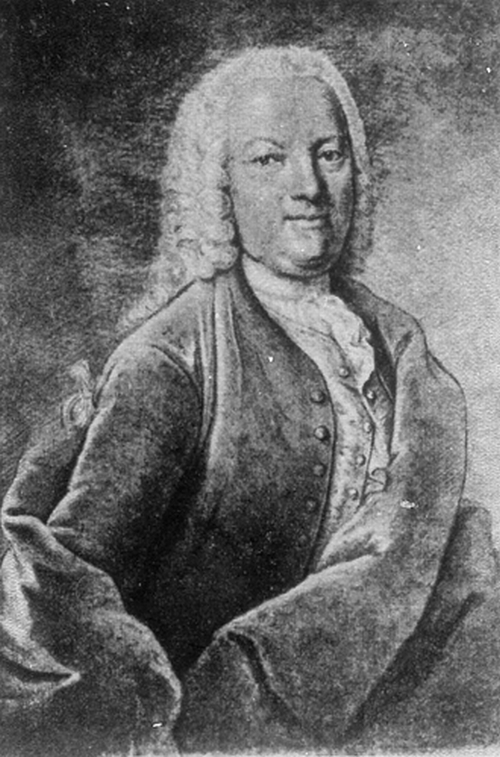
Johann Georg Pisendel

After reading Dirksen’s article on Bach’s connection with the Dresden violinist Johann Georg Pisendel,** and knowing that soon after Trinity 17 it would be Michaelmas, I got excited: the cantata 148 story was coming full circle! I was now no longer seeing Bach juggling ink and parchment on the coach back from Dresden to Leipzig on Saturday September 22, 1725, but instead I was imagining a friend in that coach with him: Johann Georg Pisendel.

If it is true that Pisendel visited Leipzig for the Purification of Mary holiday in 1724, as Dirksen suggests, it is not far-fetched to assume he would do so again for the feast of Michaelmas in 1725 (on September 29, so only six days after Trinity 17 in 1725). St. Michael’s Fair was a huge event in Leipzig, drawing visitors from as far as England and Poland, increasing the city’s population to 30,000, and thus also increasing the “audiences” for Bach’s music in the churches.

For this cantata, I prefer the recording by Bach Collegium Japan, with soloists Robin Blaze (countertenor), Gerd Türk (tenor), Toshio Shimada (trumpet), and Natsumi Wakamatsu (violin). Listen to this recording on Spotify or support the artists and purchase the album on Amazon.com, Amazon.de, or Amazon.fr.

Find the German texts with English translations here, and the score here.

The text of cantata 148 Bringet dem Herrn Ehre seines Namens talks about the importance of coming to church on Sunday, and listening to the music in the church (tenor recitative and aria), but it also talks about taking a day of rest (alto aria).

While the opening chorus is exceptional,  it doesn’t sound very polished or “finished.” Gardiner, while otherwise excited about it, is not satisfied with the ending, and suggests that “perhaps Anna Magdalena called from the kitchen that dinner was on the table and the soup was getting cold.” What can I say? Only a male writer would say this!

The virtuoso violin part shows up in the tenor aria. On this recording of Bach Collegium Japan, played by Natsumi Wakamatsu, it moves me to tears. The tenor aria on the Gardiner recording is good too, with tenor Mark Padmore, and violinist Maya Homburger. You can find that one here. Whoever played this violin part in 1725, this person was not resting on Sunday …

©Wieneke Gorter, originally written September 18, 2016; revised February 4, 2017, links updated and picture of Pisendel added October 2, 2020.

*In his article Dirksen explains in detail how Bach went through the trouble of making the violin solo of cantata 76  relatively easy to play for an intermediate violinist, and suggests Bach was a good violinist, but perhaps not such a virtuoso as many believe him to be. Dirksen’s article appears on pages 135-156 of Bachs 1. Leipziger Kantantenjahrgang: Bericht über das 3. Dortmunder Bach-Symposion 2000 — Dortmund: Klangfarben Musikverlag, 2002.

**Pisendel had been friends with Bach since 1709 and several scholars think that it was for this Italian-trained virtuoso that Bach wrote his most complicated violin music. It is assumed that Bach had Pisendel in mind when writing the violin part of the “Laudamus te” of his Mass in B Minor.

The Herreweghe sopranos

11 Sunday Sep 2016

Posted by cantatasonmymind in 1723 Trinity season special series, Cantatas, Leipzig, Trinity

≈ Leave a comment

Tags

Bach, cantatas, Collegium Vocale Gent, Dominique Verkinderen, Dorothee Mields, Hana Blazikova, John Eliot Gardiner, Mark Padmore, Peter Kooy, Phlippe Herreweghe, Trinity 16

bwv95_sopraan

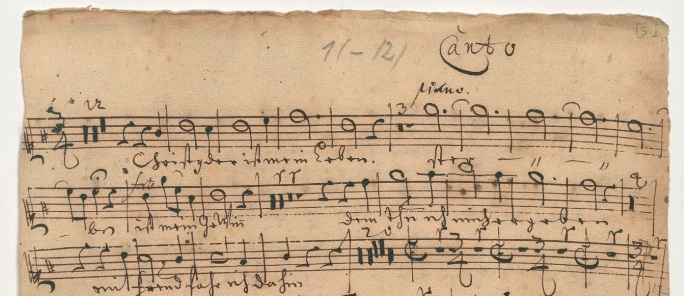
The soprano part of cantata 95 Christus, der ist mein Leben. Staatsbibliothek zu Berlin – Preußischer Kulturbesitz

After all his experimenting with the form of the cantata last week, Bach keeps exploring how he can build a cantata based on chorale melodies and chorale texts. As a result, this week’s cantata 95 Christus, der ist mein Leben again takes a unique place in Bach’s cantata collection: it features no less than four different chorales, all part of the Sterbe-lieder (Deathbed songs) that were very popular in Leipzig at the time: Christus, der ist mein Leben; Mit Fried und Freud, ich fahr dahin; Valet will ich dir geben; and Weil du vom Tod erstanden bist.

I recommend Herreweghe’s recording of this cantata. Listen to this recording on YouTube, or on Spotify. Support the artists and purchase this recording on Amazon. (Or find them in the Amazon stores  for  Germany and France)

Soloists: soprano Dorothee Mields, counter-tenor Matthew White, tenor Hans Jörg Mammel, bass Thomas E. Bauer. Choir sopranos: Dorothee Mields, Hana Blazikova, Dominique Verkinderen.

In the manuscript of the soprano part pictured above, it is interesting to note the dynamic markings for the text “Sterben ist mein Gewinn.” Dynamics are not very common in Bach manuscripts, but, as Alfred Dürr points out, Leipzig had a strong tradition of singing softly and slowly on the word “Sterben,” and singing loudly on “ist mein Gewinn,” going back at least to 1629. In that year, then Thomaskantor Johann Hermann Schein wrote this note for his singers:

“da singen sie adagio mit einem sehr langsamen Tactu, weiln in solchen versiculis verba emphatica enthalten” (here you should sing adagio in a very slow tempo, because verses like these contain emphatic words)

How Herreweghe’s sopranos sing this Sterben ist mein Gewinn in the first chorale takes my breath away, and this is the most important reason why I prefer this recording. Having grown accustomed to the boy choirs of the Leonhardt and Harnoncourt recordings in the 1970s, my parents, sister, and I were blown away by Herreweghe’s Collegium Vocale Gent when their first CDs started coming out in the late 1980s and early 1990s.

My mother was especially taken by the sound and blend of the sopranos, and “Herreweghe sopranos” became a household term in our family. After attending a performance by a different group, we would often say to each other: “it was nice, but they are not Herreweghe sopranos….,” and sigh a little.

This cantata is all about longing for life after death, and over the course of the cantata these statements are made: I will be happy to die (opening movement), because life on earth is worthless (soprano recitative). Saying goodbye to that will be freeing (soprano chorale), so please can I die as soon as possible (tenor recitative and aria), because death is only a sleep (bass recitative) from which I will wake up to join Jesus, who has gone before me (closing chorale).

The outstanding tenor aria features Bach’s signature “death bells” in the pizzicato strings. Bach uses these “Leichenglocken”  also in cantatas 73, 8, 105, 127, 161, and 198. For an alternative recording of this movement, with gorgeous singing by Mark Padmore, listen to the Gardiner recording on Spotify.

The concept of death being only a short period of sleep after which the dying person wakes up to meet Jesus in the afterlife was an extremely important part of 18th-century Lutheran faith. When dealing with death on a daily basis, it was comforting to believe that death would ultimately lead to paradise. And by stressing this concept, Bach also refers to the Gospel for this 16th Sunday after Trinity. It is the story of the miracle at Nain: a young man who has died  is carried out of the city and then woken up by Jesus.

Wieneke Gorter, September 11, 2016, updated October 7, 2025

A most amazing trumpet part

21 Sunday Aug 2016

Posted by cantatasonmymind in 1723 Trinity season special series, Bach's life, Cantatas, Leipzig, Trinity

≈ Leave a comment

Tags

Anhalt-Zerbst, Anna Magdalena Bach, Bach, Bach Collegium Japan, BWV 635, BWV 678, BWV 679, BWV 75, BWV 76, BWV 77, Gottfried Reiche, John Eliot Gardiner, Köthen, Kirsten Sollek, Luther, Lutheran Church year, Masaaki Suzuki, organ preludes, Peter Kooy, Saxe-Weissenfels, slide trumpet, Toshio Shimada, tromba da tirarsi, trumpet, Wilcke

master_of_the_good_samaritan_001
The Good Samaritan by “the Master of the Good Samaritan,” Dutch, 1537

To fully appreciate today’s cantata, I encourage you to first listen to Luther’s hymn,  Dies sind die heil’gen Zehn Gebot (These are the holy Ten Commandments). I was not familiar with this tune, and had to do some research to understand what the slide trumpet was playing in the opening chorus. It was a very well-known hymn in Bach’s time. The Leipzig congregations sang it many times a year, and also sang it during the church services on Sunday August 22, 1723, the 13th Sunday after Trinity (probably preceded by an organ prelude in the style of BWV 635, see below). It was an important hymn for Bach. You can listen to his own chorale setting of it here.

It is also worthwhile to listen how Bach used this melody in three very different organ works: BWV 635, BWV 678, and BWV 679. He wrote BWV 635 as part of the Orgelbüchlein, in Weimar, the other two in the mid 1730s as part of the Clavier-Übung III.

The cantata for this Sunday, cantata 77 Du sollt Gott, deinen Herren, lieben features this chorale-tune in the opening chorus, but only in the tromba da tirarsi (slide trumpet) part and the continuo part. In the continuo it appears in long notes, and is not as clearly audible as in the trumpet part. There are exactly ten entrances for the trumpet within that opening chorus, the last time featuring the entire chorale tune, of course pointing to the ten commandments.

Bach Collegium Japan’s recording showcases this feature the best of all recordings I listened to, superbly played by Toshio Shimada, on a real tromba da tirarsi. I also like his playing the best in the alto aria. Listen to this recording on Spotify or on YouTube.

Read the text here, and find the score here.

John Eliot Gardiner suggests that Bach made a theological statement by presenting his first two Trinity cantatas in Leipzig,  75 for Trinity 1 (focusing on the love of God/how to be before God) and 76 for Trinity 2 (focusing on brotherly love/how to love one’s neighbor) in close relation to each other, and that all through this 1723 Trinity season he has tried to reinforce the idea that those themes are connected, and how the believers should apply the laws from the Bible to themselves and to their own daily lives. He further argues that with this opening chorus he comes full circle back to that connection, by using a double fugue, by reminding the listeners of the “law” by way of the chorale in  the trumpet part, and by setting the text of the Gospel immediately preceding the parable of the Good Samaritan (Luke 10):

27. Er antwortete und sprach: Du sollst GOtt, deinen HErrn, lieben von ganzem Herzen, von ganzer Seele, von allen Kräften und von ganzem Gemüt und deinen Nächsten als dich selbst.

[27] And he answering said, Thou shalt love the Lord thy God with all thy heart, and with all thy soul, and with all thy strength, and with all thy mind; and thy neighbour as thyself.

After the bass recitative and soprano aria further elaborating on the “Love for God”-theme, and the tenor aria on the “Good Samaritan / Love your neighbor”-theme, we are treated to the most amazing tromba da tirarsi playing of all Bach cantatas written for this instrument, in this very unusual and humble alto aria, beautifully sung by mezzo-soprano Kirsten Sollek, and expertly played on the slide trumpet by Toshio Shimada.

This is an incredibly difficult part for the tromba da tirarsi, and almost impossible to play well on a “regular” Baroque trumpet. Was this Bach’s way of illustrating the “Unvolkommenheit” in the text? Would even Reiche not have been able to play this perfectly, with only a few days rehearsal time? And/or did Bach want people in the church to pay attention, so that this would be a true moment of reflection in the service?

In the region where Bach lived and worked, the trumpeters were very good, and Bach knew them and their world well, especially since he had married into a trumpet family in 1721. All the men in Anna Magdalena Wilcke’s family that we know of (father, brother, and husbands of all three sisters) were well-regarded trumpeters at the Anhalt-Zerbst court, about 17 miles (28 km) directly north of Köthen, and the Saxe-Weissenfels court, about 22 miles (35 km) south-west of Leipzig. The trumpeters in Leipzig were all Stadtpfeifer, employed by the city, and thus not always available to him.

Wieneke Gorter, August 20, 2016, updated August 28, 2023.

← Older posts
Newer posts →

Recent Posts

  • “Missa Miniatura” by CONTINUUM/Elina Albach Even More Moving in 2025
  • Bachfest Leipzig 2025
  • Bach Cantatas for Christmas – 1724 and 1734 editions
  • Fourth Sunday of Advent – more insight into Cantata 62 helped me better understand Bach’s Christmas Oratorio
  • Saint Ambrose and Luther in Milan – Second Sunday of Advent

Archives

  • August 2025
  • July 2025
  • December 2024
  • November 2024
  • June 2024
  • January 2024
  • December 2023
  • October 2023
  • September 2023
  • August 2023
  • April 2022
  • February 2022
  • January 2022
  • December 2021
  • November 2021
  • June 2021
  • May 2021
  • April 2021
  • February 2021
  • January 2021
  • December 2020
  • November 2020
  • October 2020
  • September 2020
  • August 2020
  • July 2020
  • May 2020
  • April 2020
  • March 2020
  • February 2020
  • January 2020
  • December 2019
  • November 2019
  • May 2018
  • April 2018
  • March 2018
  • February 2018
  • January 2018
  • December 2017
  • November 2017
  • October 2017
  • September 2017
  • August 2017
  • July 2017
  • June 2017
  • May 2017
  • April 2017
  • March 2017
  • February 2017
  • January 2017
  • December 2016
  • November 2016
  • October 2016
  • September 2016
  • August 2016
  • July 2016
  • June 2016
  • May 2016
  • April 2016
  • March 2016
  • February 2016
  • January 2016

Enter your email address to follow this blog and receive notifications of new posts by email.

Join 338 other subscribers

Categories

  • 1723 Trinity season special series
  • Advent
  • After Easter
  • Ascension
  • Bach's life
  • Cantatas
  • Chorale cantatas 1724/1725
  • Christmas
  • Easter
  • Epiphany
  • Following Bach in 1725
  • Köthen
  • Leipzig
  • Septuagesima
  • Travel
  • Trinity
  • Weimar

Meta

  • Create account
  • Log in
  • Entries feed
  • Comments feed
  • WordPress.com

Website Built with WordPress.com.

  • Subscribe Subscribed
    • Weekly Cantata
    • Join 158 other subscribers
    • Already have a WordPress.com account? Log in now.
    • Weekly Cantata
    • Subscribe Subscribed
    • Sign up
    • Log in
    • Report this content
    • View site in Reader
    • Manage subscriptions
    • Collapse this bar
 

Loading Comments...