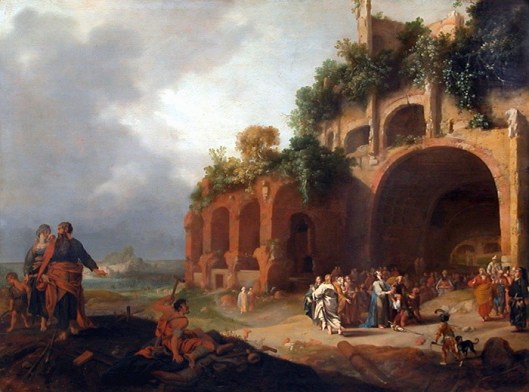
Jesus healing a deaf and mute man at Decapolis, by Bartholomeus Breenbergh, 1635
Last week, Bach gave his principal trumpet and horn player Gottfried Reiche a little break, but this week he needs him back: after the “old style” church motet opening chorus for Trinity 11, this week’s cantata for Trinity 12 opens with festive trumpets and timpani.
Listen to this cantata 69a Lobe den Herrn, meine Seele in the recording by Bach Collegium Japan on Spotify, with Toshio Shimada on trumpet.
Even though the text of the Gospel for this Sunday, the story of Jesus healing a deaf and mute man, is a jubilant one, it is still unusual that for a “regular” Sunday Bach would use three trumpets and timpani in the orchestra. Had the council complained about him teaching too much of his stern theology, being too somber, in the past cantatas? Was perhaps Anna Magdalena’s father (the principal trumpeter at the court of Saxe-Weissenfels, and most probably a friend of Reiche, who was from that same region) in Leipzig to see his daughter and grandkids, and wanted to play in the orchestra with his friend? Again, all good material for a movie script …
In his journal of their cantata pilgrimage in 2000, John Eliot Gardiner writes that the trumpet part in the opening chorus makes him think of the last seven bars of the Cum Sancto Spiritu from the Mass in B minor. I agree, but the start of this opening chorus also really makes me think back to cantata 147 for the feast of the Visitation of Mary on July 2.
Just like last week’s cantata, and many other cantatas from this period, today’s composition ended up in Bach’s top 15, in the sense that he re-used it many times afterwards, and reworked it into important other works. In this case he changed the tenor aria with oboe da caccia and recorder into an alto aria for oboe and violin for a performance in 1727, and reworked the entire cantata into a celebratory cantata for the re-election of the council in 1749 (BWV 69).
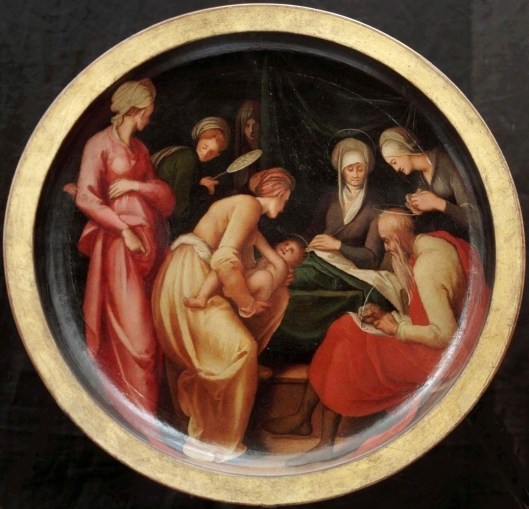
Birth of St. John the Baptist, Zechariah writing “His name is John,” by Jacopo Pontormo, c. 1526. Uffizi, Florence, Italy.
In Bach’s time, June 24 was an important feast day, celebrating the birth of John the Baptist. In the Lutheran faith, it is believed that John the Baptist paved the way for Jesus to come into the world, and his birthday was thus dated exactly six months before Jesus’ birthday. Many paintings from the 16th century onward show Mary with a baby Jesus in her lap, while John the Baptist, or St. John, usually depicted as an already standing infant, is looking on or playing with Jesus.
It means that on this day, June 24, 1723, the Leipzig congregation got to hear a new cantata already on Thursday: cantata 167, Ihr Menschen, rühmet Gottes Liebe.
My favorite recording of this cantata is the one by Montreal Baroque, with terrific singing especially by tenor Charles Daniels and soprano Suzie Leblanc.
A little more than a week later, on July 2, the church would celebrate the feast of the Visitation (Mary visiting her relative Elizabeth), strongly related to St. John. (Another wonderful cantata for that coming up next week!)
So let’s imagine two consecutive weeks of festival buzz in Leipzig, since both these holidays were important. Thanks to Gardiner’s research, we know that during trade fairs, the Leipzig population would grow to 30,000, and that Bach would often have extra students and colleagues visiting. The feasts of St. John and the Visitation did not fall during a trade fair, but we can assume that there were nonetheless a few hundred, or maybe even a few thousand visitors in Leipzig for these holidays.
And it really looks and sounds to me as if Bach is showing off to his fellow musicians in the writing of this St. John cantata from 1723. While it is a small-scale and intimately scored work, it showcases impressive composition talent and skills: a lovely tenor aria with wonderful melismas on the word “preiset” (praise), brilliant meter changes in the already striking soprano-alto duet, a bass recitative which gives the listeners a “sneak peek” at the melody of the closing chorale, and a terrific setting of the closing chorale.
The Gospel reading for this day is the declamation by Zechariah from Luke 1: 57-80. Zechariah, the father of St. John the Baptist, has been made mute by Gabriel because he didn’t believe Gabriel’s announcement that he and his wife Elisabeth would have a son. At the time of his son’s birth, Zechariah carves a sign to tell the community “His name is John,” and as soon as he has done this, he regains his voice, and praises God. The unknown librettist of this cantata reworks this song of praise (also known as the Benedictus) into the text for the tenor aria as well as the alto recitative in this aria, sometimes quoting directly from the Gospel.
This past Sunday, in cantata 24, Bach decided to let a recitative blossom out into an arioso at the end, probably to emphasize the text. It was not a new thing, as he had actually often written recitatives this way in Weimar and Köthen. But it created a wonderful effect in cantat 24, and he must have liked it himself, because he uses the same “trick” in this cantata, at the end of the alto recitative as well as at the end of the bass recitative.
The exquisite soprano-alto duet, which at times sounds more like a motet than an aria, moves into a 4/4 canon on the text “was er in dem Paradies,” and then–still within that middle-part–moves smoothly back into 3/4, so when music and text goes back to the beginning, as if it were a standard “da capo” aria, the meter has already been back to 3/4 for a while.
In the bass recitative the Weimar/Köthen characteristic feature of letting a recitative blossom out into an arioso Bach already played with in cantata 24 gets even better: The call to action to see Zachary as an example and now also praise God is illustrated by musically quoting the closing chorale on the words “und stimmet ihn ein Loblied an” (and sing praise unto him). It is a witty joke, which, just like the clever move with the meter in the duet, only fellow musicians would have fully appreciated. But that is just my own humble opinion …
The impressive features of this cantata are more obvious in the closing chorale. As Gardiner points out, and as those who remember cantata 75 might have already heard: Bach wrote the closing chorale of this cantata 167 in the same way he wrote the closing chorales for cantatas 22 (the cantata which he performed as part of his audition in Leipzig in February 1723) and 75 (his debut piece on Trinity 1). While the chorus sings a “standard” chorale setting, the orchestra parts, moving to a walking bass, are completely separate, and form another piece of music around the chorale, just like a beautifully ornamented Baroque frame around an already great painting. In this case the frame is a golden one, because of the extra luster the trumpet part brings to the music.
Pieter Brueghel the Elder: The Parable of the Blind Leading the Blind, 1568
Previously on Weekly Cantata: For his first three Sundays in Leipzig, Bach presented ambitious, two-part cantatas, the first part before the sermon, the second part after. On this Trinity 4, June 20 1723, the congregation and the musicians in Leipzig may still have had the trumpets and timpani from the impressive closing chorus of last week’s Ich hatte viel Bekümmernisgoing through their heads.
Up until now, it seems to all have been part of a plan: Bach probably wrote his cantatas for Trinity 1 (cantata 75) and Trinity 2 (cantata 76) while still living in Köthen, and most likely had also been planning all along to perform cantata 21 on Trinity 3. *
But now what to do for Trinity 4? In his stack of Weimar cantata manuscripts there was a nice one, very closely referring to the Gospel for the day (Luke 6: 36-42), but it was too short, and not very impressively scored.
So, it was time to write a new cantata that could function as Part I, the part before the sermon, and then present the one from Weimar after the sermon, as part II. This newly composed piece became cantata 24 Ein ungefärbt Gemüte. Only four weeks into his new post at Leipzig, and possibly up to his ears in getting things organized at the St. Thomas School, Bach had not had the time (or the social intelligence, we don’t know) to find a librettist, so for this cantata he used a pre-existing text by Erdmann Neumeister, a Leipzig-trained theologian, who was preaching at the St. Jacob church in Hamburg from 1715 to 1756. Bach may very well have met him there, since this was the same church where he applied for the post of cantor and organist in 1720. Neumeister’s many volumes of cantata texts were published in the early 1700s, and through the excellent library at the castle in Weimar Bach might have had access to these too, as he already used a Neumeister text for his Weimar Advent cantata 61 from 1714.
The recording of cantata 24 Ein ungefärbt Gemüte I like the best is Bach Collegium Japan’s recording, with beautiful singing by countertenor Robin Blaze and tenor Gerd Türk in the arias. Listen to this cantata on Spotify, or purchase the album on Amazon. Read the German texts with English translations here.
Though on a much smaller scale than cantata 75 from three weeks ago, this cantata 24 again displays a wonderful symmetry: Bach emphasizes that the main message “Everything that you want other people to do to you, you should do yourself for them” is at the center of the cantata text. He sets that part of the text to an intricate choral piece with the fullest instrumentation of the entire cantata, including trumpet, and scores the arias and recitatives around this main message much more soberly. In the two recitatives, Bach accentuates the words at the end of each by letting the music blossom out into an arioso in those spots. This happens on this text in the tenor recitative:
Mach aus dir selbst ein solches Bild (Make yourself such an image)
Wie du den Nächsten haben willt! (As you want your neighbour to have)
and in the bass recitative on these words:
So geht es dort, so geht es hier. (These things go on here, there and everywhere.)
Der liebe Gott behüte mich dafür! (That the dear God preserve me from this!)
Then comes Part Two, cantata 185 Barmherziges Herze der ewigen Liebe, written in Weimar in 1715. For this 1723 Leipzig re-creation of it, Bach transposed it from F sharp minor to G minor, since the tuning in Weimar was different than in Leipzig, and had a trumpet play the chorale tune in the opening duet, instead of an oboe.
Of all the recordings I listened to, only Gardiner brings to life the opening duet of this Leipzig version of cantata 185, with a trumpet playing instead of an oboe. Listen to a recording of that first movement by Gardiner, with soprano Magdalena Kozena and tenor Paul Agnew, on YouTube. However, for the wonderful alto rectitative and aria that come next, as well as the bass recitative and aria, I feel the need to switch to Koopman’s recording, with countertenor Kai Wessel and bass Klaus Mertens. Listen to this recording on YouTube, starting with the alto recitative (when you click on this link, it starts at 4m1s into the cantata).
I am too much of a countertenor lover to pass up this heavenly singing by Kai Wessel for Nathalie Stutzmann on the Gardiner recording, but I realize others might prefer it the other way around. I’m also not completely convinced by Gardiner’s argument that Bach is imitating an irritating Weimar preacher in the bass recitative and aria, so while Gardiner’s bass soloist Nicolas Testé very skillfully portrays this interpretation, it is a bit overdone to my taste.
So why not listen to the entire Koopman recording of this cantata? Well, there’s the strange opening duet: Koopman makes the surprising choice to have the choir sopranos sing the chorale melody with text instead of having an oboe (per the Weimar version) or a trumpet (per the Leipzig version) play that part. This decision is not explained in their liner notes. And while I like soprano Barbara Schlick’s and tenor Guy de Mey’s individual voices, I feel that Schlick’s voice outbalances De Mey’s on this recording.
One wonders: was the new job as teacher at the St. Thomas School and director of the choir a bit overwhelming for Bach, or was he by this time already getting frustrated with the lack of skill and talent among the choir boys? A few years later, he would complain to the council that there weren’t enough strong voices, and that he needed the good instrumentalists among them to fill the many vacant seats in the orchestra, and could thus not use them in the choir. It is interesting to see how, after the many challenging choral pieces in cantata 21 last week, there is only one polyphonic chorus part in the combined cantatas for today, and only an embellished chorale in the cantata for the feast of St. John the Baptist Bach was preparing for June 24.
Wieneke Gorter, June 18, 2016
*Please note: the numbers we use now for these cantatas are a product of the 19th and 20th century. Bach never gave his compositions numbers, and he must have referred to the cantatas by title only.
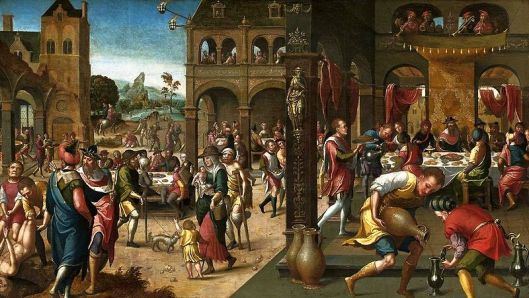
The Parable of the Great Supper / the Great Banquet, by anonymous Dutch painter “the Braunschweig (Brunswick) Monogrammist,” ca. 1525
Trinity season in the Lutheran Church year means no feast days until Christmas, no stories about Jesus’ life in the Gospel texts, and no Vox Christi bass recitatives. To still keep this blog exciting for myself and you loyal readers, I decided to make it into a true weekly series, and will be following all of Bach’s 1723 Leipzig cantatas until Advent, without taking any detours to his Weimar cantatas or later Leipzig cantatas.
A few things that make it irresistible for me to try this: Bach started working in Leipzig on the first Sunday after Trinity in 1723 (see last week’s blog post); the dates of the Lutheran Church year in 2016 are practically the same as in 1723 – off by only one day; and I believe that by following this 1723 sequence, we can better imagine how it must have been for the Leipzig audiences (congregation) to hear one cantata after the other, and perhaps get a little insight in how it must have been for Bach himself to write one after the other.
The second Sunday after Trinity in 1723 marked Bach’s debut in the Thomaskirche (St. Thomas Church). On Sunday June 6, he performed cantata 76 Die Himmel erzählen die Ehre Gottes there, and this one is even more impressive than 75, and includes a festive opening chorus which makes me think of Bach’s later Ascension Oratorio.
There are many similarities between cantata 75 and 76, the most obvious one being that they share the ambitious length of 14 movements in total, divided over two parts. From a superficial point of view, both cantatas start with a psalm text in the opening chorus, have challenging soprano arias, feature bass arias with trumpet, and -never seen again in later cantatas- an instrumental sinfonia at the start of the second part (after the sermon). However there are more (hidden) similarities and cross-references between the two, so that one could almost think about these two first cantatas of the 1723/1724 cycle as a diptych.
I appreciate Gardiner’s interpretation of cantata 76 the most of all recordings I listened to. And the universe will have it that this one was recorded in the Basilique de Saint-Denis (directly north of Paris), which was my subway stop for four fabulous music-filled months in 1994. In his journal from 2000, Gardiner writes that they were very concerned about the enormous size of this Gothic cathedral, and feared that a large audience (needed to balance out the acoustics) wouldn’t show up because it was the night of the France-Italy final in the Euro soccer competition. But everything turned out fine: there were more than 1200 people in the audience, and France won.
Listen to Gardiner’s recording of cantata 76 Die Himmel erzählen die Ehre Gottes on Spotify or on YouTube, or buy this recording on Amazon.
Cantata 76 starts with a text about heaven: the first and third verse of Psalm 19, Die Himmel erzählen die Ehre Gottes. To illustrate this, the heavenly trumpet (in cantata 75 not introduced until the start of the second half) is heard right away. The fugue on the text “Es ist keine Sprache noch Rede, da man nicht ihre Stimme höre” is fantastic, Bach at his best in my opinion.
After this, the text of the cantata refers to the Gospel reading of the day: the parable of the Great Supper from Luke 14: 16-24 about a man who has invited many guests to a Dinner/Supper/Banquet, receives one cancellation after the other, after which he decides to invite all the beggars and cripples his servant can find, and serves them the dinner instead, not leaving one place open for any of the previously invited guests. All this combined with the “Brotherly love” theme from the Epistle reading of the day: 1 John 3: 13-18.
Another example, though through a completely opposite story as the one from cantata 75, of why it is good to share food and love with others.
Besides the incredible opening chorus, the highlights of this cantata for me are: the soprano aria with violin/cello accompaniment (no. 3), the bass aria with trumpet (no. 5), the incredible sinfonia for oboe d’amore and viola da gamba at the start of the second half (no. 8), the dramatic, operatic tenor aria (no. 10, fabulously performed by James Gilchrist, including the “shake” Bach wrote on the word “Hasse”), and the alto recitative with viola da gamba (no. 11).
For those who have extra time: listen to the violin/cello duet in the soprano aria accompaniment in an unrivaled (as far as I am concerned) interpretation by Alice and Nikolaus Harnoncourt on their recording from 1976 (scroll to 06:11)
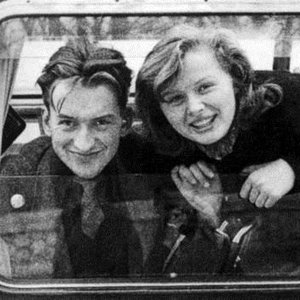
Nikolaus & Alice Harnoncourt, 1951, before they were married, on tour with the Vienna Chamber Orchestra
Read the German text with English translations of this cantata here, and find the score here.
If you don’t want to miss an episode of this 1723 Trinity season series, please consider signing up to receive an email every time I’ve posted a new story.
Please feel free to share this on Facebook, or forward to anyone you think might enjoy coming along for this ride. Thank you!
Wieneke Gorter, June 4, 2016, links updated June 12, 2021.
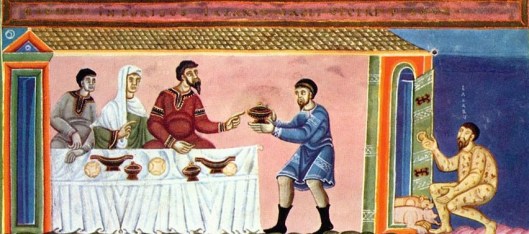
Lazarus and the Rich Man / Lazarus and Dives, Codex Aureus of Echternach, 11th century
On this First Sunday after Trinity (for short:Trinity 1), Sunday May 30, 1723, Bach started his first cycle of weekly cantatas in Leipzig. It was two days before his official installation, and one week after he and his family had arrived in the city.
Trinity is also the start of the part of the church year that deals exclusively with issues of faith and doctrine, instead of celebrating events from Jesus’ life, as was done in the period between Advent and Pentecost. This change must have been important to Bach too, because all three surviving cantatas for Trinity 1 are large-scale, musically ambitious works.
The composition with which Bach made his debut in the St. Nicholas Church (he would not perform in the St. Thomas Church until one week later) was cantata 75 Die Elenden sollen essen, a piece of considerable length, containing no less than 14 movements, seven before the sermon, seven after.
Listen to Herreweghe’s recording of cantata 75 Die Elenden sollen essen (with soloists Carolyn Sampson, Daniel Taylor, Mark Padmore, and Peter Kooy) on YouTube
Purchase Herreweghe’s recording of cantata 75 Die Elenden sollen essen and two other cantatas on Amazon
Find the complete German text with English translation of this cantata here.
The text of the opening chorus is from Psalm 22, but it is strongly related to the Gospel of the day: the story of Lazarus (a poor leper, who lies in front of the door of a rich man’s house, asking the rich man for food every day) and Dives (the rich man, who ends up in hell when he dies because he didn’t share his blessings/wealth with those in need).
When I listen to the opening chorus, I keep wondering if Bach wrote a Kyrie in Köthen which he never finished or which got lost for another reason. This is not backed up by any of the commentary about this cantata, but in these first measures I can’t stop myself from hearing “Ky-ri-e-e-le–” in my head when the choir sings “Die-ie E-e-le–.” The music accents the second syllable of the word Elenden, while in the spoken language the stress would be on the first syllable. I find it strange that Bach would have ignored word stress in such an important composition, which he spent extra time on, and probably already wrote before he arrived in Leipzig (Gardiner notes that the paper of the manuscript was not from Leipzig, and that the handwriting was extremely neat). So I’m hoping something will turn up in my lifetime to substantiate this hunch I have ….
Wherever the opening chorus originated from, it is beautifully written, as are all the arias. The soprano aria has a tender, plaintive oboe d’amore accompaniment, the alto aria floats on a rich blanket of strings, and the bass aria is a show-off piece with virtuosic music for the singer as well as the trumpeter.
There is a symmetry to the order in which the recitatives and arias appear in the cantata which is rarely seen in other Bach cantatas.
But of course it is typical for Bach to use mathematical design when wanting to make a lasting impression with a composition (such as with the St. Matthew Passion and the Mass in B minor). Also the fact that there are 14 movements to this cantata is not a coincidence: it is the sum of the numbers B, A, C, and H in the alphabet.
There is more symmetry in the cantata: The text of the first half refers to the Gospel story from Luke about Lazarus and Dives, and talks about earthly life and material possessions. In contrast to this, the second half of the cantata moves up to a spiritual level, and up to heaven. This change is illustrated by the introduction of the instrument that was associated with heaven: the trumpet. In the opening movement of the second half of this cantata the trumpet plays the chorale tune with which the first half had ended, Was Gott tut, das ist wohlgetan, and then later accompanies the bass in a stand-out virtuosic aria.
There is also more “showing off” in this cantata. As Gardiner points out, Bach seems to have wanted to make it clear that he was a skilled court composer (which he had been at Köthen before he took the position in Leipzig): after the French Ouverture of the opening chorus, all the arias together from a French Suite: The tenor aria is a Polonaise, the soprano aria a Minuet, the alto aria a Passepied, and the Bass aria a Gigue.
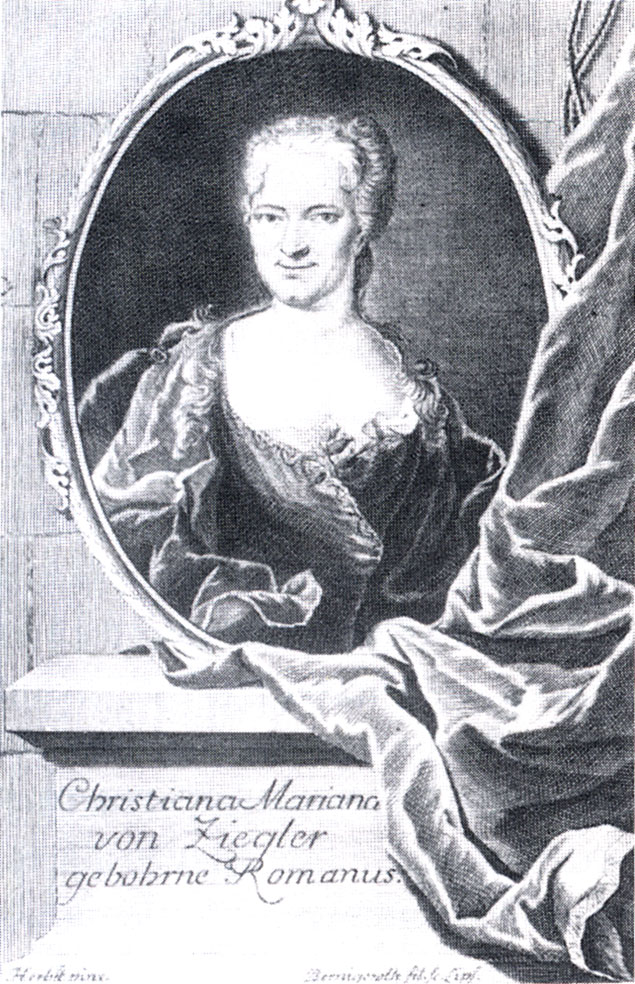
In 1725, between Easter and Pentecost, Bach set nine cantatas in a row to texts by Christiane Mariana von Ziegler (1695–1760). And it is in part thanks to her poetry that I’m favoring the cantata from 1725 over the one from 1724 for this “Rogate” Sunday – the fifth Sunday after Easter.
This cantata 87 from 1725, Bisher habt ihr nichts gebeten in meinem Namen, contains two jewels of arias: the alto aria (no 2) and the tenor aria (no 6). Von Ziegler’s poetry combined with Bach’s sublime scoring in those arias completely knocked me over when I first listened to this cantata this week. I found Gardiner’s recording of this cantata (which I happened upon by accident – read more about this at the very end of this post) the most moving.
(This album is absolutely worth purchasing – cantata 86 is beautiful too, and the violin accompaniment in the alto aria of that cantata 86 on this recording is the best)
About Christiane Mariana von Ziegler: A female librettist, who didn’t have to hide behind a male alias to get recognition or to get her works published? In 18th century Leipzig? When I first heard about this I could not believe it. But it turns out that by unusual circumstances, Christiane Mariane von Ziegler was as “free” as probably no other woman at that time was, at least between 1722 and 1741.
In that time period, there was no husband or other male relative by whose rules she had to live: her father had been in jail since she was 11, she had been twice widowed, and had lost both her children (one from each marriage). Despite all this, she was still in possession of her family’s house and fortune, and was well respected in Leipzig society. She wrote poetry, sang, and played many musical instruments. In 1722 (at age 27) she was appointed the official guardian of her family’s household, a position normally never awarded to a woman. For the next two decades her house served as the salon where many artists and intellectuals could meet. She would promote artists, poets and writers, and introduce them to representatives of the university who also attended her events.
In 1730, Von Ziegler became the first and only female member of Gottsched’s German Literary Society. She was named “poet laureate,” crowned by the emperor in 1733. In 1732 and 1734 she received the poetry prize from the German Literary Society. Her last published work appeared in 1739. In 1741, she married Professor Balthasar von Steinwehr and lived with him in Frankfurt an der Oder until her death in 1760. As far as we know, she did not write anything in this last period of her life.
In 1728, she published Versuch in gebundener Schreib=Art, which contains the texts for the nine 1725 Bach Cantatas (103, 108, 87, 128, 183, 74, 68, 175, 176). In 1729 she published In Gebundener Schreib-Art: Anderer und letzter Theil, which contains the rest of a complete yearly cantata cycle which Bach never set to music.
Since there is no correspondence between Von Ziegler and Bach left to us, we don’t know why they started working together, we don’t know why the working relationship ended, nor why Bach never used the other texts she had provided for the rest of the cantata cycle. There are some theories that she must have been vexed about Bach altering her texts on several occasions in 1725. However, the only proof we have for what her “original” texts would have been are her publications from several years later. She might have changed them herself between Bach first using them and her later publishing them. We do know that Bach first worked with Picander, the poet with whom he would later collaborate extensively (including for the St. Matthew Passion) in February 1725.
Back to this cantata. It was Bach’s life goal to not only praise God, but also educate “his neighbor” (the congregation, his fellow believers) with his church music, and it seems that Von Ziegler definitely shared this vision. To not make this post too long, I’ll only highlight the alto aria, since it is the piece that impressed me most, but the rest of the cantata is well worth listening to, especially the tenor aria.
The Gospel reading for this Sunday was the last part of Jesus’ speech to his disciples, from John. Note verse 24 (quoted in the bass arioso opening) and the overall stress on speaking in proverbs versus speaking plainly.
23. Und an demselbigen Tage werdet ihr mich nichts fragen. Wahrlich, wahrlich, ich sage euch: So ihr den Vater etwas bitten werdet in meinen Namen,so wird er’s euch geben.
[23] And in that day ye shall ask me nothing. Verily, verily, I say unto you, Whatsoever ye shall ask the Father in my name, he will give it you.
24. Bisher habt ihr nichts gebeten in meinem Namen. Bittet, so werdet ihr nehmen, daß eure Freude vollkommen sei.
[24] Hitherto have ye asked nothing in my name: ask, and ye shall receive, that your joy may be full.
25. Solches hab’ ich zu euch durch Sprichwörter geredet. Es kommt aber die Zeit, daß ich nicht mehr durch Sprichwörter mit euch reden werde, sonderneuch frei heraus verkündigen von meinem Vater.
[25] These things have I spoken unto you in proverbs: but the time cometh, when I shall no more speak unto you in proverbs, but I shall shew you plainly of the Father.
26. An demselbigen Tage werdet ihr bitten in meinem Namen. Und ich sage euch nicht, daß ich den Vater für euch bitten will;
[26] At that day ye shall ask in my name: and I say not unto you, that I will pray the Father for you:
27. denn er selbst, der Vater, hat euch lieb, darum daß ihr mich liebet und glaubet, daß ich von GOtt ausgegangen bin.
[27] For the Father himself loveth you, because ye have loved me, and have believed that I came out from God.
28. Ich bin vom Vater ausgegangen und kommen in die Welt; wiederum verlasse ich die Welt und gehe zum Vater.
[28] I came forth from the Father, and am come into the world: again, I leave the world, and go to the Father.
29. Sprechen zu ihm seine Jünger: Siehe, nun redest du frei heraus und sagest kein Sprichwort.
[29] His disciples said unto him, Lo, now speakest thou plainly, and speakest no proverb.
30. Nun wissen wir, daß du alle Dinge weißt und bedarfst nicht, daß dich jemand frage. Darum glauben wir, daß du von GOtt ausgegangen bist.
[30] Now are we sure that thou knowest all things, and needest not that any man should ask thee: by this we believe that thou camest forth from God.
After the Vox Christi bass arioso opening (beautifully scored as an opening “chorus” for strings, oboes, and bass voice), Von Ziegler doesn’t hold back in communicating what the believers should take away from this lesson, and writes this text for the alto recitative:
O Wort, das Geist und Seel erschreckt! O word, that terrifies spirit and soul! Ihr Menschen, merkt den Zuruf, was dahinter steckt! You people, notice the call hidden behind these words! Ihr habt Gesetz und Evangelium vorsätzlich übertreten; You have deliberately transgressed the law and gospel; Und dies möcht’ ihr ungesäumt in Buß und Andacht beten. And because of this you should pray without delay in repentance and devotion.
And then gives them the prayer they should be saying in the alto aria, and this is the part that bowled me over, because of the combination of the music, the text, and the humble interpretation of it on the Gardiner recording:
Vergib, o Vater, unsre Schuld Forgive, O Father, our guilt Und habe noch mit uns Geduld, and still have patience with us, Wenn wird in Andacht beten when we devoutly pray Und sagen: Herr, auf dein Geheiß, and say: Lord, at your command, Ach, rede nicht mehr sprichwortsweis, Ah, speak no more proverbs, Hilf uns vielmehr vertreten. Instead help us represent ourselves.
Here’s the story of how I happened upon the Gardiner recording of this cantata, and this aria in particular: I was only familiar with cantata 86, not with 87. When comparing several recordings of the alto aria in cantata 86 (because of the stunningly beautiful and very virtuosic violin accompaniment), I decided I liked the violin playing on Gardiner’s recording the best. Satisfied that I had found this and knew what my blog post was going to be about, I took a break while letting the album play, and of course cantata 87 was next. I was on the floor on my yoga mat, just lying there, letting the music wash over me, unable to do anything else.
I am rarely so physically moved by a Gardiner recording, so I went and looked up his journal of the live performances (and recordings) in question, and found this:
“In addition to our habitual position of “bringing coals to Newcastle,” the potential impertinence of interpreting Bach to the Germans, we faced the far pricklier issue of performing Bach in the city [Dresden] whose cultural treasure had been wantonly destroyed by British bombs in one mad night towards the end of the war and with colossal loss of life.”
So there it was: the prayer for forgiveness and better representation had been as meaningful to the British musicians in the German city at the time of this recording as it was to me this week.
Wieneke Gorter, May 1, 2016, links updated May 19, 2024.
Fragment from Bach’s manuscript of cantata 12 in the Staatsbibliothek zu Berlin – Preußischer Kulturbesitz
For this third Sunday after Easter, I’m jumping back in time to Weimar, 1714, and Bach’s monthly cantata cycle there. Cantata 12 Weinen, Klagen, Sorgen, Zagen was the second cantata Bach wrote in Weimar after having been promoted to Konzertmeister in 1714.*
There are several very good recordings of this cantata, but I would recommend listening to the one by Collegium Vocale/Herreweghe, or to the one by Cantus Cölln/Konrad Junghänel, and then listen again to the tenor aria on the American Bach Soloists recording (keep reading until the end to learn why).
I love the Collegium Vocale/Herreweghe recording for the excellent timing and phrasing, the sound of the alto section in the choir, and Marcel Ponseele’s oboe playing. Listen to cantata 12 by Herreweghe on YouTube
2020 update: if you can afford to financially support the artists (especially important now, while they have no income from performances!) please consider purchasing their recordings instead of just listening on YouTube.
Cantus Cölln/Konrad Junghänel’s recording is one on a part, more similar to what it would have sounded like from the small organ loft in the Himmelsburg, and soprano Johanna Koslowsky’s singing always gives me goose bumps, no matter how many times I’ve listened to it. Listen to cantata 12 by Cantus Cölln.
Find the German texts with English translation of this cantata here and the score here.
The beautiful but sad openingsinfonia would probably have served as an “entrada” for the Duke and his entourage. It is very similar to the one of cantata 21 Ich hatte viel bekümmernis, also written in Weimar.
Several of Bach’s Weimar cantatas were lost when the castle’s chapel burnt down in 1774. Most of the Weimar cantatas we still have today survived only because Bach performed those again in Leipzig, sometimes several times. If he did this because he was proud of these cantatas, then Weinen, Klagen, Sorgen, Zagen must have been his greatest pride, since he later transformed its opening chorus into the Crucifixus for his Mass in B Minor.
Both the sinfonia and opening chorus convey enormous sadness, while it is “Jubilate” Sunday, and only three weeks after Easter. This has to do with the Gospel reading for this Sunday: Jesus’ speech to his disciples explaining that he will leave them, that they will go through immense suffering, but that their sorrow will turn into joy, comparing it to a woman going through childbirth.
So this cantata first conveys the feelings of the disciples, knowing they will soon be without Jesus, and the “tribulations” Jesus predicts for them. But then it explores the journey “from sadness to joy.”
First of all, the entire score can be seen as uplifting, even though the general atmosphere is downcast. As many scholars have pointed out, the score ascends, movement by movement, in intervals of a third, alternating a minor key with its relative major: f, A flat, c, E flat, g, B flat. Gardiner says that this is the “escape ladder” Bach lowers into the pit of sorrow.
The “sorrow to joy”-theme is also cleverly portrayed in the texts, thanks to Salomo Franck, the Duke’s librarian, acting as librettist for all cantatas Bach wrote in Weimar. Many consider Franck’s poetry superior to most of the texts Bach had to work with in his Leipzig years. The alto aria is a good example: after the Gospel quote in the recitative “Wir müssen durch viel Trübsal” (we have to go through tribulation) comes an upbeat aria illuminating how “Kreuz und Krone” (cross and crown) and “Kampf and Kleinod” (conflict and jewel) are always connected.
While I love everything about this cantata, my absolute favorite part is the tenor ariaSei getreu.
The text of the tenor part refers to the Gospel text “A little while, and ye shall not see me: and again, a little while, and ye shall see me, because I go to the Father” and plays on that concept of “little while” – Franck decided it was not any longer than a period of rainy weather (which in Germany can be a few weeks in a row of course) …
Sei getreu, alle Pein Be faithful, all pain
Wird doch nur ein Kleines sein. will only be a little while.
Nach dem Regen After the rain
Blüht der Segen, blessing blossoms, Alles Wetter geht vorbei. all bad weather passes by. Sei getreu, sei getreu! Be faithful, be faithful!
And it gets better! Bach offers additional consolation by way of his music: through this aria, a trumpet plays the melody of “Jesu, meine Freude.” Everyone in attendance in the Himmelsburg would immediately have recognized the melody, and would have heard these words in their head:
Jesu, meine Freude, Jesus, my joy,
Meines Herzens Weide, My heart’s delight
Jesu, meine Zier, Jesus, my treasure
Ach wie lang, ach lange Ah how long,ah how long
Ist dem Herzen bange must my heart be anxious
Und verlangt nach dir! And full of longing for you!
Gottes Lamm, mein Bräutigam, Lamb of God, my bridegroom
Außer dir soll mir auf Erden, Besides you there is in on earth
Nichts sonst Liebers werden. Nothing else that is dearer to me.
My all-time favorite recording of this particular aria is the one by American Bach Soloists, with Benjamin Butterfield singing tenor, and Stephen Escher playing the chorale melody on a cornetto. On most recordings (Herreweghe, Cantus Cölln, Gardiner) the part is played on a Baroque trumpet, on some (Koopman) on a Baroque oboe. The softer, more human sound of the cornetto combined with Escher’s fabulous playing makes this the most moving interpretation of this aria I’ve ever heard. Listen for yourself: find American Bach Soloists’ recording of Sei getreu on YouTube.
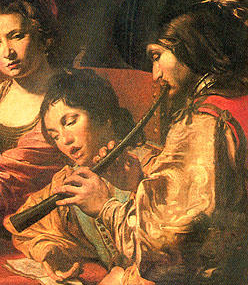
singer with cornetto player, anonymous, 16th century
2020 update: Since I wrote this in 2016, Vox Luminis released a wonderful recording of this cantata. They use a slide trumpet in the tenor aria, which is a beautiful middle between the Baroque trumpets of the Herreweghe, Cantus Cölln, and Gardiner recordings and the cornetto of the American Bach Soloists recording.
Find Vox Luminis’ recording of Cantata 12 on YouTube, on Amazon, or on iTunes.
Wieneke Gorter, April 16, 2016, updated April 27, 2020.
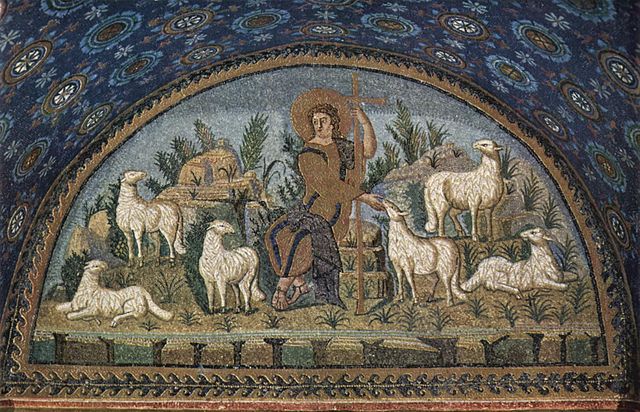
The Good Shepherd, mosaic in the Mausoleum of Galla Placidia, Ravenna, 1st half of the 5th century
There are three beautiful cantatas for this second Sunday after Easter, or “Misericordias Domini” Sunday: BWV 104, 85, and 112. Illustrating the “good shepherd” scripture for this Sunday (John 10, verse 12-16), Bach incorporated pastoral themes or orchestration in each of these cantatas.*
I’ve decided to focus on cantata 85 Ich bin ein guter Hirt, written for April 15, 1725. Of all three cantatas, this is the one I remember the best from my childhood, because of the tenor aria “Seht, was die Liebe tut.” Also: Last week, I already mentioned the similarities between cantata 6 (for Easter Monday 1725), and cantata 42 (for the first Sunday after Easter 1725). This cantata 85 is the culmination of that “sub group” within the cantatas from 1725.
Which recording to listen to?
While I have good memories of hearing Kurth Equiluz sing the tenor aria on the Harnoncourt recording from 1977, I am enamored by Bach Collegium Japan’s recording of this cantata, and I think this is the best “overall” recording, featuring fabulous soloists Carolyn Sampson, Robin Blaze, Gerd Türk, and Peter Kooij. It is also one of the most noteworthy because of the use of a violoncello da spalla, played by Dmitry Badiarov.
Listen to Bach Collegium Japan’s recording of cantata 85 Ich bin ein guter Hirt on Spotify. Or better yet, if you can afford to financially support the artists (especially important now, while they have no income from performances!) please consider purchasing the digital versions of Bach Collegium Japan’s recording of cantata 85 on Amazon or on iTunes.
If you prefer to watch a live recording, there is a wonderful recording available on YouTube by the J.S. Bach Foundation. Soloists are Gerlinde Sämann, soprano; Terry Wey, alto; Georg Poplutz, tenor; Markus Volpert, bass; and Martin Zeller, violoncello piccolo.
Back to the Bach Collegium Japan recording: After lovely and convincing singing by bass Peter Kooij in the opening arioso (Jesus saying “I am a good shepherd”), we get a sublime performance by countertenor Robin Blaze of the alto aria “Jesus ist ein guter Hirt,” which also features the unusual violoncello piccolo da spalla. Someone could probably write an entire PhD thesis on the difference between the violoncello piccolo “da spalla” (held on the shoulder, like a violin), and the violoncello piccolo “da gamba” (held between the legs, like a cello), and whether Bach meant the one or the other when he wrote a part for “violoncello piccolo.” Most recordings (Harnoncourt, Gardiner, Coin, Koopman, and J.S. Bach Foundation) feature the one held between the legs, but Bach Collegium Japan’s recording features the “da spalla” variety, played by the same person who built it in 2004, Dmitry Badiarov.
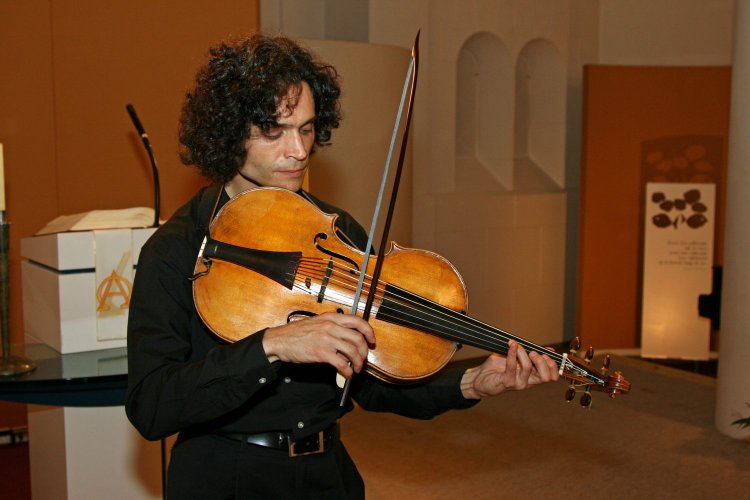
Dmitry Badiarov demonstrating the violoncello piccolo da spalla
Following this, we hear a radiant soprano solo chorale with oboe accompaniment (which makes me think back to the soprano solo chorale from cantata 6, in that case with the violoncello piccolo “da gamba”), beautifully sung by soprano Carolyn Sampson and expertly played by oboists Masamitsu San’nomiya and Atsuko Ozaki.
And when you didn’t think it could get any better, here comes a tenor recitative which in text and string accompaniment strongly refers to Jesus’ recitative from the St. Matthew Passion “Ich werde den Hirten schlagen, und die Schafe der Herde werden sich zerstreuen.” (Christ, having arrived at the Mount of Olives, reminds his disciples of the prophecy that the shepherd will be slain and the sheep will scatter).
With this only recitative in cantata 85, Bach has gotten everyone’s attention, so now we’re ready for the jewel in the crown of this cantata: the tenor aria “Seht, was die Liebe tut.” It is one of the most lyrical and lovely among all Bach’s tenor arias.
Seht, was die Liebe tut. See, what love does. Mein Jesus hält in guter Hut My Jesus in his own safekeeping Die Seinen feste eingeschlossen keeps those who are his own firmly enclosed Und hat am Kreuzesstamm vergossen and on the beam of the cross he hasshed Für sie sein teures Blut. for them his own precious blood.
Again there is a strong association with the St. Matthew Passion both in text and music. In his book Bach: Music in the Castle of Heaven Gardiner makes a very convincing case for his theory that Bach had wanted to perform the St. Matthew Passion on Good Friday 1725, only one year after the St. John Pasion. This didn’t happen because either the council disapproved, or Bach wasn’t ready composing the piece. If Bach had indeed been working on the St. Matthew Passion before Easter 1725, it is no wonder we’re getting glimpses of that monumental work in his cantatas after Easter 1725.
Wieneke Gorter, April 9, 2016, updated April 26, 2020
*I wrote about Cantata 104 for the Second Sunday after Easter in 1724 in this blog post.
Parabel of the Laborers in the Vineyard by Jan Luyken, print, 1703
A number of Dutch things converged for me when writing this post. Whenever I think about the parable of the Laborers in the Vineyard, the Bible story for this Septuagesima Sunday, or the third Sunday before Lent, I see the windows of my 3rd or 4th grade classroom.* I also have to think of my late grandfather reading this story from the Bible. Quickly summarized, this story is: A landlord pays all his laborers equally, no matter how many hours they worked. Those that worked all day object.
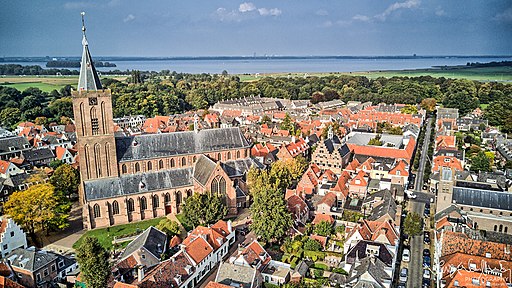
My favorite recording of cantata 144 Nimm, was dein ist, und gehe hin (first performed on Sunday February 6, 1724) turns out to have two connections to my home country: It was recorded in the Grote Kerk in Naarden, during the Bach Pilgrimage tour of Gardiner/English Baroque Soloists, and it features Dutch singer Wilke te Brummelstoete as alto soloist. Counter-tenor fan that I am, I can safely state that I will mention no more than a handful of female altos on this blog each year, so this is pretty special.
Naarden, The Netherlands
The icing on the cake is the illustration I discovered when searching for a good picture to go with this blog post: an etching by Haarlem artist Jan Luyken as published in the Amsterdam Mortierbijbel (Bible published by Pieter Mortier) in 1703, from the collection of the Rijksmuseum in Amsterdam.
Soloists: Miah Persson, soprano; Wilke te Brummelstroete, alto; James Oxley, tenor; Jonathan Brown, bass.
As I’m updating this post on February 8, 2020, the J.S. Bach Foundation has just released their entire live video recording of this cantata, and that one is wonderful too, especially because Nuria Rial sings the soprano aria. Find that video here on YouTube. Soloists are Nuria Rial, soprano; Markus Forster, alto; Raphael Höhn, tenor.
What to listen for in cantata 144 Nimm, was dein ist, und gehe hin:
In the opening chorus: the illustration of the text gehe hin, gehe hin! (off you go!) with ascending figures, each gehe hin “retaken” so that the text really leaps off the page, more on the Gardiner recording than on other ones. Also listen how beautifully the sopranos and violins enhance each other’s sound in this movement. That happens too on the J.S. Bach Foundation recording.
In the alto aria: The illustration of the grumbling workers by the repeated 8th-notes in the strings. The music on the text “Murre nicht” (Don’t grumble) is always low, the music with the text “Lieber Christ” (please note that this means “dear Christian,” not “dear Christ”) always goes up. Very well done in an appropriate style by Wilke te Brummelstoete on the Gardiner recording.
In the soprano aria: the glorification of the “Genügsamkeit” (being satisfied with what you have, a concept that must have been very important to Bach), and the wonderful voice of soprano Miah Persson on the Gardiner recording or the always radiant Nuria Rial on the J.S. Bach Foundation recording. Read more about Miah Persson in my blog post about cantata 179 and those about cantatas 186 and 186a. Read more about Nuria Rial in my posts about Cantata 36 and Cantata 89.
Thank you for reading! Please leave your email address in the “follow this blog” section on the left side of this blog post. You will receive an email by WordPress whenever I have posted a new story. Please note that the choice of words and spelling in their confirmation email is by WordPress, not me. My apologies for that, and many thanks to you for your patience while I work on a more elegant solution!
To support this blog, please consider purchasing Gardiner’s album featuring cantata 144 on Amazon. I receive a small percentage of every sale made through this link. And it would be so fun if someone would actually buy a CD through this link. So far (February 13, 2020), it hasn’t happened 😉 Thank you!
Wieneke Gorter, February 6, 2016, updated January 27, 2024.
*Though a protestant school, it was pretty moderate in its teachings, and I don’t really remember Bible reading in the classroom. However, we learned a hymn every week and the reason I have to think of the classroom when reading this parable probably has to do with the hymn “De eersten zijn de laatsten” (The first will be the last) which is based on this same story.
The Storm on the Sea of Galilee by Rembrandt van Rijn, 1633. Formerly at the Isabella Stuart Gardner Museum, Boston, USA. Stolen in 1990.
Cantata 81 Jesus schläft, was soll ich hoffen? from 1724 closely follows the reading for the 4th Sunday after Epiphany: the story of Jesus calming the storm on the sea of Galilee.
In combining masterful text illustration with his theology, Bach presents a powerful drama rivaling a Handel opera. And I was lucky to find two conductors especially not shy of the opera-element in this cantata: Harnoncourt and Gardiner. The recording from 1978 directed by Harnoncourt has a great sense of drama as well as good singing in all the movements. For me it is the most “overall” satisfying recording of this cantata. It was not an easy decision though this week, and the fact that I grew up with the Harnoncourt recording might of course have influenced my choice. Soloists: Paul Esswood, counter-tenor; Kurt Equiluz, tenor; Ruud van der Meer, bass.
If you have time to listen some more: The absolute best rendition of the spectacular tenor aria in my opinion appears on the Gardiner recording, with very convincing “waves” in the orchestra (at an even higher tempo than Harnoncourt) and truly marvelous singing by Paul Agnew. Listen to this aria on Spotify.
What to keep in mind when listening:
The reading for this 4th Sunday after Epiphany, from Matthew 8:
23. Und er trat in das Schiff, und seine Jünger folgeten ihm.
[23] And when he entered into a ship, his disciples followed him.
24. Und siehe, da erhub sich ein groß Ungestüm im Meer, also daß auch das Schifflein mit Wellen bedeckt ward; und er schlief.
[24] And, behold, there arose a great tempest in the sea, insomuch that the ship was covered with the waves: but he was asleep.
25. Und die Jünger traten zu ihm und weckten ihn auf und sprachen: HERR, hilf uns, wir verderben!
[25] And his disciples came to him, and awoke him, saying, Lord, save us: we perish.
26. Da sagte er zu ihnen: Ihr Kleingläubigen, warum seid ihr so furchtsam? Und stund auf und bedräuete den Wind und das Meer; da ward es ganz stille.
[26] And he saith unto them, Why are ye fearful, O ye of little faith? Then he arose, and rebuked the winds and the sea; and there was a great calm.
27. Die Menschen aber verwunderten sich und sprachen: Was ist das für ein Mann, daß ihm Wind und Meer gehorsam ist?
[27] But the men marvelled, saying, What manner of man is this, that even the winds and the sea obey him!
In Western Europe at Bach’s time, there was probably no insight yet that the “sea” in this bible story was actually a large sweet-water lake. Bach’s Lutheran bible talked of a sea, not a lake, and most paintings from the 16th and 17th centuries depict seagulls, cliffs, or port cities in the distance. Of course a storm can also develop on a large lake, but we have to assume that Bach and his librettist had a full-blown storm at sea in mind when writing this. Bach probably never witnessed one, but Gardiner says that one of the theologian books in Bach’s library featured a vivid commentary on this part of the gospel. That book’s author, Heinrich Müller, lived in Rostock, on the Baltic sea. And who knows what interpretations of a “tempesta di mare” by other composers Bach had heard at the opera in Hamburg or seen on copied music which traveling colleagues and students might have brought with them.
Already in the opening aria Bach combines opera with theology. The recorders illustrate the “sleeping” Jesus, but also the loneliness of a life without Jesus/without faith (Bach uses recorders for this purpose more often, for example in the O Schmerz tenor-aria from the St. Matthew Passion (when for a moment Jesus feels he has lost faith), as well as in the Sanfte soll mein Todeskummer tenor-aria from the Easter Oratorio). There is also some hint in the orchestra of the calm before the storm, underlining the anxiety of the question “Was soll ich hoffen?”
The big storm at sea manifests in the tenor aria, equal to a “rage” aria by Handel, with the orchestra and the singer imitating the rolling waves and wind.
Then enters Jesus in the bass arioso, asking his disciples, but also the believers in general, why they didn’t have faith. Dürr remarks that the music is like an “Invention” and is practically a bass duet, with the other “singer” being the continuo. This is also a pivotal point in the cantata, moving from the part without Jesus/faith (nos 1-3) to the part with Jesus/faith.
Another “storm aria” follows, sung by the bass, but this time the storm is somewhat quieting down, and the oboe lines paint a quieter mood. All this to illustrate that Jesus is calming the storm. The alto recitative states/confirms that Jesus has calmed the storm, and is with us, and the chorale (second verse of the beautiful Jesu meine Freude) is the final affirmation:
Unter deinen Schirmen Beneath your protection Bin ich für den Stürmen I am free from storms Aller Feinde frei. and all enemies. Laß den Satan wittern, Let Satan sniff around, Laß den Feind erbittern, let the enemy be exasperated Mir steht Jesus bei. Jesus stands by me. Ob es itzt gleich kracht und blitzt, Though there is thunder and lightning, Ob gleich Sünd und Hölle schrecken, though sin and hell terrify, Jesus will mich decken. Jesus will protect me.
Thank you for reading! Please leave your email address in the “follow this blog” section on the left side of this blog post. You will receive an email by WordPress whenever I have posted a new story. Please note that the choice of words and spelling in their confirmation email is by WordPress, not me. My apologies for that, and many thanks to you for your patience while I work on a more elegant solution!
Wieneke Gorter, January 31, 2016, links updated February 2, 2020





 Weekly Cantata