Weekly Cantata

Weekly Cantata

Tag Archives: Masaaki Suzuki

Trinity 3: from Weimar, with love

12 Sunday Jun 2016

Posted by cantatasonmymind in 1723 Trinity season special series, Cantatas, Leipzig, Trinity, Weimar

≈ Comments Off on Trinity 3: from Weimar, with love

Tags

according to Lutheran Church year, Alfred Dürr, Bach, Bach Collegium Japan, Barbara Schlick, cantatas, Christoph Wolff, Collegium Vocale Gent, Lutheran Church year, Masaaki Suzuki, Monika Frimmer, Peter Kooy, Phlippe Herreweghe, Rachel Podger, Vivaldi
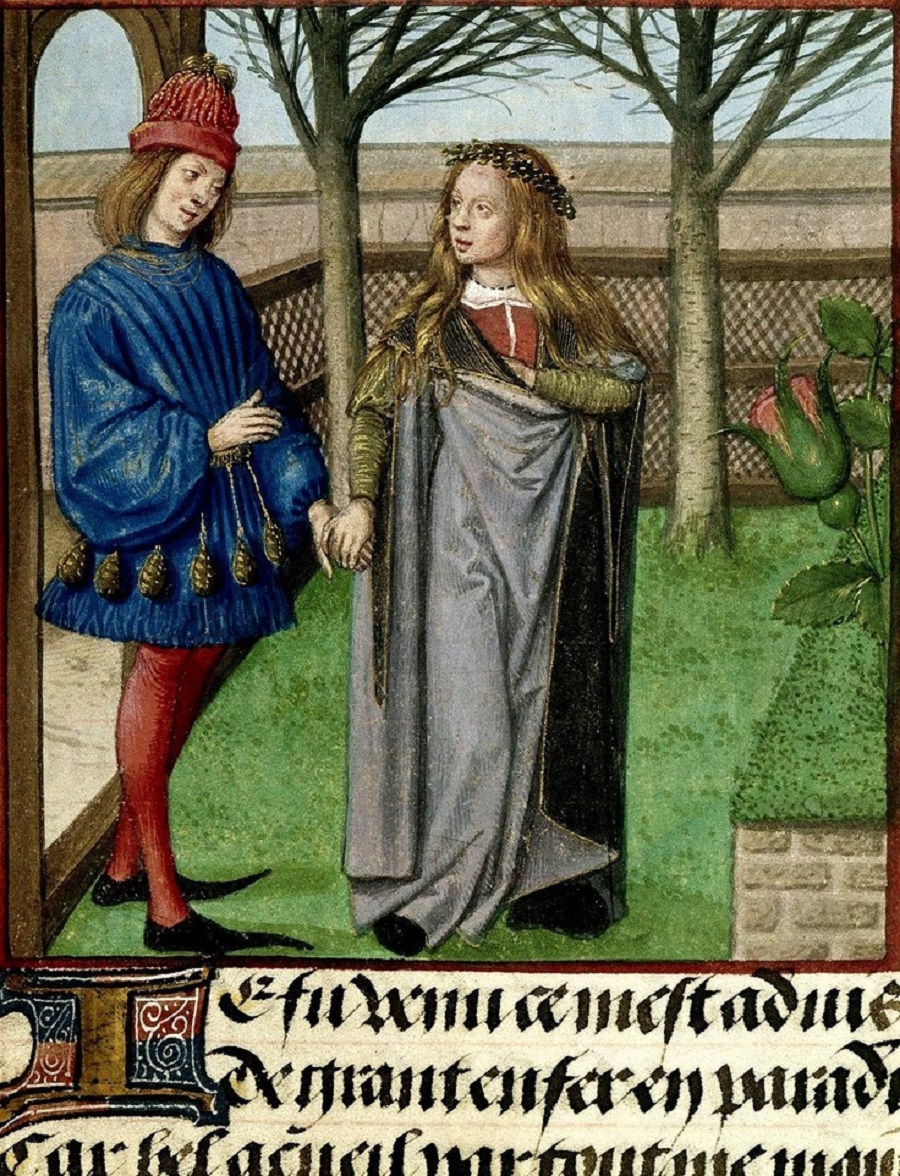
Roman de la Rose, Netherlands (Bruges), c. 1490-c. 1500

Only three episodes into this special 1723 Leipzig Trinity season series,  I’m already taking a detour to Weimar. It’s Bach’s fault, because, after the two newly written cantatas he presented on May 30 and June 6, 1723, he “recycled” his Weimar cantata for this third Sunday after Trinity: cantata 21 Ich hatte viel Bekümmernis, written in 1714, or possibly in 1713.

We dont’ know for sure why Bach chose to use an “old” composition this early in his first season (though probably nobody except his own family knew it was not new), but  I think that he couldn’t wait to impress the Leipzig Council and congregation with a composition that was one of his all-time favorites. He had written and performed it at least twice in Weimar, then presented it in Hamburg or Köthen in 1720* and would perform it many more times in Leipzig on future third Sundays after Trinity. Another reason I believe  it was Bach’s plan all along to present this cantata 21 on Trinity 3 in Leipzig: it seems to me that when writing the masterful fugue in the opening chorus of cantata 76, Bach must have had the fugue in no. 6 of cantata 21 on his mind.

Whether it was thanks to the multiple performances during Bach’s lifetime, or to Mattheson mentioning it (however unfavorably!) in his writings, cantata 21 was known among Bach’s colleagues and students throughout the 18th and 19th centuries, and is still one of the most well-known and most frequently performed cantatas today.

Instead of talking about the music, I would like to shine some light on the history of this cantata, and show you that it was not a stand-alone masterpiece that Bach created out of nothing. Most of the findings here below are from  books by Alfred Dürr and Christoph Wolff.

There are parts of this cantata that fit extremely well within the style of the 1714 Weimar cantatas. To hear cantata 21 in this context, if you have time, before you listen to the sinfonia (no. 1) of cantata 21, I invite you to first listen to the sinfonia of cantata 12. They are remarkably similar. Next, just for the fun of it, you might want to listen to the “love” duet from Weimar Pentecost cantata 172 (beautifully sung by soprano Dorothee Mields and countertenor Alex Potter during a streamed concert from 2021)

 Soprano (Soul)

Komm, laß mich nicht länger warten,
Come , let me wait no longer,
Komm, du sanfter Himmelswind,
come, you gentle wind of heaven,
Wehe durch den Herzensgarten!
blow through the garden of my heart

 Alto (Holy Spirit)

Ich erquicke dich, mein Kind.
I refresh you, my child

Liebste Liebe, die so süße,
Dearest love, who are so delightful,
Aller Wollust Überfluß,
abundance of all joys,
Ich vergeh, wenn ich dich misse.
I shall die, if I have to be without you

Nimm von mir den Gnadenkuß.
Take from me the kiss of grace.

Sei im Glauben mir willkommen,
Welcome in faith to me,
Höchste Liebe, komm herein!
Highest love, come within!
Du hast mir das Herz genommen.
You have taken my heart from me

Ich bin dein, und du bist mein!
I am yours, and you are mine!

and compare it to the “love” duet from cantata 21:

Soprano (Soul):

Komm, mein Jesu, und erquicke,

Bass (Jesus):

Ja, ich komme und erquicke

Come, my Jesus, and restore

Yes, I come and restore

Und erfreu mit deinem Blicke.

Dich mit meinem Gnadenblicker,

and rejoice with your look

you with my look of grace

Diese Seele,

Deine Seele,

This soul

Your soul

 Die soll sterben,

 Die soll leben,

that must die

that must live

Und nicht leben

 Und nicht sterben

and not live

and not die

 Und in ihrer Unglückshöhle

Hier aus dieser wunden Höhle

and in its den of misfortune

here from this den of wounds

Ganz verderben.

Sollst du erben

wholly perish.

 you shall be given

 Ich muß stets in Kummer schweben,

Heil! durch diesen Saft der Reben,

I must always be suspended in misery

Salvation! throught this juice of the grape

Ja, ach ja, ich bin verloren!

Nein, ach nein, du bist erkoren!

Yes, oh, yes, I am lost

No,oh, no, you are chosen

 Nein, ach nein, du hassest mich!

Ja, ach ja, ich liebe dich!

No, ah, no, you hate me!

Yes, oh, yes,I love you!

 Ach, Jesu, durchsüße mir Seele und Herze,

Entweichet, ihr Sorgen, verschwinde, du Schmerze!

Jesus, sweeten my soul and heart.

Give way, worries, vanish, pain!

Komm, mein Jesus, und erquicke

Ja, ich komme und erquicke

Come, Jesus, and restore

Yes, I come and restore

Mit deinem Gnadenblicke!

Dich mit meinem Gnadenblicke

 with your look of grace

 you with my look of grace.

Of course none of these are officially  meant to speak of earthly love. But still, both these duets are extremely cute, musically completely similar to opera love duets from that time, and their texts could at least partly be interpreted as such love duets, so I can imagine the Weimar poet and the young Bach must have enjoyed writing these.

To really appreciate “the making of” the opening chorus (no. 2) of cantata 21, it’s worth listening to a magnificent Vivialdi violin concerto and one of Bach’s lesser known organ prelude and fugues, to hear where Bach found the theme for the Ich hatte viel Bekümmernis fugue:

In the spring of 1713, the half-brother of Bach’s employer in Weimar, prince Johann Ernst, “a great lover of music and an incomparable violinist” (according to a testimony by Philipp David Kräuter, a student of Bach in Weimar) went on a study trip, and spent a long time in the Netherlands. Upon his return, he had brought “much fine Italian and French” music with him. One of the pieces was Vivaldi’s Concerto in D minor Opus 3, no. 11  for two violins from Book II of L’Estro armonico (RV 565), published in Amsterdam in 1711.

Listen to this Vivaldi concerto in the award-winning interpretation by the fabulous Rachel Podger with Brecon Baroque on Spotify, or on YouTube

Maybe Bach, an accomplished violinist himself, and the prince played this together after the prince returned in July 1713. Bach rewrote this Vivaldi concerto into an organ concerto (BWV 596), but also used the theme in his organ prelude and fugue in B minor, BWV 544,  written in Weimar as well.  It is in this piece in particular that I can hear the relation with cantata 21 Dürr wants to point out in his book.

About recordings of cantata 21: While Bach Collegium Japan deserves a medal for  taking the trouble to research all the different versions and record the ones from 1720 and 1714 on their volume 6 , and the true 1723 Leipzig version (with trombones added in no. 9 and solo/tutti distinctions in the choruses) on their volume 12, I still like Herreweghe’s recording of this cantata the best, mainly because of the strong, crisp choruses and the music always having long lines and strong sense of direction. Listen to Herreweghe’s interpretation of  this cantata on Spotify or on YouTube.

Update from 2021: find an absolutely stunning performance of the 1720 version (with only soprano and bass soloists) on the YouTube channel of the J.S. Bach Foundation here.

Read the German text with English translations of cantata 21 here, and find the score here.

If you don’t want to miss an episode of this 1723 Trinity season series, please consider signing up to receive an email every time I’ve posted a new story.

Please feel free to share this on Facebook, or forward to anyone you think might enjoy coming along for this ride. Thank you!

Wieneke Gorter, June 12, 2016. Updated June 19, 2021.

*Bach visited Hamburg in November 1720, to apply for an organist and cantor post there. It turned out, however, that the post needed to be “bought” and the job went to a lesser talented but wealthy candidate. Most scholars are confident there was a performance of this cantata in 1720 in either Köthen or Hamburg, based on the surviving manuscripts of the parts. Because it was the Hamburg-based writer Mattheson who criticized the cantata in a letter  in 1725, it is probable that the performance took place in Hamburg during Bach’s visit there.

According to Bach Collegium Japan’s leader Masaaki Suzuki, the 1720 performance featured only a soprano and a bass, with the soprano also singing all the arias and recitatives we know nowadays as written for tenor.

72 and 73

24 Sunday Jan 2016

Posted by cantatasonmymind in Cantatas, Epiphany, Leipzig

≈ Comments Off on 72 and 73

Tags

Bach Collegium Japan, Bist du bei mir, Collegium Vocale Gent, Dorothee Mields, Eduard van Hengel, Leichenglocken, Lutheran Church year, Masaaki Suzuki, Monika Mauch, Montreal Baroque, Peter Kooy, Phlippe Herreweghe, Rachel Nicholls, Robin Blaze, Thomas Hobbs

ChristCleansing

Christ cleansing a leper, Jean-Marie Melchior Doze, 1864

For this third Sunday after Epiphany, we find no less than four gems in Bach’s treasure trove: cantatas 73, 111, 72, and 156. I decided to highlight 73 and 72, because of the interesting references between the two. As far as we can tell, Bach loved these cantatas too: He performed cantata 73 at least one more time, and transcribed the opening chorus of cantata 72 into the Gloria of his Mass in G minor.

From the chronology of performances in Leipzig, it looks as if Bach wrote cantata 73 in 1724 and cantata 72 two years later. However, some scholars argue that (a large part of) cantata 72 was probably already written around 1715, since most of the poetry is from a collection Bach used when working in Weimar at that time. But whether 72 was first or 73 was first, it doesn’t matter that much for the appreciation of these two beautiful cantatas.

I have a soft spot for cantata 73 because I love the way Herreweghe performs this, have listened to the 1990 recording many times since it came out, and then to the (better!) 2013 recording. The best parts are the opening chorus and the bass aria (sung by Peter Kooy on both recordings) and I’m grateful for Eduard van Hengel’s Bach website (in Dutch) where I learned a lot about the many possible bits of reference in this cantata to other works.

Listen first to Cantata 72 Alles nur nach Gottes willen by Bach Collegium Japan/Masaaki Suzuki on Spotify

soloists: Rachel Nicholls (one of the most “boy soprano”-like voices of the soprano soloists in that series, I love it), Robin Blaze (counter-tenor), Peter Kooy (bass)

If you only have access to YouTube, you could listen to Montreal Baroque’s recording or to Gardiner’s recording instead.

What to listen for in cantata 72:

The most important words from the Bible text for this third Sunday after Epiphany (the story of Jesus cleansing a leper, from the gospel of Matthew):

Da er aber vom Berg herabging, folgte ihm viel Volks nach. Und siehe, ein Aussätziger kam und betete ihn an und sprach: Herr, so du willst, kannst du mich wohl reinigen. Und Jesus streckte seine Hand aus, rührte ihn an und sprach: Ich will’s tun; sei gereinigt!

(When He had come down from the mountain, great multitudes followed Him. And behold, a leper came and worshiped Him, saying, Lord, if You are willing, You can make me clean. Then Jesus put out His hand and touched him, saying, I am willing; be cleansed.)

In the opening chorus: The illustration of the word “Alles” (Everything): one can hear all the instruments in the orchestra, and when the voices come in, they first jump an octave over two quarter notes, signifying all the possible notes in the chord, and then run up in 16th notes, singing every single note in the chord.

In the alto aria: nine times the words “Herr, so du willt” – make sure to remember this melody!

In the bass aria: the text is set in the third person, but it is almost as if Jesus himself is speaking here, and this is where the text moves to the “Ich will’s tun” (I will do it / I am willing) words from the gospel.

In the soprano aria*: the happy and sweet elaboration on the “Ich will’s tun” – which here turns into “my Jesus will do it!”

The closing chorale: the same text and tune Bach uses throughout cantata 111 for this same Sunday in 1725, as well as in the St. Matthew Passion (but in that case with different harmonies in the last four lines!)

***

Next, listen to cantata 73 Herr, wie du willt, so schick’s mit mir in a fantastic recording by Collegium Vocale Gent/Philippe Herreweghe, from 2013, on Spotify soloists: Dorothee Mields (soprano), Thomas Hobbs (tenor), Peter Kooy (bass)

or their 1990 recording here on YouTube soloists: Barbara Schlick (soprano), Howard Crook (tenor) and Peter Kooij (bass).

Please note: these are two different Herreweghe recordings. The newest one, on Herreweghe’s own label, features a different soprano and tenor soloist than on his earlier recording of this same cantata (Virgin Classics, 1990, with soprano Barbara Schlick and tenor Howard Crook). I like this new one better. The entire CD is wonderful, and also features fabulous counter-tenor Damien Guillon in the other cantatas on the disc. If you like this recording, please consider supporting the artists by purchasing it on Amazon.

What to listen for in cantata 73:

In the opening chorus: the first four notes of the original chorale Herr, wie du willt, so schick’s mit mir in Leiden und Sterben, used as a four-note “Leitmotiv,” first appearing staccato in the horn in the orchestra:

Screenshot 2016-01-22 23.47.40
and at the very end of the movement, homophonically in the choir, repeated three times, not something Bach normally does in cantata opening choruses:
Screenshot 2016-01-22 23.54.06

In the bass aria: now the “Herr, wie du willt” from the chorale text turns in to “Herr, so du willt” from the gospel text. And to accentuate this, Bach again gives this text its own “Leitmotiv”-like melody. However, it might not have been a new melody. It is very similar to “Bist du bei mir” from Anna Magdalena’s music book. She wrote this aria in her book much later, but it was copied from an opera aria by Stölzel from 1717. Perhaps this opera aria was already being hummed in the Bach household in 1724, we will never know. Later in the bass aria in cantata 73, the “Herr, so du willt”-melody from the alto aria of cantata 72 returns!

What I love especially in this bass-aria is the illustration of “Leichenglocken” (death bells) by pizzicato strings and a somewhat “tolling” movement in the vocal part. My mother (a walking Bach encyclopedia who played a cantata on the turntable / CD player every Sunday) would always point features like this out to me. Bach used it in many other cantatas, for example in (cantata number/movement number): 8/1, 95/5, 105/4, 127/3, 161/4, 198/4. [Thanks again to Eduard van Hengel, I didn’t have to look this up myself].

* While overall I like Bach Collegium Japan’s recording of cantata 72 best, and I love how Rachel Nicholls sings the soprano aria, I would like to mention that on Montreal Baroque’s recording of this work, the soprano aria by Monika Mauch is excellent and worth listening to. How she makes everything calm on the words “sanft und still” is very special.

More links:
German text with English translation for cantata 72
Score for cantata 72
German text with English translation for cantata 73
Score for cantata 73

Wieneke Gorter, January 24, 2016; links updated January 25, 2020, and January 23, 2021.

Newer posts →

Recent Posts

  • The Recording that Knocked My Socks off – Cantata 162 for Trinity 20
  • It’s Not What You Think – The Kreuzstab Cantata for Trinity 19
  • A Rainbow of Colors – Cantata 169 for Trinity 18
  • Gli Angeli Genève’s Chorale Cantata Box & Cantata 114 for Trinity 17
  • Family stories and more “Vision Bach” – BWV 179 and 199 for Trinity 11

Archives

  • October 2026
  • September 2026
  • August 2026
  • August 2025
  • July 2025
  • December 2024
  • November 2024
  • June 2024
  • January 2024
  • December 2023
  • October 2023
  • September 2023
  • August 2023
  • April 2022
  • February 2022
  • January 2022
  • December 2021
  • November 2021
  • June 2021
  • May 2021
  • April 2021
  • February 2021
  • January 2021
  • December 2020
  • November 2020
  • October 2020
  • September 2020
  • August 2020
  • July 2020
  • May 2020
  • April 2020
  • March 2020
  • February 2020
  • January 2020
  • December 2019
  • November 2019
  • May 2018
  • April 2018
  • March 2018
  • February 2018
  • January 2018
  • December 2017
  • November 2017
  • October 2017
  • September 2017
  • August 2017
  • July 2017
  • June 2017
  • May 2017
  • April 2017
  • March 2017
  • February 2017
  • January 2017
  • December 2016
  • November 2016
  • October 2016
  • September 2016
  • August 2016
  • July 2016
  • June 2016
  • May 2016
  • April 2016
  • March 2016
  • February 2016
  • January 2016

Enter your email address to follow this blog and receive notifications of new posts by email.

Join 336 other subscribers

Categories

  • 1723 Trinity season special series
  • Advent
  • After Easter
  • Ascension
  • Bach's life
  • Cantatas
  • Chorale cantatas 1724/1725
  • Christmas
  • Easter
  • Epiphany
  • Following Bach in 1725
  • Köthen
  • Leipzig
  • Leipzig 1726/1727
  • Septuagesima
  • Travel
  • Trinity
  • Weimar

Meta

  • Create account
  • Log in
  • Entries feed
  • Comments feed
  • WordPress.com

Website Built with WordPress.com.

  • Subscribe Subscribed
    Weekly Cantata
    Join 156 other subscribers

    Have a WordPress.com account? Log in now.

  • Weekly Cantata
    View site in Reader
    Manage subscriptionsSign upLog in
    Report this content
    Collapse this bar
Loading Comments...