Weekly Cantata

Weekly Cantata

Tag Archives: Peter Kooij

Belated Trinity 9

30 Saturday Jul 2016

Posted by cantatasonmymind in 1723 Trinity season special series, Cantatas, Leipzig, Trinity

≈ Leave a comment

Tags

according to Lutheran Church year, Bach, Barbara Schlick, BWV 105, BWV 162, BWV 244, BWV 245, BWV 46, BWV 67, cantatas, Damien Guillon, Hana Blazikova, Lutheran Church year, Peter Kooij, Peter Kooy, Philippe Herreweghe, Thomas Hobbs

In the previous episode of this special 1723 Leipzig Trinity series we saw how Trinity 8 marked the start of the shorter cantata, containing only around 6 movements instead of 10 to 14 movements. However, that weeks’ cantata was probably still based on earlier compositions. This means that cantata 105 Herr, gehe nicht ins Gericht could be considered the start of the true Leipzig cantata.

Two striking “Leipzig only” features make an appearance in this cantata: clear references to Bach’s future Passions (see below), and the “corno da tirarsi” (slide horn).

Only three cantatas (Trinity 10’s cantata 46, as well as 162 and 67) show the full name corno da tirarsi written in the manuscript, but there are 27 cantatas from Leipzig requiring a corno in which that part is not playable on a natural horn, so must have been written for this corno da tirarsi as well. Cantata 105 is included in that group. Bach is the only composer who ever mentioned this instrument in writing, and most probably his principal brass player Gottfried Reiche was the only one who ever played it. After Reiche’s death in 1734 Bach did not write for this instrument anymore, and for repeat performances of any cantatas containing a corno da tirarsi part, Bach rewrote it for other instruments. Read more about this in Olivier Picon’s article on the “corno da tirarsi” from 2010. 

Herreweghe has recorded this cantata 105 Herr, gehe nicht ins Gericht twice: first in 1992 (with soloists Barbara Schlick, Gerard Lesne, Howard Crook, and Peter Kooij), and again in 2012 (with soloists Hana Blazikova, Damien Guillon, Thomas Hobbs, and again Peter Kooij).

Though that first recording from 1992 is excellent, and the soprano aria on that recording has more character to my taste, I recommend the 2012 recording for the following reasons:

  1. At the time of the 1992 recording, no corno da tirarsi was available, which means that the tenor aria on that recording has an oboe accompaniment. The recording from 2012 does feature a corno da tirarsi in this aria.
  2. The “Herr, Herr” exclamations are more prominent in the opening chorus of the 2012 recording, and the tempo of the opening chorus is also a bit faster, which I like.
  3. The 2012 album, which includes three other cantatas, focuses on 1723 Trinity cantatas only, which of course is extra special for this blog’s special 1723 Trinity series.

Listen to this 2012 recording by Herreweghe on Spotify.

Listen to this 2012 recording on YouTube, by way of a playlist I created (it is possible that this only works for readers in the USA):

Support the artists and purchase this recording on Amazon. (it’s always worth it, but this time you’ll get three more cantatas in that same album that will be discussed on this blog in the coming weeks!)

Read the German text with English translations here, and find the score here.

Listen for the “Herr, Herr” exclamations in the opening chorus. They will appear in the opening chorus of the St. John Passion in early 1724. The exquisite soprano aria has no bass instrument in the continuo. Bach will later use that feature more often in other Leipzig cantatas, to either show purity or uncertainty, and it is a strong feature of the Aus Liebe aria from the St. Matthew Passion. And last but not least: when I listen to the bass arioso from this cantata 105, I am strongly reminded of the bass arioso Am Abend da es kühle war from the St. Matthew Passion. The music is not 100% the same, but very similar, and there are also references in the text.

Other stunning features of this cantata 105: the strings accompanying the soprano aria illustrate the “shivering” and “quavering” in the text, and those same “uncertain” strings turn up again in the orchestra part of the closing chorale.

Wieneke Gorter, July 30, 2016, links updated August 2, 2023.
Trinity 8: the start of the shorter cantata

16 Saturday Jul 2016

Posted by cantatasonmymind in 1723 Trinity season special series, Cantatas, Leipzig, Trinity

≈ Leave a comment

Tags

Bach Collegium Japan, BWV 136, BWV 167, BWV 234, BWV 24, BWV 75, BWV 76, corno da tirarsi, Kai Wessel, Makoto Sakurada, Masaaki Suzuki, Peter Kooij, Trinity 8

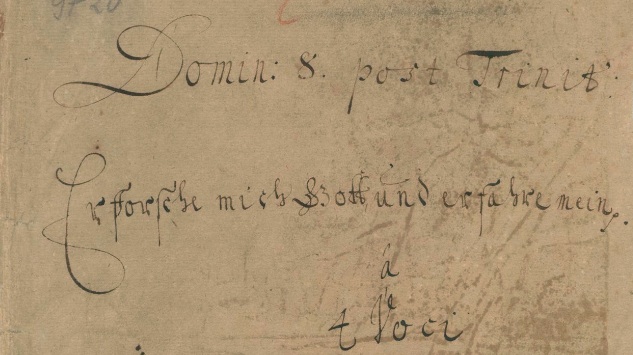
Trinity8

Excerpt from the title page of the manuscript, Staatsbibliothek zu Berlin, Preußischer Kulturbesitz


Previously on Weekly Cantata: Beginning on May 30, 1723 (the first Sunday after Trinity) Bach presented a long cantata of 10 to 14 movements each to the Leipzig congregations every Sunday, including cantatas for the special occasions of St. John (Johannis) on June 24 and the Visitation of Mary (Mariä Heimsuchung) on July 2.

However, only a few of these were newly written in Leipzig. The first two cantatas (75 for Trinity 1 and 76 for Trinity 2) were new, but he had probably already prepared them in Köthen, before moving to Leipzig.* For several weeks after that, he wrote almost no new works, but “recycled” creations from his Weimar period, adding recitatives and sometimes changing aria texts to make them better suited for the specific Gospel readings in Leipzig, and adding chorales to make them longer. The only two new works he wrote in Leipzig in those first months were the “additional” cantata 24 for Trinity 4 and the modest cantata 167 for St. John.

With the exception of cantata 167, all cantatas in the first seven weeks after Trinity were 10 to 14 movements long, divided over two parts, one before the sermon, one after.

What changed for this 8th Sunday after Trinity in 1723 (July 18, 1723) was not that Bach stopped recycling older works—scholars think that this cantata 136 Erforsche mich, Gott, und erfahre mein Herz most probably was an assembly of several different unknown compositions from Köthen**–– but that the cantatas became significantly shorter in length: starting with this one for Trinity 8, cantatas will generally be only around six movements long. We don’t know the reason for this: an order or request from the Leipzig Council, Bach’s own decision that it would be too much work to write such a long work every week, or Bach’s experience that the notable members of the congregation would not actually arrive in the church until right before the sermon?

For this cantata 136 Erforsche mich, Gott, und erfahre mein Herz, I prefer the recording by Bach Collegium Japan, because of their interpretation of the opening chorus, alto aria (with one of my favorite countertenors, Kai Wessel), bass recitative (excellent job by Peter Kooij), and tenor/bass duet (the voices of Makoto Sukurada and Peter Kooij are a wonderful match here). Listen to this recording on Spotify.

Read the German text with English translation of this cantata here. Find the score here.

About ten years later, Bach reworked the glorious music of the opening chorus of this cantata into the In Gloria Dei Patris, Amen of his short Mass in A Major (BWV 234). This entire opening chorus is terrific, already from the very beginning: before the fugue even starts, its theme already sounds in the horn part, and then in the soprano part.

The alto aria elaborates on the Doomsday which was already announced three times in the tenor recitative. To make the vocal part of this aria sound a bit more threatening, Bach composed a new, fast middle part for the Leipzig performance. I enjoy listening to Kai Wessel’s voice, which is deep and clear at the same time, and this aria truly showcases his talent and skills.

At first, the closing chorale seems like a normal, “simple” setting, the way it will be in most cantatas after this, but when you pay a bit more attention, you’ll hear that the first violins play a beautiful ornamental part which floats over the vocal lines.

Wieneke Gorter, July 16, 2016, updated August 1, 2020.

*The paper of the manuscripts has been declared “non-Leipzig” paper by the researchers, and the compositions have many similarities and cross-references. Read more about this in the posts about cantata 75 and cantata 76.

**The manuscript is written very neatly, as if existing work was being copied, the opening chorus doesn’t really match the rest of the work in style or key, and the tenor-bass duet is very similar in style to the secular cantatas Bach wrote for the Köthen court.

A good shepherd, a violoncello piccolo da spalla, and a bit of St. Matthew Passion

09 Saturday Apr 2016

Posted by cantatasonmymind in After Easter, Cantatas, Leipzig

≈ Comments Off on A good shepherd, a violoncello piccolo da spalla, and a bit of St. Matthew Passion

Tags

2nd Sunday after Easter, Atsuko Ozaki, Bach, Bach Collegium Japan, BWV 42, BWV 6, BWV 85, cantatas, Caroyn Sampson, Dmitry Badiarov, Georg Poplutz, Gerd Türk, Gerlinde Säman, Harnoncourt, J.S. Bach Foundation, John Eliot Gardiner, Kurt Equiluz, Markus Volpert, Martin Zeller, Peter Kooij, Peter Kooy, Robin Blaze, Rudolf Lutz, St. Matthew Passion, Terry Wey, violoncello da spalla, violoncello piccolo

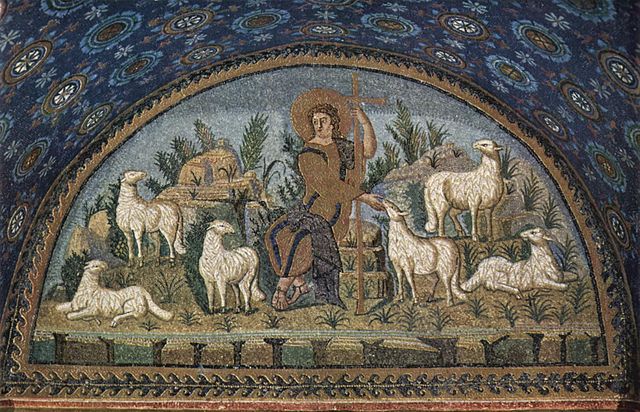
640px-meister_des_mausoleums_der_galla_placidia_in_ravenna_002
The Good Shepherd, mosaic in the Mausoleum of Galla Placidia, Ravenna, 1st half of the 5th century

There are three beautiful cantatas for this second Sunday after Easter, or “Misericordias Domini” Sunday: BWV 104, 85, and 112. Illustrating the “good shepherd” scripture for this Sunday (John 10, verse 12-16), Bach incorporated pastoral themes or orchestration in each of these cantatas.*

I’ve decided to focus on cantata 85 Ich bin ein guter Hirt, written for April 15, 1725. Of all three cantatas, this is the one I remember the best from my childhood, because of the  tenor aria “Seht, was die Liebe tut.” Also: Last week, I already mentioned the similarities between cantata 6 (for Easter Monday 1725), and cantata 42 (for the first Sunday after Easter 1725). This cantata 85 is the culmination of that “sub group” within the cantatas from 1725.

Which recording to listen to?

While I have good memories of hearing Kurth Equiluz sing the tenor aria on the Harnoncourt recording from 1977, I am enamored by Bach Collegium Japan’s recording of this cantata, and I think this is the best “overall” recording, featuring fabulous soloists Carolyn Sampson, Robin Blaze, Gerd Türk, and Peter Kooij. It is also one of the most noteworthy because of the use of a  violoncello da spalla, played by Dmitry Badiarov.

Listen to Bach Collegium Japan’s recording of cantata 85 Ich bin ein guter Hirt on Spotify. Or better yet, if you can afford to financially support the artists (especially important now, while they have no income from performances!) please consider purchasing the digital versions of Bach Collegium Japan’s recording of cantata 85 on Amazon or on iTunes.

If you prefer to watch a live recording, there is a wonderful recording available on YouTube by the J.S. Bach Foundation. Soloists are Gerlinde Sämann, soprano; Terry Wey, alto; Georg Poplutz, tenor; Markus Volpert, bass; and Martin Zeller, violoncello piccolo.

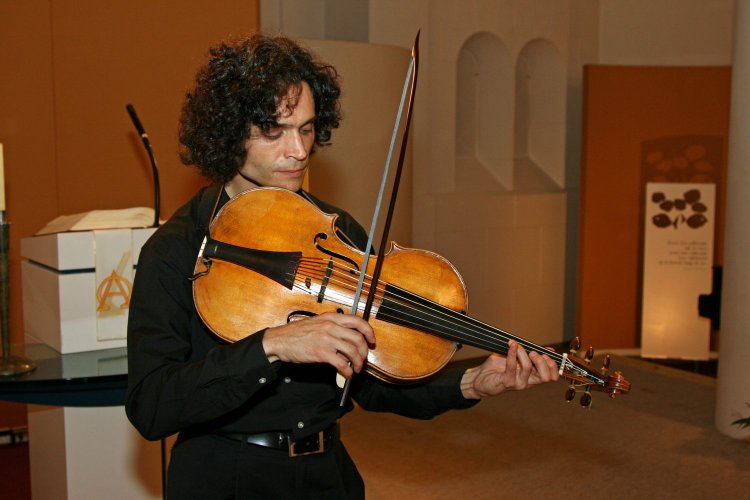
Back to the Bach Collegium Japan recording: After lovely and convincing singing by bass Peter Kooij in the opening arioso (Jesus saying “I am a good shepherd”), we get a sublime performance by countertenor Robin Blaze of the alto aria “Jesus ist ein guter Hirt,” which also features the unusual violoncello piccolo da spalla. Someone could probably write an entire PhD thesis on the difference between the  violoncello piccolo  “da spalla” (held on the shoulder, like a violin),  and the violoncello piccolo “da gamba”  (held between the legs,  like a cello), and whether Bach meant the one or the other when he wrote a part for “violoncello piccolo.”  Most recordings (Harnoncourt, Gardiner, Coin, Koopman, and J.S. Bach Foundation) feature the one held between the legs, but Bach Collegium Japan’s recording features the “da spalla” variety, played by the same person who built it in 2004, Dmitry Badiarov.

Badiarov-Dmitry-04
Dmitry Badiarov demonstrating the violoncello piccolo da spalla

Following this, we hear a radiant soprano solo chorale with oboe accompaniment (which makes me think back to the soprano solo chorale from cantata 6, in that case with the violoncello piccolo “da gamba”), beautifully sung by soprano Carolyn Sampson and expertly played by oboists Masamitsu San’nomiya and Atsuko Ozaki.

And when you didn’t think it could get any better, here comes a tenor recitative which in text and string accompaniment strongly refers to Jesus’ recitative from the St. Matthew Passion “Ich werde den Hirten schlagen, und die Schafe der Herde werden sich zerstreuen.” (Christ, having arrived at the Mount of Olives, reminds his disciples of the prophecy that the shepherd will be slain and the sheep will scatter).

With this only recitative in cantata 85, Bach has gotten everyone’s attention, so now we’re ready for the jewel in the crown of this cantata: the tenor aria “Seht, was die Liebe tut.” It is one of the most lyrical and lovely among all Bach’s tenor arias.

Seht, was die Liebe tut.
See, what love does.
Mein Jesus hält in guter Hut
My Jesus in his own safekeeping
Die Seinen feste eingeschlossen
keeps those who are his own firmly enclosed
Und hat am Kreuzesstamm vergossen
and on the beam of the cross he has shed
Für sie sein teures Blut.
for them his own precious blood.

Again there is a strong association with the St. Matthew Passion both in text and music. In his book Bach: Music in the Castle of Heaven Gardiner makes a very convincing case for his theory that Bach had wanted to perform the St. Matthew Passion on Good Friday 1725, only one year after the St. John Pasion. This didn’t happen because either the council disapproved, or Bach wasn’t ready composing the piece. If Bach had indeed been working on the St. Matthew Passion before Easter 1725, it is no wonder we’re getting glimpses of that monumental work in his cantatas after Easter 1725.

Wieneke Gorter, April 9, 2016, updated April 26, 2020

*I wrote about Cantata 104 for the Second Sunday after Easter in 1724 in this blog post.

One of my favorite cantatas

03 Sunday Apr 2016

Posted by cantatasonmymind in After Easter, Cantatas, Leipzig

≈ Comments Off on One of my favorite cantatas

Tags

1st Sunday after Easter, Barbara Schlick, BWV 21, BWV 31, BWV 4, BWV 42, BWV 6, Gérard Lesne, Howard Crook, Peter Kooij, Philippe Herreweghe

appearance-of-christ-to-his-disciples
Anthony van Dyck: Appearance of Christ to his Disciples, 1625/1626

This post is about Cantata 42 Am Abend aber desselbigen Sabbats, written for the 1st Sunday after Easter in 1725.

For Bach, Easter season in Leipzig was extremely busy. Immediately after the passion on Good Friday, he needed to have three to four cantatas ready to go: two cantatas for Easter Sunday, one for Easter Monday, and one for Easter Tuesday. And then five days later, again one for the Sunday after Easter, the one I am discussing here. If we imagine Bach having to work on most of these in the week before Easter, that same week in which he was rehearsing the Passion for Good Friday, and often adjusting the score still too, it is not so strange that he often re-used existing music at this time of year. It would either be a repeat performance of an Easter cantata from his time in Mühlhausen (Christ lag in Todesbanden) or Weimar (Der Himmel lacht! Die Erde Jubilieret!) or a new cantata, with new text, but largely based on existing secular music he had written for the Weimar or Köthen courts.

In 1725, the performance list looked like this:

Good Friday: St. John Passion, 2nd version, significantly rewritten from the year before.

Easter Sunday: Easter-Oratorio, largely based on existing court music from Köthen + a repeat of Christ Lag in Todesbanden (Bible story: Maria Magdalena and Maria Jacobi finding the empty tomb)

Easter Monday: new composition: Cantata 6 Bleib bei uns, denn es will Abend werden (Bible story: Jesus appeared before two of his disciples while they were walking on the road to Emmaus).

(If you have time, it is helpful to listen to cantata 6 (here on YouTube) before you listen to today’s cantata 42, because 42 refers to 6 in style and thought, and the use of the “two and three” in the text of the alto aria of cantata 42 might even be meant to “remind” us of these *two* disciples in that story of Easter Monday.

Easter Tuesday: we don’t know what was performed on this day in that year.

1st Sunday after Easter: Cantata 42 Am Abend aber desselbigen Sabbats, opening sinfonia and alto aria based on existing court music from Köthen (Bible story: while a small group of his disciples are inside a house in Jerusalem, with all the doors and windows locked, Jesus appears in their midst).

Ever since I started this blog at the beginning of this year, I’ve been eagerly awaiting this first Sunday after Easter, so I can finally introduce you to cantata 42 from 1725. It is one of my favorites because of the many gems strung together: a Brandenburg concerto-like sinfonia (as if Bach wanted to continue the kind of instrumental opening he had written for the Easter Oratorio from last week), a bit of Evangelist recitative (which is missing from the Easter Oratorio, so is more a reference to the St. John Passion), a terrific alto aria, a pretty soprano-tenor duet, an impressive bass aria, and a wonderful closing chorale.

I discovered this cantata about fifteen years ago, on the Ich hatte viel Bekümmernis CD Herreweghe recorded in 2000. It took me a little while to listen past the well-known cantata 21, and thus get to know cantata 42, but then I fell in love with it, especially with the alto aria, so beautifully sung by Gérard Lesne.  Later, in 2007, while watching the documentary DVD Philippe Herreweghe by himself, it was a treat to find a couple of scenes showing Herreweghe rehearsing that same alto aria  (though sadly not with Lesne).

Listen to cantata 42 on YouTube

Soloists on this Herreweghe recording are Barbara Schlick, Gérard Lesne, Howard Crook, and Peter Kooij.

Read the German text with English translation of cantata 42 here.

For a long time I thought that the gorgeous oboe parts at the start of the alto aria were based on the opening chorus of cantata 3 (and only found one other commentator ever to remark on this too) but thanks to Gardiner’s recent research, we know that the music for the aria as well as for the opening sinfonia of this cantata was copied from a (now lost) birthday serenata Bach wrote for Prince Leopold of Anhalt-Köthen (BWV 66a).

We can only guess if Bach had always meant to use the birthday music from Köthen, and selected text that would fit on the music, or if he received the “Wo zwei und drei versammlet sind” (Where two or three are gathered together) text from his librettist and only then had to think of that composition he had written in Köthen, with the groups of two and three in the orchestration …

Wieneke Gorter, April 3, 2016, updated April 26, 2020.

Eardrums and perhaps a connection with Schütz

10 Sunday Jan 2016

Posted by cantatasonmymind in Cantatas, Epiphany, Leipzig

≈ Comments Off on Eardrums and perhaps a connection with Schütz

Tags

Bach, Bach Collegium Japan, BWV 154, BWV 32, cantatas, Caroline Weynants, Christ among the Doctors, Gerd Türk, Il Gardellino, James Gilchrist, Jesus among the Doctors, John Eliot Gardiner, Marcel Ponseele, Paolo Veronese, Peter Kooij, Robin Blaze, Sunday after Epiphany

Veronese_Jesus_Among_the_Doctors
Paolo Veronese: Jesus Among the Doctors, circa 1560, oil on canvas

Lutherans in the 18th century knew very well that on this Sunday, the first after Epiphany, they should fast-forward twelve years in Jesus’ life, to the story of his parents losing him on a trip to Jerusalem, and then finding him in the temple, conversing with the Doctors. This story often appeared on paintings from the 15th century onward, and the text from Luke was probably as familiar to the Leipzig congregation as the Christmas story :

48. Und da sie ihn sahen, entsetzten sie sich. Und seine Mutter sprach zu ihm: Mein Sohn, warum hast du uns das getan? Siehe, dein Vater und ich haben dich mit Schmerzen gesucht.

[48] And when they saw him, they were astonished. And his mother said to him : ‘My son, why have you done this to us? Your father and I have looked for you with anxiety.’

49. Und er sprach zu ihnen: Was ist’s, daß ihr mich gesucht habt? Wisset ihr nicht, daß ich sein muß in dem, was meines Vaters ist?

[49] And he said to them : ‘How is it that you looked for me?Did you not know that I must be in that which is my father’s?’

In cantata 154 Mein liebster Jesus ist verloren (from 1724, written 3 days after Sie werden aus Saba alle kommen) Bach doesn’t set the scripture literally, except for one of Jesus’ lines of text. He doesn’t let Jesus’ parents talk (as for example Schütz had done 75 years before in his Mein Sohn, warum hast du uns das getan? from Symphoniae Sacrae III) but instead it is “man” in general who thinks he has lost Jesus, and is later happy to have found him again. However, the loss of a child as well as the fear of it happening is something that Bach could relate to, and that drama is palpable in the opening tenor aria.

Listen to cantata 154 by Bach Collegium Japan on Spotify (fabulous singing by Robin Blaze and Gerd Türk)

For those without access to Spotify, listen to cantata 154 by Kuijken on YouTube

Find the German text with English translations here, and the score here.

For the rest this cantata feels almost like a little opera, with the very pretty alto aria asking Jesus to please not hide in the clouds, followed by the appearance of Jesus speaking “Wisset ihr nicht, daß ich sein muß in dem, was meines Vaters ist?” and then the exuberant alto/tenor duet rejoicing in the fact that Jesus has been found. Bach uses two special and wonderful orchestrations in this cantata. In the alto aria he uses a “high continuo” with violins and harpsichord to accompany the voice and the oboes, most probably to illustrate purity and innocence.  And in the alto/tenor duet Bach brings both the violins of the tenor aria and the oboes from the alto aria together, the first violin and first oboe playing the same part, the second violin and the second oboe also playing the same part, as an additional illustration of the happy reunion and the last two lines of text of the duet:

Ich will dich, mein Jesu, nun nimmermehr lassen,
I want never again to abandon you, my Jesus,
Ich will dich im Glauben beständig umfassen.
I want to embrace you constantly in faith.

John Eliot Gardiner, in his terrific liner notes with his recording (scroll down to page 6), states that on the text “O Donnerwort in meinen Ohren” (O thunderous word in my ears) in the opening tenor aria, the orchestra should evoke “ear drumming.” (If you would like to listen to this Gardiner interpretation with tenor James Gilchrist, you can find that here on YouTube). Gardiner also points out that this tenor aria is a cousin to Peter’s Ach, mein Sinn! aria from the St. John Passion. That passion would not be performed until Good Friday of that year, 1724, but in his book Bach: Music in the Castle of Heaven Gardiner suggests that Bach was probably working on the passion, and might have been preparing the people in Leipzig for it. This included introducing them to Jesus (even a twelve-year-old one) as a bass voice. This might explain why Bach somewhat unnaturally “interjects” Jesus’ text “Wisset ihr nicht, daß ich sein muß in dem, was meines Vaters ist?” in between the alto aria and the tenor recitative in this cantata.

With cantata 32 Liebster Jesu, mein Verlangen (from 1726), Bach steps even further away from the literal story of this Sunday. It is now not even “man” anymore who has lost Jesus and then finds him again, but the “soul” in the form of a soprano voice, and Jesus. Herreweghe’s first oboist, Marcel Ponseele, recorded a handful cantatas with his own ensemble Il Gardellino and I was excited to find out that they also recorded cantata 32. Beautiful job by soprano Caroline Weynants and of course Marcel Ponseele himself in the pretty opening aria.

Listen to the entire recording of cantata 32 by Il Gardellino on Spotify

Listen to the entire recording of cantata 32 by Il Gardellino on YouTube

Click here for the German text with English translation of cantata 32

Click here for a vocal score for cantata 32

In closing, some food for thought: Bach incorporates the text of Psalm 84 Wie lieblich sind deine Wohnungen in the fourth movement of Cantata 32 in the soprano voice. Knowing that Schütz also used that same Psalm text at the end of his  Mein Sohn, warum hast du uns das getan?, I wonder if Bach knew that particular Schütz piece and used it as inspiration for this cantata and, who knows, perhaps also for cantata 154, since that one is so operatic, shall we say Schütz-like, in nature and structure …

Wieneke Gorter, January 10, 2016, links updated January 11, 2020.

Newer posts →

Recent Posts

  • “Missa Miniatura” by CONTINUUM/Elina Albach Even More Moving in 2025
  • Bachfest Leipzig 2025
  • Bach Cantatas for Christmas – 1724 and 1734 editions
  • Fourth Sunday of Advent – more insight into Cantata 62 helped me better understand Bach’s Christmas Oratorio
  • Saint Ambrose and Luther in Milan – Second Sunday of Advent

Archives

  • August 2025
  • July 2025
  • December 2024
  • November 2024
  • June 2024
  • January 2024
  • December 2023
  • October 2023
  • September 2023
  • August 2023
  • April 2022
  • February 2022
  • January 2022
  • December 2021
  • November 2021
  • June 2021
  • May 2021
  • April 2021
  • February 2021
  • January 2021
  • December 2020
  • November 2020
  • October 2020
  • September 2020
  • August 2020
  • July 2020
  • May 2020
  • April 2020
  • March 2020
  • February 2020
  • January 2020
  • December 2019
  • November 2019
  • May 2018
  • April 2018
  • March 2018
  • February 2018
  • January 2018
  • December 2017
  • November 2017
  • October 2017
  • September 2017
  • August 2017
  • July 2017
  • June 2017
  • May 2017
  • April 2017
  • March 2017
  • February 2017
  • January 2017
  • December 2016
  • November 2016
  • October 2016
  • September 2016
  • August 2016
  • July 2016
  • June 2016
  • May 2016
  • April 2016
  • March 2016
  • February 2016
  • January 2016

Enter your email address to follow this blog and receive notifications of new posts by email.

Join 338 other subscribers

Categories

  • 1723 Trinity season special series
  • Advent
  • After Easter
  • Ascension
  • Bach's life
  • Cantatas
  • Chorale cantatas 1724/1725
  • Christmas
  • Easter
  • Epiphany
  • Following Bach in 1725
  • Köthen
  • Leipzig
  • Septuagesima
  • Travel
  • Trinity
  • Weimar

Meta

  • Create account
  • Log in
  • Entries feed
  • Comments feed
  • WordPress.com

Website Built with WordPress.com.

  • Subscribe Subscribed
    • Weekly Cantata
    • Join 158 other subscribers
    • Already have a WordPress.com account? Log in now.
    • Weekly Cantata
    • Subscribe Subscribed
    • Sign up
    • Log in
    • Report this content
    • View site in Reader
    • Manage subscriptions
    • Collapse this bar
 

Loading Comments...