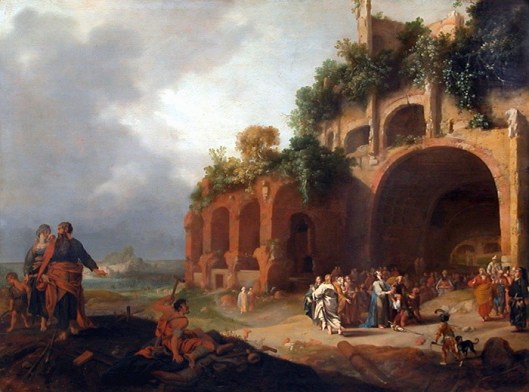
Jesus healing a deaf and mute man at Decapolis, by Bartholomeus Breenbergh, 1635
Last week, Bach gave his principal trumpet and horn player Gottfried Reiche a little break, but this week he needs him back: after the “old style” church motet opening chorus for Trinity 11, this week’s cantata for Trinity 12 opens with festive trumpets and timpani.
Listen to this cantata 69a Lobe den Herrn, meine Seele in the recording by Bach Collegium Japan on Spotify, with Toshio Shimada on trumpet.
Even though the text of the Gospel for this Sunday, the story of Jesus healing a deaf and mute man, is a jubilant one, it is still unusual that for a “regular” Sunday Bach would use three trumpets and timpani in the orchestra. Had the council complained about him teaching too much of his stern theology, being too somber, in the past cantatas? Was perhaps Anna Magdalena’s father (the principal trumpeter at the court of Saxe-Weissenfels, and most probably a friend of Reiche, who was from that same region) in Leipzig to see his daughter and grandkids, and wanted to play in the orchestra with his friend? Again, all good material for a movie script …
In his journal of their cantata pilgrimage in 2000, John Eliot Gardiner writes that the trumpet part in the opening chorus makes him think of the last seven bars of the Cum Sancto Spiritu from the Mass in B minor. I agree, but the start of this opening chorus also really makes me think back to cantata 147 for the feast of the Visitation of Mary on July 2.
Just like last week’s cantata, and many other cantatas from this period, today’s composition ended up in Bach’s top 15, in the sense that he re-used it many times afterwards, and reworked it into important other works. In this case he changed the tenor aria with oboe da caccia and recorder into an alto aria for oboe and violin for a performance in 1727, and reworked the entire cantata into a celebratory cantata for the re-election of the council in 1749 (BWV 69).
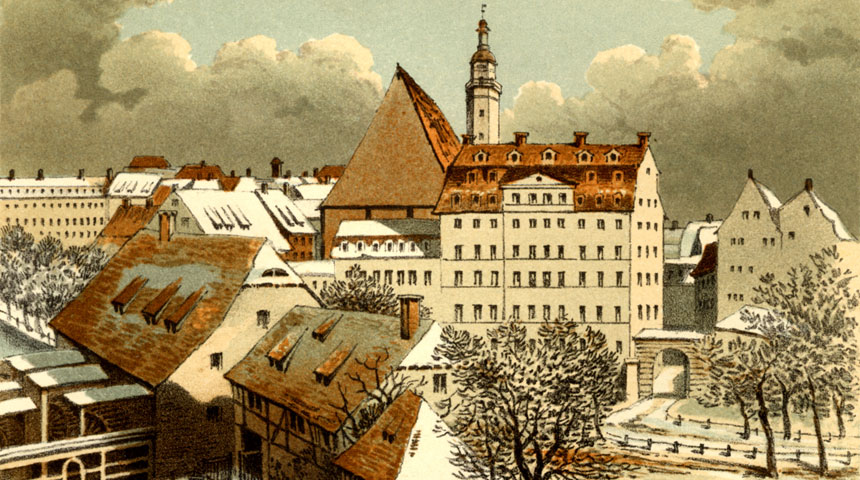
Mendelssohn’s sketch of the Thomasschule (St. Thomas School) and, behind it, the Thomaskirche (St. Thomas Church) in Leipzig.
Thank you for following this blog, and thank you for reading this long post all the way to the end!
For Trinity 11 (August 8 in 1723), we’re listening to Cantata179 Siehe zu, daß deine Gottesfurcht nicht Heuchelei sei, with a superb opening chorus and one of the most beautiful soprano arias Bach ever wrote.
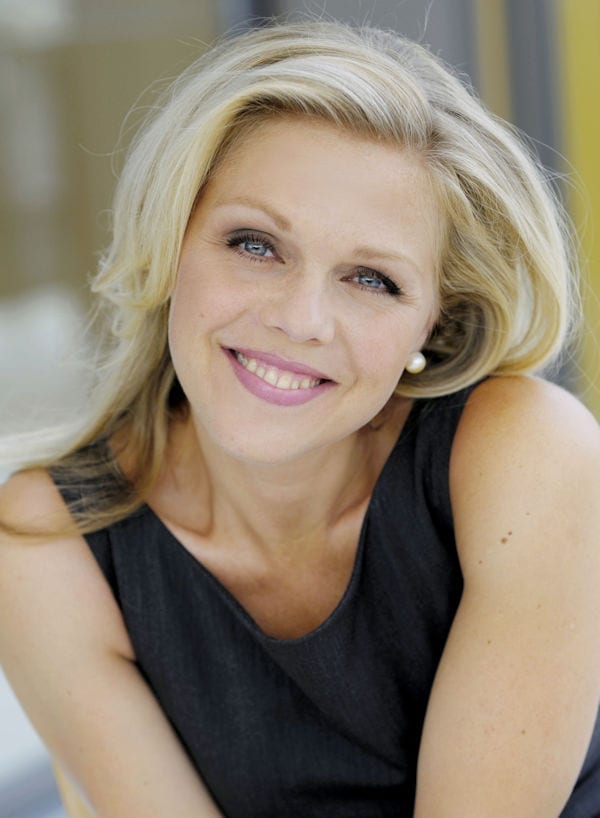
Miah Persson. Photo by Monika Rittershaus.
I prefer Bach Collegium Japan’s recording of this cantata. It’s a special recording, with Miah Persson singing the soprano aria. She’s having quite a career now, so I think we’re lucky to have her beautiful voice and sensitive interpretation on this recording from 1999. You can find it on Youtube or Spotify. Please consider purchasing this recording on jpc.de, Amazon, or iTunes. Soloists on this recording are Miah Persson, soprano; Makoto Sakurada, tenor; and Peter Kooij, bass.
Please find the score here (it’s fun to read along with the recording, especially in the opening chorus, to see what Bach does with the fugue) and the German text with English translation here.
It is now more than two months since Bach started his new job in Leipzig, and he is about three weeks into writing a brand new composition every week, and I’m sorry if I sound too casual here, but he’s on a roll. He must now have a vision of what it is he really wants to do for these churches (see the tiny preludes to his Passions he incorporates in cantatas 105 and 46), and he must have the classes at the St. Thomas School organized, and his singers sufficiently trained, so that he can now have them sing a new and challenging opening chorus every week. Just listening to the opening choruses alone, starting with the one of cantata 136 for Trinity 8, I marvel at what he comes up with every time. Every single one of them is stunning, but at the same time completely different from the one of the previous Sunday. This time Bach chooses to write a perfect “old style” (Palestrina-style) motet fugue as opening chorus.
As always, to fully understand the cantata and not miss any of Bach’s hidden messages, it is important to look at the Gospel reading for the day. In this case it is the parable of the Pharisee and the Publican (or Pharisee and the Tax Collector), a story Jesus tells as an illustration on how to pray: the Pharisee is full of himself, telling God how good he is, while the Publican in his own prayer merely asks for mercy, and tells God how bad he is. This concept of “how to be a good Christian before God” was very important to Bach and apparently his librettist got the message loud and clear. He or she uses the opportunity to first write a strong protest against fake religion and hypocrisy in “Christianity today” in movements 1 to 3 (probably having certain people in Leipzig in mind), after which he/she states that all Christians should take the humbleness of the publican as example in movements 4 to 6. For another example of how Bach interprets this Bible story, read my post about Cantata 113, written for this same 11th Sunday after Trinity, in 1724.
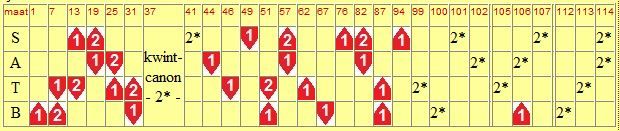
The most special feature of the fugue in the opening chorus is that since the text talks about beautiful outer appearance versus a bad character, Bach uses a mirror-fugue, which he used as well in fugues 5-7 from the Art of the Fugue (the theme of six bars is first introduced by the basses, and then is answered by the tenors in an “inversion:” every step up from the basses becomes a step down in the tenor part.)
To understand how Bach built this intricate fugue I am sharing the excellent music example and diagram by Dutch Bach writer Eduard van Hengel, with his permission:
Even though the text here is in Dutch, the diagram speaks for itself, with this quick explanation of the numbers and symbols:
1 = The theme (or first half-sentence of the text: Siehe zu, dass deine Gottesfurcht nicht Heuchelei sei). Note the ascending line on the word “Gottesfurcht” (fear of God/love of God) and the descending line on the word “Heuchelei” (hypocrisy).
2 = The counter-subject (or second half-sentence of this text: und diene Gott nicht mit falschem Herzen). Note here that there is a chromatic line every time the word “falschem” appears in the text: for the chromatic line the composers needs accidentals that are not part of the key the piece is written in, which in the “old polyphony” would be seen as “falsch” (not right, off-key).
2* = a more compact (only 4 bars instead of 6 bars long) theme which is derived from the first counterpoint/counter-subject on the words und diene Gott nicht mit falschem Herzen, still with the chromatic line on falschem Herzen.
The numbers at the top are measure (“maat”) numbers.
Bach himself must have greatly valued this cantata. About 15 years later, he used no less than three movements from this cantata for use in his short masses, or Lutheran masses.**
The opening chorus was later “recycled” as the first movement (Kyrie) in the Mass in G Major, BWV 236. Keep listening, or scroll to 18:00 and you’ll discover that the tenor aria Quoniam (sung here by Thomas Hobbs) was, with some changes and a much slower tempo, recycled from the tenor aria in this cantata 179. In cantata 179 the tenor aria gets a colorful accompaniment of two oboes and first violins in unison. The second violins and violas fill in the meaningless middle part (representing the “nothingness, emptiness”). When recycling this later for the Quoniam in the Mass in G Major, Bach uses only one solo oboe for the accompaniment, and completely leaves out all strings (confirming that with a different text, the meaningless middle part is not relevant anymore).
This cantata’s wonderful soprano aria (with two oboi da caccia and basso continuo) was later reworked into the Qui Tollis for the Mass in A Major, BWV 234 (with two flutes and only high strings as continuo). This was actually how I first knew and loved this soprano aria, I didn’t know cantata 179 until I started listening to it for this blog. Please click on this link and listen to the amazing Agnès Mellon sing the Qui Tollis from the Mass in A Major.
Wieneke Gorter, August 14, 2016, links updated August 15, 2023.
** These are called “short” or “Lutheran” masses because they consisted of only the Kyrie and Gloria part of the traditional Catholic mass. Bach wrote four of them (BWV 233-236), and they are all made up of existing movements from cantatas, but reworked and compiled in a very smart way and they are all absolutely beautiful. You can purchase an album with Herreweghe’s recording of all of them on jpc.de, iTunes, or Amazon.
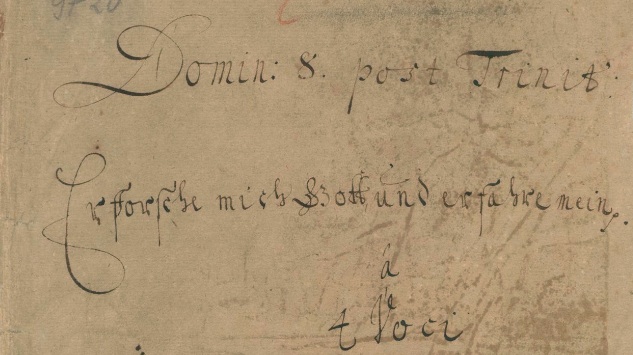
Excerpt from the title page of the manuscript, Staatsbibliothek zu Berlin, Preußischer Kulturbesitz
Previously on Weekly Cantata: Beginning on May 30, 1723 (the first Sunday after Trinity) Bach presented a long cantata of 10 to 14 movements each to the Leipzig congregations every Sunday, including cantatas for the special occasions of St. John (Johannis) on June 24 and the Visitation of Mary (Mariä Heimsuchung) on July 2.
However, only a few of these were newly written in Leipzig. The first two cantatas (75 for Trinity 1 and 76 for Trinity 2) were new, but he had probably already prepared them in Köthen, before moving to Leipzig.* For several weeks after that, he wrote almost no new works, but “recycled” creations from his Weimar period, adding recitatives and sometimes changing aria texts to make them better suited for the specific Gospel readings in Leipzig, and adding chorales to make them longer. The only two new works he wrote in Leipzig in those first months were the “additional” cantata 24 for Trinity 4 and the modest cantata 167 for St. John.
With the exception of cantata 167, all cantatas in the first seven weeks after Trinity were 10 to 14 movements long, divided over two parts, one before the sermon, one after.
What changed for this 8th Sunday after Trinity in 1723 (July 18, 1723) was not that Bach stopped recycling older works—scholars think that this cantata 136 Erforsche mich, Gott, und erfahre mein Herz most probably was an assembly of several different unknown compositions from Köthen**–– but that the cantatas became significantly shorter in length: starting with this one for Trinity 8, cantatas will generally be only around six movements long. We don’t know the reason for this: an order or request from the Leipzig Council, Bach’s own decision that it would be too much work to write such a long work every week, or Bach’s experience that the notable members of the congregation would not actually arrive in the church until right before the sermon?
For this cantata 136 Erforsche mich, Gott, und erfahre mein Herz, I prefer the recording by Bach Collegium Japan, because of their interpretation of the opening chorus, alto aria (with one of my favorite countertenors, Kai Wessel), bass recitative (excellent job by Peter Kooij), and tenor/bass duet (the voices of Makoto Sukurada and Peter Kooij are a wonderful match here). Listen to this recording on Spotify.
Read the German text with English translation of this cantata here. Find the score here.
About ten years later, Bach reworked the glorious music of the opening chorus of this cantata into the In Gloria Dei Patris, Amen of his short Mass in A Major (BWV 234). This entire opening chorus is terrific, already from the very beginning: before the fugue even starts, its theme already sounds in the horn part, and then in the soprano part.
The alto aria elaborates on the Doomsday which was already announced three times in the tenor recitative. To make the vocal part of this aria sound a bit more threatening, Bach composed a new, fast middle part for the Leipzig performance. I enjoy listening to Kai Wessel’s voice, which is deep and clear at the same time, and this aria truly showcases his talent and skills.
At first, the closing chorale seems like a normal, “simple” setting, the way it will be in most cantatas after this, but when you pay a bit more attention, you’ll hear that the first violins play a beautiful ornamental part which floats over the vocal lines.
Wieneke Gorter, July 16, 2016, updated August 1, 2020.
*The paper of the manuscripts has been declared “non-Leipzig” paper by the researchers, and the compositions have many similarities and cross-references. Read more about this in the posts about cantata 75 and cantata 76.
**The manuscript is written very neatly, as if existing work was being copied, the opening chorus doesn’t really match the rest of the work in style or key, and the tenor-bass duet is very similar in style to the secular cantatas Bach wrote for the Köthen court.
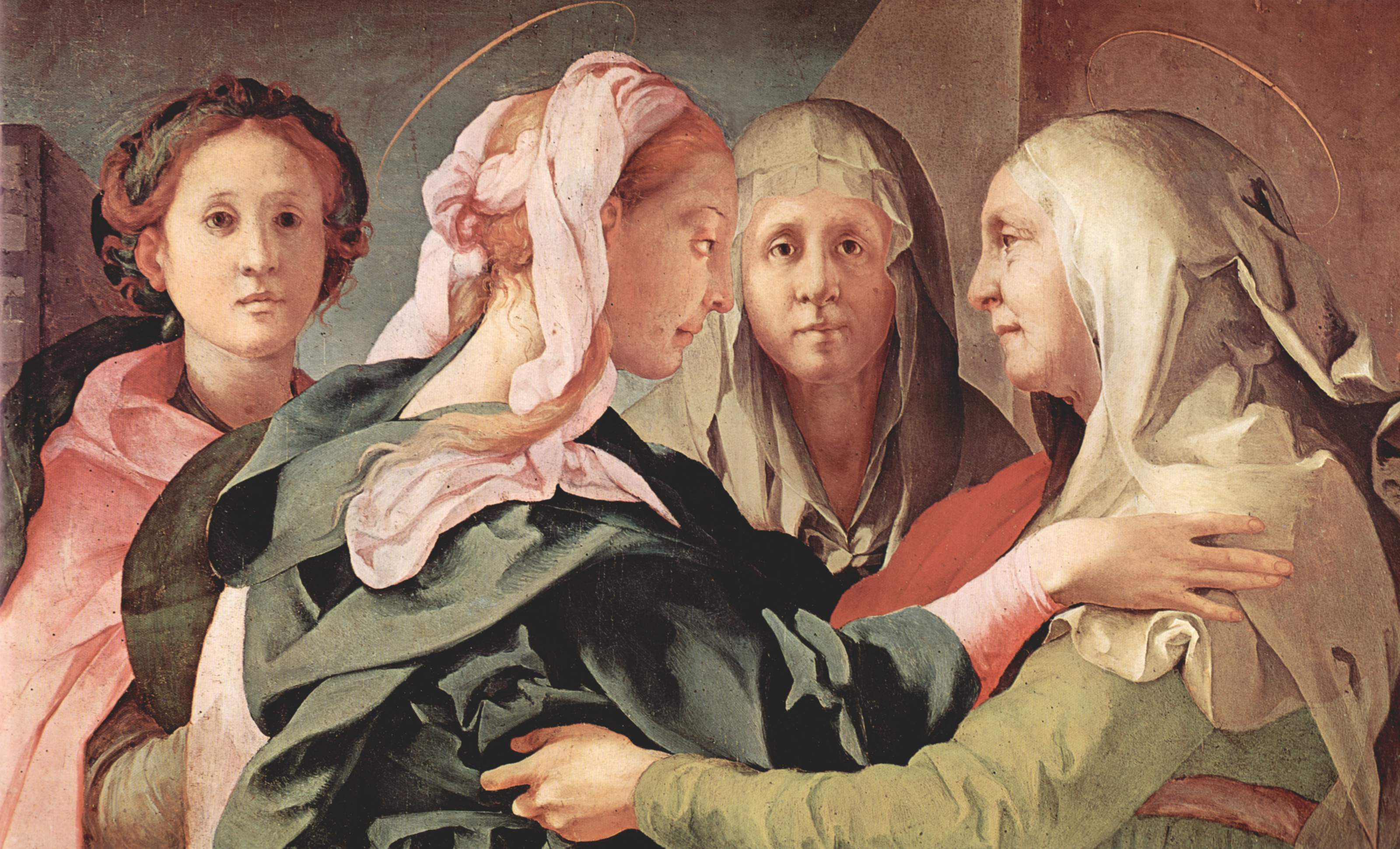
The Visitation, by Jacopo Pontormo, ca. 1528, at the Church of San Francesco e Michele, Carmignano, Italy.
On July 2, eight days after Johannis(St. John, the birthday of John the Baptist), the churches in Leipzig celebrated Mariä Heimsuchung (or Visitation of Mary, celebrating the story of a newly pregnant Mary going “back home” to visit her relative Elizabeth, who was six months further along, carrying John the Baptist). It is one of the few Marian feast days the Lutheran Church kept on their calendar, and which is still celebrated on July 2.*
For this holiday in 1723, Bach reworked a short Advent cantata from Weimar into a longer, two-part cantata, with a chorale at the end of each half. This cantata 147, Herz und Mund und Tat und Leben is a truly beautiful and memorable cantata, and for many more reasons than just the famous closing chorale Jesus bleibet meine Freude. What actually stands out the most for me is the incredible trumpet part in the opening chorus and the bass aria, and the beautiful violin accompaniment of the gorgeous soprano aria. All these movements are from the original Weimar composition, which contained only the arias, the opening chorus, and a different closing chorale (we don’t know which one). For the Leipzig performance, Bach changed the order of the arias, added recitatives to reflect the Gospel reading of the story of the visitation and Mary’s praise to God (the Magnificat), and added a new closing chorale at the end of each half of the cantata.
I recommend the recording by Bach Collegium Japan of this cantata 147 Herz und Mund und Tat und Leben, with wonderful singing by soprano Yukari Nohoshita, countertenor Robin Blaze, tenor Gerd Türk, an excellent performance by bass Peter Kooy, and fabulous playing by Toshio Shimada (trumpet) and Ryo Terakado (violin). Listen to this recording on Spotify.
Support the artists and purchase this CD on Amazon.
If you don’t have access to Spotify, or would love to watch a live performance, I recommend the YouTube video by the J.S. Bach Foundation (Bach Stiftung), with with Hana Blažiková, soprano; Margot Oitzinger, alto; Jakob Pilgram, tenor; and Wolf Matthias Friedrich, bass.
Follow the German text with English translations here.
Continuing on the path of the wild hypothesis I made last week, that many of Bach’s colleagues and students would be in town for these two weeks of holidays, let’s now imagine that many of these visitors were playing in the orchestra for this week’s cantata, thus creating a situation where all orchestra seats were filled, and the musically gifted among the choir boys could actually sing in the choir. Of course I don’t know if this is what happened, and if Bach maybe even planned it this way, but I hope you’ll allow me this indulgence. (We do know from later letters that choir members often had to fill the many vacancies in the orchestra).
Several scholars have suggested that Bach recycled/reworked so many of his Weimar cantatas in the first months in Leipzig because he was overwhelmed. But what if he just really wanted to show off these Weimar cantatas to the Leipzig congregation? Especially the ones originally written for Advent, since he knew he would not be able to perform those in Leipzig at all. (No figural music was allowed during Advent in Leipzig). What if he hadn’t found a librettist yet in Leipzig who matched the talent of Weimar court poet Salomo Franck? What if he wanted to show off the talent and skills of his first trumpet player in Leipzig, the famous Gottfried Reiche, to all the visitors who were in town for this holiday? When we see cantata movements returning in the form of movements of his Lutheran Masses, his Mass in B minor, and repeat performances in Leipzig, we say “he must have been proud of that piece.” Well, when I hear the opening chorus and the arias of Herz und Mund und Tat und Leben, I can understand why the Duke in Weimar didn’t want to let Bach go. Those movements already composed in Weimar are exciting and deeply moving at the same time. Definitely something to be proud of.
We don’t know who the librettist of the new recitatives was, but he or she did a good Lutheran job of teaching the congregation that even though they were celebrating a Marian feast day, they should really not praise her too much, but praise Jesus instead. Bach did an even better job setting these recitatives to music. Listen to all the word painting in the bass recitative, and the musical illustration of the text Er wird bewegt, er hüpft und springet(he is moved, he leaps and jumps) in the alto recitative, describing how John moved in Elizabeth’s womb upon hearing Mary talk of Jesus. The other remarkable thing about this alto recitative is that it has an accompaniment by two oboi da caccia, as Bach would later use in his St. Matthew Passion.
Gottfried Reiche, principal trumpeter in Leipzig until 1734.
Wieneke Gorter, July 2, 2016.
*In 1969, the Catholic Church moved this day to May 31, after they realized that it is strange to celebrate a mother (Elizabeth) being pregnant after celebrating the birth of her son (John the Baptist), but the Lutheran Church has kept the feast day on July 2.
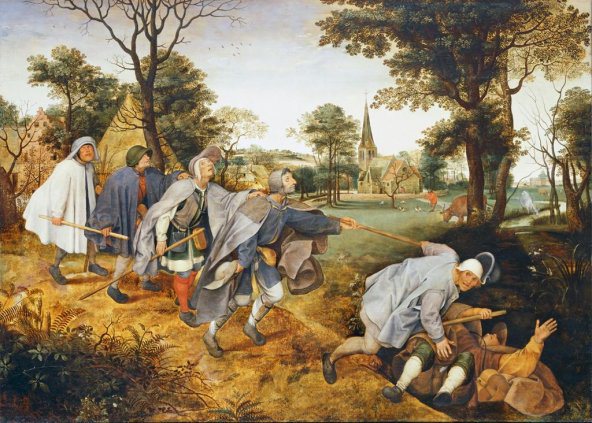
Pieter Brueghel the Elder: The Parable of the Blind Leading the Blind, 1568
Previously on Weekly Cantata: For his first three Sundays in Leipzig, Bach presented ambitious, two-part cantatas, the first part before the sermon, the second part after. On this Trinity 4, June 20 1723, the congregation and the musicians in Leipzig may still have had the trumpets and timpani from the impressive closing chorus of last week’s Ich hatte viel Bekümmernisgoing through their heads.
Up until now, it seems to all have been part of a plan: Bach probably wrote his cantatas for Trinity 1 (cantata 75) and Trinity 2 (cantata 76) while still living in Köthen, and most likely had also been planning all along to perform cantata 21 on Trinity 3. *
But now what to do for Trinity 4? In his stack of Weimar cantata manuscripts there was a nice one, very closely referring to the Gospel for the day (Luke 6: 36-42), but it was too short, and not very impressively scored.
So, it was time to write a new cantata that could function as Part I, the part before the sermon, and then present the one from Weimar after the sermon, as part II. This newly composed piece became cantata 24 Ein ungefärbt Gemüte. Only four weeks into his new post at Leipzig, and possibly up to his ears in getting things organized at the St. Thomas School, Bach had not had the time (or the social intelligence, we don’t know) to find a librettist, so for this cantata he used a pre-existing text by Erdmann Neumeister, a Leipzig-trained theologian, who was preaching at the St. Jacob church in Hamburg from 1715 to 1756. Bach may very well have met him there, since this was the same church where he applied for the post of cantor and organist in 1720. Neumeister’s many volumes of cantata texts were published in the early 1700s, and through the excellent library at the castle in Weimar Bach might have had access to these too, as he already used a Neumeister text for his Weimar Advent cantata 61 from 1714.
The recording of cantata 24 Ein ungefärbt Gemüte I like the best is Bach Collegium Japan’s recording, with beautiful singing by countertenor Robin Blaze and tenor Gerd Türk in the arias. Listen to this cantata on Spotify, or purchase the album on Amazon. Read the German texts with English translations here.
Though on a much smaller scale than cantata 75 from three weeks ago, this cantata 24 again displays a wonderful symmetry: Bach emphasizes that the main message “Everything that you want other people to do to you, you should do yourself for them” is at the center of the cantata text. He sets that part of the text to an intricate choral piece with the fullest instrumentation of the entire cantata, including trumpet, and scores the arias and recitatives around this main message much more soberly. In the two recitatives, Bach accentuates the words at the end of each by letting the music blossom out into an arioso in those spots. This happens on this text in the tenor recitative:
Mach aus dir selbst ein solches Bild (Make yourself such an image)
Wie du den Nächsten haben willt! (As you want your neighbour to have)
and in the bass recitative on these words:
So geht es dort, so geht es hier. (These things go on here, there and everywhere.)
Der liebe Gott behüte mich dafür! (That the dear God preserve me from this!)
Then comes Part Two, cantata 185 Barmherziges Herze der ewigen Liebe, written in Weimar in 1715. For this 1723 Leipzig re-creation of it, Bach transposed it from F sharp minor to G minor, since the tuning in Weimar was different than in Leipzig, and had a trumpet play the chorale tune in the opening duet, instead of an oboe.
Of all the recordings I listened to, only Gardiner brings to life the opening duet of this Leipzig version of cantata 185, with a trumpet playing instead of an oboe. Listen to a recording of that first movement by Gardiner, with soprano Magdalena Kozena and tenor Paul Agnew, on YouTube. However, for the wonderful alto rectitative and aria that come next, as well as the bass recitative and aria, I feel the need to switch to Koopman’s recording, with countertenor Kai Wessel and bass Klaus Mertens. Listen to this recording on YouTube, starting with the alto recitative (when you click on this link, it starts at 4m1s into the cantata).
I am too much of a countertenor lover to pass up this heavenly singing by Kai Wessel for Nathalie Stutzmann on the Gardiner recording, but I realize others might prefer it the other way around. I’m also not completely convinced by Gardiner’s argument that Bach is imitating an irritating Weimar preacher in the bass recitative and aria, so while Gardiner’s bass soloist Nicolas Testé very skillfully portrays this interpretation, it is a bit overdone to my taste.
So why not listen to the entire Koopman recording of this cantata? Well, there’s the strange opening duet: Koopman makes the surprising choice to have the choir sopranos sing the chorale melody with text instead of having an oboe (per the Weimar version) or a trumpet (per the Leipzig version) play that part. This decision is not explained in their liner notes. And while I like soprano Barbara Schlick’s and tenor Guy de Mey’s individual voices, I feel that Schlick’s voice outbalances De Mey’s on this recording.
One wonders: was the new job as teacher at the St. Thomas School and director of the choir a bit overwhelming for Bach, or was he by this time already getting frustrated with the lack of skill and talent among the choir boys? A few years later, he would complain to the council that there weren’t enough strong voices, and that he needed the good instrumentalists among them to fill the many vacant seats in the orchestra, and could thus not use them in the choir. It is interesting to see how, after the many challenging choral pieces in cantata 21 last week, there is only one polyphonic chorus part in the combined cantatas for today, and only an embellished chorale in the cantata for the feast of St. John the Baptist Bach was preparing for June 24.
Wieneke Gorter, June 18, 2016
*Please note: the numbers we use now for these cantatas are a product of the 19th and 20th century. Bach never gave his compositions numbers, and he must have referred to the cantatas by title only.
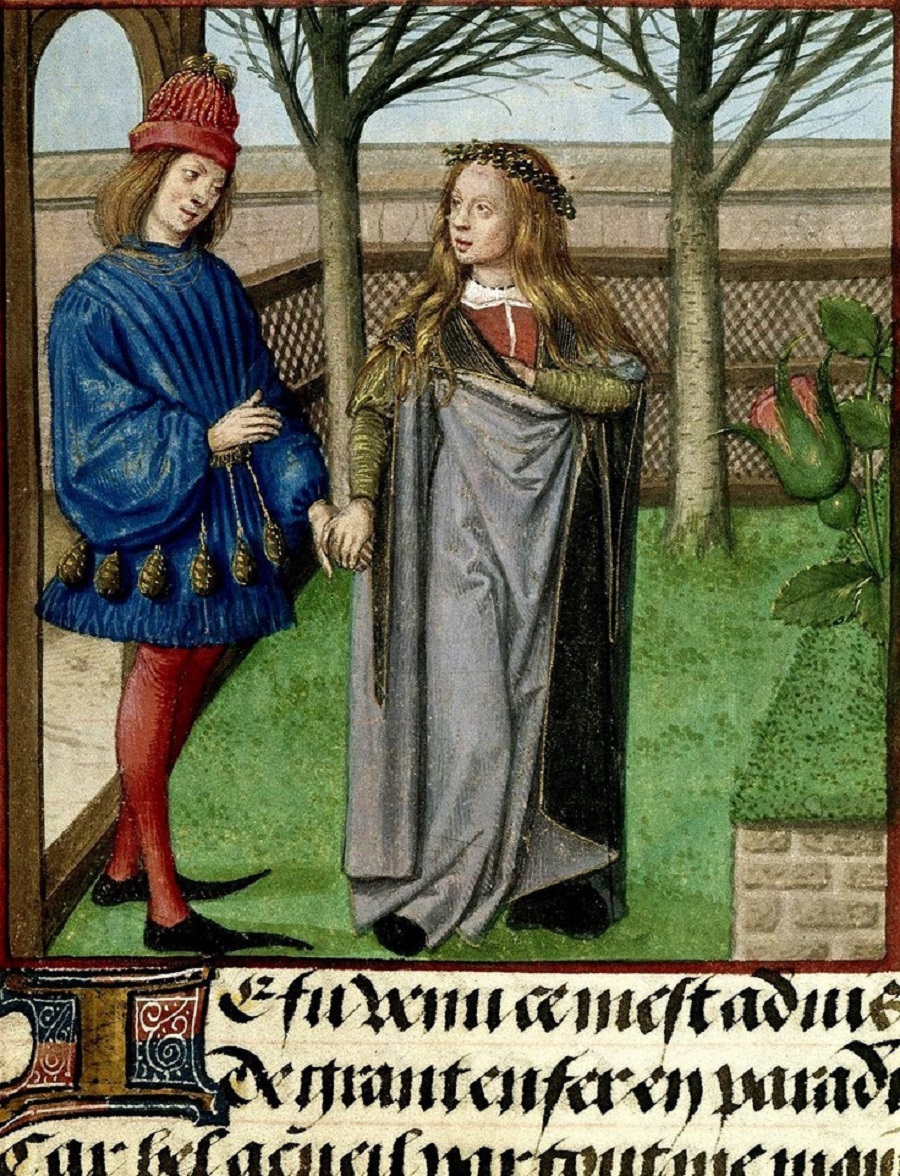
Roman de la Rose, Netherlands (Bruges), c. 1490-c. 1500
Only three episodes into this special 1723 Leipzig Trinity season series, I’m already taking a detour to Weimar. It’s Bach’s fault, because, after the two newly written cantatas he presented on May 30 and June 6, 1723, he “recycled” his Weimar cantata for this third Sunday after Trinity: cantata 21 Ich hatte viel Bekümmernis, written in 1714, or possibly in 1713.
We dont’ know for sure why Bach chose to use an “old” composition this early in his first season (though probably nobody except his own family knew it was not new), but I think that he couldn’t wait to impress the Leipzig Council and congregation with a composition that was one of his all-time favorites. He had written and performed it at least twice in Weimar, then presented it in Hamburg or Köthen in 1720* and would perform it many more times in Leipzig on future third Sundays after Trinity. Another reason I believe it was Bach’s plan all along to present this cantata 21 on Trinity 3 in Leipzig: it seems to me that when writing the masterful fugue in the opening chorus of cantata 76, Bach must have had the fugue in no. 6 of cantata 21 on his mind.
Whether it was thanks to the multiple performances during Bach’s lifetime, or to Mattheson mentioning it (however unfavorably!) in his writings, cantata 21 was known among Bach’s colleagues and students throughout the 18th and 19th centuries, and is still one of the most well-known and most frequently performed cantatas today.
Instead of talking about the music, I would like to shine some light on the history of this cantata, and show you that it was not a stand-alone masterpiece that Bach created out of nothing. Most of the findings here below are from books by Alfred Dürr and Christoph Wolff.
There are parts of this cantata that fit extremely well within the style of the 1714 Weimar cantatas. To hear cantata 21 in this context, if you have time, before you listen to the sinfonia (no. 1) of cantata 21, I invite you to first listen to the sinfonia of cantata 12. They are remarkably similar. Next, just for the fun of it, you might want to listen to the “love” duet from Weimar Pentecost cantata 172 (beautifully sung by soprano Dorothee Mields and countertenor Alex Potter during a streamed concert from 2021)
Soprano (Soul)
Komm, laß mich nicht länger warten, Come , let me wait no longer,
Komm, du sanfter Himmelswind, come, you gentle wind of heaven,
Wehe durch den Herzensgarten! blow through the garden of my heart
Alto (Holy Spirit)
Ich erquicke dich, mein Kind. I refresh you, my child
Liebste Liebe, die so süße, Dearest love, who are so delightful,
Aller Wollust Überfluß, abundance of all joys,
Ich vergeh, wenn ich dich misse. I shall die, if I have to be without you
Nimm von mir den Gnadenkuß. Take from me the kiss of grace.
Sei im Glauben mir willkommen, Welcome in faith to me,
Höchste Liebe, komm herein! Highest love, come within!
Du hast mir das Herz genommen. You have taken my heart from me
Ich bin dein, und du bist mein! I am yours, and you are mine!
and compare it to the “love” duet from cantata 21:
Soprano (Soul):
Komm, mein Jesu, und erquicke,
Bass (Jesus):
Ja, ich komme und erquicke
Come, my Jesus, and restore
Yes, I come and restore
Und erfreu mit deinem Blicke.
Dich mit meinem Gnadenblicker,
and rejoice with your look
you with my look of grace
Diese Seele,
Deine Seele,
This soul
Your soul
Die soll sterben,
Die soll leben,
that must die
that must live
Und nicht leben
Und nicht sterben
and not live
and not die
Und in ihrer Unglückshöhle
Hier aus dieser wunden Höhle
and in its den of misfortune
here from this den of wounds
Ganz verderben.
Sollst du erben
wholly perish.
you shall be given
Ich muß stets in Kummer schweben,
Heil! durch diesen Saft der Reben,
I must always be suspended in misery
Salvation! throught this juice of the grape
Ja, ach ja, ich bin verloren!
Nein, ach nein, du bist erkoren!
Yes, oh, yes, I am lost
No,oh, no, you are chosen
Nein, ach nein, du hassest mich!
Ja, ach ja, ich liebe dich!
No, ah, no, you hate me!
Yes, oh, yes,I love you!
Ach, Jesu, durchsüße mir Seele und Herze,
Entweichet, ihr Sorgen, verschwinde, du Schmerze!
Jesus, sweeten my soul and heart.
Give way, worries, vanish, pain!
Komm, mein Jesus, und erquicke
Ja, ich komme und erquicke
Come, Jesus, and restore
Yes, I come and restore
Mit deinem Gnadenblicke!
Dich mit meinem Gnadenblicke
with your look of grace
you with my look of grace.
Of course none of these are officially meant to speak of earthly love. But still, both these duets are extremely cute, musically completely similar to opera love duets from that time, and their texts could at least partly be interpreted as such love duets, so I can imagine the Weimar poet and the young Bach must have enjoyed writing these.
To really appreciate “the making of” the opening chorus (no. 2) of cantata 21, it’s worth listening to a magnificent Vivialdi violin concerto and one of Bach’s lesser known organ prelude and fugues, to hear where Bach found the theme for the Ich hatte viel Bekümmernis fugue:
In the spring of 1713, the half-brother of Bach’s employer in Weimar, prince Johann Ernst, “a great lover of music and an incomparable violinist” (according to a testimony by Philipp David Kräuter, a student of Bach in Weimar) went on a study trip, and spent a long time in the Netherlands. Upon his return, he had brought “much fine Italian and French” music with him. One of the pieces was Vivaldi’s Concerto in D minor Opus 3, no. 11 for two violins from Book II of L’Estro armonico (RV 565), published in Amsterdam in 1711.
Listen to this Vivaldi concerto in the award-winning interpretation by the fabulous Rachel Podger with Brecon Baroque on Spotify, or on YouTube
Maybe Bach, an accomplished violinist himself, and the prince played this together after the prince returned in July 1713. Bach rewrote this Vivaldi concerto into an organ concerto (BWV 596), but also used the theme in his organ prelude and fugue in B minor, BWV 544, written in Weimar as well. It is in this piece in particular that I can hear the relation with cantata 21 Dürr wants to point out in his book.
About recordings of cantata 21: While Bach Collegium Japan deserves a medal for taking the trouble to research all the different versions and record the ones from 1720 and 1714 on their volume 6 , and the true 1723 Leipzig version (with trombones added in no. 9 and solo/tutti distinctions in the choruses) on their volume 12, I still like Herreweghe’s recording of this cantata the best, mainly because of the strong, crisp choruses and the music always having long lines and strong sense of direction. Listen to Herreweghe’s interpretation of this cantata on Spotify or on YouTube.
Update from 2021: find an absolutely stunning performance of the 1720 version (with only soprano and bass soloists) on the YouTube channel of the J.S. Bach Foundation here.
Read the German text with English translations of cantata 21 here, and find the score here.
If you don’t want to miss an episode of this 1723 Trinity season series, please consider signing up to receive an email every time I’ve posted a new story.
Please feel free to share this on Facebook, or forward to anyone you think might enjoy coming along for this ride. Thank you!
Wieneke Gorter, June 12, 2016. Updated June 19, 2021.
*Bach visited Hamburg in November 1720, to apply for an organist and cantor post there. It turned out, however, that the post needed to be “bought” and the job went to a lesser talented but wealthy candidate. Most scholars are confident there was a performance of this cantata in 1720 in either Köthen or Hamburg, based on the surviving manuscripts of the parts. Because it was the Hamburg-based writer Mattheson who criticized the cantata in a letter in 1725, it is probable that the performance took place in Hamburg during Bach’s visit there.
According to Bach Collegium Japan’s leader Masaaki Suzuki, the 1720 performance featured only a soprano and a bass, with the soprano also singing all the arias and recitatives we know nowadays as written for tenor.
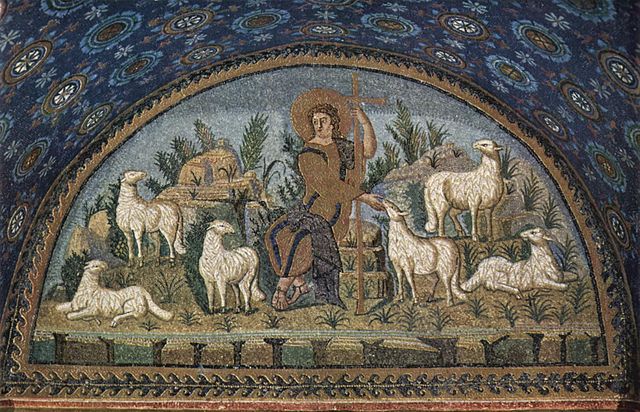
The Good Shepherd, mosaic in the Mausoleum of Galla Placidia, Ravenna, 1st half of the 5th century
There are three beautiful cantatas for this second Sunday after Easter, or “Misericordias Domini” Sunday: BWV 104, 85, and 112. Illustrating the “good shepherd” scripture for this Sunday (John 10, verse 12-16), Bach incorporated pastoral themes or orchestration in each of these cantatas.*
I’ve decided to focus on cantata 85 Ich bin ein guter Hirt, written for April 15, 1725. Of all three cantatas, this is the one I remember the best from my childhood, because of the tenor aria “Seht, was die Liebe tut.” Also: Last week, I already mentioned the similarities between cantata 6 (for Easter Monday 1725), and cantata 42 (for the first Sunday after Easter 1725). This cantata 85 is the culmination of that “sub group” within the cantatas from 1725.
Which recording to listen to?
While I have good memories of hearing Kurth Equiluz sing the tenor aria on the Harnoncourt recording from 1977, I am enamored by Bach Collegium Japan’s recording of this cantata, and I think this is the best “overall” recording, featuring fabulous soloists Carolyn Sampson, Robin Blaze, Gerd Türk, and Peter Kooij. It is also one of the most noteworthy because of the use of a violoncello da spalla, played by Dmitry Badiarov.
Listen to Bach Collegium Japan’s recording of cantata 85 Ich bin ein guter Hirt on Spotify. Or better yet, if you can afford to financially support the artists (especially important now, while they have no income from performances!) please consider purchasing the digital versions of Bach Collegium Japan’s recording of cantata 85 on Amazon or on iTunes.
If you prefer to watch a live recording, there is a wonderful recording available on YouTube by the J.S. Bach Foundation. Soloists are Gerlinde Sämann, soprano; Terry Wey, alto; Georg Poplutz, tenor; Markus Volpert, bass; and Martin Zeller, violoncello piccolo.
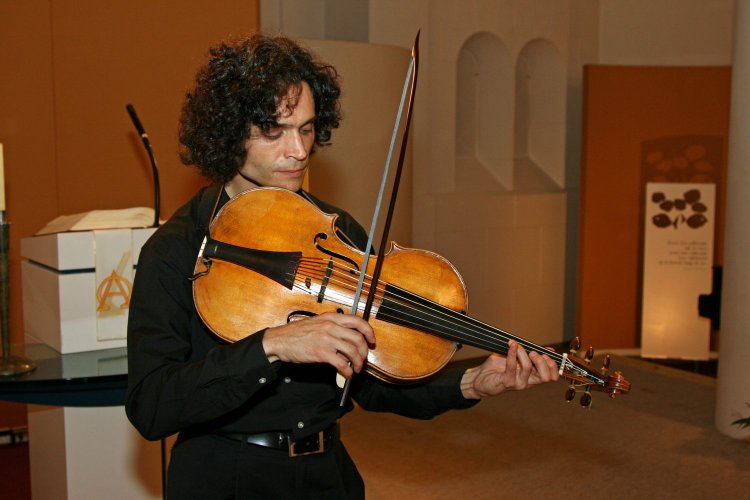
Back to the Bach Collegium Japan recording: After lovely and convincing singing by bass Peter Kooij in the opening arioso (Jesus saying “I am a good shepherd”), we get a sublime performance by countertenor Robin Blaze of the alto aria “Jesus ist ein guter Hirt,” which also features the unusual violoncello piccolo da spalla. Someone could probably write an entire PhD thesis on the difference between the violoncello piccolo “da spalla” (held on the shoulder, like a violin), and the violoncello piccolo “da gamba” (held between the legs, like a cello), and whether Bach meant the one or the other when he wrote a part for “violoncello piccolo.” Most recordings (Harnoncourt, Gardiner, Coin, Koopman, and J.S. Bach Foundation) feature the one held between the legs, but Bach Collegium Japan’s recording features the “da spalla” variety, played by the same person who built it in 2004, Dmitry Badiarov.
Dmitry Badiarov demonstrating the violoncello piccolo da spalla
Following this, we hear a radiant soprano solo chorale with oboe accompaniment (which makes me think back to the soprano solo chorale from cantata 6, in that case with the violoncello piccolo “da gamba”), beautifully sung by soprano Carolyn Sampson and expertly played by oboists Masamitsu San’nomiya and Atsuko Ozaki.
And when you didn’t think it could get any better, here comes a tenor recitative which in text and string accompaniment strongly refers to Jesus’ recitative from the St. Matthew Passion “Ich werde den Hirten schlagen, und die Schafe der Herde werden sich zerstreuen.” (Christ, having arrived at the Mount of Olives, reminds his disciples of the prophecy that the shepherd will be slain and the sheep will scatter).
With this only recitative in cantata 85, Bach has gotten everyone’s attention, so now we’re ready for the jewel in the crown of this cantata: the tenor aria “Seht, was die Liebe tut.” It is one of the most lyrical and lovely among all Bach’s tenor arias.
Seht, was die Liebe tut. See, what love does. Mein Jesus hält in guter Hut My Jesus in his own safekeeping Die Seinen feste eingeschlossen keeps those who are his own firmly enclosed Und hat am Kreuzesstamm vergossen and on the beam of the cross he hasshed Für sie sein teures Blut. for them his own precious blood.
Again there is a strong association with the St. Matthew Passion both in text and music. In his book Bach: Music in the Castle of Heaven Gardiner makes a very convincing case for his theory that Bach had wanted to perform the St. Matthew Passion on Good Friday 1725, only one year after the St. John Pasion. This didn’t happen because either the council disapproved, or Bach wasn’t ready composing the piece. If Bach had indeed been working on the St. Matthew Passion before Easter 1725, it is no wonder we’re getting glimpses of that monumental work in his cantatas after Easter 1725.
Wieneke Gorter, April 9, 2016, updated April 26, 2020
*I wrote about Cantata 104 for the Second Sunday after Easter in 1724 in this blog post.
The Storm on the Sea of Galilee by Rembrandt van Rijn, 1633. Formerly at the Isabella Stuart Gardner Museum, Boston, USA. Stolen in 1990.
Cantata 81 Jesus schläft, was soll ich hoffen? from 1724 closely follows the reading for the 4th Sunday after Epiphany: the story of Jesus calming the storm on the sea of Galilee.
In combining masterful text illustration with his theology, Bach presents a powerful drama rivaling a Handel opera. And I was lucky to find two conductors especially not shy of the opera-element in this cantata: Harnoncourt and Gardiner. The recording from 1978 directed by Harnoncourt has a great sense of drama as well as good singing in all the movements. For me it is the most “overall” satisfying recording of this cantata. It was not an easy decision though this week, and the fact that I grew up with the Harnoncourt recording might of course have influenced my choice. Soloists: Paul Esswood, counter-tenor; Kurt Equiluz, tenor; Ruud van der Meer, bass.
If you have time to listen some more: The absolute best rendition of the spectacular tenor aria in my opinion appears on the Gardiner recording, with very convincing “waves” in the orchestra (at an even higher tempo than Harnoncourt) and truly marvelous singing by Paul Agnew. Listen to this aria on Spotify.
What to keep in mind when listening:
The reading for this 4th Sunday after Epiphany, from Matthew 8:
23. Und er trat in das Schiff, und seine Jünger folgeten ihm.
[23] And when he entered into a ship, his disciples followed him.
24. Und siehe, da erhub sich ein groß Ungestüm im Meer, also daß auch das Schifflein mit Wellen bedeckt ward; und er schlief.
[24] And, behold, there arose a great tempest in the sea, insomuch that the ship was covered with the waves: but he was asleep.
25. Und die Jünger traten zu ihm und weckten ihn auf und sprachen: HERR, hilf uns, wir verderben!
[25] And his disciples came to him, and awoke him, saying, Lord, save us: we perish.
26. Da sagte er zu ihnen: Ihr Kleingläubigen, warum seid ihr so furchtsam? Und stund auf und bedräuete den Wind und das Meer; da ward es ganz stille.
[26] And he saith unto them, Why are ye fearful, O ye of little faith? Then he arose, and rebuked the winds and the sea; and there was a great calm.
27. Die Menschen aber verwunderten sich und sprachen: Was ist das für ein Mann, daß ihm Wind und Meer gehorsam ist?
[27] But the men marvelled, saying, What manner of man is this, that even the winds and the sea obey him!
In Western Europe at Bach’s time, there was probably no insight yet that the “sea” in this bible story was actually a large sweet-water lake. Bach’s Lutheran bible talked of a sea, not a lake, and most paintings from the 16th and 17th centuries depict seagulls, cliffs, or port cities in the distance. Of course a storm can also develop on a large lake, but we have to assume that Bach and his librettist had a full-blown storm at sea in mind when writing this. Bach probably never witnessed one, but Gardiner says that one of the theologian books in Bach’s library featured a vivid commentary on this part of the gospel. That book’s author, Heinrich Müller, lived in Rostock, on the Baltic sea. And who knows what interpretations of a “tempesta di mare” by other composers Bach had heard at the opera in Hamburg or seen on copied music which traveling colleagues and students might have brought with them.
Already in the opening aria Bach combines opera with theology. The recorders illustrate the “sleeping” Jesus, but also the loneliness of a life without Jesus/without faith (Bach uses recorders for this purpose more often, for example in the O Schmerz tenor-aria from the St. Matthew Passion (when for a moment Jesus feels he has lost faith), as well as in the Sanfte soll mein Todeskummer tenor-aria from the Easter Oratorio). There is also some hint in the orchestra of the calm before the storm, underlining the anxiety of the question “Was soll ich hoffen?”
The big storm at sea manifests in the tenor aria, equal to a “rage” aria by Handel, with the orchestra and the singer imitating the rolling waves and wind.
Then enters Jesus in the bass arioso, asking his disciples, but also the believers in general, why they didn’t have faith. Dürr remarks that the music is like an “Invention” and is practically a bass duet, with the other “singer” being the continuo. This is also a pivotal point in the cantata, moving from the part without Jesus/faith (nos 1-3) to the part with Jesus/faith.
Another “storm aria” follows, sung by the bass, but this time the storm is somewhat quieting down, and the oboe lines paint a quieter mood. All this to illustrate that Jesus is calming the storm. The alto recitative states/confirms that Jesus has calmed the storm, and is with us, and the chorale (second verse of the beautiful Jesu meine Freude) is the final affirmation:
Unter deinen Schirmen Beneath your protection Bin ich für den Stürmen I am free from storms Aller Feinde frei. and all enemies. Laß den Satan wittern, Let Satan sniff around, Laß den Feind erbittern, let the enemy be exasperated Mir steht Jesus bei. Jesus stands by me. Ob es itzt gleich kracht und blitzt, Though there is thunder and lightning, Ob gleich Sünd und Hölle schrecken, though sin and hell terrify, Jesus will mich decken. Jesus will protect me.
Thank you for reading! Please leave your email address in the “follow this blog” section on the left side of this blog post. You will receive an email by WordPress whenever I have posted a new story. Please note that the choice of words and spelling in their confirmation email is by WordPress, not me. My apologies for that, and many thanks to you for your patience while I work on a more elegant solution!
Wieneke Gorter, January 31, 2016, links updated February 2, 2020
Christ cleansing a leper, Jean-Marie Melchior Doze, 1864
For this third Sunday after Epiphany, we find no less than four gems in Bach’s treasure trove: cantatas 73, 111, 72, and 156. I decided to highlight 73 and 72, because of the interesting references between the two. As far as we can tell, Bach loved these cantatas too: He performed cantata 73 at least one more time, and transcribed the opening chorus of cantata 72 into the Gloria of his Mass in G minor.
From the chronology of performances in Leipzig, it looks as if Bach wrote cantata 73 in 1724 and cantata 72 two years later. However, some scholars argue that (a large part of) cantata 72 was probably already written around 1715, since most of the poetry is from a collection Bach used when working in Weimar at that time. But whether 72 was first or 73 was first, it doesn’t matter that much for the appreciation of these two beautiful cantatas.
I have a soft spot for cantata 73 because I love the way Herreweghe performs this, have listened to the 1990 recording many times since it came out, and then to the (better!) 2013 recording. The best parts are the opening chorus and the bass aria (sung by Peter Kooy on both recordings) and I’m grateful for Eduard van Hengel’s Bach website (in Dutch) where I learned a lot about the many possible bits of reference in this cantata to other works.
soloists: Rachel Nicholls (one of the most “boy soprano”-like voices of the soprano soloists in that series, I love it), Robin Blaze (counter-tenor), Peter Kooy (bass)
The most important words from the Bible text for this third Sunday after Epiphany (the story of Jesus cleansing a leper, from the gospel of Matthew):
Da er aber vom Berg herabging, folgte ihm viel Volks nach. Und siehe, ein Aussätziger kam und betete ihn an und sprach: Herr, so du willst, kannst du mich wohl reinigen. Und Jesus streckte seine Hand aus, rührte ihn an und sprach: Ich will’s tun; sei gereinigt!
(When He had come down from the mountain, great multitudes followed Him. And behold, a leper came and worshiped Him, saying, Lord, if You are willing, You can make me clean. Then Jesus put out His hand and touched him, saying, I am willing; be cleansed.)
In the opening chorus: The illustration of the word “Alles” (Everything): one can hear all the instruments in the orchestra, and when the voices come in, they first jump an octave over two quarter notes, signifying all the possible notes in the chord, and then run up in 16th notes, singing every single note in the chord.
In the alto aria: nine times the words “Herr, so du willt” – make sure to remember this melody!
In the bass aria: the text is set in the third person, but it is almost as if Jesus himself is speaking here, and this is where the text moves to the “Ich will’s tun” (I will do it / I am willing) words from the gospel.
In the soprano aria*: the happy and sweet elaboration on the “Ich will’s tun” – which here turns into “my Jesus will do it!”
The closing chorale: the same text and tune Bach uses throughout cantata 111 for this same Sunday in 1725, as well as in the St. Matthew Passion (but in that case with different harmonies in the last four lines!)
Please note: these are two different Herreweghe recordings. The newest one, on Herreweghe’s own label, features a different soprano and tenor soloist than on his earlier recording of this same cantata (Virgin Classics, 1990, with soprano Barbara Schlick and tenor Howard Crook). I like this new one better. The entire CD is wonderful, and also features fabulous counter-tenor Damien Guillon in the other cantatas on the disc. If you like this recording, please consider supporting the artists by purchasing it on Amazon.
What to listen for in cantata 73:
In the opening chorus: the first four notes of the original chorale Herr, wie du willt, so schick’s mit mir in Leiden und Sterben, used as a four-note “Leitmotiv,” first appearing staccato in the horn in the orchestra:
and at the very end of the movement, homophonically in the choir, repeated three times, not something Bach normally does in cantata opening choruses:
In the bass aria: now the “Herr, wie du willt” from the chorale text turns in to “Herr, so du willt” from the gospel text. And to accentuate this, Bach again gives this text its own “Leitmotiv”-like melody. However, it might not have been a new melody. It is very similar to “Bist du bei mir” from Anna Magdalena’s music book. She wrote this aria in her book much later, but it was copied from an opera aria by Stölzel from 1717. Perhaps this opera aria was already being hummed in the Bach household in 1724, we will never know. Later in the bass aria in cantata 73, the “Herr, so du willt”-melody from the alto aria of cantata 72 returns!
What I love especially in this bass-aria is the illustration of “Leichenglocken” (death bells) by pizzicato strings and a somewhat “tolling” movement in the vocal part. My mother (a walking Bach encyclopedia who played a cantata on the turntable / CD player every Sunday) would always point features like this out to me. Bach used it in many other cantatas, for example in (cantata number/movement number): 8/1, 95/5, 105/4, 127/3, 161/4, 198/4. [Thanks again to Eduard van Hengel, I didn’t have to look this up myself].
* While overall I like Bach Collegium Japan’s recording of cantata 72 best, and I love how Rachel Nicholls sings the soprano aria, I would like to mention that on Montreal Baroque’s recording of this work, the soprano aria by Monika Mauch is excellent and worth listening to. How she makes everything calm on the words “sanft und still” is very special.
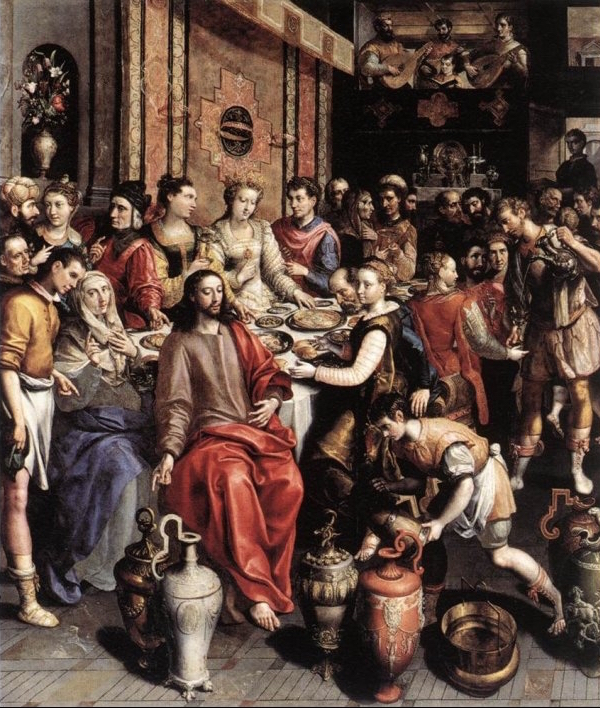
Marriage at Cana by Marten de Vos, 1597. Cathedral of Our Lady, Antwerp, Belgium.
Judging by the text and lamenting style of their opening choruses or opening arias, all cantatas for this Sunday (155, 3, and 13) are very sad at first glance. Which seems strange, since the reading for the day is the miracle of Jesus turning water into wine at the Marriage at Cana. So let’s dig a little deeper in the cantata for this Sunday that I love the most, Cantata 3 Ach Gott, wie manches Herzeleid, from 1725.
My favorite interpretation of this cantata the one by Bach Collegium Japan. The choir sopranos (including Dorothee Mields) sing a truly heavenly “zum Himmel” in the opening chorus, bass soloist Peter Kooy does an excellent job in his on purpose difficult aria and doesn’t hold back in the chorale tune in the opening chorus, and last but not least: fabulous singing by soprano Dorothee Mields and counter-tenor Pascal Bertin in the duet.
If you can’t listen on Spotify or prefer not to, you can find Gardiner’s recording here on YouTube. Soprano: Joanne Lunn; Counter-tenor: Richard Wyn Roberts; Tenor: Julian Podger; Bass: Gerald Finley.
Find the text of Cantata 3 Ach Gott, wie manches Herzeleidhere, and the score here.
Bach was not just a strong believer but also a self-taught theologian, and stated several times that his church music was intended for the glorification of God and to instruct his “neighbor.” On this day of the Marriage at Cana reading, he might have been compelled to illustrate the deeper meaning of the Bible story: earthly troubles can turn into heavenly bliss if you are patient and believe strongly enough that Jesus will lead you. So either he himself or his librettist decided not to mention the Bible story at all in the the text of this cantata.*
It is then not so strange anymore that in the music of this cantata Bach keeps, brilliantly, combining the struggle and the salvation in almost every part of the work.
The achingly beautiful opening chorus at first just sounds like a lament, but has some hidden messages which reveal the salvation. First, in the instrumental introduction, there is an ascending (the way to salvation/heaven) line in the violins at the same time as there is a chromatic descending line (the struggle/affliction) in the oboes, illustrating the last two lines of the text of that chorus:
Der schmale Weg ist trübsalvoll, (The narrow way is full of affliction) Den ich zum Himmel wandern soll. (by which I must travel to heaven.)
Click here to see that visualized by Thomas Braatz on the Bach Cantatas website.
While the Leipzig congregation might have missed this first hidden message, they would have gotten the second: the text communicated through the well-known chorale tune. The same way my Dutch calvinist great-grandmother had all the verses of all the Psalm texts memorized, the Lutherans in Bach’s time knew all their chorales and would immediately think of the text when hearing the tune. For this opening chorus, Bach chose the tune of O Jesu Christ mein’s Lebens Licht, so there was some glorification of Jesus right there amidst the lamentation:
O Jesu Christ mein’s Lebens Licht
Mein Hort, mein Trost, mein Zuversicht
Auf Erden bin ich nur ein Gast
Und drückt mich sehr der Sünden Last.
O Jesus Christ, light of my life,
my refuge, my comfort, my reassurance,
on earth I am only a guest And the burden of sin presses down heavily upon me.
And to make this stand out, Bach uses his “pay attention!” trick again, letting this chorale melody appear in a for him very unusual place: the vocal bass line. To emphasize it, he doubles it with a trombone (which is probably also the reason why this cantata is almost never performed today, because who is going to hire an expensive trombonist just to play along with the choir in one part of the cantata?).
In the other outstanding part of this cantata, the soprano/alto duet, this is all reversed: the music sounds absolutely happy, but if you look at the score, you see a visual illustration of the text in the middle section: Mein Kreuz hilft Jesus tragen (Jesus helps to bear my cross). When the oboe line goes up, the continuo line goes down, and when one vocal line goes up, the other vocal line goes down. On top of that, there are four sharps in the key signature (in Bach’s manuscript this would look like four crosses and a sharp is also called a “cross” in German). We know from other works that hidden messages like this are not a coincidence in Bach’s writing.
Wieneke Gorter, January 16, 2016. Links updated January 10, 2018 and January 31, 2020.
*Seen in the context of the chorale cantata series of 1724/1725, this is not unusual at all. On Several occasions before this Sunday in 1725, Bach had decided to focus more on the text of the chorale he had chosen for the cantata than on the Gospel reading for that day. See for example my post about December 31, 1724 and January 1, 1725.





 Weekly Cantata