Weekly Cantata

Weekly Cantata

Tag Archives: J.S. Bach Foundation

Starlight shining on a Trinity cantata

15 Sunday Oct 2017

Posted by cantatasonmymind in Cantatas, Chorale cantatas 1724/1725, Leipzig, Trinity

≈ Leave a comment

Tags

18th Sunday after Trinity, Bach, Bach Collegium Japan, Bachstiftung, BWV 103, BWV 96, Christmas, cornetto, Deborah York, Epiphany, flauto piccolo, flute, Franziska Gottwald, J.S. Bach Foundation, Jan Börner, Julius Pfeifer, Maurice Steger, Nik Tasarov, Noëmi Sohn-Nad, Paul Agnew, Peter Kooij, Peter Kooy, Rudolf Lutz, sopranino recorder, St. Thomas Church, Thomaskirche, Ton Koopman, Trinity 18, Wolf Matthias Friedrich

threekings
The Adoration of the Kings, circa 1440. From a series of four boards from the former High Altar of the Heilig-Kreuz-Münsters in Rottweil, Germany.

In the summer and fall of 1724, Bach wrote an entire series of chorale cantatas, meaning that each cantata was based on a hymn. If at all possible, it was to be a hymn associated with that particular Sunday in the church year.  For this 18th Sunday after Trinity, he chose Herr Christ, der einige Gottessohn (Lord Christ, the only son of God). Keep reading to learn why.

When I first wrote about this Cantata 96 Herr Christ, der einige Gottessohn, in 2017, I recommended Ton Koopman’s recording. Listen to that recording here on Amazon, or here on Spotify. (It is not available on YouTube). Soloists are: Deborah York, soprano; Franziska Gottwald, alto; Paul Agnew, tenor; Klaus Mertens, bass; Heiko ter Schegget, sopranino recorder; and Wilbert Hazelzet, transverse flute.

However, since then a wonderful live video registration by the J.S. Bach Foundation has come out: you can find that here on YouTube. This is a terrific recording as well, with the added bonus that you can see the sopranino recorder and all the other instruments. Soloists in this performance are: Noëmi Sohn, soprano; Jan Börner, alto; Julius Pfeifer, tenor; Wolf-Matthias Friedrich, bass; and Maurice Steger, sopranino recorder.

Find the German text with English translation here and the score here.

In the Lutheran Church the chorale Herr Christ, der einige Gottessohn, one of the oldest Protestant hymns, was not so much associated with this 18th Sunday after Trinity, but more with Epiphany/Three Kings (January 6), for its reference to the Morning Star. Bach brings the luster of the Christmas season into this cantata in the most beautiful way. He gives the opening chorus a dusting of starlight by writing a part for flauto piccolo, or sopranino recorder*, over the rest of the vocal and instrumental parts. Since this time it is the altos that have the chorale melody in the opening chorus, Bach can create an ethereal link between the chorus and the flauto piccolo by way of the soprano part in the chorus. In the fifth line of the text, Er ist die Morgensterne (he is the Morning Star), he modulates to the brilliant key of E Major on the word “Morgensterne.”

But why did Bach select this chorale for a Sunday in the Trinity season? It becomes a bit more clear in the alto recitative and tenor aria. They refer to the fact that Jesus is God’s son, not David’s son. This is the only direct reference to the Gospel reading for this Sunday: Jesus giving the Jewish elders a hard time after they had claimed that he was only David’s son, not God’s son (Matthew 22: 34-46).  In the tenor aria Bach features his star flute player again.

In the soprano recitative, the focus changes to Jesus as guiding light, referring to the “he is the Morning Star” text from the chorale. The soprano’s statement that it can be hard to stay on the “right path” is illustrated in the bass aria.

We have heard faltering steps in Bach cantatas before (read my post about that here), but this time Bach offers a more theatrical illustration. In the St. Thomas Church in Leipzig a visual and aural effect would have made this even stronger: the violins, playing when the bass sings “zu rechten” (now to the right), would have stood on the right-hand balcony, the oboes, playing when the bass sings “zu linken” (now to the left) would have stood on the left-hand balcony. Also, in Bach’s rhetoric, right meant good and high, left meant bad and low.

The middle part of this cantata, with the text “Gehe doch, mein Heiland, mit” (My saviour please come with me) always moves me, especially when Peter Kooij sings it (listen to that here on Spotify, with Bach Collegium Japan).

Wieneke Gorter, October 15, 2017, updated October 8, 2020.

Follow this blog on Facebook or Instagram

*Since his arrival in Leipzig, Bach had used recorders in cantatas quite often (see this image by Nik Tarasov), but this is the very first time he writes for sopranino recorder, or “flauto piccolo.” The second time was on March 25, 1725, in Cantata 1 Wie schön leuchtet der Morgenstern, and the third time on the third Sunday after Easter in 1725, in Cantata 103 Ihr werdet weinen und heulen.


Faltering steps à la Bach and Damien Guillon’s art of singing four consonants in a row

09 Saturday Sep 2017

Posted by cantatasonmymind in Cantatas, Chorale cantatas 1724/1725, Leipzig, Trinity

≈ Leave a comment

Tags

Andreas Post, Bach, Bach Collegium Japan, BWV 105, BWV 33, BWV 77, BWV 78, Damien Guillon, duet, Good Samaritan, Il Gardellino, J.S. Bach Foundation, Leipzig, Marcel Ponseele, Markus Volpert, Rudolf Lutz, Ruth Sandhoff, Trinity 13, violin

WieFurchtsam
Excerpt from the manuscript of the alto part for cantata 33 (copied out by Bach’s student Johann Andreas Kuhnau), Leipzig Bach-Archive.

It is now the 13th Sunday after Trinity — time for the story of the Good Samaritan. For a sublime cantata that stays close to that Gospel text, read my earlier post about cantata 77 Bach wrote for this Sunday in 1723.

When Bach receives the libretto for Cantata 33 Allein zu dir, Herr Jesu Christ in 1724, it is -except for one line- not related to the Bible story at all. Maybe he already knows this, since he himself was probably responsible for selecting the chorale to serve as the basis for this cantata: a hymn of penitence from 1540, asking Christ to be freed of the pressing burden of sins. The part of the libretto that might have moved him the most* is this:

Wie furchtsam wankten meine Schritte,
Doch Jesus hört auf meine Bitte
Und zeigt mich seinem Vater an.
Mich drückten Sündenlasten nieder,
Doch hilft mir Jesu Trostwort wieder,
Dass er für mich genug getan.

How fearfully were faltering my footsteps,
but Jesus listens to my entreaties
and bears witness for me to his Father.
The burden of my sins weighed down heavily on me,
but Jesus’ word of comfort reassures me
that he has done enough for me.

The first line probably made Bach think of the soprano aria he wrote a little over a year ago, for the ninth Sunday after Trinity in 1723. (click on the link to listen to it). **

The text of that aria is:

Wie zittern und wanken
Der Sünder Gedanken,
Indem sie sich untereinander verklagen
Und wiederum sich zu entschuldigen wagen.
So wird ein geängstigt Gewissen
Durch eigene Folter zerrissen.

How tremble and waver
the sinners’ thoughts
while they bring accusations against each other
and on the other hand dare to make excuses for themselves.
In this way a troubled conscience
is torn apart through its own torments.

Bach is in general also still exploring ways to get more drama and text illustration into the music of his cantatas without it coming across as too operatic. So after a delicate opening chorus (Gardiner describes this as “an antique ring” in which the ornate beauty of the orchestral setting almost eclipses the inner gem of the hymn setting) and a powerful bass recitative, he writes a heart-wrenching alto aria on the moving text.

Damien Guillon. Photo by Julien Mignot

Click on this link to hear the amazing interpretation by countertenor Damien Guillon and the instrumentalists of Belgian ensemble Il Gardellino. Nobody delivers such a fantastic combination of completely “getting” the text and wonderful, seemingly effortless singing.  And listen to how he pronounces the consonants r-ch-t-s in the word “Furchtsam” without any concession to the vowel sounds.

When the libretto finally comes to the only quote of the Good Samaritan story: “I may love my neighbour as myself” in the fifth movement, Bach takes the opportunity to write a striking duet, including the parallel thirds and sixths characteristic of the amorous duets in Venetian operas of the time. If you thought that the famous soprano-alto duet from cantata 78 came out of the blue, here is the  artist’s study for it, one week before 🙂

A wonderful live performance of this cantata by the J.S. Bach Foundation is available here on YouTube. Soloists in this video registration are Ruth Sandhoff, alto; Andreas Post, tenor; Markus Volpert, bass.

Find the text here, and the score here.

Wieneke Gorter, September 8, 2017, updated September 1, 2023.

*of course I don’t know for a fact that this was the part of the libretto that moved Bach most. It is the text that moves me most, and of course that is partly because of Bach’s beautiful setting of it.

**and of course I don’t know this for a fact either, but it is the first thing I wrote down when I listened to this cantata, without having read Gardiner’s notes, which state that this alto aria from cantata 33 “bears a striking kinship in mood, subject-matter, and even melodic outline” to the soprano aria from cantata 105. So I am not alone in noticing this.

A good shepherd, a violoncello piccolo da spalla, and a bit of St. Matthew Passion

09 Saturday Apr 2016

Posted by cantatasonmymind in After Easter, Cantatas, Leipzig

≈ Comments Off on A good shepherd, a violoncello piccolo da spalla, and a bit of St. Matthew Passion

Tags

2nd Sunday after Easter, Atsuko Ozaki, Bach, Bach Collegium Japan, BWV 42, BWV 6, BWV 85, cantatas, Caroyn Sampson, Dmitry Badiarov, Georg Poplutz, Gerd Türk, Gerlinde Säman, Harnoncourt, J.S. Bach Foundation, John Eliot Gardiner, Kurt Equiluz, Markus Volpert, Martin Zeller, Peter Kooij, Peter Kooy, Robin Blaze, Rudolf Lutz, St. Matthew Passion, Terry Wey, violoncello da spalla, violoncello piccolo

640px-meister_des_mausoleums_der_galla_placidia_in_ravenna_002
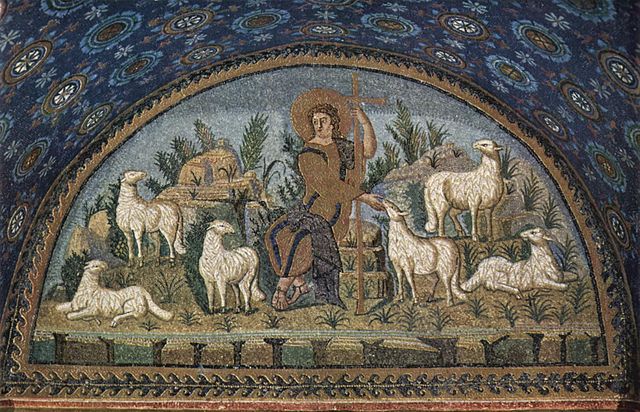
The Good Shepherd, mosaic in the Mausoleum of Galla Placidia, Ravenna, 1st half of the 5th century

There are three beautiful cantatas for this second Sunday after Easter, or “Misericordias Domini” Sunday: BWV 104, 85, and 112. Illustrating the “good shepherd” scripture for this Sunday (John 10, verse 12-16), Bach incorporated pastoral themes or orchestration in each of these cantatas.*

I’ve decided to focus on cantata 85 Ich bin ein guter Hirt, written for April 15, 1725. Of all three cantatas, this is the one I remember the best from my childhood, because of the  tenor aria “Seht, was die Liebe tut.” Also: Last week, I already mentioned the similarities between cantata 6 (for Easter Monday 1725), and cantata 42 (for the first Sunday after Easter 1725). This cantata 85 is the culmination of that “sub group” within the cantatas from 1725.

Which recording to listen to?

While I have good memories of hearing Kurth Equiluz sing the tenor aria on the Harnoncourt recording from 1977, I am enamored by Bach Collegium Japan’s recording of this cantata, and I think this is the best “overall” recording, featuring fabulous soloists Carolyn Sampson, Robin Blaze, Gerd Türk, and Peter Kooij. It is also one of the most noteworthy because of the use of a  violoncello da spalla, played by Dmitry Badiarov.

Listen to Bach Collegium Japan’s recording of cantata 85 Ich bin ein guter Hirt on Spotify. Or better yet, if you can afford to financially support the artists (especially important now, while they have no income from performances!) please consider purchasing the digital versions of Bach Collegium Japan’s recording of cantata 85 on Amazon or on iTunes.

If you prefer to watch a live recording, there is a wonderful recording available on YouTube by the J.S. Bach Foundation. Soloists are Gerlinde Sämann, soprano; Terry Wey, alto; Georg Poplutz, tenor; Markus Volpert, bass; and Martin Zeller, violoncello piccolo.

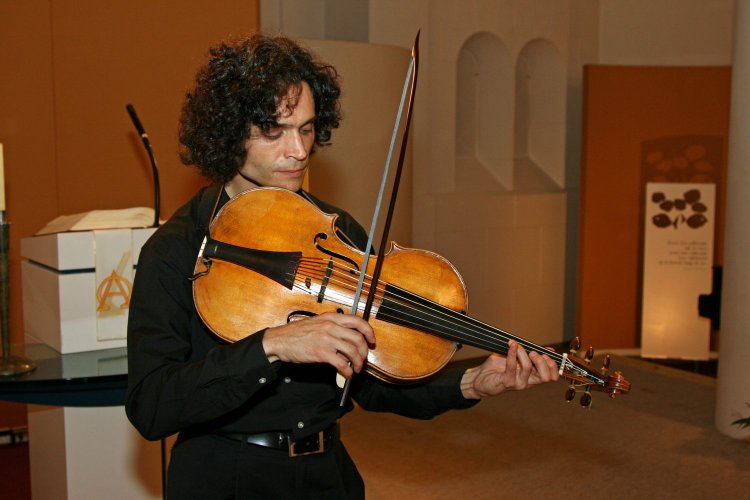
Back to the Bach Collegium Japan recording: After lovely and convincing singing by bass Peter Kooij in the opening arioso (Jesus saying “I am a good shepherd”), we get a sublime performance by countertenor Robin Blaze of the alto aria “Jesus ist ein guter Hirt,” which also features the unusual violoncello piccolo da spalla. Someone could probably write an entire PhD thesis on the difference between the  violoncello piccolo  “da spalla” (held on the shoulder, like a violin),  and the violoncello piccolo “da gamba”  (held between the legs,  like a cello), and whether Bach meant the one or the other when he wrote a part for “violoncello piccolo.”  Most recordings (Harnoncourt, Gardiner, Coin, Koopman, and J.S. Bach Foundation) feature the one held between the legs, but Bach Collegium Japan’s recording features the “da spalla” variety, played by the same person who built it in 2004, Dmitry Badiarov.

Badiarov-Dmitry-04
Dmitry Badiarov demonstrating the violoncello piccolo da spalla

Following this, we hear a radiant soprano solo chorale with oboe accompaniment (which makes me think back to the soprano solo chorale from cantata 6, in that case with the violoncello piccolo “da gamba”), beautifully sung by soprano Carolyn Sampson and expertly played by oboists Masamitsu San’nomiya and Atsuko Ozaki.

And when you didn’t think it could get any better, here comes a tenor recitative which in text and string accompaniment strongly refers to Jesus’ recitative from the St. Matthew Passion “Ich werde den Hirten schlagen, und die Schafe der Herde werden sich zerstreuen.” (Christ, having arrived at the Mount of Olives, reminds his disciples of the prophecy that the shepherd will be slain and the sheep will scatter).

With this only recitative in cantata 85, Bach has gotten everyone’s attention, so now we’re ready for the jewel in the crown of this cantata: the tenor aria “Seht, was die Liebe tut.” It is one of the most lyrical and lovely among all Bach’s tenor arias.

Seht, was die Liebe tut.
See, what love does.
Mein Jesus hält in guter Hut
My Jesus in his own safekeeping
Die Seinen feste eingeschlossen
keeps those who are his own firmly enclosed
Und hat am Kreuzesstamm vergossen
and on the beam of the cross he has shed
Für sie sein teures Blut.
for them his own precious blood.

Again there is a strong association with the St. Matthew Passion both in text and music. In his book Bach: Music in the Castle of Heaven Gardiner makes a very convincing case for his theory that Bach had wanted to perform the St. Matthew Passion on Good Friday 1725, only one year after the St. John Pasion. This didn’t happen because either the council disapproved, or Bach wasn’t ready composing the piece. If Bach had indeed been working on the St. Matthew Passion before Easter 1725, it is no wonder we’re getting glimpses of that monumental work in his cantatas after Easter 1725.

Wieneke Gorter, April 9, 2016, updated April 26, 2020

*I wrote about Cantata 104 for the Second Sunday after Easter in 1724 in this blog post.

Dutch memories, Dutch discoveries

06 Saturday Feb 2016

Posted by cantatasonmymind in Cantatas, Leipzig, Septuagesima

≈ Comments Off on Dutch memories, Dutch discoveries

Tags

Bach, BWV 144, cantatas, English Baroque Soloists, J.S. Bach Foundation, John Eliot Gardiner, Miah Persson, Nuria Rial, Septuagesima, Wilke te Brummelstoete

Opnamedatum:  2012-04-06
Parabel of the Laborers in the Vineyard by Jan Luyken, print, 1703

A number of Dutch things converged for me when writing this post. Whenever I think about the parable of the Laborers in the Vineyard, the Bible story for this Septuagesima Sunday, or the third Sunday before Lent, I see the windows of my 3rd or 4th grade classroom.* I also have to think of my late grandfather reading this story from the Bible.  Quickly summarized, this story is: A landlord pays all his laborers equally, no matter how many hours they worked. Those that worked all day object.

My favorite recording of cantata 144 Nimm, was dein ist, und gehe hin (first performed on Sunday February 6, 1724) turns out to have two connections to my home country: It was recorded in the Grote Kerk in Naarden, during the Bach Pilgrimage tour of Gardiner/English Baroque Soloists, and it features Dutch singer Wilke te Brummelstoete as alto soloist. Counter-tenor fan that I am, I can safely state that I will mention no more than a handful of female altos on this blog each year, so this is pretty special.

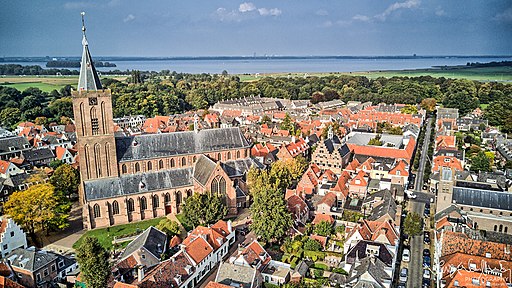
Naarden, The Netherlands

The icing on the cake is the illustration I discovered when searching for a good picture to go with this blog post: an etching by Haarlem artist Jan Luyken as published in the Amsterdam Mortierbijbel (Bible published by Pieter Mortier) in 1703, from the collection of the Rijksmuseum in Amsterdam.

Listen to John Eliot Gardiner’s recording of cantata 144 on Spotify

Listen to John Eliot Gardiner’s recording of cantata 144 on Youtube

Soloists: Miah Persson, soprano; Wilke te Brummelstroete, alto;
James Oxley, tenor; Jonathan Brown, bass.

As I’m updating this post on February 8, 2020, the J.S. Bach Foundation has just released their entire live video recording of this cantata, and that one is wonderful too, especially because Nuria Rial sings the soprano aria. Find that video here on YouTube. Soloists are Nuria Rial, soprano; Markus Forster, alto; Raphael Höhn, tenor.

Read the German text with English translation of cantata 144

Find the score of cantata 144 here

What to listen for in cantata 144 Nimm, was dein ist, und gehe hin:

In the opening chorus: the illustration of the text gehe hin, gehe hin! (off you go!) with ascending figures, each gehe hin “retaken” so that the text really leaps off the page, more on the Gardiner recording than on other ones. Also listen how beautifully the sopranos and violins enhance each other’s sound in this movement. That happens too on the J.S. Bach Foundation recording.

In the alto aria:  The illustration of the grumbling workers by the repeated 8th-notes in the strings. The music on the text “Murre nicht” (Don’t grumble) is always low, the music with the text “Lieber Christ” (please note that this means “dear Christian,” not “dear Christ”) always goes up. Very well done in an appropriate style by Wilke te Brummelstoete on the Gardiner recording.

In the soprano aria: the glorification of the “Genügsamkeit” (being satisfied with what you have, a concept that must have been very important to Bach), and the wonderful voice of soprano Miah Persson on the Gardiner recording or the always radiant Nuria Rial on the J.S. Bach Foundation recording. Read more about Miah Persson in my blog post about cantata 179 and those about cantatas 186 and 186a. Read more about Nuria Rial in my posts about Cantata 36 and Cantata 89.

Thank you for reading! Please leave your email address in the “follow this blog” section on the left side of this blog post. You will receive an email by WordPress whenever I have posted a new story. Please note that the choice of words and spelling in their confirmation email is by WordPress, not me. My apologies for that, and many thanks to you for your patience while I work on a more elegant solution!

To support this blog, please consider purchasing Gardiner’s album featuring cantata 144 on Amazon. I receive a small percentage of every sale made through this link. And it would be so fun if someone would actually buy a CD through this link. So far (February 13, 2020), it hasn’t happened 😉 Thank you!

Wieneke Gorter, February 6, 2016, updated January 27, 2024.

*Though a protestant school, it was pretty moderate in its teachings, and I don’t really remember Bible reading in the classroom. However, we learned a hymn every week and the reason I have to think of the classroom when reading this parable probably has to do with the hymn “De eersten zijn de laatsten” (The first will be the last) which is based on this same story.

Newer posts →

Recent Posts

  • “Missa Miniatura” by CONTINUUM/Elina Albach Even More Moving in 2025
  • Bachfest Leipzig 2025
  • Bach Cantatas for Christmas – 1724 and 1734 editions
  • Fourth Sunday of Advent – more insight into Cantata 62 helped me better understand Bach’s Christmas Oratorio
  • Saint Ambrose and Luther in Milan – Second Sunday of Advent

Archives

  • August 2025
  • July 2025
  • December 2024
  • November 2024
  • June 2024
  • January 2024
  • December 2023
  • October 2023
  • September 2023
  • August 2023
  • April 2022
  • February 2022
  • January 2022
  • December 2021
  • November 2021
  • June 2021
  • May 2021
  • April 2021
  • February 2021
  • January 2021
  • December 2020
  • November 2020
  • October 2020
  • September 2020
  • August 2020
  • July 2020
  • May 2020
  • April 2020
  • March 2020
  • February 2020
  • January 2020
  • December 2019
  • November 2019
  • May 2018
  • April 2018
  • March 2018
  • February 2018
  • January 2018
  • December 2017
  • November 2017
  • October 2017
  • September 2017
  • August 2017
  • July 2017
  • June 2017
  • May 2017
  • April 2017
  • March 2017
  • February 2017
  • January 2017
  • December 2016
  • November 2016
  • October 2016
  • September 2016
  • August 2016
  • July 2016
  • June 2016
  • May 2016
  • April 2016
  • March 2016
  • February 2016
  • January 2016

Enter your email address to follow this blog and receive notifications of new posts by email.

Join 336 other subscribers

Categories

  • 1723 Trinity season special series
  • Advent
  • After Easter
  • Ascension
  • Bach's life
  • Cantatas
  • Chorale cantatas 1724/1725
  • Christmas
  • Easter
  • Epiphany
  • Following Bach in 1725
  • Köthen
  • Leipzig
  • Septuagesima
  • Travel
  • Trinity
  • Weimar

Meta

  • Create account
  • Log in
  • Entries feed
  • Comments feed
  • WordPress.com

Website Built with WordPress.com.

  • Subscribe Subscribed
    • Weekly Cantata
    • Join 156 other subscribers
    • Already have a WordPress.com account? Log in now.
    • Weekly Cantata
    • Subscribe Subscribed
    • Sign up
    • Log in
    • Report this content
    • View site in Reader
    • Manage subscriptions
    • Collapse this bar
 

Loading Comments...