Weekly Cantata

Weekly Cantata

Tag Archives: Kloosterkerk

Cantata movements in organ works

17 Saturday Feb 2018

Posted by cantatasonmymind in Bach's life, Cantatas, Chorale cantatas 1724/1725, Leipzig

≈ Leave a comment

Tags

Bach, BWV 140, BWV 549, BWV 6, BWV 645, BWV 647, BWV 93, chorales, Dorothee Mields, Freiberg, Groningen, Ignace Bossuyt, J.S. Bach Foundation, Jan Hage, Kloosterkerk, Martini Church, Michael Schultheis, organ, Philippe Herreweghe, Schübler, Schnitger-Hinsz, Seligenstadt, Silbermann, The Netherlands, Ton Koopman, Wim van Beek
bach-schubler-titelblad
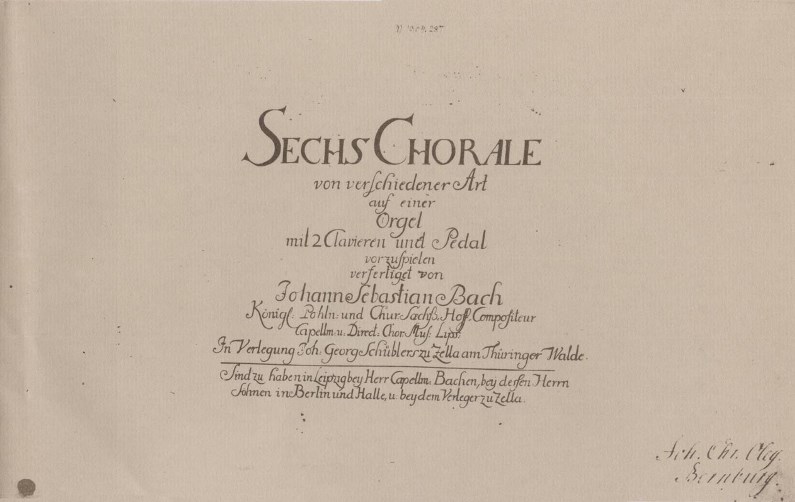
Title page of Schübler’s edition of six of Bach’s organ chorales based on cantata movements, known nowadays as the “Schübler Chorales.” The two last lines are instructions on where to purchase more of these: in Leipzig from Bach himself, from his sons in Berlin and Halle, and from the publisher [Schübler] in Zella.

There is no cantata for this Sunday, as no figural music was allowed in Leipzig in the 40 days before Easter, with the exception of the feast of the Annunciation (March 25).

For me this means I now finally have time to share some of what I learned during the Bach Festival in Bruges. On Friday January 26 I attended an all-day lecture by Professor Ignace Bossuyt about how Bach “reworked” his own music and the music of others in his compositions. The biggest eye-opener for me was that all Bach’s “Schübler Chorales” for organ (named after their publisher, Johann Georg Schübler) from 1747/1748 are actually arrangements of movements from Bach’s 1724/1725 cycle of cantatas I have been discussing on this blog since June 2017.

While I am not an organist at all, I did grow up in the land of organs and miss hearing them. My mother comes from a family of organists on her mother’s side. When other little boys dreamed of cars, my father dreamed of being an organist and built organ keyboards from blocks at home and would pretend to play them (sadly because of class perception his parents didn’t deem it appropriate to send him for lessons). Thus my parents were extremely picky where we went to church – there had to be a good organist. So I heard my share of Bach chorale preludes and Schübler Chorales, even before I knew what they were.

Because of the funeral service for my mother in the Kloosterkerk in The Hague I already referred to last week, I also have a soft spot for Bach’s “Schübler Chorale” BWV 645, Wachet auf, ruft uns die Stimme, because the incomparable Jan Hage (now organist at the Dom Church in Utrecht) played this at the end of the service, as we were walking out behind the coffin. This music, together with smiles of dear friends we passed by, gave me great comfort at a moment that could otherwise have been unbearable. Listen to this chorale, played by Jan Hage on that same organ of the Kloosterkerk in The Hague, here on YouTube. Another wonderful, and historically significant, performance of this chorale by Ton Koopman, on the Silbermann organ* (1714) in the Freiberg Cathedral, Germany, can be found here on YouTube. Bach and Silbermann knew each other, and Bach might have played on this organ too.

What I didn’t know until Professor Bossuyt’s lecture is that this piece of music was taken from the fourth movement of Cantata 140 with the same title. This cantata is officially not part of the 1724/1725 cycle, but in Bach’s head in 1747 it probably was. Bach wrote Cantata 140 Wachet auf, ruft uns die Stimme in 1731, most likely in an attempt to leave a complete chorale cantata cycle for posterity. During the chorale cantata cycle of 1724/1725, there had been no 26th or 27th Sunday after Trinity (by that time it was already Advent and it is of course no coincidence that Bach uses an Advent chorale in this cantata). Watch the tenor solo from this Cantata 140 Wachet auf, ruft uns die Stimme by all the tenors and baritones of the Amsterdam Baroque Choir (on a live recording conducted by Ton Koopman) here on YouTube.

I have two more beautiful examples of how Bach arranged an existing chorale cantata movements into his “Schübler Chorales”:

Bach turned the fourth movement of Cantata 93 Wer nur den lieben Gott lässt walten into the Schübler Chorale with the same title, BWV 647. Watch the duet from Cantata 93 by the J.S. Bach Foundation with soprano Miriam Feuersinger and alto Jan Börner here on Youtube. Watch the Schübler chorale played by Michael Schultheis on the organ of the Basilica in Seligenstadt, Germany, here on YouTube.

The last example is from a cantata that is nowadays not considered a true chorale cantata, but if Bach used it for the Schübler chorales, we can assume that he himself did regard it as such. It is Cantata 6 Bleib bei uns, denn es will Abend werden for Easter Monday in 1725. Hear Dorothee Mields sing the third movement from Cantata 6 live here on YouTube. Then listen here on YouTube to Dutch organist Wim van Beek play the Schübler Chorale with the same title, BWV 549, on the historic Schnitger-Hinsz organ (1740) in the Martini church in Groningen, The Netherlands.

Wieneke Gorter, February 17, 2018, links updated December 2, 2019

*learn more about the Silbermann organ here.

The last weeks of Trinity = bass aria time for Bach (Trinity 23 & 24 in 1724)

26 Sunday Nov 2017

Posted by cantatasonmymind in Cantatas, Chorale cantatas 1724/1725, Leipzig, Trinity

≈ Leave a comment

Tags

Antonia Frey, Bach, Bach Collegium Japan, BWV 139, BWV 163, BWV 26, BWV 70, BWV 90, Ekkehard Ebele, J.S. Bach Foundation, Johannes Kaleschke, Kloosterkerk, Makoto Sakurada, Marc Pantus, Monteverdi, Peter Kooij, Peter Kooy, Robin Blaze, Susanne Frei, Yukari Nonoshita

sid59217s-1400x1400_q85
Jacob Isaacksz van Ruisdael, ‘Landscape with a waterfall’, circa 1668, Rijksmuseum, Amsterdam.

Last week it was the 7th anniversary of my mother’s passing. I wasn’t sure what to write about that, so ended up not posting that day. If you would like to read more about the woman who still is my main inspiration for this blog, you can read my tribute to her here.

But as it turns out, it is not a bad thing to combine the cantatas Bach wrote for Trinity 23 & 24 in 1724 in one and the same blog post, since they both stand out for their bass arias. It is noteworthy that Bach ended both his 1723 and 1724 Trinity seasons in Leipzig with cantatas featuring impressive bass arias*. That the “End of Life/End of Time/Judgement Day” theme was on every Protestant’s mind in the 18th century around this time of year of course had a lot to do with this. Bach often associates the bass voice with this theme, see for example Cantata 20 O Ewigkeit du Donnerwort, discussed here on this blog.

Regarding Cantata 139 Wohl dem, der sich auf seinen Gott, for the 23rd Sunday after Trinity (which was last week), I prefer the recording by the J.S. Bach Foundation (Bachstiftung). Especially the tenor aria is very well done by tenor Johannes Kaleschke and violinists Renate Steinmann and Martin Korrodi. Update from 2019: when I first wrote about this performance in 2017, the cantata was not available on YouTube in full length, but now it is! You can find it here. For those who can understand German, there is also a terrific explanation by conductor Rudolf Lutz of everything that happens in the cantata available on YouTube here. You can even download the same worksheet (“Lutzogramm”) as the audience is looking at here.  Rudolf Lutz is at his best here, very clever, witty, and informative. He spent a lot of time prepping for this workshop, including entering entire orchestrations into his “Lady Yamaha,” which is very effective for understanding Bach’s incredible composition. Soloists are Susanne Frei, soprano; Antonia Frey, alto; Johannes Kaleschke, tenor; Ekkehard Abele, bass.

However, since the subject of this post is bass arias … the best interpretation of the extremely unusual bass aria appears on the Bach Collegium Japan recording. Peter Kooij does a fabulous job bringing out the different character for the 11 (!) different sections of the aria. I created a playlist on Spotify of this Bach Collegium Japan recording here. Soloists are Yukari Nonoshita, soprano; Robin Blaze, countertenor; Makoto Sakurada, tenor; Peter Kooij, bass.

Find the text of Cantata 139 here, and the score here.

peterkooyklein
Peter Kooij

Peter Kooij/Bach Collegium Japan again wins “best interpretation of the bass aria” in Cantata 26 Ach wie flüchtig, ach wie nichtig for the 24th Sunday after Trinity in 1724. Listen to Bach Collegium Japan’s recording via a playlist I created here on Spotify. This cantata was released on the same album as Cantata 139, so the soloists are again Soloists are Yukari Nonoshita, soprano; Robin Blaze, countertenor; Makoto Sakurada, tenor; and Peter Kooy, bass. 

Find the text of Cantata 26 here, and the score here.

And what a bass aria this is! The calmly babbling brook from the lovely tenor aria earlier in the cantata has become a white water river in this bass aria. And the combination of bass voice with the oboes makes me think of Hades in Monteverdi’s Orfeo. Peter Kooij is great and my mother loved him very much, but in my humble opinion, the luckiest people today are those attending the cantata service in the Kloosterkerk in The Hague, Netherlands, where my good friend and favorite Bach bass Marc Pantus will be singing this aria. The Kloosterkerk was also my mother’s church for the last decade of her life, so I have now successfully circled back to her in this post, and miss her much more today than I did last week.

© Wieneke Gorter, November 26, 2017, last updated November 12, 2026.

*The first cantata Bach ever wrote for this particular time of year was Cantata 163 in Weimar. It contains a bass aria accompanied by two cellos, an instrumentation Bach never ever used after that.  The last two cantatas of the 1723 Trinity season were Cantatas 90 and 70. Read my post about Cantata 90 for the 25th Sunday after Trinity here and my post about Cantata 70 for the 26th Sunday after Trinity here.

Recent Posts

  • Three Listening Guides – First Sunday of Advent
  • The End of Times and Christmas Combined – Cantata 116 for Trinity 25
  • From the Archives, with a New Recording – Cantatas 60 and 26 for Trinity 24
  • A Controversy and a Coin Collection – Cantata 163 for Trinity 23
  • Giving the Choir a Breather? – Cantata 89 for Trinity 22

Archives

  • November 2026
  • October 2026
  • September 2026
  • August 2026
  • August 2025
  • July 2025
  • December 2024
  • November 2024
  • June 2024
  • January 2024
  • December 2023
  • October 2023
  • September 2023
  • August 2023
  • April 2022
  • February 2022
  • January 2022
  • December 2021
  • November 2021
  • June 2021
  • May 2021
  • April 2021
  • February 2021
  • January 2021
  • December 2020
  • November 2020
  • October 2020
  • September 2020
  • August 2020
  • July 2020
  • May 2020
  • April 2020
  • March 2020
  • February 2020
  • January 2020
  • December 2019
  • November 2019
  • May 2018
  • April 2018
  • March 2018
  • February 2018
  • January 2018
  • December 2017
  • November 2017
  • October 2017
  • September 2017
  • August 2017
  • July 2017
  • June 2017
  • May 2017
  • April 2017
  • March 2017
  • February 2017
  • January 2017
  • December 2016
  • November 2016
  • October 2016
  • September 2016
  • August 2016
  • July 2016
  • June 2016
  • May 2016
  • April 2016
  • March 2016
  • February 2016
  • January 2016

Enter your email address to follow this blog and receive notifications of new posts by email.

Join 338 other subscribers

Categories

  • 1723 Trinity season special series
  • Advent
  • After Easter
  • Ascension
  • Bach's life
  • Cantatas
  • Chorale cantatas 1724/1725
  • Christmas
  • Easter
  • Epiphany
  • Following Bach in 1725
  • Köthen
  • Leipzig
  • Leipzig 1726/1727
  • Septuagesima
  • Travel
  • Trinity
  • Weimar

Meta

  • Create account
  • Log in
  • Entries feed
  • Comments feed
  • WordPress.com

Website Built with WordPress.com.

  • Subscribe Subscribed
    Weekly Cantata
    Join 158 other subscribers

    Have a WordPress.com account? Log in now.

  • Weekly Cantata
    View site in Reader
    Manage subscriptionsSign upLog in
    Report this content
    Collapse this bar
Loading Comments...