Weekly Cantata

Weekly Cantata

Tag Archives: BWV 139

A Controversy and a Coin Collection – Cantata 163 for Trinity 23

07 Saturday Nov 2026

Posted by cantatasonmymind in 1723 Trinity season special series, Cantatas, Chorale cantatas 1724/1725, Leipzig, Trinity, Weimar

≈ 4 Comments

Tags

Alex Potter, Bach, Bach Akademie Stuttgart, Benedikt Kristjánsson, Bernhard Schrammek, Brandenburg concertos, BWV 139, BWV 163, BWV 52, cantatas, Daniel R. Melamed, Der Bach Kanal, Felix Zimmermann, Hans-Christoph Rademann, J.S. Bach Foundation, Johannes Kaleschke, Magistertaler, Matthew 22, Michael Marissen, Michael Maul, Miriam Feuersinger, Renate Steinmann, Rudolf Lutz, Salomo Franck, Thomas Pitt, Tobias Berndt, Trinity 23, Vision Bach
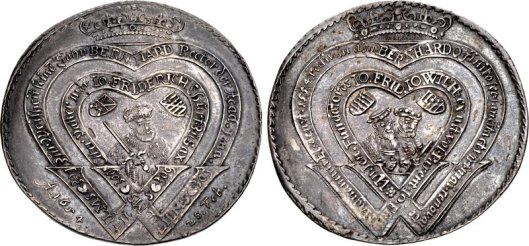
Magistertaler* which Duke Wilhelm of Saxe-Weimar had minted in Weimar in 1654. Duke Wilhelm was the grandfather of Duke Wilhelm Ernst who reigned during Bach’s time in Weimar.

A romantic soprano-alto duet, a radiant bass aria, and a heavenly tenor aria, Cantata 163 Nur jedem das Seine! (Just to each what is his) has it all. Still, it is very seldomly performed, and usually appears on recordings only as part of a comprehensive collection of cantatas. This most probably has to do with the atrocious reality of the Nazis misusing the motto “Jedem das Seine” during the Second World War. I first learned of this controversy through the J.S. Bach Foundation’s toughtful pre-concert lecture about this cantata. When doing further research, I found a good explanation by American Bach experts Daniel R. Melamed and Michael Marissen in their English translation of this cantata’s text:

Some present-day listeners are concerned that the title of this cantata, “Nur jedem das Seine,” resonates with anti-Jewish and other contempt, as its language might be taken to pre-echo the motto moulded on to the gate at the Buchenwald concentration camp, JEDEM DAS SEINE—literally, “to each his own,” but which the Nazis understood as “one gets what he deserves.” Cantata 163’s “Nur jedem das Seine,” however, is employed in the context of the biblical obligation to pay taxes to secular authorities [“Give to Caesar what is Caesar’s, and to God what is God’s,” from Matthew 22:15-22]. In the cantata’s biblical-liturgical context, the more specific sense of “Nur jedem das Seine” would be “Only to each his due,” and so we have rendered the phrase not as “Only to each his own,” […] but rather as “Just to each what is his.”

My favorite Recording: Bach Akademie Stuttgart under the direction of Hans-Christoph Rademann
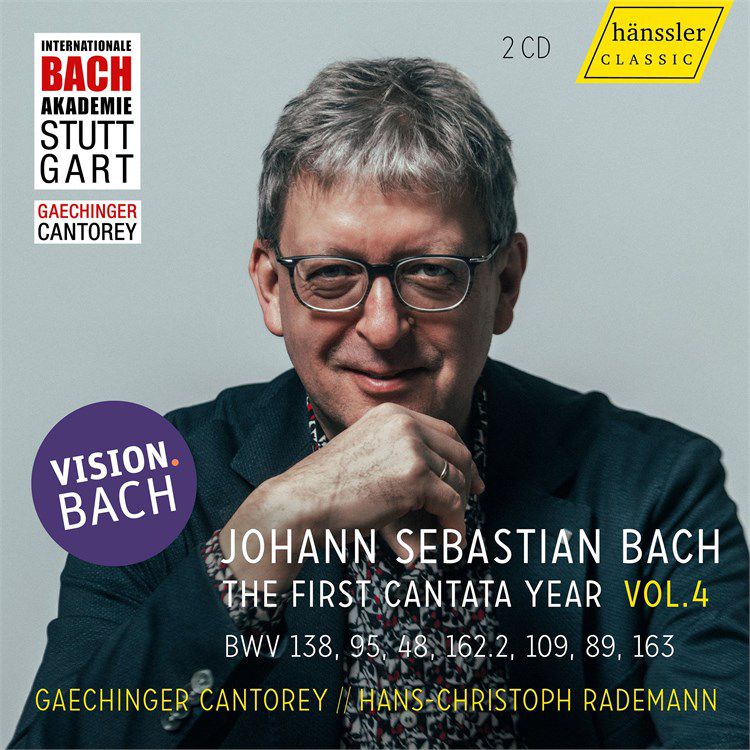
Bach performed Cantata 163 Nur jedem das Seine! in Weimar in 1715, and most probably again in Leipzig in 1723. Because of this Leipzig performance, Bach Akademie Stuttgart / Hans-Christoph Rademann included it in their Vision Bach – The First Cantata Year series. It’s the very last cantata on Volume 4 of this series, and it makes this double-CD go out with a bang, with an all-star cast of soloists (Miriam Feuersinger, soprano; Alex Potter, countertenor; Benedikt Kristjánsson, tenor; Tobias Berndt, bass) and the always fabulous orchestra. Except for a teeny tiny part of the tenor aria (see below), this is my absolute favorite recording of this cantata. This Volume 4 also includes Cantata 162 for Trinity 20 and Cantata 89 for Trinity 22. Purchase it on Amazon.com or on jpc.de.

Please find the playlists I created for this specific cantata here on Spotify, and here on YouTube. Please find the text of Cantata 163 Nur jedem das Seine! here, and the score here.

The tenor aria – Weimar versus Leipzig
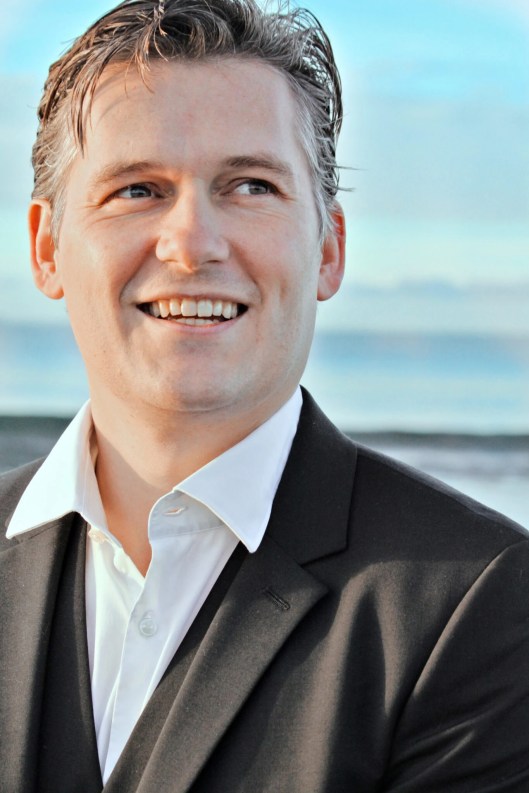
Benedikt Kristjánsson

Bach’s librettist in Weimar lets the tenor paraphrase the Gospel reading for this 23rd Sunday after Trinity, the story in which the Pharisees ask Jesus a trick question: Does loyalty to God actually permit paying taxes to the Emperor? To which Jesus, pointing to the Emperor’s image on a coin, cleverly replies, “Give to Caesar what is Caesar’s, and to God what is God’s.” Bach illustrates the words “Doch bleibet das Herze dem Höchsten alleine” (But the heart remains to the Most High alone) very lovingly with a tender question-and-answer between the tenor and the violin. With the larger, Leipzig style orchestra Rademann uses for the recording I recommended above, that tenderness gets lost a bit, because the original duet between one violin and one tenor (the way it must have been performed on the small organ loft in Weimar), is now a duet between an entire violin section and one tenor. While I really truly love Benedikt Kristjánsson’s singing on the Rademann recording (I love his voice and my qualm about this bit has nothing to do with him, just with the number of violins!), for this specific part I prefer the J.S. Bach Foundation recording with tenor Johannes Kaleschke and first violinist Renate Steinmann.

A bass aria with *two* solo cellists!

Similar to last week, this week I learned the most intriguing information about a cantata by listening to Michael Maul’s and Bernhard Schrammek’s podast.** In their episode about Cantata 163, Michael Maul explains that the Duke of Weimar’s favorite hobby was collecting coins, and that Bach’s librettist in Weimar, Salomo Franck (1659-1725), was also the administrator of the Duke’s extensive coin collection. When I looked this up, I realized that this coin collection had been in the Duke’s family for generations (see picture at the top of this post). What Franck and Bach thus do to please their employer results in a unique bass aria. Franck writes this text:

Lass mein Herz die Münze sein,
Die ich dir, mein Jesu, steure!
Ist sie gleich nicht allzu rein,
Ach! so komm doch und erneure,
Herr, den schönen Glanz bei ihr!
Komm! arbeite, schmelz und präge,
Dass dein Ebenbild bei mir
Ganz erneuert glänzen möge!

Let my heart be the coin
That I render [pay as tax] unto you, my Jesus.
If it [the coin] is not altogether pristine,
Ah, do come then and renew,
Lord, the beautiful radiance to it.
Come; work, melt, and emboss [it],
So that your very image
May radiate in me [who is] entirely renewed.
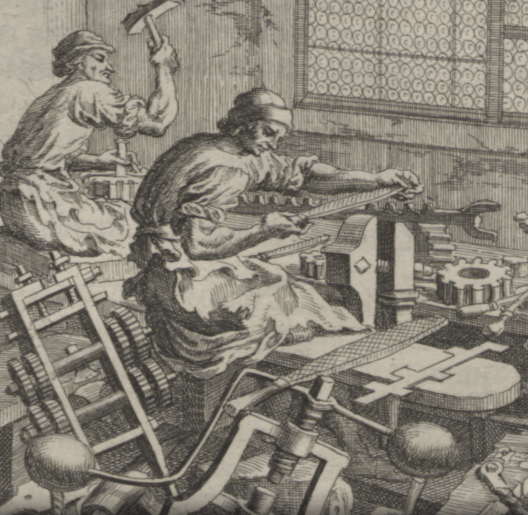
A minter’s workshop, late 17th century.

And then Bach does something he’s never done before: he decides to evoke the mechanical character of a minter’s work with a trio of low voices, all operating in the same range: a bass singer, accompanied by two solo cellos. The cellists don’t play continuo, but true solo parts. Never before or again do we see two solo cellos in a Bach aria. And there’s another reason he picks cellos, not bassoons, for example, because this way he can still illustrate the coin’s “schönen Glanz” (beautiful radiance). Never have I heard this done so beautifully as by Felix Zimmermann and Thomas Pitt, the cellists on the Rademann recording.

Miriam Feuersinger and Alex Potter – I can listen to them for days
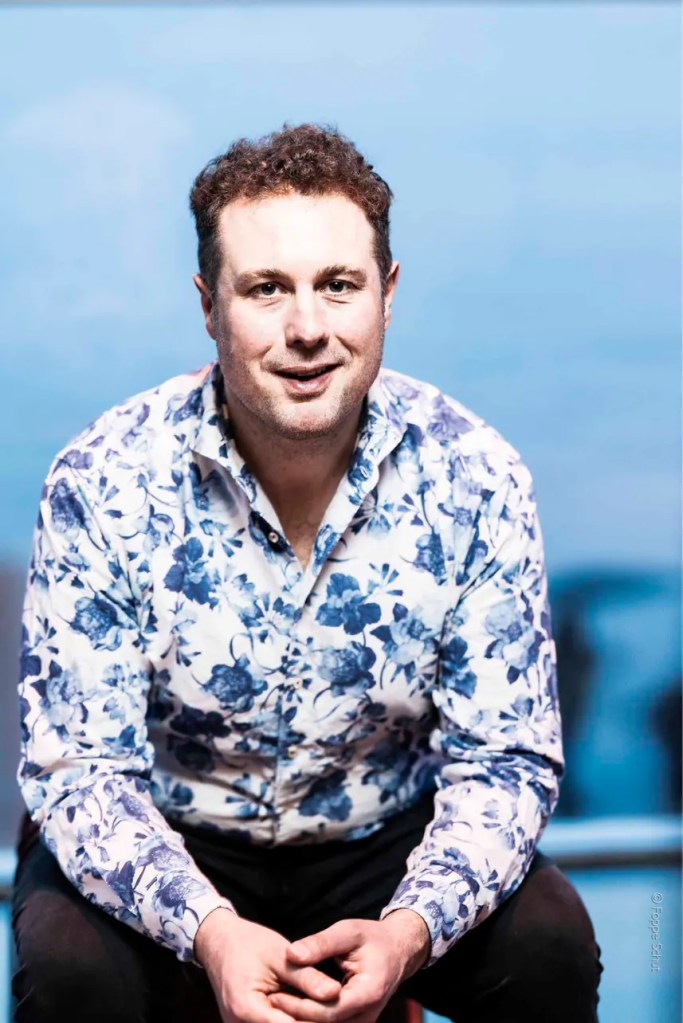
Alex Potter
Miriam Feuersinger

Along with the above mentioned controversy, the main reason why I had never written about this cantata before is that I hadn’t found a completely satisfying rendition of this cantata’s gorgeous soprano-alto duet. But fortunately that has now all changed with this Bach Akademie Stuttgart / Rademann recording. I can listen for days to Miriam Feuersinger and countertenor Alex Potter singing together, it gives me peace and comfort.

Other cantatas for this Sunday

I wrote about Cantata 139 Wohl dem, der sich auf seinen Gott from 1724 twice already on this blog. My favorite recording of this cantata is still the one by the J.S. Bach Foundation under the direction of Rudolf Lutz. Find all the links in my post from 2017. In 1726 Bach wrote Cantata 52 Falsche Welt, dir trau ich nicht!, a cantata for solo soprano, with the music of the opening Sinfonia copied from his First Brandenburg Concerto. For this one I also recommend the J.S. Bach Foundation’s recording, with soprano Miriam Feuersinger. Find that recording here.

I would love it if you would share this article with a friend! Thank you! Not an email subscriber yet? You can sign up below. I won’t use your email address for anything else.

© Wieneke Gorter, November 7, 2026.

*The Magistertaler was minted to commemorate the election of Prince Bernhard, son of Duke Wilhelm of Saxony-Weimar (1640–1672), as Rector Magnificissimus and the anniversary of the University of Jena in 1654. All magisters received the taler during the festivities marking this anniversary. The coin subsequently came to be known as the Magistertaler. Duke Wilhelm, founder of the main line of Saxony-Weimar, had the commemorative taler minted in Weimar.

**Who’s who: Prof. Dr. Michael Maul is a leading Bach researcher and the intendant of Bachfest Leipzig. Bernhard Schrammek is a musicologist and radio host. During the Covid pandemic, they started a podcast about Bach cantatas. Even though they have by now discussed all of Bach’s cantatas, they haven’t stopped the podcast. The podcasts name has since changed from “Die Bachkantate” to “Der Bach Kanal” but is still going strong. They even recorded live episodes with audience during this year’s Bachfest Leipzig. For a photo of both of them, see my post from last week.
Biden’s Aria

14 Saturday Nov 2020

Posted by cantatasonmymind in Cantatas, Chorale cantatas 1724/1725, Leipzig, Trinity

≈ Leave a comment

Tags

23rd Sunday after Trinity, BWV 139, BWV 38, BWV 5, BWV 78, Howard Crook, J.S. Bach Foundation, J.S. Bach Stiftung, Joe Biden, Johannes Kaleschke, Philippe Herreweghe, Raphael Höhn, Rudolf Lutz, tenor arias, Trinity 23, trio sonatas

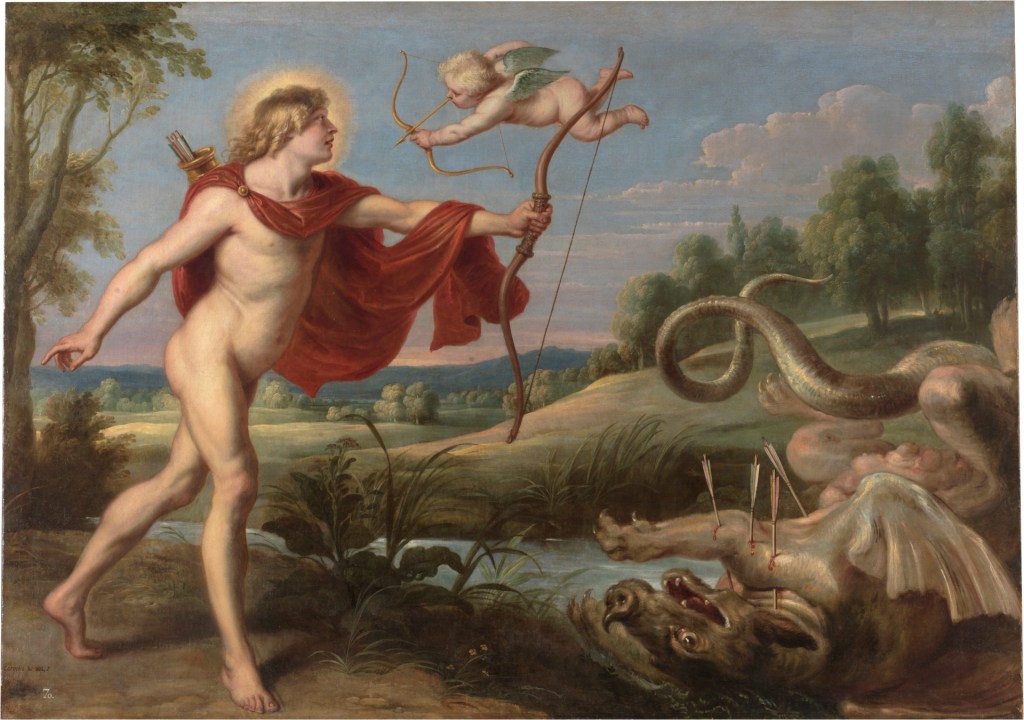
Apollo and the Python by Cornelis de Vos, 1636 – 1638. Oil on Canvas, after a sketch by Rubens. Museo del Prado, Madrid, Spain (not on display).

I always write about bass arias around this time of year (see this post). But let’s not forget about the tenor arias. As I’ve said before, I believe that Bach wrote some of his best trio sonatas in the form of tenor arias. Wonderful examples of this are the following tenor arias from the Fall of 1724:

from Cantata 78, sung here by Howard Crook on the Herreweghe recording from 1988

from Cantata 5, sung here by Raphael Höhn with the J.S. Bach Foundation

from Cantata 38, sung here by Johannes Kaleschke with the J.S. Bach Foundation — this is the “consolation” aria I mentioned in my previous blog post.

And for today, the 23rd Sunday after Trinity, the fabulous tenor aria from Cantata 139 Wohl dem, der sich auf seinen Gott, sung here by Johannes Kaleschke with the J.S. Bach Foundation. When I looked at the text of this aria again today, I realized that if Cantata 139 were an opera, this aria would be Joe Biden’s:

Gott ist mein Freund; was hilft das Toben,
So wider mich ein Feind erhoben!
Ich bin getrost bei Neid und Hass.
Ja, redet nur die Wahrheit spärlich,
Seid immer falsch, was tut mir das?
Ihr Spötter seid mir ungefährlich.

God is my friend; what use is all the raging
that an enemy has raised against me!
I am consoled in the midst of envy and hate.
Yes, though you speak the truth only rarely,
though you are always false, what is that to me?
You scoffers are to me no danger.

© Wieneke Gorter, November 14, 2020, links updated November 6, 2026.

The last weeks of Trinity = bass aria time for Bach (Trinity 23 & 24 in 1724)

26 Sunday Nov 2017

Posted by cantatasonmymind in Cantatas, Chorale cantatas 1724/1725, Leipzig, Trinity

≈ Leave a comment

Tags

Antonia Frey, Bach, Bach Collegium Japan, BWV 139, BWV 163, BWV 26, BWV 70, BWV 90, Ekkehard Ebele, J.S. Bach Foundation, Johannes Kaleschke, Kloosterkerk, Makoto Sakurada, Marc Pantus, Monteverdi, Peter Kooij, Peter Kooy, Robin Blaze, Susanne Frei, Yukari Nonoshita

sid59217s-1400x1400_q85
Jacob Isaacksz van Ruisdael, ‘Landscape with a waterfall’, circa 1668, Rijksmuseum, Amsterdam.

Last week it was the 7th anniversary of my mother’s passing. I wasn’t sure what to write about that, so ended up not posting that day. If you would like to read more about the woman who still is my main inspiration for this blog, you can read my tribute to her here.

But as it turns out, it is not a bad thing to combine the cantatas Bach wrote for Trinity 23 & 24 in 1724 in one and the same blog post, since they both stand out for their bass arias. It is noteworthy that Bach ended both his 1723 and 1724 Trinity seasons in Leipzig with cantatas featuring impressive bass arias*. That the “End of Life/End of Time/Judgement Day” theme was on every Protestant’s mind in the 18th century around this time of year of course had a lot to do with this. Bach often associates the bass voice with this theme, see for example Cantata 20 O Ewigkeit du Donnerwort, discussed here on this blog.

Regarding Cantata 139 Wohl dem, der sich auf seinen Gott, for the 23rd Sunday after Trinity (which was last week), I prefer the recording by the J.S. Bach Foundation (Bachstiftung). Especially the tenor aria is very well done by tenor Johannes Kaleschke and violinists Renate Steinmann and Martin Korrodi. Update from 2019: when I first wrote about this performance in 2017, the cantata was not available on YouTube in full length, but now it is! You can find it here. For those who can understand German, there is also a terrific explanation by conductor Rudolf Lutz of everything that happens in the cantata available on YouTube here. You can even download the same worksheet (“Lutzogramm”) as the audience is looking at here.  Rudolf Lutz is at his best here, very clever, witty, and informative. He spent a lot of time prepping for this workshop, including entering entire orchestrations into his “Lady Yamaha,” which is very effective for understanding Bach’s incredible composition. Soloists are Susanne Frei, soprano; Antonia Frey, alto; Johannes Kaleschke, tenor; Ekkehard Abele, bass.

However, since the subject of this post is bass arias … the best interpretation of the extremely unusual bass aria appears on the Bach Collegium Japan recording. Peter Kooij does a fabulous job bringing out the different character for the 11 (!) different sections of the aria. I created a playlist on Spotify of this Bach Collegium Japan recording here. Soloists are Yukari Nonoshita, soprano; Robin Blaze, countertenor; Makoto Sakurada, tenor; Peter Kooij, bass.

Find the text of Cantata 139 here, and the score here.

peterkooyklein
Peter Kooij

Peter Kooij/Bach Collegium Japan again wins “best interpretation of the bass aria” in Cantata 26 Ach wie flüchtig, ach wie nichtig for the 24th Sunday after Trinity in 1724. Listen to Bach Collegium Japan’s recording via a playlist I created here on Spotify. This cantata was released on the same album as Cantata 139, so the soloists are again Soloists are Yukari Nonoshita, soprano; Robin Blaze, countertenor; Makoto Sakurada, tenor; and Peter Kooy, bass. 

Find the text of Cantata 26 here, and the score here.

And what a bass aria this is! The calmly babbling brook from the lovely tenor aria earlier in the cantata has become a white water river in this bass aria. And the combination of bass voice with the oboes makes me think of Hades in Monteverdi’s Orfeo. Peter Kooij is great and my mother loved him very much, but in my humble opinion, the luckiest people today are those attending the cantata service in the Kloosterkerk in The Hague, Netherlands, where my good friend and favorite Bach bass Marc Pantus will be singing this aria. The Kloosterkerk was also my mother’s church for the last decade of her life, so I have now successfully circled back to her in this post, and miss her much more today than I did last week.

© Wieneke Gorter, November 26, 2017, last updated November 12, 2026.

*The first cantata Bach ever wrote for this particular time of year was Cantata 163 in Weimar. It contains a bass aria accompanied by two cellos, an instrumentation Bach never ever used after that.  The last two cantatas of the 1723 Trinity season were Cantatas 90 and 70. Read my post about Cantata 90 for the 25th Sunday after Trinity here and my post about Cantata 70 for the 26th Sunday after Trinity here.

Recent Posts

  • Three Listening Guides – First Sunday of Advent
  • The End of Times and Christmas Combined – Cantata 116 for Trinity 25
  • From the Archives, with a New Recording – Cantatas 60 and 26 for Trinity 24
  • A Controversy and a Coin Collection – Cantata 163 for Trinity 23
  • Giving the Choir a Breather? – Cantata 89 for Trinity 22

Archives

  • November 2026
  • October 2026
  • September 2026
  • August 2026
  • August 2025
  • July 2025
  • December 2024
  • November 2024
  • June 2024
  • January 2024
  • December 2023
  • October 2023
  • September 2023
  • August 2023
  • April 2022
  • February 2022
  • January 2022
  • December 2021
  • November 2021
  • June 2021
  • May 2021
  • April 2021
  • February 2021
  • January 2021
  • December 2020
  • November 2020
  • October 2020
  • September 2020
  • August 2020
  • July 2020
  • May 2020
  • April 2020
  • March 2020
  • February 2020
  • January 2020
  • December 2019
  • November 2019
  • May 2018
  • April 2018
  • March 2018
  • February 2018
  • January 2018
  • December 2017
  • November 2017
  • October 2017
  • September 2017
  • August 2017
  • July 2017
  • June 2017
  • May 2017
  • April 2017
  • March 2017
  • February 2017
  • January 2017
  • December 2016
  • November 2016
  • October 2016
  • September 2016
  • August 2016
  • July 2016
  • June 2016
  • May 2016
  • April 2016
  • March 2016
  • February 2016
  • January 2016

Enter your email address to follow this blog and receive notifications of new posts by email.

Join 338 other subscribers

Categories

  • 1723 Trinity season special series
  • Advent
  • After Easter
  • Ascension
  • Bach's life
  • Cantatas
  • Chorale cantatas 1724/1725
  • Christmas
  • Easter
  • Epiphany
  • Following Bach in 1725
  • Köthen
  • Leipzig
  • Leipzig 1726/1727
  • Septuagesima
  • Travel
  • Trinity
  • Weimar

Meta

  • Create account
  • Log in
  • Entries feed
  • Comments feed
  • WordPress.com

Website Built with WordPress.com.

  • Subscribe Subscribed
    Weekly Cantata
    Join 158 other subscribers

    Have a WordPress.com account? Log in now.

  • Weekly Cantata
    View site in Reader
    Manage subscriptionsSign upLog in
    Report this content
    Collapse this bar
Loading Comments...