Weekly Cantata

Weekly Cantata

Tag Archives: Leipzig

Many things to be proud of

26 Saturday Nov 2016

Posted by cantatasonmymind in Advent, Cantatas, Leipzig, Weimar

≈ 2 Comments

Tags

Advent, Bach, BWV 61, Christophe Pregardien, Eduard van Hengel, First Sunday of Advent, French ouverture, Harnoncourt, Leipzig, Luther, Nuria Rial, Peter Kooy, Seppi Kronwitter, Sybilla Rubens, Weimar

giotto-entry-into-jerusalem

The Entry into Jerusalem by Giotto, ca. 1305. Fresco in the Scrovengni Chapel, Padua, Italy.

Bach performed this cantata 61 Nun komm der Heiden Heiland in Leipzig on November 28, 1723, as a “rerun” of the first performance in Weimar in 1714. Why did he not write a new cantata? The prevailing scholarly answer is that Bach was giving himself a break from composing in between the three-week frenzy of cantatas 60, 90, and 70 and the new works (including a Magnificat) he was planning for the Christmas days.  I think Bach was proud of his Weimar cantatas, and I believe he wanted to show off the special features in this cantata to his colleagues and to the thousands of Lutherans that he knew would flock to the Leipzig churches on holidays.

I myself am proud of having followed Bach’s cantata writing of 1723 every week for the entire Trinity season. After all this listening and reading, I see a pattern in Bach reviving some of his Weimar cantatas on Leipzig feast days*, and I now look at cantata 61 Nun komm der Heiden Heiland in a new way.

This cantata had already been in my top five because of the moving interpretation of the soprano aria by Seppi Kronwitter (soprano) and Nikolaus Harnoncourt (cello) on the Harnoncourt recording from 1976. My mother loved this aria and played this recording many times, and I have fond memories of listening to it with her.

Harnoncourt-cello

I had always found the bass recitative that precedes it very charming, with the musical illustration of the knocking on the door, but not more than that.  I had seen this recitative in the context of all the Bach cantatas and passions that I knew, and had compared it with other typical Bach “Vox Christi” writing for bass. But those were all written after November 28, 1723.  So now, after having tried to place myself in the shoes of the Leipzig congregations for the entire 1723 Trinity season, I am fully aware that they had not heard a “Vox Christi” at all in any of the cantatas leading up to this one.** And thus I finally realize how it must not have been charming, but truly moving to them to hear this announcement presented in this way, on the first Sunday they started looking forward to the birth of Christ.

In the text of the recitative, Jesus says: “See, I am in front of your door! I’m knocking!” The librettist means the door of the believer’s heart, in which he’s planning to live. The pizzicato in the strings, as well as the staccato and the intervals in the voice part illustrate the knocking, and the dissonances at the beginning only resolve until the final “klopfe an.” The form of this recitative is highly unusual, and perhaps also something Bach wanted to show off in Leipzig.

However Bach’s greatest source of pride was probably the opening chorus of this cantata. To understand this, we need to do a mini music history class. First, in the 4th century, Ambrosius created the hymn Veni Redemptor Gentium, beautifully sung here on this video by Giovanni Vianini, director of the Schola Gregoriana Mediolanensis in Milan, Italy. Then, in 1524, Luther turned that hymn into Nun komm der Heiden Heiland, which sounds like this and which all Lutherans in Bach’s time knew very well.

In Weimar Bach had come into contact with French and Italian court music, and had adopted the habit of writing almost every opening chorus or opening sinfonia of his cantatas as a royal “entrada,” to show off his skills in French ouverture writing as well as to please the Duke.

So now Bach needed/wanted to merge the timeless hymn with a fashionable French ouverture. And the result is stunning. Or, as Eduard van Hengel says: Bach wrote “brilliant fusion” at the age of 29. Listen to this in the recording by Philippe Herreweghe on YouTube (Sybilla Rubens, soprano; Christoph Prégardien, tenor; Peter Kooij, bass).

Find the German text with English translations here and the score here.

The first line of the hymn is sung one voice part at a time, an illustration of the Bible reading for this Sunday: the people greeting the messiah who is riding into Jerusalem. The second line is then sung as a simple four-part hymn, while the instrumental parts keep playing the first part of the ouverture. The third line becomes a mini motet in the fast and happy (“Gai”) middle part of the ouverture, in 3/4. 

The fourth line of text is then again a simple four-part setting on the third part of the ouverture.

For the closing chorale, Bach chose the last two lines of Wie schön leuchtet der Morgenstern as melody. And again he marries the chorale tune beautifully with the instrumental writing.

Wieneke Gorter, November 26, 2016, updated December 1, 2019.

*Read more about this in my post about the feast of St. John the Baptist on June 24, The Visitation on July 2, and last week’s post about cantata 70. Read how proud Bach was of his Weimar cantatas in this post about cantata 12.

** unless they had a really good memory, and were present at Bach’s “audition” in February 1723. There is a Vox Christi in Cantata 22 which he presented at that time, but didn’t repeat in Leipzig until that same time in the church year in 1724.

Trying to find some beauty in ugliness

13 Sunday Nov 2016

Posted by cantatasonmymind in 1723 Trinity season special series, Cantatas, Leipzig, Trinity

≈ Leave a comment

Tags

Bachstiftung, Gustav Leonhardt, Leipzig, Max van Egmond, Patrick Henrichs, slide trumpet, trumpet

trumpetsmemling

The least gruesome detail of Hans Memling’s “The Last Judgment”, a triptych painted between 1467 and 1471. National Museum, Gdansk, Poland.

This week I’ve been trying harder than ever in my life to find islands of beauty in a sea of ugliness. I found some: I witnessed communities coming together, had a very uplifting choir rehearsal, attended a concert at my daughter’s music school where the director gave a heart-felt speech, and the choir director had included We Shall Overcome in their part of the program. I have talked with my children about what it means to “stand up” for the millions who will suffer discrimination in the next four years in this country.  I realize I have many different readers of this blog, and that some of you might not share my political opinion. But I would urge you to be there for each other. And whomever you had been meaning to contact, whether it is a friend you should have apologized to four weeks ago, someone you know who is having a hard time, a relative you haven’t called in too long, or your representative in the House or Senate, write that letter, make that phone call. Don’t put it off.

In today’s cantata 90 Es reißet euch ein schrecklich Ende (A terrible end shall sweep you away), written for November 14, 1723, the 25th Sunday after Trinity, it is not easy to find beauty either, at least not the soul-soothing kind, since it is based on the Bible story of The Last Judgement, which is an ugly concept in my opinion. However this story was important in Bach’s time, and it was thus appropriate to let the Trinity season go out with a bang: two weeks in a row of impressive cantatas, including some of the most magnificent (and difficult!) arias for bass and trumpet in all of his work.

While Bach’s audience (the congregations of the St. Thomas and St. Nicholas churches in Leipzig) got plenty of tenor drama in the fall of 1723, it had been a long time (August 1, 1723 to be exact) since they had last heard an operatic aria for bass, with the majestic trumpet as accompanying instrument.

Since this emotional week also calls for some nostalgia, I’m going with the Leonhardt recording of this cantata, because I grew up listening to Max van Egmond sing these bass arias. The trumpet player on that recording however barely makes it, so if you would like to listen to a better player in that particular aria, and also see a close-up of the instrument, watch this video (of the bass aria only) by the Bach Foundation, with Patrick Henrichs on trumpet.

Find the text here, and the score here.

Wieneke Gorter, November 13, 2016, Links updated November 24, 2019.

A pretty soprano aria for Trinity 22

23 Sunday Oct 2016

Posted by cantatasonmymind in 1723 Trinity season special series, Cantatas, Leipzig, Trinity

≈ Leave a comment

Tags

Bach, Leipzig, Nuria Rial

parable_of_the_unfaithful_servant

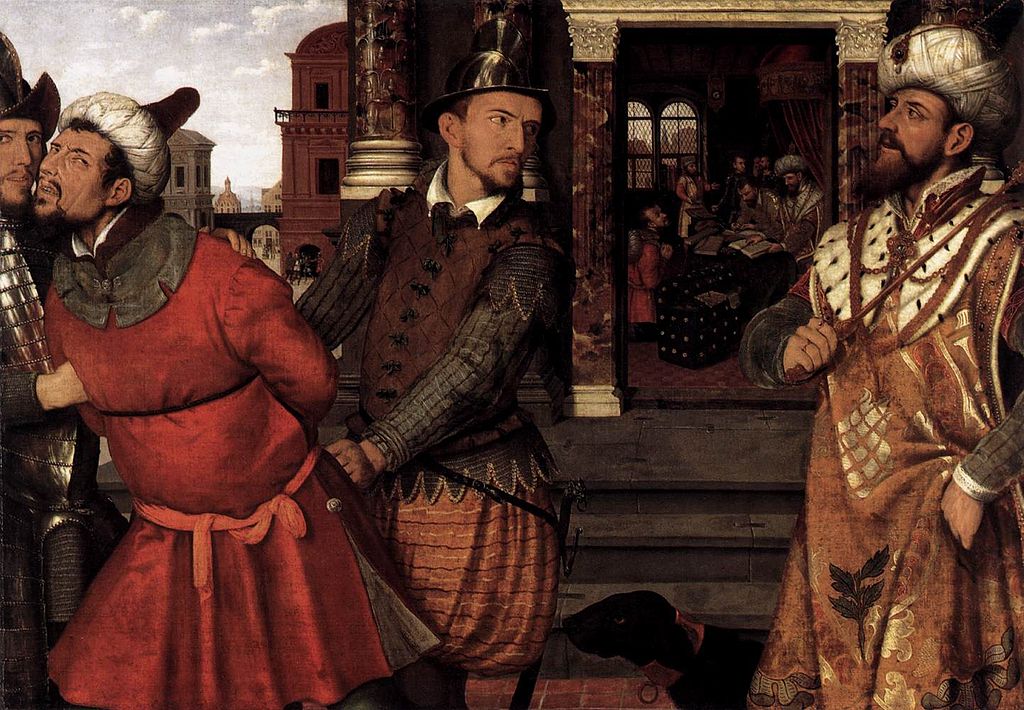
Parable of the Unmerciful Servant by an unknown master from Northern Germany, ca. 1560. Gemäldegalerie, Berlin.

For this 22nd Sunday after Trinity, October 24 in 1723, Bach wrote cantata 89 Was soll ich aus dir machen, Ephraim?

Apart from providing you with the title of the cantata, the stunning painting, and a pretty YouTube video, you’re on your own this week for reading and listening more about this, as I’ve been busy producing these two fabulous concerts.

To find an overview of the recordings, links to the text & translations, and links to the score of this cantata, please visit this page of the “Bach Cantata Bible” by Aryeh Oron.

For a very beautiful interpretation of the soprano aria (fifth movement) from this cantata, please watch this video of the Bach Stiftung, with soprano Nuria Rial, in Trogen, Switzerland. I first heard the fabulous Nuria Rial sing on the German radio in December 2010 and have been a fan since. Watch her sing Cavalli arias at the Utrecht Early Music Festival in the summer of 2016.  I’ll talk about her again on the first Sunday of Advent, in about a month 🙂

Wieneke Gorter, October 23, 2016

Tenor drama

16 Sunday Oct 2016

Posted by cantatasonmymind in 1723 Trinity season special series, Cantatas, Leipzig, Trinity

≈ Leave a comment

Tags

Bach, Damien Guillon, Dorothee Mields, John Eliot Gardiner, La Petite Bande, Leipzig, Paul Agnew, Peter Kooy, Phlippe Herreweghe, St. John Passion, Thomas Hobbs

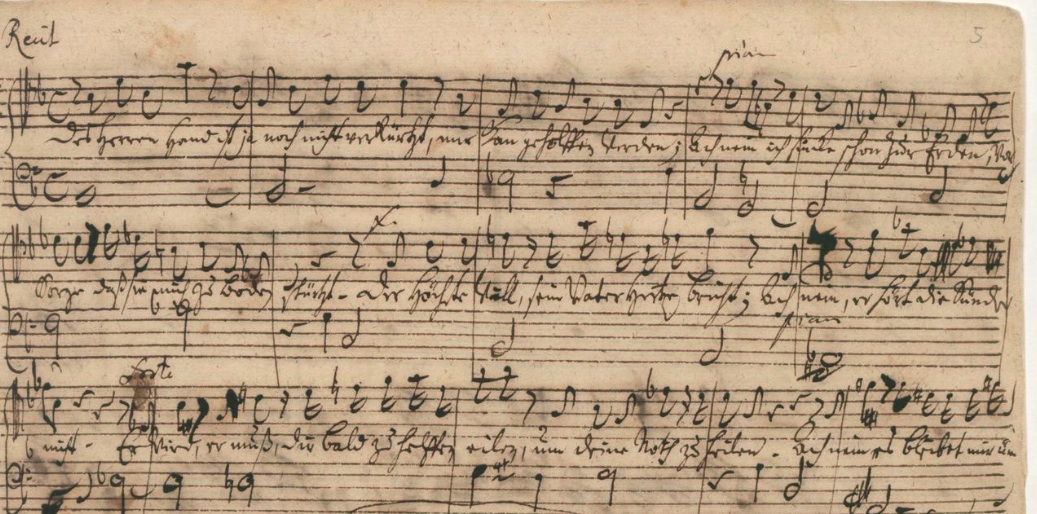
bwv109_tenormanuscript

Excerpt from the start of the tenor recitative from cantata 109, with “piano” and “forte” marked. Staatsbibliothek zu Berlin, Preußischer Kulturbesitz

For this 21st Sunday after Trinity, Bach wrote cantata 109 Ich glaube, lieber Herr, hilf meinem Unglauben! in 1723.

For overall best performance, I recommend Herreweghe’s recording from 2013, with counter-tenor Damien Guillon and tenor Thomas Hobbs.

Listen to this recording on YouTube. To support the artists, please consider purchasing the entire album on Amazon — a good deal if you like this blog, as it also includes three cantatas I discussed here earlier this year: cantata 44, cantata 73, and cantata 48.

Read the German texts with English translations here, and find the score here.

I love Herreweghe’s interpretation of  the opening and closing chorus as well as Damien Guillon’s singing in the alto recitative and aria.

However, there is an extremely dramatic and unusual recitative and aria for tenor in this cantata which I like better on the Gardiner recording. The recitative is unusual because Bach has two voices/persons speak: the uncertain/fearful voice, marked “piano” in his manuscript (see picture above), and the certain/faithful voice, marked “forte” in the manuscript. According to Gardiner, this feature never appears anywhere else in Bach’s recitative writing.

Just as with the “Storm on the lake” aria from cantata 81, only Gardiner and the fabulous Paul Agnew are able to properly convey the drama of the text and context of this tenor recitative and aria. If at first you think this might be a bit over the top, it is most probably exactly what Bach had in mind. A bit of opera to properly bring out the agony of the text.

Listen to these two movements by Gardiner and Agnew on YouTube: the recitative here, and the aria here.

Bach might have been preparing the Leipzig congregations for the St. John Passion he was planning for Good Friday 1724, as this tenor aria is very similar in dramatic intensity and music to the Ach mein Sinn aria from that passion. Those who know the St. John Passion well might hear other resemblances in this cantata 109.


Wieneke Gorter, October 16, 2016

A Weimar cantata for Trinity 20

09 Sunday Oct 2016

Posted by cantatasonmymind in 1723 Trinity season special series, Cantatas, Leipzig, Trinity

≈ 2 Comments

Tags

Bach, Bach Collegium Japan, Leipzig, Makoto Sakurada, Peter Kooy, St. Matthew Passion, Trinity 20, Yoshikazu Mera, Yumiko Kurisu

Vornehme Hochzeitsgesellschaft

Vornehme Hochzeitsgesellschaft (Distinguished Wedding party) by Wolfgang Heimbach, 1637. Kunsthalle Bremen, Germany.

I’m in the middle of St. Matthew Passion concert weekend now with California Bach Society. To read more about the connection between this blog and Bach’s Great Passion, please see my post from last week.

This week, while doing dishes, packing dinners, promoting our concerts on Facebook, and making spreadsheets for the youth choir logistics, I listened to several recordings of the 1723 cantata for this Sunday: cantata 162 Ach! ich sehe, itzt, da ich zur Hochzeit gehe, and can safely say I recommend Bach Collegium Japan’s recording of this cantata. It has the most sensitive playing in the instrumental opening and the best interpretation of the bass aria and the soprano aria in my opinion.

Listen to the recording of cantata 162 by Bach Collegium Japan on Spotify. Soloists: Soprano: Yumiko Kurisu, Counter-tenor: Yoshikazu Mera, Tenor: Makoto Sakurada, Bass: Peter Kooy.

Read the text here, and find the score here.

Bach wrote this cantata in Weimar, and performed it there on October 25, 1716. For the performance in Leipzig on October 10, 1723, he added a corno da tirarsi to the instrumentation (the Bach Collegium Japan recording is based on the Weimar version, and thus doesn’t feature the corno da tirarsi).

A very short explanation of the cantata, thanks to Eduard van Hengel: Cantata 162 is based on the Gospel text for this Sunday: Jesus compares the heavenly kingdom with the wedding of a King’s son. Many guests decline the invitation, and several of those who do come are sent away because they are not properly dressed. Since the relationship between Jesus and the soul of the believer is compared to the bond between groom and bride, the believers will be at first concerned that they will not be allowed to join the wedding (cantata movements 1-3), but can then rejoice in their conviction that Jesus, through his suffering, will provide the proper dress for them (cantata movements 4-6).

To read more in Dutch, please go to Eduard van Hengel’s website; to read more in English, find Gardiner’s notes about this cantata here.

Wieneke Gorter, October 9, 2016. Updated October 21, 2023.

The Opening Chorus’ Silver Lining

01 Saturday Oct 2016

Posted by cantatasonmymind in 1723 Trinity season special series, Cantatas, Leipzig, Trinity

≈ Leave a comment

Tags

19th Sunday after Trinity, Bach, BWV 48, Collegium Vocale Gent, Damien Guillon, Leipzig, Philippe Herreweghe, Thomas Hobbs, Trinity 19, tromba da tirarsi, trumpet

genezing_lamme_masolino

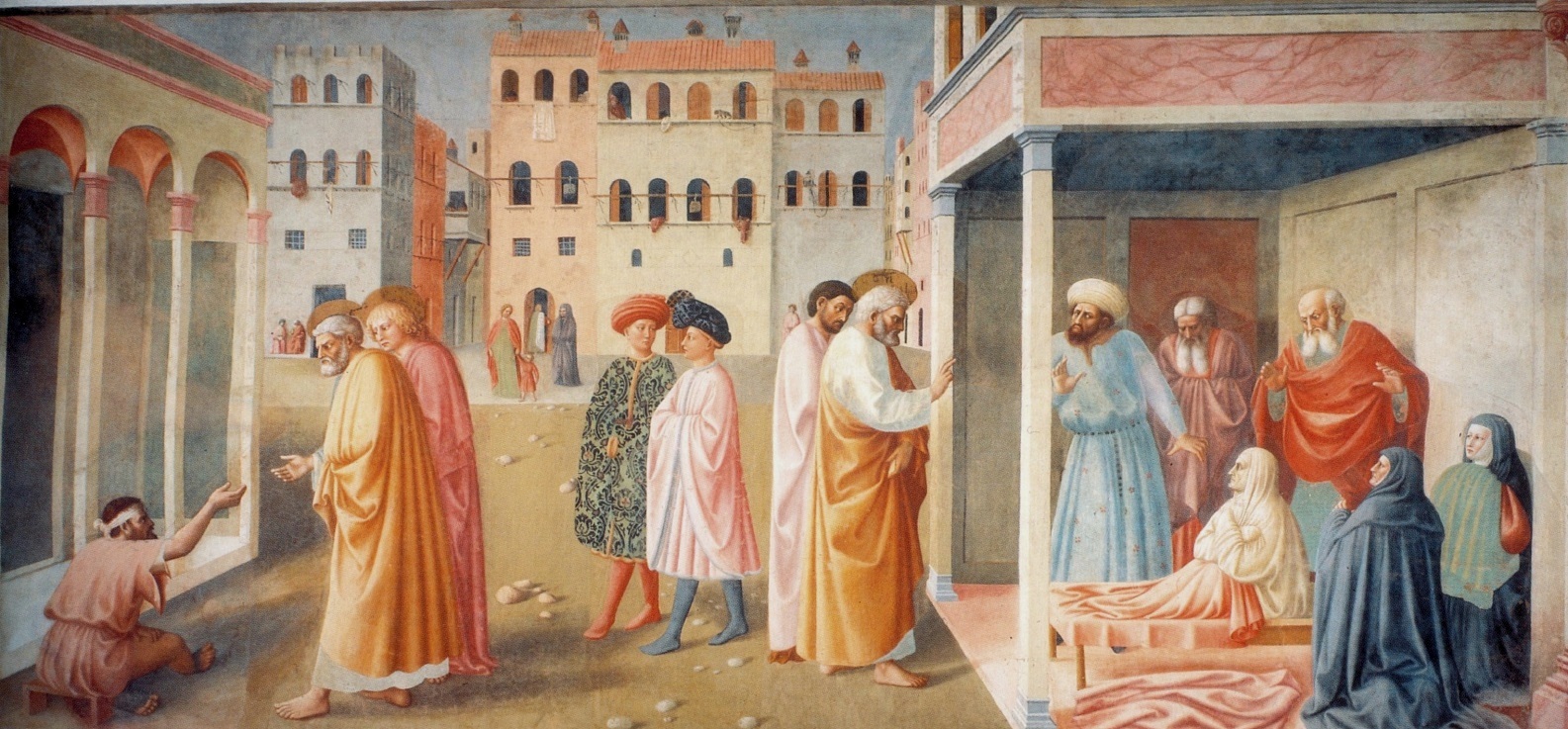
Healing of the Cripple (on left) and Raising of Tabitha (on right) by Masolino da Panicale, 1424-25. Fresco in the Brancacci Chapel, Santa Maria del Carmine, Florence, Italy.

My head has been in the St. Matthew Passion. For a few weeks already. Yes, that is pretty strange for me, having grown up in a house where Bach’s music was played often, but only on the Sundays and holidays for which it was written (read more about that in this blog post). However, it can happen when one sings in a Bach Choir in the United States. While in The Netherlands all 180 (!) St. Matthew Passion concerts happen in the weeks before Easter, here in the USA the piece is presented much less often, and the only classical music performances with a strong seasonal tie are those of Handel’s Messiah in the weeks before Christmas.

But working on the St. Matthew Passion and this Weekly Cantata blog at the same time has been a blessing, as the two areas of study influence each other. Nine months of research for this blog have inspired me to read more about the St. Matthew Passion and study the music in more detail. In that process I have learned many new things about the piece I thought I already knew so well. And experiencing the composition Bach’s sons referred to as their father’s Great Passion on a deeper level has, I believe, improved my understanding of Bach’s cantata writing.

Let’s just look at the opening chorus of this week’s cantata 48 Ich elender Mensch, written for the 19th Sunday after Trinity (October 3 in 1723).

I listened to Bach Collegium Japan (with Robin Blaze and Gerd Türk), Koopman (with Bernhard Landauer and Christoph Prégardien), Gardiner (with William Towers and James Gilchrist), Harnoncourt (with Paul Esswood and Kurt Equiluz), and Herreweghe (with Damien Guillon and Thomas Hobbs), and find Herreweghe’s interpretation the most moving. Herreweghe is also the only one who uses a tromba da tirarsi in the opening chorus, and I  love that sound. Listen to Herreweghe’s recording on YouTube or on Spotify. Please consider supporting the artists by purchasing the recording on Amazon: click here for USA, here for UK, here for Germany, or here for France.

Please find the German text with English translation here and the score here.

The main music is hauntingly beautiful (It’s not just the Herreweghe sopranos that give me goose bumps this time – the altos and tenors move me to tears, and none of this could happen without the basses providing that wonderful foundation for everyone to build on) but extremely downcast. It is clearly full of Elend (misery), in reference to the Gospel text of the day.* The same holds for the main music and words of the opening chorus of the St. Matthew Passion. It is clearly full of klagen (lamenting), and paints the picture of the Via Crucis, Jesus on his way to the cross.

However, in the midst of all the misery, a J.S. Bach opening chorus almost always provides a preview of the salvation that is to come later in the piece, or that is implied in the Gospel. In the opening chorus of the St. Matthew Passion he does this by superimposing the German Agnus Dei – the chorale O Lamm Gottes Unschuldig (O Lamb of God, unspotted), sung by a treble choir in G major, over the lamenting E minor of the two other choirs and orchestras. The repeated  auf unsre Schuld (for our sins) of Choir I is answered by the treble chorus with: All Sünd hast du getragen (you took away all sins).

The congregation in Leipzig, where the St. Matthew Passion was first performed on the afternoon of Good Friday in 1727, would have sung this German Agnus Dei earlier that day at the conclusion of the morning service. Back to this week’s cantata for October 3, 1723: in that Sunday service, the congregation might have sung the chorale Herr Jesu Christ, ich schreie zu dir:

Herr Jesu Christ ich schreie zu dir
Mit ganz betrübter Seele:
Dein Allmacht laß erscheinen mir
Und mich nicht also quäle.
Viel grösser ist die Angst und Schmerz.
So anficht und turbirt mein Herz,
Als daß ich kan erzählen.
Lord Jesus Christ, I cry to you
With a soul that is wholly troubled:
Let your almighty power appear to me
And do not punish me in this way.
Far greater is the anguish and pain
That challenge and confuse my heart
Than I can explain

The congregation might thus have heard those words in their head, when two bars after the soprano entrance the tromba da tirarsi starts playing this melody, later followed by two oboes in unison. In this way, these three instruments accompany every choral passage with a new line from the chorale, and the chorale thus starts forming the frame of the opening chorus.

After this preview message in the opening chorus that Jesus might be able to offer salvation, we have to wait until the tenor aria for the all-around convincing message that everything will be OK, in music as well as in text:

Vergibt mir Jesus meine Sünden,

If Jesus forgives me my sins,
So wird mir Leib und Seele gesund.
then my body and soul will become healthy.
Er kann die Toten lebend machen
He can make the dead live
Und zeigt sich kräftig in den Schwachen,
and shows himself to be mighty in those who are weak,
Er hält den längst geschloßnen Bund,
he keeps the covenant made long ago
Daß wir im Glauben Hilfe finden.
that in faith we find support.

Wieneke Gorter, October 1, 2016, links updated October 15, 2020.

* The Gospel story for this 19th Sunday after Trinity was the miracle of Jesus healing a cripple. From the time the Gospel was written through Bach’s time, unfortunately, having a disability or illness was seen as carrying a sin. When Jesus heals the man, he also takes his sins away.

Christmas in August

27 Saturday Aug 2016

Posted by cantatasonmymind in 1723 Trinity season special series, Bach's life, Cantatas, Leipzig, Trinity

≈ Leave a comment

Tags

according to Lutheran Church year, Anhalt-Zerbst, Anna Magdalena Bach, Bach, Bruce Dickey, cantatas, City Council, Collegium Vocale Gent, concerto palatino, cornetto, Deborah York, Eduard van Hengel, Hana Blazikova, Ingeborg Danz, Köthen, Leipzig, Lutheran Church year, Mark Padmore, Peter Kooy, Phlippe Herreweghe, Ratswechsel, recorder, Saxe-Weissenfels, Thomas Hobbs, Trinity 14, trombone, trumpet, Wilcke

gesu_lebbrosi
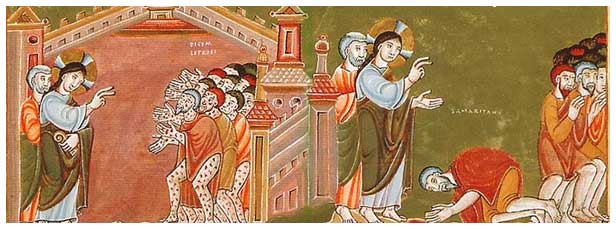
Jesus heals ten lepers, from the Codex Aureus of Echternach, c. 1035-1040

Only a handful of Bach cantatas ask for the Renaissance/Early Baroque ensemble of one cornetto and three trombones in the opening and closing chorus. This instrumentation was considered somewhat “old fashioned” in Bach’s time, while at the same time it was still very normal in cities to hear Stadtpfeifers (city pipers) play chorales from the towers during the day, to remind the citizens of their Christian duties. In this Cantata 25 Es ist nichts Gesundes an meinem Leibe, for the 14th Sunday after Trinity (August 29 in 1723), the playing of the chorale tune by this ensemble in the opening chorus stands for the way it has always been, the way it has been true for centuries.

palatino
Concerto Palatino, the leading cornetto/trombone ensemble for the past 25 years. Photo by Sabrina Flauger. Learn more about them here.

My preferred recording of Cantata 25 is the one by Herreweghe, on the same album as cantata 105 for Trinity 9 and cantata 46 for Trinity 10, as well as cantata 138 for next week. Soloists in cantata 25: soprano Hana Blažíková, tenor Thomas Hobbs, and bass Peter Kooij. Cornetto: Bruce Dickey  (pictured above, front row, on left); trombones: Claire McIntyre, Simen van Mechelen (pictured above, top row, on left), and Joost Swinkels.

Listen to this recording on Spotify or on YouTube. Please consider supporting the artists by purchasing this album (containing four cantatas for this 1723 Trinity season) on Amazon.

Read the text of this cantata here, and find the score here.

I could write an entire blog post about the opening chorus alone, the way I did last week for cantata 77 and two weeks earlier for cantata 179. But in the interest of variety, I’m going to keep this section short, and I will just say that the opening chorus  is an incredible, unrivaled complex composition for ten voices, again completely different than any opening chorus the Leipzig congregations had heard before during this Trinity season of 1723. By having the “ancient” brass quartet play the chorale melody of Herzlich tut mich verlangen nach einem selgen End (With my whole heart I long for my blessed End / my Salvation)** Bach shows that the promise of salvation after death will always provide a silver lining to the sorrow of the daily, sinful human condition. He also illustrates this “salvation” with the recorders in the uplifting and soothing soprano aria (Hana Blažíková in top shape!), and the brass and recorders in the closing chorale, and intensifies the “sickness” of the human sins by setting these texts to “dry” recitatives  (though listen to that bass arioso, beautifully sung by Peter Kooij) in between. Again, it was completely normal in his day and age to think this way, and Bach saw it as his mission in life to teach this theology to his fellow Lutherans by way of his church music.

But, listen to the festive, large orchestra for this cantata! No less than four brass players (one cornetto and three trombones) and five wind players (two oboists and three recorder players) were required at the same time in the opening chorus and closing chorale. For a cantata about the healing of ten lepers? Well, it turns out that this weekend it was Christmas in August for Bach, and the extra players were probably in town for the much more important and incredibly festive Cantata 119 Preise, Jerusalem, den Herrn that was on the calendar for the next day, Monday August 30, the day of the inauguration of the new City Council (Ratswechsel). *** As I already suggested in my post about cantata 147, Bach might have sometimes used guest musicians in his orchestra who were in town for other reasons, and judging from the level of playing required for the Brandenburg concerto-like Cantata 119, the extra brass (all playing trumpet in 119) and wind (playing oboe and recorder in 119) players might have been needed to be of the level of court chamber musician, not just Stadtpfeifer (usually a lower rank, and not necessarily used to playing the complicated court music). So in my probably not so unlikely movie script fantasy, Bach hired musicians from the not too far away courts where he had worked before or where his in-laws worked (Köthen, Weissenfels, Zerbst) to play in the orchestra on Monday August 30, and he had asked them to also play in the service on Sunday August 29.

Listen to the Ratswechsel cantata 119 Preise, Jerusalem, den Herrn by Herreweghe on YouTube. (Soloists: soprano Deborah York; alto Ingeborg Danz; tenor Mark Padmore, bass Peter Kooij.)

Wieneke Gorter, August 24, 2016, updated September 8, 2023.

** Several writers have suggested the chorale best known to the congregation at the time (on the melody we have later come to know as O Haupt voll Blut und Wunden) would have been instead Ach Herr, mich armen Sünder, but I agree with Eduard van Hengel that because of Bach’s use of the angel-like recorders and the heavenly brass it makes more sense to go with Herzlich tut mich verlangen nach einem selgen End.

*** The new city council was always chosen on August 24, and then inaugurated on the first Monday following August 24, which was Monday August 30 in 1723.

About Weekly Cantata

I am a bilingual writer, publicist, choral singer, art and nature lover, happy wife, and blessed mother of two. I started this blog in 2016, inspired by my late mother’s love for Bach’s cantatas. After 23 years in the San Francisco Bay Area, I’m now back in the Netherlands.

If you are on social media, please follow me:

  • Facebook
  • Instagram

Please subscribe!

Please join my readers from all over the world and subscribe to this blog! Simply fill in your email address and you’ll receive an email every time I’ve published a new post. Thank you so much / Vielen Dank / Merci mille fois / 감사합니다 / 谢谢 / ありがとう / Mille grazie / Muchas gracias / Muito obrigado / Takk / Terima kasih / Dankuwel!

Designed with WordPress.com

Newer posts →

Recent Posts

  • “Missa Miniatura” by CONTINUUM/Elina Albach Even More Moving in 2025
  • Bachfest Leipzig 2025
  • Bach Cantatas for Christmas – 1724 and 1734 editions
  • Fourth Sunday of Advent – more insight into Cantata 62 helped me better understand Bach’s Christmas Oratorio
  • Saint Ambrose and Luther in Milan – Second Sunday of Advent

Archives

  • August 2025
  • July 2025
  • December 2024
  • November 2024
  • June 2024
  • January 2024
  • December 2023
  • October 2023
  • September 2023
  • August 2023
  • April 2022
  • February 2022
  • January 2022
  • December 2021
  • November 2021
  • June 2021
  • May 2021
  • April 2021
  • February 2021
  • January 2021
  • December 2020
  • November 2020
  • October 2020
  • September 2020
  • August 2020
  • July 2020
  • May 2020
  • April 2020
  • March 2020
  • February 2020
  • January 2020
  • December 2019
  • November 2019
  • May 2018
  • April 2018
  • March 2018
  • February 2018
  • January 2018
  • December 2017
  • November 2017
  • October 2017
  • September 2017
  • August 2017
  • July 2017
  • June 2017
  • May 2017
  • April 2017
  • March 2017
  • February 2017
  • January 2017
  • December 2016
  • November 2016
  • October 2016
  • September 2016
  • August 2016
  • July 2016
  • June 2016
  • May 2016
  • April 2016
  • March 2016
  • February 2016
  • January 2016

Enter your email address to follow this blog and receive notifications of new posts by email.

Join 336 other subscribers

Categories

  • 1723 Trinity season special series
  • Advent
  • After Easter
  • Ascension
  • Bach's life
  • Cantatas
  • Chorale cantatas 1724/1725
  • Christmas
  • Easter
  • Epiphany
  • Following Bach in 1725
  • Köthen
  • Leipzig
  • Septuagesima
  • Travel
  • Trinity
  • Weimar

Meta

  • Create account
  • Log in
  • Entries feed
  • Comments feed
  • WordPress.com

Website Built with WordPress.com.

  • Subscribe Subscribed
    • Weekly Cantata
    • Join 156 other subscribers
    • Already have a WordPress.com account? Log in now.
    • Weekly Cantata
    • Subscribe Subscribed
    • Sign up
    • Log in
    • Report this content
    • View site in Reader
    • Manage subscriptions
    • Collapse this bar
 

Loading Comments...