Weekly Cantata

Weekly Cantata

Tag Archives: Peter Kooij

A modest Reformation Day in 1724

04 Saturday Nov 2017

Posted by cantatasonmymind in Cantatas, Chorale cantatas 1724/1725, Leipzig, Trinity

≈ Leave a comment

Tags

21st Sunday after Trinity, BWV 2, BWV 25, BWV 38, Calov Bible, Carolyn Sampson, chorales, Collegium Vocale Gent, Daniel Taylor, Luther, Mark Padmore, oboe, Peter Kooij, Peter Kooy, Philippe Herreweghe, tenor, Trinity 21
Bachs-Calov1

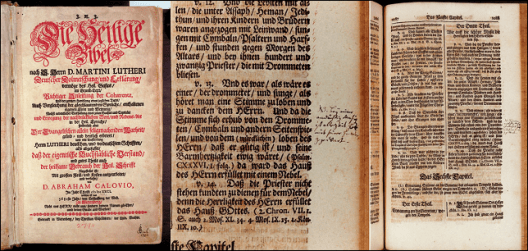
Bach’s Calov Bible after Luther, with Bach’s comment in the right margin of 2 Chronicles 5,13: “NB. Bey einer andächtigen Musiq ist allezeit Gott mit seiner Gnaden Gegenwart” (NB. Where there is devotional music, God with his grace is always present.)

This past October 31 marked the 500 anniversary of the Reformation: Luther posting his 95 theses on the door of the church in Wittenberg. Without Luther making the Bible available in German and making music an integral part of faith, Bach would probably not have felt as driven to educate his fellow believers through his music. Without Luther, there might not be any Bach cantatas, and definitely not this special cycle of chorale cantatas I’ve been discussing on this blog since June of this year.

It is interesting to me that when using one of Luther’s original chorales, Bach gives it an “old-fashioned” treatment: he writes the opening chorus in the “old style,” almost like a 16th century motet, and has the equally ancient brass quartet of one cornetto and three sackbutts (early trombones) doubling the vocal parts, as if wanting to confirm the timeless character of Luther’s chorales. A good example of this technique is Cantata 25 from 1723 and Cantata 2 from earlier in 1724, and Cantata 121 for Second Christmas Day 1724. If this was Bach’s preferred way of honoring Luther, he did this also on October 29 in 1724, two days before Reformation day, with this Cantata 38 Aus tiefer Not schrei ich zu dir for the 21st Sunday after Trinity. Aus tiefer Not schrei ich zu dir is on one of Luther’s very first chorales, and was also sung at his funeral.

I prefer Herreweghe’s recording of this cantata. It is available here on YouTube, or please consider supporting the artists by purchasing the entire album “Weinen, Klagen …” here on Amazon. The album also contains my preferred recordings of Cantata 12 (see my post about that here) and Cantata 75 (see my post about that here). Soloists are Carolyn Sampson, soprano; Daniel Taylor, countertenor; Mark Padmore, tenor, and Peter Kooij, bass.

Please find the German text with English translations here, and the score here.

If you have time, it is worth it to first listen to the opening chorus of cantata 2 Ach Gott, vom Himmel sieh darein from June 18, 1724, also based on one of Luther’s own chorales. Make sure you stop after the opening chorus, and then start listening to today’s Cantata 38 here, and hear how similar Bach’s setting of the chorale melody is. I don’t think it is a coincidence.

My favorite part of this cantata is the tenor aria: it is a beautiful piece of music, a quartet really, between the two oboe parts, the tenor voice, and the continuo, the way tenor arias often are with Bach, and I appreciate the text “Ich höre mitten in den Leiden ein Trostwort, so mein Jesus spricht” (In the midst of my sufferings I hear a word of consolation spoken by Jesus). I listened to this aria many times in the weeks after my mother passed away (seven years ago this month), Bach’s music being my “Trostwort.”

I also very much like the before-last movement of the cantata, the trio between soprano, countertenor, and bass. Excellent motet writing by Bach, and beautifully sung on the Herreweghe recording. Again this is a nod from Bach to older composition styles, linking back to the opening chorus, and perhaps an additional tribute to Luther.

Wieneke Gorter, November 4, 2017, links updated October 29, 2020.
Bass arias with trumpet

22 Sunday Oct 2017

Posted by cantatasonmymind in Cantatas, Leipzig, Trinity

≈ Leave a comment

Tags

19th Sunday after Trinity, Amsterdam Baroque Choir, Amsterdam Baroque Orchestra, Annette Markert, Azumi Takada, Bach, Bach Collegium Japan, cantatas, Christoph Prégardien, Gerd Türk, Gottfried Reiche, Klaus Mertens, Leipzig, Pascal Bertin, Peter Kooij, Peter Kooy, slide trumpet, Stephen Keavy, Susanne Rydén, Sybilla Rubens, Ton Koopman, Trinity, Trinity 19, trumpet

bwv5_manuscript_tromba

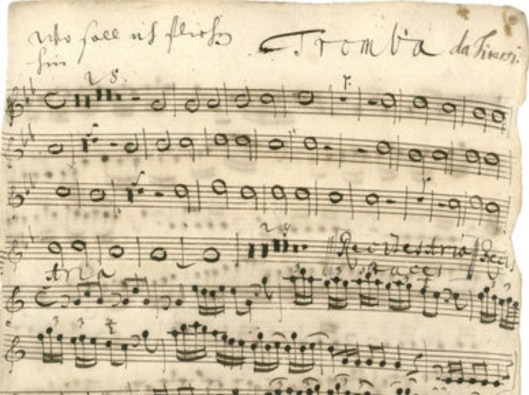
Excerpt from the trumpet part of Cantata 5 Wo soll ich fliehen hin? copied out by J.A. Kuhnau, Bach’s principal copyist, a nephew of Bach’s predecessor at Leipzig. Bach-Archiv Leipzig/Bach Digital.

The cantata from 1724 for this Sunday, the 19th after Trinity, is terrific, with a beautiful tenor aria with viola (or violin on some recordings) and rousing bass aria with trumpet. I prefer Bach Collegium Japan’s recording of this Cantata 5, Wo soll ich fliehen hin? because of Peter Kooij’s singing in the bass aria, Azumi Takada’s viola playing in the tenor aria, and the many colors of Susanne Rydén’s voice. Listen to it on YouTube via a playlist I created. Soloists are Susanne Rydén, soprano; Pascal Bertin, countertenor; Gerd Türk, tenor; Peter Kooij, bass.

Koopman’s recording of this cantata is good too, with perhaps a nicer tempo in the opening chorus, fabulous trumpet playing by Stephen Keavy in the bass aria, and good singing by Christoph Prégardien in the tenor aria. Listen to Koopman’s recording here. Soloists on this recording are Sybilla Rubens, soprano; Annette Markert, alto; Christoph Prégardien, tenor; Klaus Mertens, bass.

Find the German text with English translation here, and the score here.

Bach’s principal trumpet player, Gottfried Reiche, was an excellent musician, probably famous in the entire region, and apparently the only one who could play the tromba da tirarsi (slide trumpet) as well as the corno da tirarsi (slide horn — these were two different instruments!). And since Anna Magdalena’s father and all her three brothers-in-law were trumpet players at the regional courts, Bach knew their world well, and was most likely very well connected to many excellent players and their students. Around the feast of St. Michael’s (September 29), thousands of visitors from all over Europe would come to the Fair in Leipzig, and stay for a bit. Did Bach want to show Reiche off to all these visitors on September 29 (for Cantata 130, see below) and again this time on October 15, 1724, or were the trumpeter and/or bass singer themselves guests from out of town?

Bach paired the trumpet most often with the bass voice when writing arias. The most impressive bass arias with trumpet the Leipzig congregations would have heard between June 1723 (when Bach started working in Leipzig) and October 1724 are:

July 2, 1723: “Ich will von Jesu Wundern singen” from Cantata 147 (J.S. Bach Foundation recording from 2015 with Wolff-Matthias Friedrich, bass; Patrick Henrichs, trumpet)

August 1, 1723: “Dein Wetter zog sich auf von weiten” from Cantata 46 (Herreweghe recording from 2012 with Peter Kooij, bass; Alain De Rudder, Tromba da tirarsi).

November 14, 1723: “So löschet im Eifer der rächende Richter” from Cantata 90 (Bach Stiftung video with Klaus Häger, bass; Patrick Henrichs, trumpet)

May 28, 1724: “Heiligste Dreieinigkeit” from Cantata 172 (Leonhardt recording from 1985 with Max van Egmond, bass; Friedemann Immer, Klaus Osterloh, and Susan Willems, trumpets)

June 11, 1724: “Wacht auf, wacht auf, verloren Schafen” from Cantata 20 (Koopman recording from 1998 with Klaus Mertens, bass; Stephen Keavy, Tromba da tirarsi)

September 29, 1724, feast of St. Michael’s: “Der alte Drache brennt vor Neid” from Cantata 130 (Koopman recording from 2007 with Klaus Mertens, bass; Stephen Keavy, Jonathan Impett, and Michael Harrison, trumpets)

Wieneke Gorter, October 22, 2017, updated October 15, 2020.

If you don’t want to miss an episode of this 1724/1725 chorale cantata exploration, please consider signing up  to receive an email every time I’ve posted a new story. How to do this: If you are on a desktop computer, look to the left of this text, where it says “Follow Blog via Email,” enter your email address, and press the “Follow” button. If you are reading this on a smartphone, keep scrolling down until you find the same text.

Starlight shining on a Trinity cantata

15 Sunday Oct 2017

Posted by cantatasonmymind in Cantatas, Chorale cantatas 1724/1725, Leipzig, Trinity

≈ Leave a comment

Tags

18th Sunday after Trinity, Bach, Bach Collegium Japan, Bachstiftung, BWV 103, BWV 96, Christmas, cornetto, Deborah York, Epiphany, flauto piccolo, flute, Franziska Gottwald, J.S. Bach Foundation, Jan Börner, Julius Pfeifer, Maurice Steger, Nik Tasarov, Noëmi Sohn-Nad, Paul Agnew, Peter Kooij, Peter Kooy, Rudolf Lutz, sopranino recorder, St. Thomas Church, Thomaskirche, Ton Koopman, Trinity 18, Wolf Matthias Friedrich

threekings
The Adoration of the Kings, circa 1440. From a series of four boards from the former High Altar of the Heilig-Kreuz-Münsters in Rottweil, Germany.

In the summer and fall of 1724, Bach wrote an entire series of chorale cantatas, meaning that each cantata was based on a hymn. If at all possible, it was to be a hymn associated with that particular Sunday in the church year.  For this 18th Sunday after Trinity, he chose Herr Christ, der einige Gottessohn (Lord Christ, the only son of God). Keep reading to learn why.

When I first wrote about this Cantata 96 Herr Christ, der einige Gottessohn, in 2017, I recommended Ton Koopman’s recording. Listen to that recording here on Amazon, or here on Spotify. (It is not available on YouTube). Soloists are: Deborah York, soprano; Franziska Gottwald, alto; Paul Agnew, tenor; Klaus Mertens, bass; Heiko ter Schegget, sopranino recorder; and Wilbert Hazelzet, transverse flute.

However, since then a wonderful live video registration by the J.S. Bach Foundation has come out: you can find that here on YouTube. This is a terrific recording as well, with the added bonus that you can see the sopranino recorder and all the other instruments. Soloists in this performance are: Noëmi Sohn, soprano; Jan Börner, alto; Julius Pfeifer, tenor; Wolf-Matthias Friedrich, bass; and Maurice Steger, sopranino recorder.

Find the German text with English translation here and the score here.

In the Lutheran Church the chorale Herr Christ, der einige Gottessohn, one of the oldest Protestant hymns, was not so much associated with this 18th Sunday after Trinity, but more with Epiphany/Three Kings (January 6), for its reference to the Morning Star. Bach brings the luster of the Christmas season into this cantata in the most beautiful way. He gives the opening chorus a dusting of starlight by writing a part for flauto piccolo, or sopranino recorder*, over the rest of the vocal and instrumental parts. Since this time it is the altos that have the chorale melody in the opening chorus, Bach can create an ethereal link between the chorus and the flauto piccolo by way of the soprano part in the chorus. In the fifth line of the text, Er ist die Morgensterne (he is the Morning Star), he modulates to the brilliant key of E Major on the word “Morgensterne.”

But why did Bach select this chorale for a Sunday in the Trinity season? It becomes a bit more clear in the alto recitative and tenor aria. They refer to the fact that Jesus is God’s son, not David’s son. This is the only direct reference to the Gospel reading for this Sunday: Jesus giving the Jewish elders a hard time after they had claimed that he was only David’s son, not God’s son (Matthew 22: 34-46).  In the tenor aria Bach features his star flute player again.

In the soprano recitative, the focus changes to Jesus as guiding light, referring to the “he is the Morning Star” text from the chorale. The soprano’s statement that it can be hard to stay on the “right path” is illustrated in the bass aria.

We have heard faltering steps in Bach cantatas before (read my post about that here), but this time Bach offers a more theatrical illustration. In the St. Thomas Church in Leipzig a visual and aural effect would have made this even stronger: the violins, playing when the bass sings “zu rechten” (now to the right), would have stood on the right-hand balcony, the oboes, playing when the bass sings “zu linken” (now to the left) would have stood on the left-hand balcony. Also, in Bach’s rhetoric, right meant good and high, left meant bad and low.

The middle part of this cantata, with the text “Gehe doch, mein Heiland, mit” (My saviour please come with me) always moves me, especially when Peter Kooij sings it (listen to that here on Spotify, with Bach Collegium Japan).

Wieneke Gorter, October 15, 2017, updated October 8, 2020.

Follow this blog on Facebook or Instagram

*Since his arrival in Leipzig, Bach had used recorders in cantatas quite often (see this image by Nik Tarasov), but this is the very first time he writes for sopranino recorder, or “flauto piccolo.” The second time was on March 25, 1725, in Cantata 1 Wie schön leuchtet der Morgenstern, and the third time on the third Sunday after Easter in 1725, in Cantata 103 Ihr werdet weinen und heulen.

Inspired by Telemann? Cantatas 99 and 8

01 Sunday Oct 2017

Posted by cantatasonmymind in Cantatas, Leipzig, Trinity

≈ Leave a comment

Tags

BWV 130, BWV 148, BWV 245, BWV 8, BWV 99, Charles Daniels, Damien Guillon, Deborah York, Gerlinde Säman, Ingeborg Danz, Mark Padmore, Netherlands Bach Society, Peter Kooij, Philippe Herreweghe, St. John Passion, Telemann, Trinity 15, Trinity 16

redpalaceweimar

The Rote Schloss (Red Palace) of Duke Ernst August in Weimar, where Bach and Telemann probably first met, while Telemann was working in Eisenach and Bach was working in Weimar

This is a double post: for today, and also for last Sunday. But before I discuss Cantata 99 Was Gott tut das ist wohlgetan (Trinity 15, Sept 17, 1724) and Cantata 8 Liebster Gott, wenn wird ich sterben (Trinity 16, Sept 24, 1724), I would like to introduce you to a Telemann cantata: Du Daniel gehe hin.

Telemann’s beautiful cantata is not widely known today, but must have been rather famous among Telemann’s colleagues in the first half of the 18th century. The Kantor of the St. Nicholas Church in Berlin performed it in 1757, and I just realized this week that it must have been on Bach’s mind in 1724. While Bach and Telemann worked in the same region only from about 1708 to 1712, they were good friends, and it is generally assumed that they would have seen each other in Hamburg and Köthen a few times in the early 1720s.

I don’t know whether Bach’s “Ruht wohl, ihr heiligen Gebeine” closing chorus of the St. John Passion had anything to do with Telemann’s “Schlaft wohl, ihr seligen Gebeine” closing chorus in Du Daniel gehe hin, but it does look to me as if Bach borrowed the music of the soprano aria from Du Daniel gehe hin for the duet of  Cantata 99. If that is indeed what happened, then it seems very likely that, one week later, Bach was inspired by Telemann’s use of pizzicato strings as “funeral bells” in Du Daniel gehe hin when writing the opening chorus and tenor aria of Cantata 8.

For Cantata 99 Was Gott tut das ist wohlgetan I prefer the live video registration by the Netherlands Bach Society. Watch this recording on YouTube. Soloists are Gerlinde Sämann, soprano; Damien Guillon, alto; Charles Daniels, tenor; Peter Kooij, bass.

Find the text and translation  of Cantata 99 here, and the score here.

For Cantata 8 Liebster Gott, wenn wird ich sterben there is no other choice than Herreweghe. Soloists are Deborah York, soprano; Ingeborg Danz, alto; Mark Padmore, tenor; Peter Kooij, bass. This is definitely in my top five cantata recordings ever because of the combination of Bach’s music and Herreweghe’s interpretation. Listen to the incredibly beautiful oboe playing at the start of the tenor aria, and the horn in the opening and closing chorus. Peter Kooij does a fabulous job in the bass aria, which is so difficult it is on par with bass arias from the Christmas Oratorio and the end of the Trinity season of 1723. I wonder if Bach had an exceptional bass visiting for Michaelmas that year (Sept 29, for which he wrote this dramatic bass aria about the Archangel Michael slaying the dragon*).

Find the text and translation of Cantata 8 here, and the score here.

A striking element in both Cantatas 99 and 8 is Bach’s use of the flute. In cantata 99 Bach uses the instrument in two solo movements, the tenor aria as well as the soprano-alto duet. There could be a simple reason for this unusual choice: showing off his flute player (read more about him in this post). However, it is more likely that Bach wanted to point out the references to the cross in the text of both these movements, and what better instrument to bring out those harrowing chromatic lines than the flute? Using the flute to reinforce the image of the cross makes even more sense when you see what Bach does in the opening chorus of cantata 8. If you believe that his use of staccato flutes in the “Crucifixus” of the Mass in B Minor serves as image of hammering nails into the cross, then it is pretty clear what Bach’s hidden message is here.

Wieneke Gorter, October 1, 2017, links updated September 22, 2023.

*St. Michael’s Fair was a huge event in Leipzig, drawing visitors from as far as England and Poland, increasing the city’s population to 30,000. Read more about musicians visiting for this feast in my post about cantata 148, written for this same Sunday in 1723 or 1725.

Bach’s most famous duet

17 Sunday Sep 2017

Posted by cantatasonmymind in Cantatas, Chorale cantatas 1724/1725, Leipzig, Trinity

≈ Leave a comment

Tags

Allan Fast, BWV 10, BWV 101, BWV 113, BWV 20, BWV 25, BWV 33, BWV 78, Charles Brett, Eduard van Hengel, Howard Crook, Ingrid Schmithüsen, Joshua Rifkin, Julianne Baird, Peter Kooij, Trinity 14

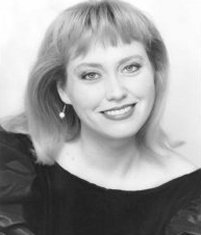
Julianne Baird
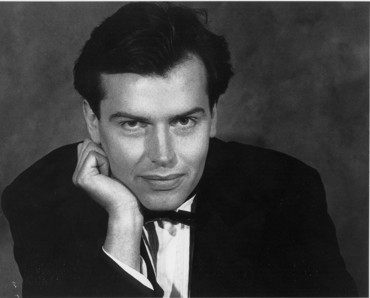
Allan Fast

Of this cantata 78 Jesu, der du meine Seele, most people only know the  soprano-alto duet Wir eilen mit schwachen, doch emsigen Schritten. The best rendition of this I have ever heard in my life is by Julianne Baird and Allan Fast on the Rifkin recording from 1988. Listen to it here. Fast passed away in 1995 at age 41.

Bach wrote this cantata for the 14th Sunday after Trinity, September 10, 1724. It was not the first time he wrote a “cute” duet — there are gorgeous examples  in sacred and secular cantatas from his Weimar and Köthen years. However, at the start of his second Leipzig cycle, for the Trinity season of 1724, there are more and more duets in his cantatas.  Alto-tenor duets appear in cantatas 20 and 10, spaced three weeks apart. A series of soprano-alto duets follows on July 9 in cantata 93, a month later in cantata 101, and the next week in cantata 113. Then there’s the terrific tenor-bass duet in cantata 33 on September 3, and this duet on September 10.

This is why I like it so much to listen to Bach’s cantatas in the order he wrote and performed them. I would never have noticed connections such as these otherwise.

The rest of the cantata is wonderful too, especially the opening chorus, which is among the most complex Bach ever wrote. For those who read Dutch, I encourage you to read Eduard van Hengel’s splendid article about this cantata here.

For the entire cantata I prefer Herreweghe’s recording, also from 1988. Soprano: Ingrid Schmithüsen; Alto: Charles Brett; Tenor: Howard Crook; Bass: Peter Kooy. Find the recording here on YouTube. Find the German text and English translations of the cantata here, and the score here.

More listening for this Sunday: cantata 25 from 1723. It has a much bigger orchestra, including many brass players. Find my explanation for that here.

Wieneke Gorter, September 17, 2017, updated September 8, 2023.

About Weekly Cantata

I am a bilingual writer, publicist, choral singer, art and nature lover, happy wife, and blessed mother of two. I started this blog in 2016, inspired by my late mother’s love for Bach’s cantatas. After 23 years in the San Francisco Bay Area, I’m now back in the Netherlands.

If you are on social media, please follow me:

  • Facebook
  • Instagram

Please subscribe!

Please join my readers from all over the world and subscribe to this blog! Simply fill in your email address and you’ll receive an email every time I’ve published a new post. Thank you so much / Vielen Dank / Merci mille fois / 감사합니다 / 谢谢 / ありがとう / Mille grazie / Muchas gracias / Muito obrigado / Takk / Terima kasih / Dankuwel!

Designed with WordPress.com

Something with this Sunday & Robin Blaze’s art of singing a chorale melody

27 Sunday Aug 2017

Posted by cantatasonmymind in Cantatas, Chorale cantatas 1724/1725, Leipzig, Trinity

≈ Leave a comment

Tags

alto, Bach, Bach Collegium Japan, BWV 113, BWV 179, cantatas, flute, Gerd Türk, John Eliot Gardiner, Leipzig, Masaaki Suzuki, Peter Kooij, Robin Blaze, Trinity, Trinity 11, Yukari Nonoshita

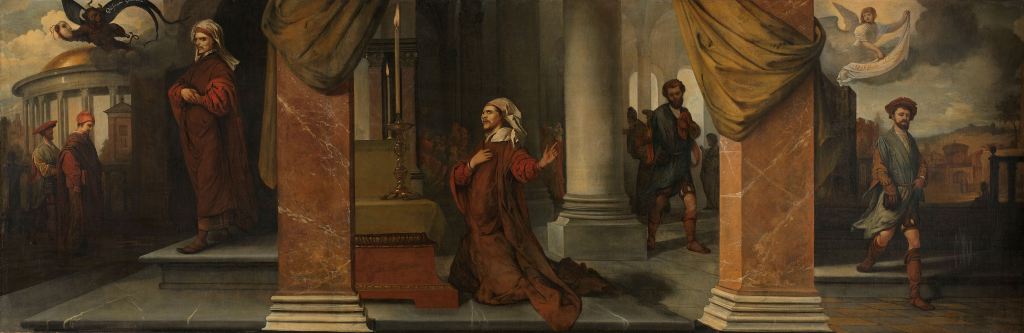
The Pharisee and the Publican by Barent Fabritius, 1661. Oil on canvas. Rijksmuseum, Amsterdam, the Netherlands.

In 1723, Bach wrote an exceptional cantata for this Sunday, the 11th after Trinity. I liked that cantata 179 so much that I gave my blog post last year the title “Bach on a roll” and I’ve been listening to it again this week. In 1724, Bach wrote cantata 113 Herr Jesu Christ, du höchstes Gut for this same Sunday. Both these cantatas truly move me. I feel as if Bach was especially humbled by this particular Sunday.

The only recording that does Cantata 113 Herr Jesu Christ, du höchstes Gut justice and gives me the good kind of stomachache is the one by Bach Collegium Japan, because of Peter Kooij’s and Robin Blaze’s terrific singing, beautiful oboe and flute playing, and the fact that Yukari Nonoshita and Robin Blaze make the duet into a lovely piece of music (instead of struggling through it, the way it seems to be on some other recordings). Listen to this recording by Bach Collegium Japan on Spotify, or on Youtube. Soloists on this recording are: Yukari Nonoshita, soprano; Robin Blaze, alto; Gerd Türk, tenor; and Peter Kooij, bass. Please consider supporting the artists by purchasing this recording on jpc.de or iTunes.

Find the text and translation here, and the score here.

That Bach might have might have felt a special touch or inspiration on this 11th Sunday after Trinity makes sense when you look at the Gospel reading for the day. It is the parable of the Pharisee and the Publican (or Pharisee and the Tax Collector), a story Jesus tells as an illustration on how to pray: the Pharisee is full of himself, telling God how good he is, while the Publican in his own prayer merely asks for mercy, and tells God how bad he is. This concept of how to be a good Christian before God, to be true, not fake, was very important to Bach.

In cantata 113 the chorale melody turns up much more often than in most of the other 1724/1725 chorale cantatas. It is even present in some of the arias that don’t have the chorale text. For the first time since starting this series of chorale cantatas, Bach doesn’t use the chorale melody as a cantus firmus in the opening chorus. Instead, he writes a simple four-part harmonized setting of the chorale melody. But, then there’s the unusual twist: Bach changes the usual 4/4 beat in which a chorale is normally sung to a 3/4, which allows him to write long suspensions in the vocal lines, thus intensifying the pleading character of the music (and the good stomach ache I get when I listen to it).

Robin Blaze. Photo by Dorothea Heise.

In the aria that follows, Bach makes up for the missing cantus firmus from the opening chorus. Any late-comers to that church service on Sunday August 20, 1724 would not have missed what chorale this cantata was based on: the alto sings the text as well as the melody of the chorale’s second stanza in long notes, against strings playing in unison.

Singing a chorale melody like this is not easy, and most recordings were unsatisfying to me because of this aria (as well as the duet). But Robin Blaze knows how to do it: sing with a brilliant sound, clearly placing each note, but also sustaining the sound throughout every note, and keeping it moving, while not forgetting word accents. It is a special art, and he masters it. I can listen to that five times in a row and not tire of it.

The bass aria could -as far as the music is concerned- easily have been inserted into the Christmas Oratorio, with the pretty oboe accompaniment. Note the word illustrations on “Zittern” (trembling) and “zerbräche” (would break), expertly sung by Peter Kooij. If this is all not pretty enough, Bach presents his talented flute player again, and gives him a beautiful but unbelievably challenging part, more virtuoso than ever before,  in the tenor aria “Jesus nimmt die Sünder an.” And then there is the duet.

Wieneke Gorter, August 27, 2017, updated August 15, 2023.

New Year’s treasures

31 Saturday Dec 2016

Posted by cantatasonmymind in Cantatas, Christmas, Leipzig

≈ Leave a comment

Tags

Barbara Schlick, BWV 122, BWV 248/4, Damien Guillon, Dorothee Mields, Feast of the Circumcision, Howard Crook, Jubeljahr, Mark Padmore, New Year's Day, Peter Kooij, Sarah Connolly, Sunday after Christmas, Thomas Hobbs, Vasiljka Jezovsek

newyearseve
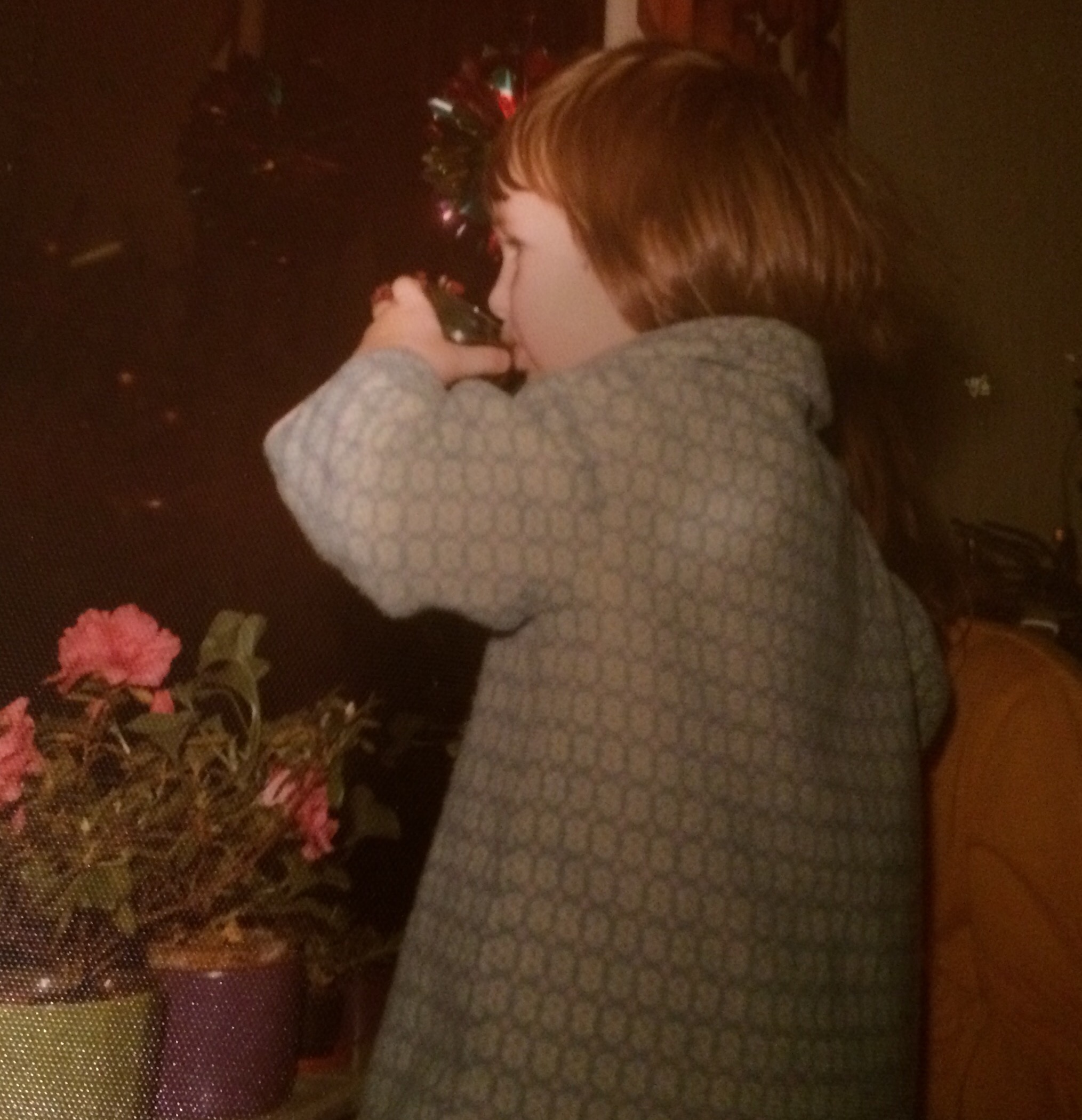
the author on New Year’s Eve, 1970s

There are many Bach cantatas for New Year’s Day, or the Feast of the Circumcision and naming of Jesus. Apart from the fourth cantata of the Christmas Oratorio I discuss here, those are: BWV 190 from 1724, BWV 41 from 1725, BWV 16 from 1726, and BWV 171 from 1729. They are all impressive, usually with trumpets and timpani in the orchestra, but rarely get performed anywhere. I hope that will change sometime.

Today is also the first Sunday after Christmas. If that day did not fall on Third Christmas Day, Bach would write a cantata for that too, as you can see in this overview. It means there is an overwhelming treasure trove of cantatas to choose from today.

The ones I like best are cantata 122 Das neugeborne Kindelein (for the first Sunday after Christmas in 1724) and the fourth cantata from the Christmas Oratorio Fallt mit Danken, fallt mit Loben (for New Year’s Day or the Feast of the Circumcision and naming of Jesus in 1735).

Listen to Herreweghe’s recording of cantata 122 Das neugeborne Kindelein on YouTube. It’s only 14 minutes long, but contains so many jewels. With soprano Vasiljka Jezovsek (stunning performance in the recitative), alto Sarah Connolly, tenor Mark Padmore, and bass Peter Kooij. I love every part of this cantata, but as a child I was most excited about the choruses: they still sounded like pretty Christmas music, but talked about the New Year!

Find the text of cantata 122 here, and the score here.

For Herreweghe’s interpretation of the 4th cantata from the Christmas Oratorio Fallt mit Danken, fallt mit Loben you have two options: There is a beautiful CD recording from 1989, which you can purchase here. Soloists on this recording are soprano Barbara Schlick, tenor Howard Crook, and bass Peter Kooij.

There is also a wonderful DVD recording from 2013, with soloists Dorothee Mields, countertenor Damien Guillon (not singing in part 4), tenor Thomas Hobbs, and bass Peter Kooij. I can highly recommend watching this. This DVD is available at ArkivMusic, Barnes and Noble, and can also be streamed on Amazon Prime.

Find the text of cantata 4 from the Christmas Oratorio here, and the score here.

I love this part of the Christmas Oratorio the best, because of the moving bass-soprano duet, the trio sonata disguised as a tenor aria with two violins, the famous echo-aria for soprano, and of course because it has horns in the orchestra! The presence of horns in the orchestra is the reason this cantata is often skipped in concert performances of the Christmas Oratorio. The entire oratorio is a bit too long for a regular concert program, there are no horns required in any of the other five parts, and natural horn players are expensive and hard to find, so presenters can save on production costs by not hiring any horn players at all.

By the way: Bach never intended for the Christmas Oratorio to be performed as a whole. He wrote each cantata for the six consecutive church Holidays in 1734/1735: First Christmas Day, Second Christmas Day, Third Christmas Day, New Year’s Day (or Feast of the Circumcision), Sunday after New Year, and Epiphany, and the separate cantatas were performed during the church services on those days. The music for the oratorio was largely based on existing choruses and arias from secular works. In this case of the fourth cantata, the opening chorus, soprano aria, and tenor aria all come from BWV 213 Laßt uns sorgen, laßt uns wachen aka Hercules at the Crossroads written in 1733 for the 11th Birthday of Prince Friedrich Christian, son of the Elector of Saxony.

I wish you a good 2017!

Wieneke Gorter, December 29, 2016, links updated December 28, 2019.

Second Christmas Day

26 Monday Dec 2016

Posted by cantatasonmymind in Cantatas, Christmas, Leipzig

≈ Leave a comment

Tags

Bach, BWV 40, Christmas, Christmas 2, Christmas Oratorio, Damien Guillon, Harnoncourt, horn, Leipzig, Max van Egmond, Peter Kooij, Philippe Herreweghe, René Jacobs, Thomas Hobbs

adoration_of_the_shepherds_1622
Adoration of the Shepherds by Dutch painter Gerard van Honthorst, 1622. Pommersches Landesmuseum (Pomerania State Museum), Germany.

In Bach’s time, there were three Christmas Days. In many countries in Europe there are still two Christmas Days. In the Netherlands, a country so small that you can easily travel to all your relatives within a day, people are expected to visit one side of the family on Christmas Day, and the other side on Second Christmas Day. Or at least that is how I remember it.

Of course, you could continue listening to the Christmas Oratorio, via the links for either Harnoncourt’s recording or Herreweghe’s recording I gave you yesterday. The second cantata is a charming one, evoking the pastoral scene of the shepherds on the field. But this composition has never grabbed or moved me the way the first or fourth cantata of the Christmas Oratorio do. The cantata I am eager to share with you today is cantata 40 Darzu ist erschienen der Sohn Gottes, written for Second Christmas Day in 1723.

The interpretation I grew up with is Leonhardt’s recording from 1974, with countertenor René Jacobs, tenor Marius van Altena, and bass Max van Egmond. There is a good live recording by Herreweghe of this cantata from a concert in Paris in 2015. You can watch this here on YouTube. Soloists are Damien Guillon, alto; Thomas Hobbs, tenor; and Peter Kooij, bass.

Find the text here, and the score here.

This cantata is really Christmas for me. I don’t know exactly why: perhaps because on Second Christmas Day we didn’t have to go to church, so I associate it with a more relaxed, unscheduled day. Perhaps because of the horns in the orchestra in the opening chorus and the tenor aria (I have a soft spot for horns or trombones in Bach cantatas), because of the impressive “Höllische schlange” (Snake of Hell) bass aria (yes, I have a soft spot for bass arias too), or because of the closing chorale that is so pretty, going up so high on the text Wonne, Wonne über Wonne! Er ist die Genadensonne. (Delight, delight upon delight! He is the son of mercy.) I sang this cantata in a Bach cantata reading group mid November this year, sitting directly behind the horns, standing next to one of my best friends, and I couldn’t believe my luck I got to sing this closing chorale.

Wieneke Gorter, December 26, 2016, updated December 24, 2019.

Our Christmas Morning

24 Saturday Dec 2016

Posted by cantatasonmymind in Cantatas, Christmas, Leipzig

≈ 2 Comments

Tags

Bach, BWV 248/1, Christmas, Christmas 1, Christmas Oratorio, Damien Guillon, Dorothee Mields, Harnoncourt, Leipzig, Peter Kooij, Phlippe Herreweghe, Thomas Hobbs, timpani, trumpet

nativity_c_1490
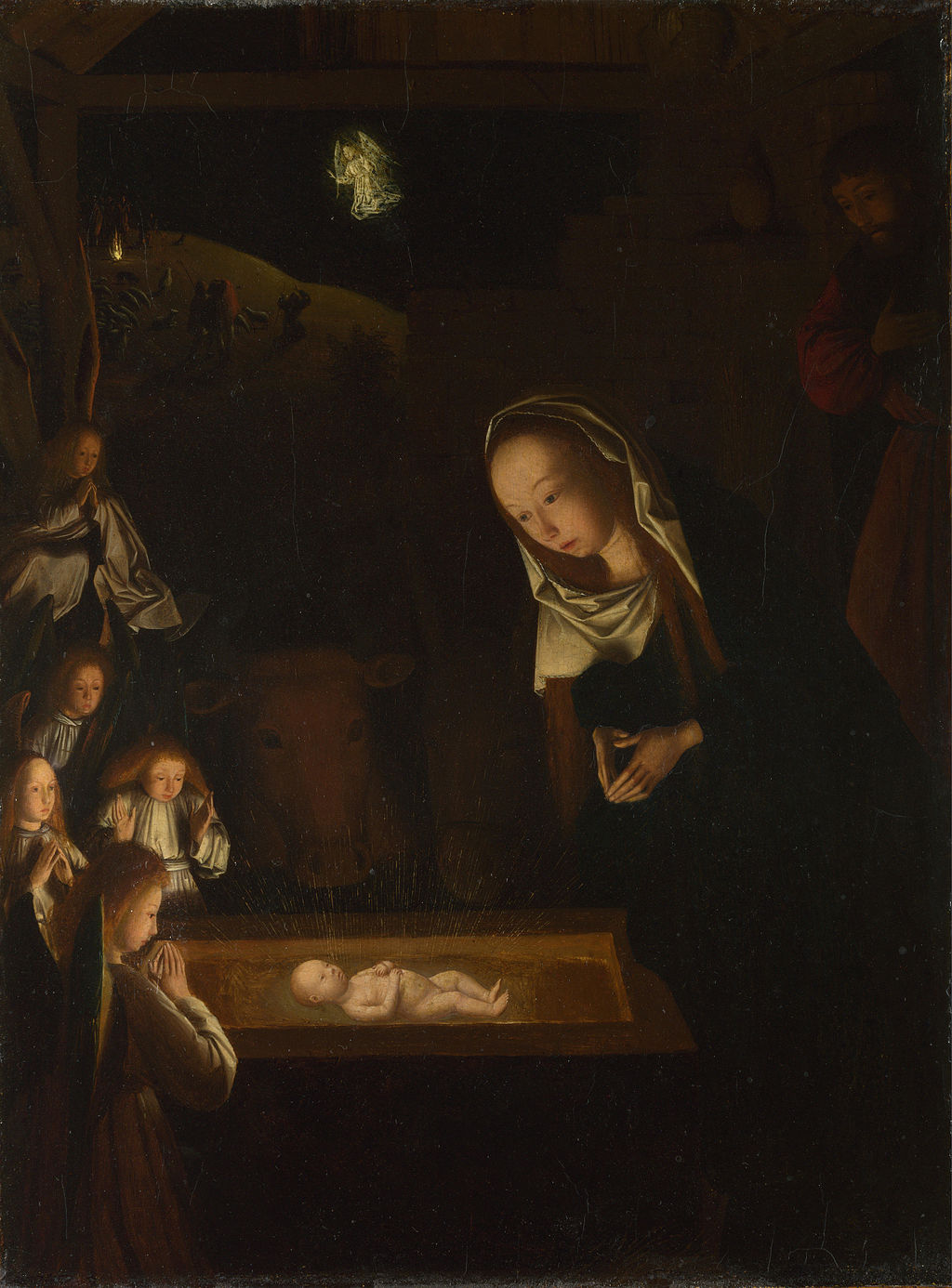
Nativity at Night by Dutch painter Geertgen tot Sint Jans, ca. 1490. National Gallery, London.

Growing up in the Netherlands, my sister and I did not expect gifts at Christmas, and certainly not under the tree. We had already received our gifts on the eve of St. Nicholas, December 5. At the dinner with relatives on Christmas Day, we would maybe receive one book, or a small piece of jewelry. It would be well coordinated between mother and grandmother that this would amount to only one present per person, and it would be next to our plate when we arrived at the well-dressed Christmas dinner table.

However, Christmas Morning was something we immensely looked forward to. The Christmas Morning breakfast was the most wonderful breakfast of the year, even better than the Easter breakfast. We would have crispy rolls from the oven, artisan sliced ham, boiled eggs, cheese, jams, and of course the sweet breakfast sprinkles American kids can’t believe Dutch kids get to eat for breakfast. And Kerststol, or Christmas Stollen, a fruit bread with an almond paste filling.

There was an unwritten rule that my parents would set out the breakfast (including my father carving a bell or Christmas tree out of the butter) and us kids would stay in bed until my mom would sound the special alarm. And the special alarm was: Harnoncourt’s recording of the opening chorus of Part One of Bach’s Christmas Oratorio at full volume, the sound of the timpani rocking the whole house. I usually play the Herreweghe recording in my own house nowadays. You can find that here on YouTube.

In 2012, Herreweghe’s performance of Bach’s Christmas Oratorio in Brussels was recorded and released on DVD. It is a beautiful registration, and has some of my favorite soloists: Dorothee Mields, soprano; Damien Guillon, alto; Thomas Hobbs, tenor; and Peter Kooij, bass. For my readers in Germany, and countries not to far from there, you can buy the regular DVD here, or the blu ray version here. For readers in the USA, if you have Amazon Prime, you can stream it here.

Read more about the history of Christmas in Europe and the USA in this extremely interesting article and join me again tomorrow for a cantata for Second Christmas Day.

Wieneke Gorter, December 24, 2016, links updated December 24, 2019.

Trinity 11, 1723: Bach on a roll

14 Sunday Aug 2016

Posted by cantatasonmymind in 1723 Trinity season special series, Bach's life, Cantatas, Leipzig, Trinity

≈ Leave a comment

Tags

11th Sunday after Trinity, according to Lutheran Church year, Agnès Mellon, Bach Collegium Japan, BWV 105, BWV 136, BWV 179, BWV 234, BWV 236, BWV 46, Collegium Vocale Gent, Masaaki Suzuki, Miah Persson, Peter Kooij, Philippe Herreweghe, Thomas Hobbs

8ea433d635c0bd84d61c155e0969f602c9c37beb
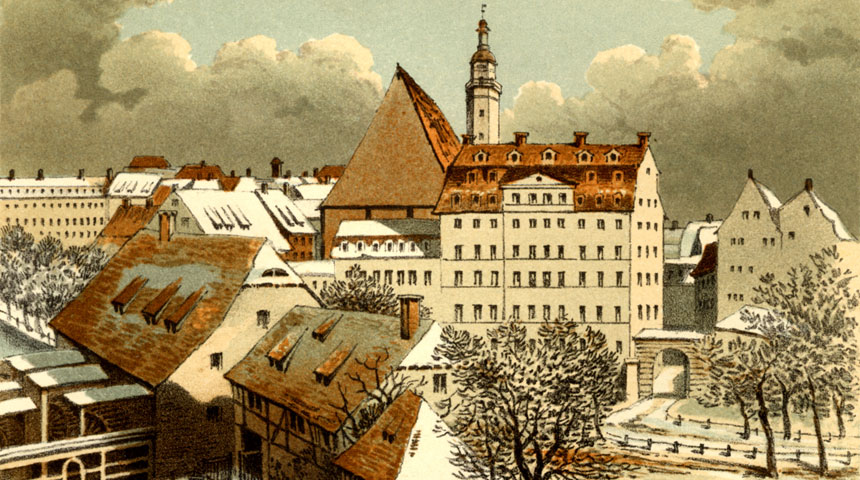
Mendelssohn’s sketch of the Thomasschule (St. Thomas School) and, behind it, the Thomaskirche (St. Thomas Church) in Leipzig.

Thank you for following this blog, and thank you for reading this long post all the way to the end!

For Trinity 11 (August 8 in 1723), we’re listening to Cantata 179 Siehe zu, daß deine Gottesfurcht nicht Heuchelei sei, with a superb opening chorus and one of the most beautiful soprano arias Bach ever wrote.

MiahPersson_MonikaRittershaus
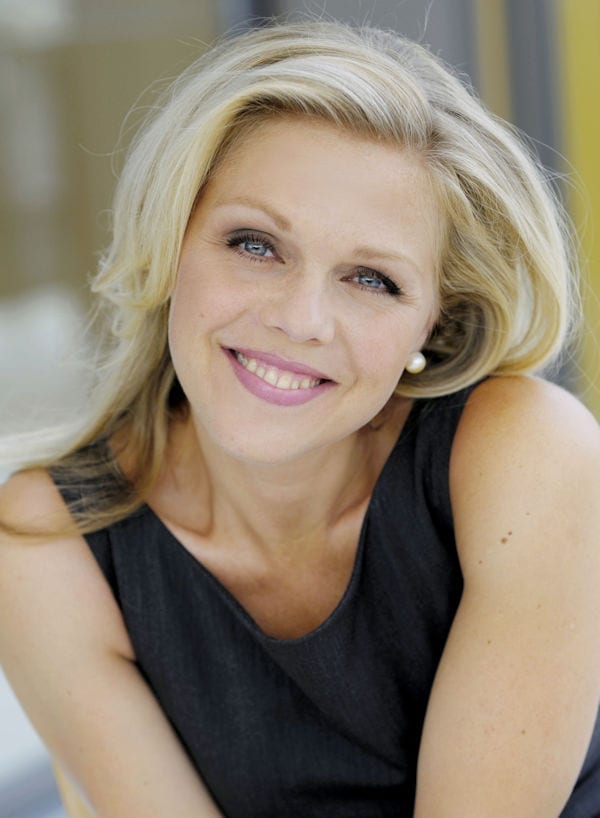
Miah Persson. Photo by Monika Rittershaus.

I prefer Bach Collegium Japan’s recording of this cantata. It’s a special recording, with Miah Persson singing the soprano aria. She’s having quite a career now, so I think we’re lucky to have her beautiful voice and sensitive interpretation on this recording from 1999. You can find it on Youtube or Spotify. Please consider purchasing this recording on jpc.de, Amazon, or iTunes. Soloists on this recording are Miah Persson, soprano; Makoto Sakurada, tenor; and Peter Kooij, bass.

Please find the score here (it’s fun to read along with the recording, especially in the opening chorus, to see what Bach does with the fugue) and the German text with English translation here.

It is now more than two months since Bach started his new job in Leipzig, and he is about three weeks into writing a brand new composition every week, and I’m sorry if I sound too casual here, but he’s on a roll. He must now have a vision of what it is he really wants to do for these churches (see the tiny preludes to his Passions he incorporates in cantatas 105 and 46), and he must have the classes at the St. Thomas School organized, and his singers sufficiently trained, so that he can now have them sing a new and challenging opening chorus every week.  Just listening to the opening choruses alone, starting with the one of cantata 136 for Trinity 8, I marvel at what he comes up with every time. Every single one of them is stunning, but at the same time completely different from the one of the previous Sunday. This time Bach chooses to write a perfect “old style” (Palestrina-style) motet fugue as opening chorus.

As always, to fully understand the cantata and not miss any of Bach’s hidden messages, it is important to look at the Gospel reading for the day. In this case it is the parable of the Pharisee and the Publican (or Pharisee and the Tax Collector), a story Jesus tells as an illustration on how to pray: the Pharisee is full of himself, telling God how good he is, while the Publican in his own prayer merely asks for mercy, and tells God how bad he is.  This concept of “how to be a good Christian before God” was very important to Bach and apparently his librettist got the message loud and clear. He or she uses the opportunity to first write a strong protest against fake religion and hypocrisy in “Christianity today” in movements 1 to 3 (probably having certain people in Leipzig in mind), after which he/she states that all Christians should take the humbleness of the publican as example in movements 4 to 6. For another example of how Bach interprets this Bible story, read my post about Cantata 113, written for this same 11th Sunday after Trinity, in 1724.

The most special feature of the fugue in the opening chorus is that since the text talks about beautiful outer appearance versus a bad character, Bach uses a mirror-fugue, which he used as well in fugues 5-7 from the Art of the Fugue (the theme of six bars is first introduced by the basses, and then is answered by the tenors in an “inversion:” every step up from the basses becomes a step down in the tenor part.)

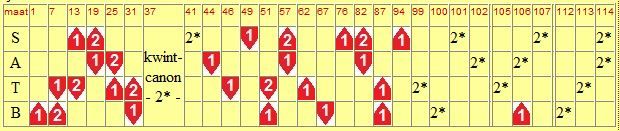
To understand how Bach built this intricate fugue I am sharing the excellent music example and diagram by Dutch Bach writer Eduard van Hengel, with his permission:

179_diagram1
179-diagram2

Even though the text here is in Dutch, the diagram speaks for itself, with this quick explanation of the numbers and symbols:

1 = The theme (or first half-sentence of the text: Siehe zu, dass deine Gottesfurcht nicht Heuchelei sei). Note the ascending line on the word “Gottesfurcht” (fear of God/love of God) and the descending line on the word “Heuchelei” (hypocrisy).

2 = The counter-subject (or second half-sentence of this text: und diene Gott nicht mit falschem Herzen). Note here that there is a chromatic line every time the word “falschem” appears in the text: for the chromatic line the composers needs accidentals that are not part of the key the piece is written in, which in the “old polyphony” would be seen as “falsch” (not right, off-key).

Upward arrow = fugue theme regular

Downward arrow = fugue theme inversed (mirror fugue)

2* = a more compact (only 4 bars instead of 6 bars long) theme which is derived from the first counterpoint/counter-subject on the words und diene Gott nicht mit falschem Herzen, still with the chromatic line on falschem Herzen.

The numbers at the top are measure (“maat”) numbers.

Bach himself must have greatly valued this cantata. About 15 years later, he used no less than three movements from this cantata for use in his short masses, or Lutheran masses.**

The opening chorus was later “recycled” as the first movement (Kyrie) in the Mass in G Major, BWV 236. Keep listening, or scroll to 18:00 and you’ll discover that the tenor aria Quoniam (sung here by Thomas Hobbs) was, with some changes and a much slower tempo, recycled from the tenor aria in this cantata 179. In cantata 179 the tenor aria gets a colorful accompaniment of two oboes and first violins in unison. The second violins and violas fill in the meaningless middle part (representing the “nothingness, emptiness”). When recycling this later for the Quoniam in the Mass in G Major, Bach uses only one solo oboe for the accompaniment, and completely leaves out all strings (confirming that with a different text, the meaningless middle part is not relevant anymore).

This cantata’s wonderful soprano aria (with two oboi da caccia and basso continuo) was later reworked into the Qui Tollis for the Mass in A Major, BWV 234 (with two flutes and only high strings as continuo). This was actually how I first knew and loved this soprano aria, I didn’t know cantata 179 until I started listening to it for this blog. Please click on this link and listen to the amazing Agnès Mellon sing the Qui Tollis from the Mass in A Major.

Wieneke Gorter, August 14, 2016, links updated August 15, 2023.

** These are called “short” or “Lutheran” masses because they consisted of only the Kyrie and Gloria part of the traditional Catholic mass. Bach wrote four of them (BWV 233-236), and they are all made up of existing movements from cantatas, but reworked and compiled in a very smart way and they are all absolutely beautiful. You can purchase an album with Herreweghe’s recording of all of them on jpc.de, iTunes, or Amazon.

← Older posts
Newer posts →

Recent Posts

  • “Missa Miniatura” by CONTINUUM/Elina Albach Even More Moving in 2025
  • Bachfest Leipzig 2025
  • Bach Cantatas for Christmas – 1724 and 1734 editions
  • Fourth Sunday of Advent – more insight into Cantata 62 helped me better understand Bach’s Christmas Oratorio
  • Saint Ambrose and Luther in Milan – Second Sunday of Advent

Archives

  • August 2025
  • July 2025
  • December 2024
  • November 2024
  • June 2024
  • January 2024
  • December 2023
  • October 2023
  • September 2023
  • August 2023
  • April 2022
  • February 2022
  • January 2022
  • December 2021
  • November 2021
  • June 2021
  • May 2021
  • April 2021
  • February 2021
  • January 2021
  • December 2020
  • November 2020
  • October 2020
  • September 2020
  • August 2020
  • July 2020
  • May 2020
  • April 2020
  • March 2020
  • February 2020
  • January 2020
  • December 2019
  • November 2019
  • May 2018
  • April 2018
  • March 2018
  • February 2018
  • January 2018
  • December 2017
  • November 2017
  • October 2017
  • September 2017
  • August 2017
  • July 2017
  • June 2017
  • May 2017
  • April 2017
  • March 2017
  • February 2017
  • January 2017
  • December 2016
  • November 2016
  • October 2016
  • September 2016
  • August 2016
  • July 2016
  • June 2016
  • May 2016
  • April 2016
  • March 2016
  • February 2016
  • January 2016

Enter your email address to follow this blog and receive notifications of new posts by email.

Join 338 other subscribers

Categories

  • 1723 Trinity season special series
  • Advent
  • After Easter
  • Ascension
  • Bach's life
  • Cantatas
  • Chorale cantatas 1724/1725
  • Christmas
  • Easter
  • Epiphany
  • Following Bach in 1725
  • Köthen
  • Leipzig
  • Septuagesima
  • Travel
  • Trinity
  • Weimar

Meta

  • Create account
  • Log in
  • Entries feed
  • Comments feed
  • WordPress.com

Website Built with WordPress.com.

  • Subscribe Subscribed
    • Weekly Cantata
    • Join 158 other subscribers
    • Already have a WordPress.com account? Log in now.
    • Weekly Cantata
    • Subscribe Subscribed
    • Sign up
    • Log in
    • Report this content
    • View site in Reader
    • Manage subscriptions
    • Collapse this bar
 

Loading Comments...