Weekly Cantata

Weekly Cantata

Tag Archives: Rudolf Lutz

Pelting rain, growing crops, it is the low instruments that do it

16 Sunday Feb 2020

Posted by cantatasonmymind in Cantatas, Weimar

≈ Leave a comment

Tags

2nd Sunday before Lent, Ageet Zweistra, American Bach Soloists, Andrew Schwartz, Anthony Martin, Armelle Plantier, Benjamin Butterfield, BWV 18, Dominik Wörner, four violas, François Fernandez, Francis Jacob, Gaëlle Lecoq, Gaëlle Volet, George Thomson, Iris Finkbeiner, J.S. Bach Foundation, James Weaver, Jan Kobow, Jeffrey Thomas, Joanna Bilger, John Butt, Josep Borras I Rocca, Julianne Baird, Kaori Uemura, Katharine Fuge, Kees Boeke, Lisa Grodin, litany, Luis Otavio Santos, Makoto Sakurada, Martina Bischof, Maya Amrein, Michael Eagan, Michele Zeoll, Neue Bach Ausgabe, Nikolaus Broda, Norbert Zeilberger, Nuria Rial, Philippe Pierlot, rain, Renate Steinmann, Rudolf Lutz, Sally Butt, Sexagesima, snow, Stephan MacLeod, Susanna Hefti, viola, Warren Stewart, Weimar

Finally I get to write about Cantata 18 Gleichwie der Regen und Schnee vom Himmel fällt (“the same way rain and snow falls from heaven”), which Bach wrote for this Sunday (Sexagesima, or the 2nd Sunday before Lent) in Weimar in 1713 or 1714. I don’t remember this cantata from my childhood, but have been impressed with it since I purchased the American Bach Soloists’ CD in 2010.

Find the German text with English translations here, and the NBA score here (Neue Bach Ausgabe score, based on the original Weimar score, the same one used by the American Bach Soloists, without recorders in the orchestra).

There is so much happening in this cantata that I could write two or three blog posts about it. To start, I’d like to share three recordings that stand out to me.

My first love of this Cantata 18, the American Bach Soloists’ recording from 1994, can be found here on Spotify. Or purchase the CD or MP3 on Amazon USA, or on Amazon DE, or on iTunes. Soloists are: Julianne Baird, soprano; Benjamin Butterfield, tenor; James Weaver, bass. Violas: Anthony Marin, Lisa Grodin, Sally Butt, George Thomson; Violoncello: Warren Stewart; Bassoon: Andrew Schwartz; Archlute: Michael Eagan; Organ: John Butt.

Director Jeffrey Thomas chooses a slower tempo for the opening sinfonia than most others, which I like. It makes the music more dramatic, and it allows the instrumentalists to paint a truly cold, wintry rain, completely appropriate for this time of year in Germany. The sound of the four violas together is wonderful throughout, and I love Julianne Baird’s singing of Luther’s “litany” in the third movement.

The next two recordings use a later* version of the score, with the addition of recorders in the orchestra.

I highly recommend the recording by Ricercar Consort from 2004, available here on YouTube. With: Katharine Fuge (Soprano); Jan Kobow (Tenor); Stephan MacLeod (Bass); François Fernandez (Viola); Luis Otavio Santos (Viola); Philippe Pierlot (Viola da gamba); Kaori Uemura (Viola da gamba); Ageet Zweistra (Violoncello); Kees Boeke (Recorder); Gaëlle Lecoq (Recorder); Josep Borras I Rocca (Bassoon); Michele Zeoll (Double-bass); Francis Jacob (Organ).

What I like about this recording: the orchestration with two violas and two viola da gambas instead of four violas. The bass instruments do an absolutely fabulous and unrivaled job of bringing out Bach’s illustration of the text “und macht sie fruchtbar und wachsend” (and make it fruitful and fertile) in the second movement. You can truly hear plants growing and blossoming there. And bass Stephan MacLeod, whose singing I usually appreciate much more in Renaissance music than in Bach, is superb in that second movement. His voice is a beautiful “Voice of God” in the text from Isaiah 55: 10-12.

Final recommendation, for now: the live video recording by the J.S. Bach Foundation from 2009, available here on YouTube. With: Núria Rial, soprano; Makoto Sakurada; tenor; Dominik Wörner, bass; Recorders: Armelle Plantier, Gaëlle Volet; Bassoon: Nikolaus Broda; Violas: Susanna Hefti, Renate Steinmann, Martina Bischof, Joanna Bilger; Violoncello: Maya Amrein; Violone: Iris Finkbeiner; Organ: Norbert Zeilberger

What I enjoy most about this recording is Nuria Rial’s singing of the soprano aria (the fourth movement). The aria is incredibly difficult, but, as always, she makes it seem effortless, and her “Fort mit allen, fort, nur fort!” is the best of all recordings I have listened to. I also enjoy the choir sopranos’ singing of the “litany” in the third movement, and the mere fact that you can watch everyone make music, since this is a live video recording.

If you would like to read about another cantata for this Sunday, find my post about Cantata 126 here. Bach wrote that cantata also for Sexagesima Sunday, in 1725.

Wieneke Gorter, February 16, 2020.

*from 1724 in Leipzig, when Bach performed this cantata again.

Bach looking back (Belated 2nd Sunday after Epiphany)

01 Saturday Feb 2020

Posted by cantatasonmymind in Cantatas, Epiphany, Leipzig

≈ Leave a comment

Tags

Bart Coen, Benny Aghassi, BWV 106, BWV 13, BWV 155, BWV 161, BWV 244, BWV 249, BWV 3, BWV 46, Colin Balzer, Collegium Vocale Gent, Easter Oratorio, Epiphany 2, Heiko ter Schegget, Herman Stinders, J.S. Bach Foundation, Jakob Pilgram, Jan Börner, Julius Pfeifer, Margot Oitzinger, Mark Padmore, Matthew White, Netherlands Bach Society, Philippe Herreweghe, recorders, Rudolf Lutz, St. Matthew Passion, Susanne Seitter, Wolf Matthias Friedrich

Wedding at Cana by Duccio di Buoninsegna, tempera on wood, between 1308 and 1311. Museo dell’ Opera dell’ Duomo, Siena, Italy. The “scene” from this story that Bach and his librettists prefer to focus on in all his cantatas for this Sunday, is also illustrated here: Jesus telling his anxious mother “Mine hour is not yet come.”

Two weeks ago I ran out of time writing this post, but I had discovered so much about Cantata 13 Meine Seufzer, meine Tränen (1726), that I would still very much like to share that cantata here. So I hope you don’t mind going back in time a little bit, to the Second Sunday after Epiphany, which fell on January 19 this year (2020), and on January 20 in 1726.

Before I prepare a new post, I always like to revisit previous posts I wrote about this same Sunday, and listen to those cantatas again. And it always thrills me when during this process I discover that Bach must have done this too: going back, either in his memory or in the physical stack of manuscripts, to the music he previously wrote for this same Sunday. Sometimes I only get a feeling that he did this, but other times, there’s an obvious quote either in the text or in the music.

This time I was excited to find Bach quoting music from Cantata 155 Mein Gott, wie lang, ach lange? in Cantata 13 Meine Seufzer, meine Tränen. Bach had written Cantata 155 already in Weimar in 1716, but performed it again in Leipzig in 1724, also on the Second Sunday after Epiphany.

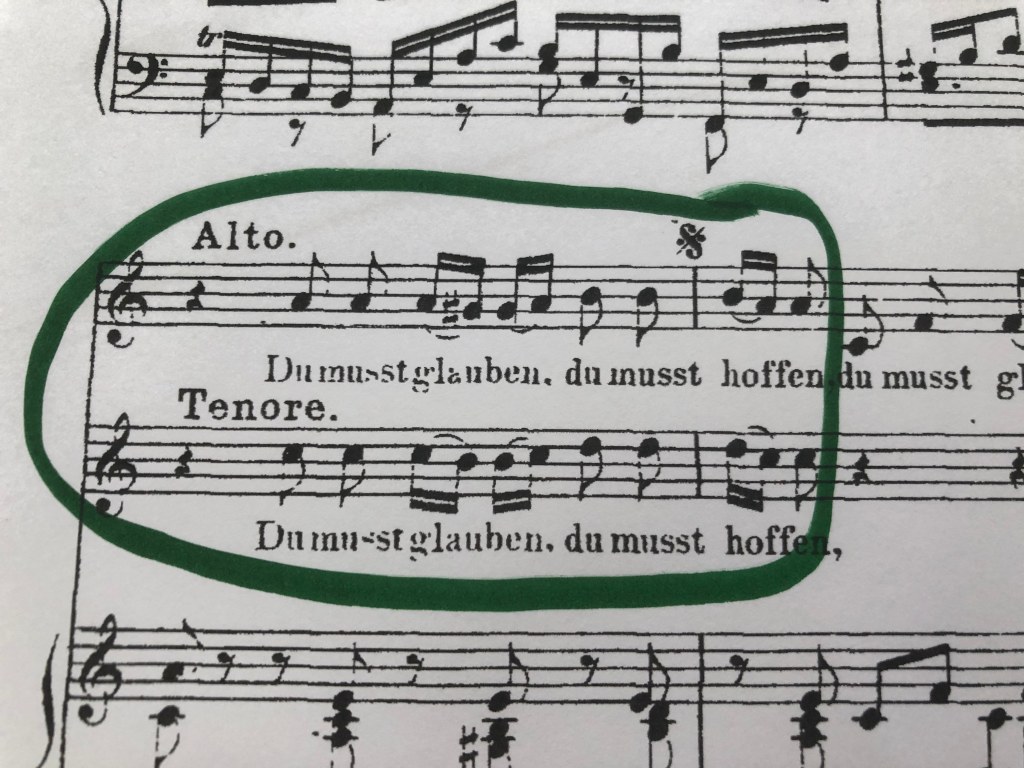
I invite you to listen to/watch the wonderful alto-tenor duet with bassoon from Cantata 155 Mein Gott, wie lang, ach lange? here, in a performance by the J.S. Bach Foundation, with alto Margot Oitzinger and tenor Julius Pfeifer. Note this theme in the voices:

After that duet is over, I would suggest turning off that recording for now. *

Now listen to/watch the entire recording of Cantata 13 Meine Seufzer, meine Tränen, also by the J.S. Bach Foundation here, with soprano Susanne Seitter, alto Jan Börner, tenor Jakob Pilgram, and bass Wolf Matthias Friedrich.

Find the German text with English translations here, and the score here. Please note that the English translation of the bass aria’s first line is incorrect: the translation of the German word “Sorgen” should be “worries” or “worrying”, not “care.” The correct translation is something like this:

Groaning and pitiful weeping
are no help to the sickness of worrying

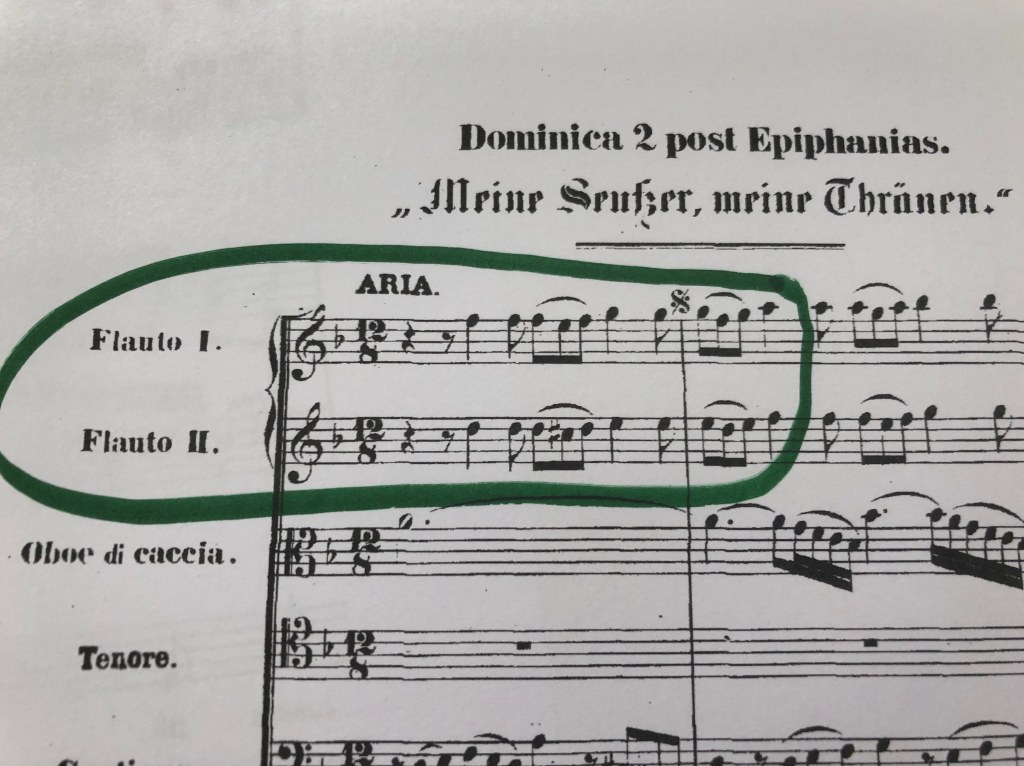
Pay attention to the recorder parts in the opening movement. The music has a slower tempo, and a more drawn out rhythm, but the theme is the same as in that duet from Cantata 155 you just heard:

There is more in this opening chorus of Cantata 13 that gives us a peek into Bach’s referencing process. Bach often uses recorders to introduce sorrow. Early in his career he had done this in the opening movements of Cantata 106 Gottes Zeit ist die allerbeste Zeit (written in 1707) and Cantata 161 Komm, du süße Todesstunde (1716). Even during his first year in Leipzig, in 1723, he used this “tool” in the opening chorus of Cantata 46 Schauet doch und sehet, ob irgendein Schmerz sei (which would later form the basis for the Qui tollis from the Mass in B minor). And while from the mid 1720s most Baroque composers, including Bach himself, favored the more fashionable French transverse flutes over recorders, Bach still uses recorders to illustrate impending sorrow or death’s slumber in his Easter Oratorio (1725) and his St. Matthew Passion (1727). Click on the links to hear/watch recordings of all these examples on YouTube. Names of performers in all these are listed at the very end of this post.**

If, after listening to / watching Cantata 13 in its entirety, you are wondering why Bach’s illustration of a miracle (Jesus turning water into wine at the Wedding at Cana) is so incredibly sorrowful, read my blog post about Cantata 3 here.

Wieneke Gorter, January 31, 2020, updated January 16, 2021.

* read my blog post about Cantata 155, which now includes a link to the J.S. Bach Foundation recording, here.

** Performers in the YouTube recordings of cantata/oratorio movements with recorders are:

Credits for YouTube recordings linked above:

Opening movement of Cantata 106: Netherlands Bach Society; Jos van Veldhoven, conductor; Heiko ter Schegget and Benny Aghassi, recorders; Dorothee Mields, soprano; Alex Potter, alto; Charles Daniels, tenor; Tobias Berndt, bass.

Opening movement of Cantata 161: Collegium Vocale Gent; Philippe Herreweghe, conductor; Bart Coen and Koen Dieltiens, recorders; Matthew White, alto; Herman Stinders, organ.

Opening movement of Cantata 46: Collegium Vocale Gent; Philippe Herreweghe, conductor. Live recording from the Festival of Saintes, France, July 15, 2013. Recorder players not specified.

Tenor aria “Sanfte soll mein Todeskummer” from Easter Oratorio, BWV 249: Collegium Vocale Gent; Philippe Herreweghe, conductor. Mark Padmore, tenor.

Tenor recitative with choir “O Schmerz, hier zittert das gequälte Herz” from St. Matthew Passion, BWV 244: Collegium Vocale Gent; Philippe Herreweghe, conductor. Colin Balzer, tenor.

Two Weimar cantatas for the fourth Sunday of Advent

21 Saturday Dec 2019

Posted by cantatasonmymind in Advent, Bach's life, Cantatas, Christmas, Leipzig, Weimar

≈ Leave a comment

Tags

Advent, Advent 4, Alfredo Bernardini, All of Bach, Bachvereniging, BWV 132, BWV 147, BWV 147a, Christmas, Dominik Wörner, Hana Blazikova, J.S. Bach Foundation, J.S. Bach Stiftung, Jakob Pilgram, Jan Kobow, Julia Doyle, Margot Oitzinger, Netherlands Bach Society, Rudolf Lutz, Tim Mead, Weimar, Wolf Matthias Friedrich

For the fourth Sunday of Advent, Bach wrote two cantatas in Weimar: Cantata 132 Bereitet die Wege, bereitet die Bahn in 1715, and Cantata 147a Herz und Mund und Tat und Leben in 1716.

Bach rewrote Cantata 147, the same way he did that with cantatas 70 and 186, into a cantata for another time of the year in Leipzig, in this case the feast of the Visitation on July 2, 1723. Read more about that here in my post from 2016. I have now updated that post with a link to the wonderful live performance of Cantata 147 by the J.S. Bach Foundation, with with Hana Blažiková, soprano; Margot Oitzinger, alto; Jakob Pilgram, tenor; and Wolf Matthias Friedrich, bass.

Cantata 132 was not transformed into a cantata for another time in the church year in Leipzig, so today’s performances of this cantata still reflect the Advent cantata from Weimar. Watch a beautiful live performance of this cantata by the Netherlands Bach Society here on YouTube. Soloists are Julia Doyle, soprano; Tim Mead, alto; Jan Kobow, tenor; and Dominik Wörner, bass.

Find the German text with English translations here, and the score here.

As I already pointed out in my Advent Calendar earlier this week, the text of the joyful opening aria refers to the story of John the Baptist, who was believed to have come to prepare the way for Jesus, and includes the Isaiah quote as it appears in the scripture: “Messias kömmt an!” (The Messiah is coming). Bach gives this text to the soprano three times, and to give it extra emphasis, each time omits all instrumental accompaniment on those three words.

The rest of the cantata stays close to the story of John the Baptist. The bass aria refers to the Pharisees interrogating John, but then Bach’s text writer (Salomo Franck, who was also the Weimar court librarian) projects the question “Wer bist du?” (Who are you?) onto the believer: ask your conscience: are you a true person or a false person?

As a child, I was enormously impressed by this bass aria, even more than by the wonderful soprano aria at the beginning of the piece. I loved how Max van Egmond sings the “Wer bist du?” text on the Leonhardt recording from 1983. You can find that recording, and read more about those childhood memories, in this blog post from 2016. I had no idea at the time that in those very cool opening notes Bach is quoting this organ piece by Buxtehude. I only learned that this week, by watching the “extra videos” the Netherlands Bach Society provides along with their live recordings on All of Bach.

If you are not following this blog yet, please consider signing up (on the left of this text if you are on a desktop computer, at the bottom of this post when you are reading on a smartphone). This way you won’t miss any posts about the many cantatas Bach wrote for all three Christmas Days (yes there were three in his time), New Year’s Day, and the Sundays after those feast days.

Wieneke Gorter, December 21, 2019.

Weekly Cantata is back!

15 Friday Nov 2019

Posted by cantatasonmymind in Cantatas, Chorale cantatas 1724/1725, Leipzig, Trinity

≈ 10 Comments

Tags

22nd Sunday after Trinity, Bachipedia.org, Bachstiftung, Balázs Máté, BWV 115, corno da tirarsi, Marc Hantaï, Olivier Picon, Rudolf Lutz

The Servant Sending his Fellow Servant to Prison, from The Parable of the Unmerciful Servant, bound in Thesaurus Sacrarum historiarum Veteris et Novi Testamenti, 1585.
Anonymous, Netherlandish. Metropolitan Museum of Art, New York (not on view).

I’m back! I’m starting with a small step, but stay tuned … a more considerable post is coming next week.

For this coming Sunday, the 22nd Sunday after Trinity, Bach wrote Cantata 89 in 1723, Cantata 115 in 1724, and Cantata 55 in 1726. Two years ago I wrote about the soprano aria from Cantata 115, not really being able to choose between Susanne Rydén with Bach Collegium Japan or Dorothee Mields with Herreweghe. I also included a link to the soprano aria from Cantata 89. Read that post here.

I still recommend the Herreweghe recording from 2017 for an overall recording of this cantata. However, sometimes it is nice to *see* a performance, and I would like to celebrate an important event in the world of Bach Cantata recordings that happened in the past year: The J.S. Bach Foundation in Switzerland (Bachstiftung) decided to make all their live video recordings of their Bach cantata performances available on YouTube, in full length. Previously, they had only made one movement of each cantata available on YouTube, and one would have to purchase the DVD or buy a live stream subscription in order to see the rest of the cantata.

So in this post I would like to share the Bachstiftung recording of Cantata 115. It was recorded on October 21, 2016, and published to YouTube on October 26, 2018.

Find the German texts with English translations here and the score here.

What is so special about this video recording is that you can see wonderful flutist Marc Hantaï at work in the opening chorus and in the soprano aria. He doesn’t appear on video that often, and they made a good choice to put him in front, so you can see his playing, and of course this way also the microphones pick up his sound better. (to hear more of what I believe is his playing, go to this post).

corno da tirarsi


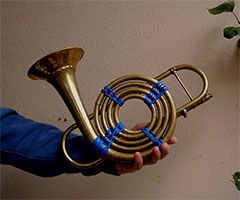
Other instrumentalists to watch in this video: Olivier Picon on corno da tirarsi, and Balázs Máté on violoncello piccolo. Only three cantatas (46, 162, and 67) show the full name corno da tirarsi written in the manuscript, but there are 27 cantatas from Leipzig requiring a corno in which that part is not playable on a natural horn, so must have been written for this corno da tirarsi as well. Cantata 115 is included in that group. Bach is the only composer who ever mentioned this instrument in writing, and most probably his principal brass player Gottfried Reiche was the only one who ever played it. After Reiche’s death in 1734 Bach did not write for this instrument anymore, and for repeat performances of any cantatas containing a corno da tirarsi part, Bach rewrote it for other instruments. Read more about this in Olivier Picon’s article on the “corno da tirarsi” from 2010. The 27 cantatas are mentioned on page 22 of the article.

To find more of the Bachstiftung videos, search their Archive on their Bachipedia.org website. Most of the videos are “unlisted” on YouTube, so you won’t find them by doing a search within YouTube. Or, for the Dutch readers of this blog, you can use Eduard van Hengel’s new website (another terrific event of this past year!) and click on the links for all YouTube recordings he conveniently provides at the top of each page under the header “Beluister” (for an example, see the one for Cantata 115 here).

Wieneke Gorter, November 15, 2019.

Wedding music for the 20th Sunday after Trinity, with a gorgeous soprano aria

30 Monday Oct 2017

Posted by cantatasonmymind in Cantatas, Chorale cantatas 1724/1725, Köthen, Leipzig, Trinity

≈ Leave a comment

Tags

Advent, Bach, Bachstiftung, BWV 140, BWV 180, BWV 21, BWV 61, Christoph Prégardien, Christophe Coin, duet, Fabrice Hayoz, flute, J.S. Bach Foundation, Jan Börner, Julius Pfeifer, Köthen, Leipzig, Maria Christina Kiehr, parable of the Wedding Banquet, recorder, Rudolf Lutz, Trinity, Trinity 20, violin, Weimar

Bachsaal_Schloss_Koethen

The mirror-hall, now called “Bach hall” in Köthen, where Bach worked from 1717 to 1723.

The 1724 cantata for yesterday, Cantata 180 Schmücke dich, o liebe Seele (Adorn yourself, beloved soul) is full of luster, with an opening chorus, a tenor/flute aria and a soprano/orchestra aria that make me think of the orchestral suites Bach wrote at the court of Köthen between 1717 and 1723. With all this joy already from the beginning, it sounds like a wedding cantata.

The recording I appreciate most is the one by the Swiss J.S. Bach Foundation from 2009, because I feel they bring the most light into the opening chorus and the soprano aria, illustrate the “knocking” the best in the tenor aria, and the singers do a great job bringing out the text. Soloists: Maria Christina Kiehr, soprano; Jan Börner, counter-tenor; Julius Pfeifer, tenor; and Fabrice Hayoz, bass.  Update from 2020: When I first wrote about this cantata, in 2017, only the soprano aria from this recording was available on YouTube, but in 2018 they made it available in full length. You can find it here.

Find the German text with English translation here, and the score here.

Why all this luster in this cantata? In Bach’s time, the Gospel reading for this Sunday, the parable of the Wedding Banquet (Matthew 22: 1-14) was seen in relation to the union of the faithful with Christ, both during communion as well as during the heavenly banquet in the afterlife. If you then realize that that union between the soul of the faithful and Christ was in that time often compared to the marriage between bride and groom, it was not unusual to present something that sounds like wedding music on this communion Sunday.  Expressing the love-like relationship of Jesus and the soul was not a foreign concept for Bach. He did it beautifully in the duet in Cantata 21 from Weimar (read my post about that cantata here) and later also in Cantata 140 Wachet auf, ruft uns die Stimme.**

In addition to this important link to the Bible texts, I think Bach might have an ulterior motive to bring so much splendor in a cantata for a Communion Sunday. On those Sundays, the congregations in the Leipzig churches would have been larger, and more prominent (read: wish-to-be-seen) families would have been present. Having followed Bach’s cantata compositions in the order he wrote them in Leipzig for almost two years now, I am seeing this pattern around large events in Leipzig: important audience = time to show off his star players and singers and his composition skills.

In his lecture (2020 update: now with English subtitles!), Rudolf Lutz, the director of the J.S. Bach Foundation, points out all the musical elements that make the opening chorus so utterly joyful and full of splendor. If you start watching at 19 minutes, you can see/hear how he shows that the bass notes are already signs of glory, similar to the way how Bach expresses that in his Magnificat from 1723 and his Cantata 140. He then goes on to explain how the recorders build a “dome” over all of it, and the unisono violins and viola express the utter pleasure of lovers, or as Lutz says: “I love you, I love you, I say it to you again! Oh! Ah!”

In the tenor aria Christ is knocking on the door of the believer. This is a reference to the Revelations chapter from the Bible. When Bach received the libretto for this cantata, he must have thought back to Cantata 61 Nun komm, der Heiden Heiland from Weimar, in which this Bible text was quoted literally. In that cantata, the “Vox Christi” bass sings:

Siehe, ich stehe vor der Tür und klopfe an.
So jemand meine Stimme hören wird und die Tür auftun,
zu dem werde ich eingehen
und das Abendmahl mit ihm halten und er mit mir.


See, I stand before the door and knock.
If anyone will hear my voice
and open the door
I shall go in
and have supper with him and he with me.

This recitative/arioso is accompanied by staccato continuo, illustrating the knocking. Bach uses this feature again in the continuo for this tenor aria from Cantata 180. Except this Christ is more impatient than the one from Cantata 61. For the rest it is pure blissful music, again putting Bach’s fabulous flute player in the spotlight. The theme of the flute part is likely based on the first three notes of the chorale melody. Julius Pfeifer does a great job singing this on the J.S. Bach Foundation recording.*** 

Note Christophe Coin on violoncello piccolo in the soprano chorale.  My most favorite part of this recording by the J.S. Bach Foundation is the soprano aria. Sublime interpretation by all, with levity, freedom, and abandon in the orchestra and superb singing by Maria Christina Kiehr. If you wonder where you know her voice from: she appears on many Savall recordings alongside Montserrat Figueras.

Wieneke Gorter, October 30, 2017, updated October 21, 2023.

** Wachet auf, ruft uns die Stimme was really also a Trinity, almost Advent, cantata, but is nowadays better known as “The Wedding Cantata” (incorrectly suggesting that Bach wrote only one Wedding cantata) because of that subject matter.

***Another fabulous recording of this aria is the one by Cristoph Prégardien on the Christophe Coin CD. Listen to it here.

Starlight shining on a Trinity cantata

15 Sunday Oct 2017

Posted by cantatasonmymind in Cantatas, Chorale cantatas 1724/1725, Leipzig, Trinity

≈ Leave a comment

Tags

18th Sunday after Trinity, Bach, Bach Collegium Japan, Bachstiftung, BWV 103, BWV 96, Christmas, cornetto, Deborah York, Epiphany, flauto piccolo, flute, Franziska Gottwald, J.S. Bach Foundation, Jan Börner, Julius Pfeifer, Maurice Steger, Nik Tasarov, Noëmi Sohn-Nad, Paul Agnew, Peter Kooij, Peter Kooy, Rudolf Lutz, sopranino recorder, St. Thomas Church, Thomaskirche, Ton Koopman, Trinity 18, Wolf Matthias Friedrich

threekings
The Adoration of the Kings, circa 1440. From a series of four boards from the former High Altar of the Heilig-Kreuz-Münsters in Rottweil, Germany.

In the summer and fall of 1724, Bach wrote an entire series of chorale cantatas, meaning that each cantata was based on a hymn. If at all possible, it was to be a hymn associated with that particular Sunday in the church year.  For this 18th Sunday after Trinity, he chose Herr Christ, der einige Gottessohn (Lord Christ, the only son of God). Keep reading to learn why.

When I first wrote about this Cantata 96 Herr Christ, der einige Gottessohn, in 2017, I recommended Ton Koopman’s recording. Listen to that recording here on Amazon, or here on Spotify. (It is not available on YouTube). Soloists are: Deborah York, soprano; Franziska Gottwald, alto; Paul Agnew, tenor; Klaus Mertens, bass; Heiko ter Schegget, sopranino recorder; and Wilbert Hazelzet, transverse flute.

However, since then a wonderful live video registration by the J.S. Bach Foundation has come out: you can find that here on YouTube. This is a terrific recording as well, with the added bonus that you can see the sopranino recorder and all the other instruments. Soloists in this performance are: Noëmi Sohn, soprano; Jan Börner, alto; Julius Pfeifer, tenor; Wolf-Matthias Friedrich, bass; and Maurice Steger, sopranino recorder.

Find the German text with English translation here and the score here.

In the Lutheran Church the chorale Herr Christ, der einige Gottessohn, one of the oldest Protestant hymns, was not so much associated with this 18th Sunday after Trinity, but more with Epiphany/Three Kings (January 6), for its reference to the Morning Star. Bach brings the luster of the Christmas season into this cantata in the most beautiful way. He gives the opening chorus a dusting of starlight by writing a part for flauto piccolo, or sopranino recorder*, over the rest of the vocal and instrumental parts. Since this time it is the altos that have the chorale melody in the opening chorus, Bach can create an ethereal link between the chorus and the flauto piccolo by way of the soprano part in the chorus. In the fifth line of the text, Er ist die Morgensterne (he is the Morning Star), he modulates to the brilliant key of E Major on the word “Morgensterne.”

But why did Bach select this chorale for a Sunday in the Trinity season? It becomes a bit more clear in the alto recitative and tenor aria. They refer to the fact that Jesus is God’s son, not David’s son. This is the only direct reference to the Gospel reading for this Sunday: Jesus giving the Jewish elders a hard time after they had claimed that he was only David’s son, not God’s son (Matthew 22: 34-46).  In the tenor aria Bach features his star flute player again.

In the soprano recitative, the focus changes to Jesus as guiding light, referring to the “he is the Morning Star” text from the chorale. The soprano’s statement that it can be hard to stay on the “right path” is illustrated in the bass aria.

We have heard faltering steps in Bach cantatas before (read my post about that here), but this time Bach offers a more theatrical illustration. In the St. Thomas Church in Leipzig a visual and aural effect would have made this even stronger: the violins, playing when the bass sings “zu rechten” (now to the right), would have stood on the right-hand balcony, the oboes, playing when the bass sings “zu linken” (now to the left) would have stood on the left-hand balcony. Also, in Bach’s rhetoric, right meant good and high, left meant bad and low.

The middle part of this cantata, with the text “Gehe doch, mein Heiland, mit” (My saviour please come with me) always moves me, especially when Peter Kooij sings it (listen to that here on Spotify, with Bach Collegium Japan).

Wieneke Gorter, October 15, 2017, updated October 8, 2020.

Follow this blog on Facebook or Instagram

*Since his arrival in Leipzig, Bach had used recorders in cantatas quite often (see this image by Nik Tarasov), but this is the very first time he writes for sopranino recorder, or “flauto piccolo.” The second time was on March 25, 1725, in Cantata 1 Wie schön leuchtet der Morgenstern, and the third time on the third Sunday after Easter in 1725, in Cantata 103 Ihr werdet weinen und heulen.

Faltering steps à la Bach and Damien Guillon’s art of singing four consonants in a row

09 Saturday Sep 2017

Posted by cantatasonmymind in Cantatas, Chorale cantatas 1724/1725, Leipzig, Trinity

≈ Leave a comment

Tags

Andreas Post, Bach, Bach Collegium Japan, BWV 105, BWV 33, BWV 77, BWV 78, Damien Guillon, duet, Good Samaritan, Il Gardellino, J.S. Bach Foundation, Leipzig, Marcel Ponseele, Markus Volpert, Rudolf Lutz, Ruth Sandhoff, Trinity 13, violin

WieFurchtsam
Excerpt from the manuscript of the alto part for cantata 33 (copied out by Bach’s student Johann Andreas Kuhnau), Leipzig Bach-Archive.

It is now the 13th Sunday after Trinity — time for the story of the Good Samaritan. For a sublime cantata that stays close to that Gospel text, read my earlier post about cantata 77 Bach wrote for this Sunday in 1723.

When Bach receives the libretto for Cantata 33 Allein zu dir, Herr Jesu Christ in 1724, it is -except for one line- not related to the Bible story at all. Maybe he already knows this, since he himself was probably responsible for selecting the chorale to serve as the basis for this cantata: a hymn of penitence from 1540, asking Christ to be freed of the pressing burden of sins. The part of the libretto that might have moved him the most* is this:

Wie furchtsam wankten meine Schritte,
Doch Jesus hört auf meine Bitte
Und zeigt mich seinem Vater an.
Mich drückten Sündenlasten nieder,
Doch hilft mir Jesu Trostwort wieder,
Dass er für mich genug getan.

How fearfully were faltering my footsteps,
but Jesus listens to my entreaties
and bears witness for me to his Father.
The burden of my sins weighed down heavily on me,
but Jesus’ word of comfort reassures me
that he has done enough for me.

The first line probably made Bach think of the soprano aria he wrote a little over a year ago, for the ninth Sunday after Trinity in 1723. (click on the link to listen to it). **

The text of that aria is:

Wie zittern und wanken
Der Sünder Gedanken,
Indem sie sich untereinander verklagen
Und wiederum sich zu entschuldigen wagen.
So wird ein geängstigt Gewissen
Durch eigene Folter zerrissen.

How tremble and waver
the sinners’ thoughts
while they bring accusations against each other
and on the other hand dare to make excuses for themselves.
In this way a troubled conscience
is torn apart through its own torments.

Bach is in general also still exploring ways to get more drama and text illustration into the music of his cantatas without it coming across as too operatic. So after a delicate opening chorus (Gardiner describes this as “an antique ring” in which the ornate beauty of the orchestral setting almost eclipses the inner gem of the hymn setting) and a powerful bass recitative, he writes a heart-wrenching alto aria on the moving text.

Damien Guillon. Photo by Julien Mignot

Click on this link to hear the amazing interpretation by countertenor Damien Guillon and the instrumentalists of Belgian ensemble Il Gardellino. Nobody delivers such a fantastic combination of completely “getting” the text and wonderful, seemingly effortless singing.  And listen to how he pronounces the consonants r-ch-t-s in the word “Furchtsam” without any concession to the vowel sounds.

When the libretto finally comes to the only quote of the Good Samaritan story: “I may love my neighbour as myself” in the fifth movement, Bach takes the opportunity to write a striking duet, including the parallel thirds and sixths characteristic of the amorous duets in Venetian operas of the time. If you thought that the famous soprano-alto duet from cantata 78 came out of the blue, here is the  artist’s study for it, one week before 🙂

A wonderful live performance of this cantata by the J.S. Bach Foundation is available here on YouTube. Soloists in this video registration are Ruth Sandhoff, alto; Andreas Post, tenor; Markus Volpert, bass.

Find the text here, and the score here.

Wieneke Gorter, September 8, 2017, updated September 1, 2023.

*of course I don’t know for a fact that this was the part of the libretto that moved Bach most. It is the text that moves me most, and of course that is partly because of Bach’s beautiful setting of it.

**and of course I don’t know this for a fact either, but it is the first thing I wrote down when I listened to this cantata, without having read Gardiner’s notes, which state that this alto aria from cantata 33 “bears a striking kinship in mood, subject-matter, and even melodic outline” to the soprano aria from cantata 105. So I am not alone in noticing this.

Mary’s lament

14 Saturday Jan 2017

Posted by cantatasonmymind in Cantatas, Epiphany, Weimar

≈ Leave a comment

Tags

Bach, Bachstiftung, BWV 155, BWV 3, Charles Daniels, Epiphany, Epiphany 2, Harry van der Kamp, Julius Pfeifer, Lamento della Ninfa, Luther, Margot Oitzinger, Mary, Monika Mauch, Monteverdi, Montreal Baroque, Nuria Rial, Raphael Jud, Rudolf Lutz, Wedding at Cana, Weimar

marriage_cana_david
The Marriage at Cana, c. 1500, by Gérard David. Musée du Louvre, Paris. Mary pleads and worries, but Jesus says: “Woman, what have I to do with thee? Mine hour is not yet come.”

This week, I watched a very good video by the Swiss Bach Foundation (Bachstiftung) about today’s cantata 155 Mein Gott, wie lang, ach lange? I found it very insightful, helpful, and even entertaining, but was struck by its Calvinist character and was a bit disappointed by the director’s statement that he doesn’t know why this cantata starts with a movement for solo soprano. When reading Gardiner’s and Van Hengel’s discussions of this cantata, I liked their suggestions that the soprano lament refers to  Mary’s role in the Bible story of this Sunday, the Marriage at Cana. It made sense to me. This cantata, from 1715 and repeated in 1724, contains references to the wine as well as to the fact that Jesus says to his mother: “my time has not come yet.”

While the Lutheran church in Bach’s time did not regard Mary as a saint, let alone a mediator between God and the people, she was still an important person in the faith, and thus probably also for Bach. The three Marian feast days*  Luther kept on the calendar were important holidays and Bach wrote cantatas for all of them. Also, Bach wrote this cantata 155 in his Weimar years, when he explored a large number of works by (Catholic) Italian composers.

Listen to Montreal Baroque’s recording of cantata 155 on YouTube through a playlist I created. With Monika Mauch, soprano; Franziska Gottwald, alto; Charles Daniels, tenor; Harry van der Kamp, bass; Anna Marsh, bassoon. If you prefer to watch a live recording, you can find the live performance by the J.S. Bach Foundation here, with Julia Neumann, soprano; Margot Oitzinger, alto; Julius Pfeifer, tenor; and Raphael Jud, bass.

Read the German text with English translation of this cantata here, and find the score here.

The cantata is not so much a musical play with the soprano taking the role of Mary, but more a reference to her role in the Gospel story and an exploration of that theme: try to trust that everything will be okay in the end, try to not be in control all the time. The first movement has the character of a lament in music and text, you can picture the hand-wringing, the desperation. There is also the steady pedal point in the bass, similar to what Bach will use later in the opening chorus of the St. Matthew Passion.

However it is the second movement, not even sung by the soprano, and with text that is trying to urge her to “let go,” that secretly is the true lament, in the music that is. To hear or see this, the video by the Swiss Bach Foundation is terrific. Rudolf Lutz explains extremely well (with music examples) how the notes of the solo bassoon part form in fact a lament for three voices. This video has English subtitles. watch from 12:10  By the way: the composition I had to think of when hearing the “lamento bass” was Monteverdi’s  Lamento della Ninfa

If you would like to explore other cantatas for this second Sunday after Epiphany, I invite you to read my post about cantata 3 from 1725 here. It is all about hidden messages in the music of a an extremely beautiful composition with an equally heart wrenching—but completely different—opening movement as this cantata 155.

Wieneke Gorter, January 14, 2017, links updated January 31, 2020. Link for the score updated January 16, 2021, link for the J.S. Bach Foundation video with English subtitles updated January 15, 2022.

*The Purification of Mary on February 2, The Annunciaton of Mary on March 25, and the Visitation of Mary on July 2.

Glorious soprano arias and unusual instrumentation

08 Sunday May 2016

Posted by cantatasonmymind in After Easter, Cantatas, Leipzig

≈ Comments Off on Glorious soprano arias and unusual instrumentation

Tags

Bach, BWV 183, bwv 44, Carolyn Sampson, Christiane Mariana von Ziegler, Dorothee Mields, Exaudi, Gerd Türk, Harnoncourt, oboe d'amore, oboe da caccia, Peter Jelosits, Peter Kooy, Phlippe Herreweghe, Robin Blaze, Rudolf Lutz, Thomas Hobbs, violoncello da spalla

BWV183titlepage

The title page of cantata 183 in Bach’s handwriting: Dominica Exaudi // Sie werden eüch in den Bann tun // à 4 Voci, 2 Hautb d’Amore, 2 Hautb da Caccia, 2 Violini, Viola, Violoncello piccolo e Continuo // di Joh. Sebas. Bach. Staatsbibiothek zu Berlin – Preußischer Kulturbesitz

There are two cantatas for this Sunday Exaudi, aka the Sunday after Ascension, or in the practical reality of the man who had to write the music and rehearse the choir: the Sunday in between Ascension and the three-day-long feast of Pentecost. Because they refer to the same Gospel text, the cantatas share the title Sie werden euch in den Bann tun, but except for the fact that they each contain a glorious soprano aria, they have nothing in common.

I discuss both cantatas in this blog post. Keep reading for Cantata 183, but let’s first look at the one Bach wrote in 1724: Cantata 44 Sie werden euch in den Bann tun.

The soprano aria from this cantata, Es ist und bleibt der Christen Trost, sung by the amazing Peter Jelosits on the Harnoncourt recording from 1975 is among the most happiest music memories of my childhood. I suspect my mom loved it so much that she played it more often than just on this Sunday. I didn’t realize how well this aria is engraved in my brain until I surprised myself during a choir carpool, singing the entire thing from memory, illustrating a story about how some of these boy sopranos could sing very complicated arias.

Es ist und bleibt der Christen Trost,
The consolation of Christians is and remains
Dass Gott vor seine Kirche wacht.
God’s watchful care over his church.
Denn wenn sich gleich die Wetter türmen,
For even though at times the clouds gather,
So hat doch nach den Trübsalstürmen
yet after the storms of affliction
Die Freudensonne bald gelacht.
the sun of joy has soon smiled on us.

If you would like to listen to the entire cantata, I recommend Herreweghe’s recording from 2013. The opening tenor/bass duet is the best here, with bass Peter Kooij singing out much more than on their 1993 recording of this same cantata, and his and Thomas Hobbs’ voice matching better than his and Christoph Prégardien’s (as much as I love Prégardien’s voice!).

Also, Herreweghe’s interpretation of the soprano aria on this 2013 recording is the most musical and the most cheerful, not in the least because it has the highest tempo of all recordings I listened to. That this proves a bit of a challenge for the always fabulous soprano Dorothee Mields is only audible in the text: after she comes out of the expertly executed but super tricky long runs, she slips back into the edition she probably studied from, which uses the more modern “für seine Kirche”  instead of the edition they’re performing from, which uses the archaic “vor seine Kirche,” so it ends up being a mix of the two texts. While this bugs me a little bit, a retake of the recording would probably have been at the expense of the magic that happens in this aria, so it is probably a good thing that they left it in.

Purchase the Herreweghe recording of cantata 44 on Amazon or on iTunes. (This album also features the beautiful recording of cantata 73 discussed here).

Find the entire German text of cantata 44 with English translations here, and the score here.

  • Thomas Hobbs, tenor (photo by B Ealovega)
  • Peter Kooij, bass

Cantata 183 from 1725 is noteworthy because it uses a text by Christiane Mariana von Ziegler and features a striking instrumentation: two oboi d’amore and two oboi da caccia in the bass recitative; a violoncello piccolo in the tenor aria; again the two oboe pairs in the alto recitative; two oboi da caccia in the soprano aria; all these instruments in the closing chorale.

My absolute favorite recording of this cantata is the one by Bach Collegium Japan. They struck gold with this recording, thanks to the combination of  Badiarov playing the violoncello piccolo da spalla, fabulous oboe players, and terrific vocal soloists: soprano Carolyn Sampson, countertenor Robin Blaze, tenor Gerd Türk, and bass Peter Kooij. I think the entire album (also featuring the recording of cantata 85 discussed here) is very inspired, and it has become one of my favorite Bach cantata CDs.

Listen to this Bach Collegium Japan recording of cantata 183 on Spotify.

Purchase this Bach Collegium Japan recording of cantata 183 (and 85!) on Amazon or on iTunes.

Find the German text with English translation of Cantata 183 here, and the score here.

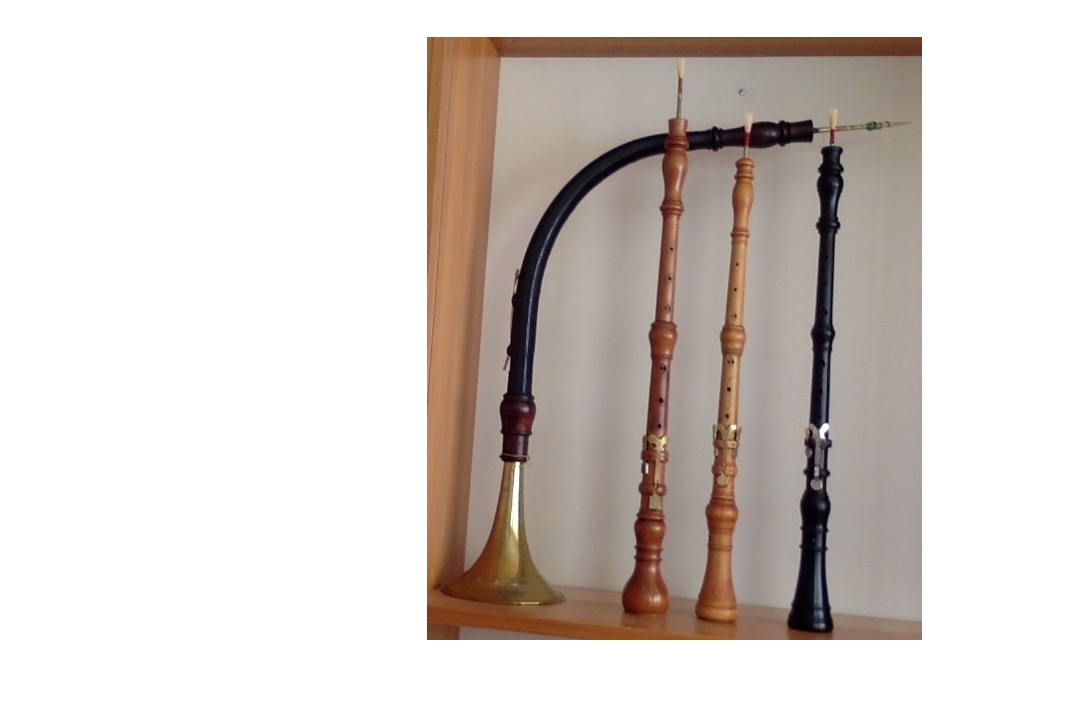
Why is this scoring for the oboes so unusual? In Bach’s time there were “regular” oboes (to the right on this photo), oboes d’amore (with a bell-like widening in the wood at the end, second from left), and oboes da caccia (or “hunting” oboes, completely curved, and with a trumpet-like brass bell at the end, far left).

Oboes
From left to right: oboe da caccia, oboe d’amore, oboes. Photo courtesy of Marianne Richert Pfau; instruments built after 18th century examples by Sand Dalton, Harry van Dias, and Paul van der Linden, respectively.

Bach often used the oboe da caccia, but only on a handful of occasions would he write for two da caccias. And even if he would write for two da caccias or two d’amores and “regular” oboes in the same cantata (or passion) they would not all be playing at the same time. On most occasions there were between one or two oboe players in the orchestra, sometimes three, alternating between the different instruments from one movement to the next. The only times Bach needed four oboists in one cantata, playing two da caccias and two d’amores at the same time, was in cantata 2 of the Christmas Oratorio (1734) and in this cantata 183. So there must have been some good oboe playing visitors in town around this time of Ascension and Pentecost in 1725.

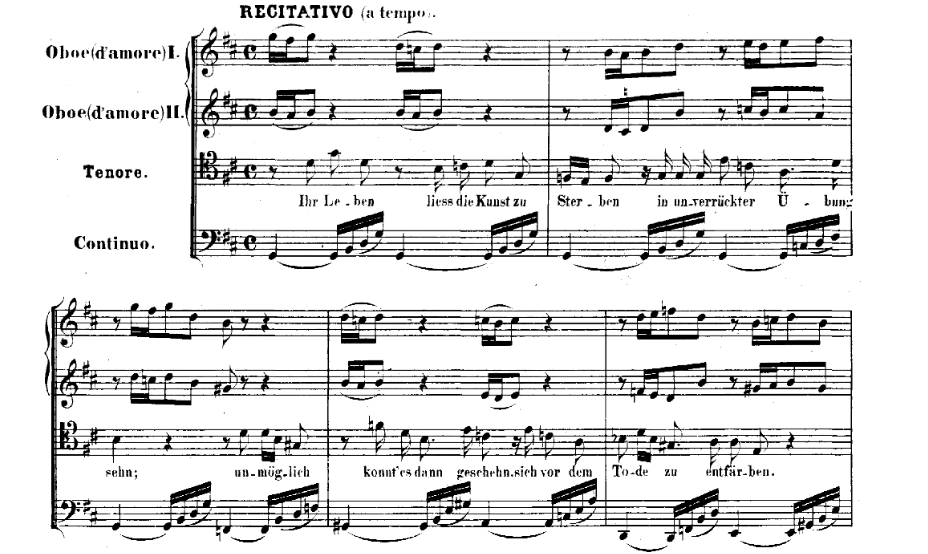
The four oboes can be heard clearly in the alto recitative, where Bach has each of them repeat the four-note theme from the “ich bin bereit”-text in the vocal part:

Screenshot 2016-05-08 10.16.33

When I hear this, I immediately have to think of the tenor recitative in Bach’s beautiful  Trauer Ode, cantata 198, this time reduced to a 3-note theme and without the da caccias:

Screenshot 2016-05-08 10.28.17

Or listen to this recitative from cantata 198 on YouTube

It is of course not exactly the same composition, but I wonder if Bach had to think back of this cantata from 1725 when he wanted to illustrate life  and death in one and the same piece of music in the Trauer Ode of 1727.

After this alto recitative comes the most glorious soprano aria, richly scored with the two oboes da caccia playing the oboe part in unisono, as well as parts for violin 1, violin 2, and viola. Harnoncourt says that even though both da caccia have this aria written in, he says it is “clearly not intended to be chorally played” and on their recording they decide to have this part covered by only one oboe da caccia. Perhaps the original full score was not available to Harnoncourt at the time he made that decision, because it clearly says: “tutti gli Oboi in unisono:”

Screenshot 2016-05-08 12.34.13
excerpt from the soprano aria from cantata 183, with Bach’s indication for “all the oboes in unisono,” Staatsbibiothek zu Berlin, Preußischer Kulturbesitz

One would almost think Bach dreamt of all four oboes playing this, also the d’amores, but when his copyists double-checked with him, he decided that was just silly, it would overpower the poor boy who had to sing this, and they only wrote it into the parts for the da caccias (it says “Arie Tacet” in the parts for the oboi d’amore).

To learn more about Cantata 183, I wholeheartedly recommend you study with Rudolf Lutz of the J.S. Bach Foundation a little bit. Find a link to his fabulous (English spoken!) lecture and improvisation about this cantata in my blog post from May 24, 2020.

Wieneke Gorter, May 8, 2016, updated May 23, 2020.

A good shepherd, a violoncello piccolo da spalla, and a bit of St. Matthew Passion

09 Saturday Apr 2016

Posted by cantatasonmymind in After Easter, Cantatas, Leipzig

≈ Comments Off on A good shepherd, a violoncello piccolo da spalla, and a bit of St. Matthew Passion

Tags

2nd Sunday after Easter, Atsuko Ozaki, Bach, Bach Collegium Japan, BWV 42, BWV 6, BWV 85, cantatas, Caroyn Sampson, Dmitry Badiarov, Georg Poplutz, Gerd Türk, Gerlinde Säman, Harnoncourt, J.S. Bach Foundation, John Eliot Gardiner, Kurt Equiluz, Markus Volpert, Martin Zeller, Peter Kooij, Peter Kooy, Robin Blaze, Rudolf Lutz, St. Matthew Passion, Terry Wey, violoncello da spalla, violoncello piccolo

640px-meister_des_mausoleums_der_galla_placidia_in_ravenna_002
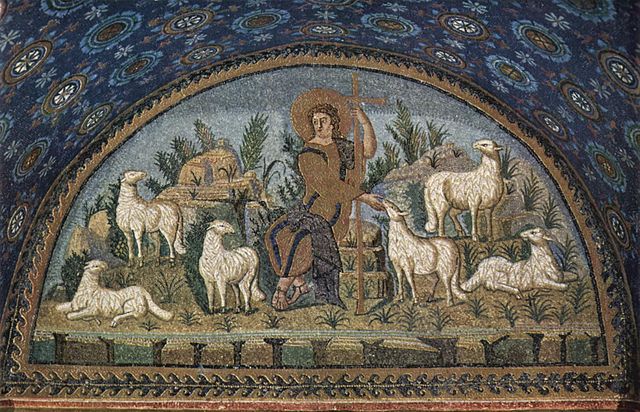
The Good Shepherd, mosaic in the Mausoleum of Galla Placidia, Ravenna, 1st half of the 5th century

There are three beautiful cantatas for this second Sunday after Easter, or “Misericordias Domini” Sunday: BWV 104, 85, and 112. Illustrating the “good shepherd” scripture for this Sunday (John 10, verse 12-16), Bach incorporated pastoral themes or orchestration in each of these cantatas.*

I’ve decided to focus on cantata 85 Ich bin ein guter Hirt, written for April 15, 1725. Of all three cantatas, this is the one I remember the best from my childhood, because of the  tenor aria “Seht, was die Liebe tut.” Also: Last week, I already mentioned the similarities between cantata 6 (for Easter Monday 1725), and cantata 42 (for the first Sunday after Easter 1725). This cantata 85 is the culmination of that “sub group” within the cantatas from 1725.

Which recording to listen to?

While I have good memories of hearing Kurth Equiluz sing the tenor aria on the Harnoncourt recording from 1977, I am enamored by Bach Collegium Japan’s recording of this cantata, and I think this is the best “overall” recording, featuring fabulous soloists Carolyn Sampson, Robin Blaze, Gerd Türk, and Peter Kooij. It is also one of the most noteworthy because of the use of a  violoncello da spalla, played by Dmitry Badiarov.

Listen to Bach Collegium Japan’s recording of cantata 85 Ich bin ein guter Hirt on Spotify. Or better yet, if you can afford to financially support the artists (especially important now, while they have no income from performances!) please consider purchasing the digital versions of Bach Collegium Japan’s recording of cantata 85 on Amazon or on iTunes.

If you prefer to watch a live recording, there is a wonderful recording available on YouTube by the J.S. Bach Foundation. Soloists are Gerlinde Sämann, soprano; Terry Wey, alto; Georg Poplutz, tenor; Markus Volpert, bass; and Martin Zeller, violoncello piccolo.

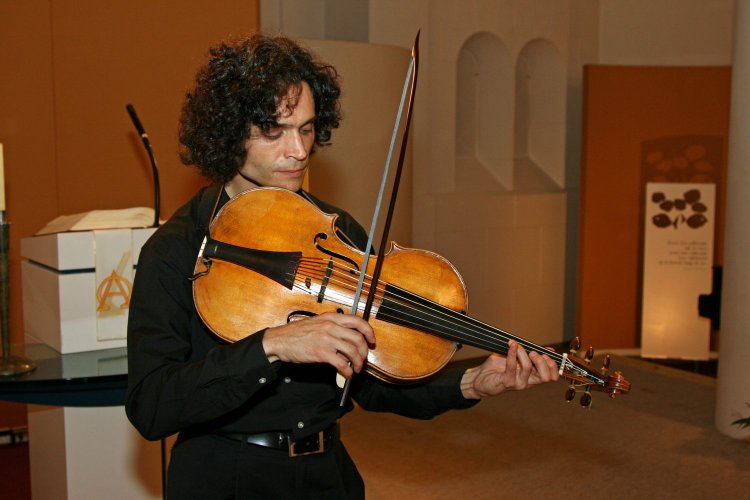
Back to the Bach Collegium Japan recording: After lovely and convincing singing by bass Peter Kooij in the opening arioso (Jesus saying “I am a good shepherd”), we get a sublime performance by countertenor Robin Blaze of the alto aria “Jesus ist ein guter Hirt,” which also features the unusual violoncello piccolo da spalla. Someone could probably write an entire PhD thesis on the difference between the  violoncello piccolo  “da spalla” (held on the shoulder, like a violin),  and the violoncello piccolo “da gamba”  (held between the legs,  like a cello), and whether Bach meant the one or the other when he wrote a part for “violoncello piccolo.”  Most recordings (Harnoncourt, Gardiner, Coin, Koopman, and J.S. Bach Foundation) feature the one held between the legs, but Bach Collegium Japan’s recording features the “da spalla” variety, played by the same person who built it in 2004, Dmitry Badiarov.

Badiarov-Dmitry-04
Dmitry Badiarov demonstrating the violoncello piccolo da spalla

Following this, we hear a radiant soprano solo chorale with oboe accompaniment (which makes me think back to the soprano solo chorale from cantata 6, in that case with the violoncello piccolo “da gamba”), beautifully sung by soprano Carolyn Sampson and expertly played by oboists Masamitsu San’nomiya and Atsuko Ozaki.

And when you didn’t think it could get any better, here comes a tenor recitative which in text and string accompaniment strongly refers to Jesus’ recitative from the St. Matthew Passion “Ich werde den Hirten schlagen, und die Schafe der Herde werden sich zerstreuen.” (Christ, having arrived at the Mount of Olives, reminds his disciples of the prophecy that the shepherd will be slain and the sheep will scatter).

With this only recitative in cantata 85, Bach has gotten everyone’s attention, so now we’re ready for the jewel in the crown of this cantata: the tenor aria “Seht, was die Liebe tut.” It is one of the most lyrical and lovely among all Bach’s tenor arias.

Seht, was die Liebe tut.
See, what love does.
Mein Jesus hält in guter Hut
My Jesus in his own safekeeping
Die Seinen feste eingeschlossen
keeps those who are his own firmly enclosed
Und hat am Kreuzesstamm vergossen
and on the beam of the cross he has shed
Für sie sein teures Blut.
for them his own precious blood.

Again there is a strong association with the St. Matthew Passion both in text and music. In his book Bach: Music in the Castle of Heaven Gardiner makes a very convincing case for his theory that Bach had wanted to perform the St. Matthew Passion on Good Friday 1725, only one year after the St. John Pasion. This didn’t happen because either the council disapproved, or Bach wasn’t ready composing the piece. If Bach had indeed been working on the St. Matthew Passion before Easter 1725, it is no wonder we’re getting glimpses of that monumental work in his cantatas after Easter 1725.

Wieneke Gorter, April 9, 2016, updated April 26, 2020

*I wrote about Cantata 104 for the Second Sunday after Easter in 1724 in this blog post.

Newer posts →

Recent Posts

  • “Missa Miniatura” by CONTINUUM/Elina Albach Even More Moving in 2025
  • Bachfest Leipzig 2025
  • Bach Cantatas for Christmas – 1724 and 1734 editions
  • Fourth Sunday of Advent – more insight into Cantata 62 helped me better understand Bach’s Christmas Oratorio
  • Saint Ambrose and Luther in Milan – Second Sunday of Advent

Archives

  • August 2025
  • July 2025
  • December 2024
  • November 2024
  • June 2024
  • January 2024
  • December 2023
  • October 2023
  • September 2023
  • August 2023
  • April 2022
  • February 2022
  • January 2022
  • December 2021
  • November 2021
  • June 2021
  • May 2021
  • April 2021
  • February 2021
  • January 2021
  • December 2020
  • November 2020
  • October 2020
  • September 2020
  • August 2020
  • July 2020
  • May 2020
  • April 2020
  • March 2020
  • February 2020
  • January 2020
  • December 2019
  • November 2019
  • May 2018
  • April 2018
  • March 2018
  • February 2018
  • January 2018
  • December 2017
  • November 2017
  • October 2017
  • September 2017
  • August 2017
  • July 2017
  • June 2017
  • May 2017
  • April 2017
  • March 2017
  • February 2017
  • January 2017
  • December 2016
  • November 2016
  • October 2016
  • September 2016
  • August 2016
  • July 2016
  • June 2016
  • May 2016
  • April 2016
  • March 2016
  • February 2016
  • January 2016

Enter your email address to follow this blog and receive notifications of new posts by email.

Join 336 other subscribers

Categories

  • 1723 Trinity season special series
  • Advent
  • After Easter
  • Ascension
  • Bach's life
  • Cantatas
  • Chorale cantatas 1724/1725
  • Christmas
  • Easter
  • Epiphany
  • Following Bach in 1725
  • Köthen
  • Leipzig
  • Septuagesima
  • Travel
  • Trinity
  • Weimar

Meta

  • Create account
  • Log in
  • Entries feed
  • Comments feed
  • WordPress.com

Website Built with WordPress.com.

  • Subscribe Subscribed
    • Weekly Cantata
    • Join 156 other subscribers
    • Already have a WordPress.com account? Log in now.
    • Weekly Cantata
    • Subscribe Subscribed
    • Sign up
    • Log in
    • Report this content
    • View site in Reader
    • Manage subscriptions
    • Collapse this bar
 

Loading Comments...