Merry Christmas! My sincere apologies if you are somewhere in the world where it is not Christmas Morning anymore.
I have two new videos for you today, that will last you until January 6, just in case I don’t manage to write another blog post between now and then.
The J.S. Bach Foundation has released all six cantatas of Bach’s Christmas Oratorio to YouTube. They released these on CD and DVD for purchase last year, but have now made them available to everyone. You can find that video recording here.
What is even better: they also made the effort to provide English subtitles for Rudolf Lutz’ lecture about Part I of the Oratorio, for Christmas Day. You can find that video here. I highly recommend watching this to better understand the meaning of the music, to learn how Bach reworked some of his secular cantatas into this Oratorio, and that he perhaps planned to do that all along.
There is also a good video of parts I, II, III, and VI of Bach’s Christmas Oratorio by Bach Akademie Stuttgart. The setting in which they perform is less festive looking than the beautiful Baroque church of the J.S. Bach Foundation, but it’s also well done. You can find it here.
If you would like to read and listen more, here’s an overview of my previous blog posts for this First Christmas Day:
Our Christmas Morning, from 2016, talks about how my mother used to wake my sister and me up with Bach’s Christmas Oratorio.
Three Days of Christmas, from 2017, gives you the three cantatas Bach wrote in 1724, all three brand-new, no reworking there.
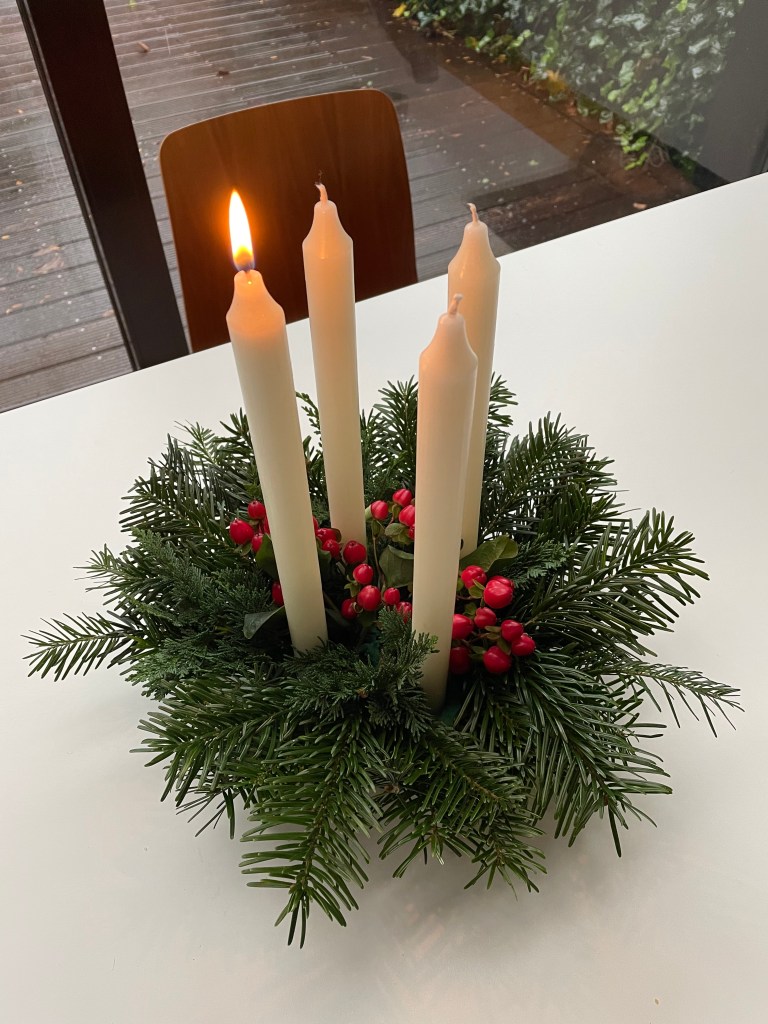
In German-speaking countries, people wish each other either a “schönen” (beautiful, pleasant), “lieblichen” (lovely, love-filled), or a “besinnlichen” (thoughtful, contemplative) Advent. I wish you all of that: beauty, love, and contemplation for the next four weeks.
On this first Sunday of Advent, I present to you again the J.S. Bach Foundation (J.S. Bachstiftung) with soprano Núria Rial, this time in Cantata 36 Schwingt freudig euch empor. In 1731, Bach transformed a secular birthday cantata from 1725 into this work for Advent. Enjoy watching these two videos by the J.S. Bach Foundation to get better acquainted with this composition:
If you would like to read, listen, or watch more, here’s a little overview of my previous posts for the first Sunday of Advent:
In Weimar, in 1714, Bach wrote Cantata 61 Nun komm, der Heiden Heiland. This one I remember the best from my childhood, because my mother loved Seppi Kronwitter’s singing of the soprano aria on the Harnoncourt recording. Read about it here. More about Bach’s prolific Advent cantata writing in Weimar next week.
In Leipzig, in 1724, Bach wrote Cantata 62 Nun komm, der Heiden Heiland. My most recent writing about this cantata is from 2020, not for this blog, but for that of California Bach Society. Find it here. My post from 2017 about this cantata is here.
Read my post about Cantata 36 Schwingt freudig euch emporhere.
Wieneke Gorter, November 28, 2021.
By the way: the video of the J.S. Bach Foundation’s 15th Anniversary concert with Núria Rial is still available here on YouTube. It is a registration of the performance in Trogen, held one day after the one I attended in Basel.
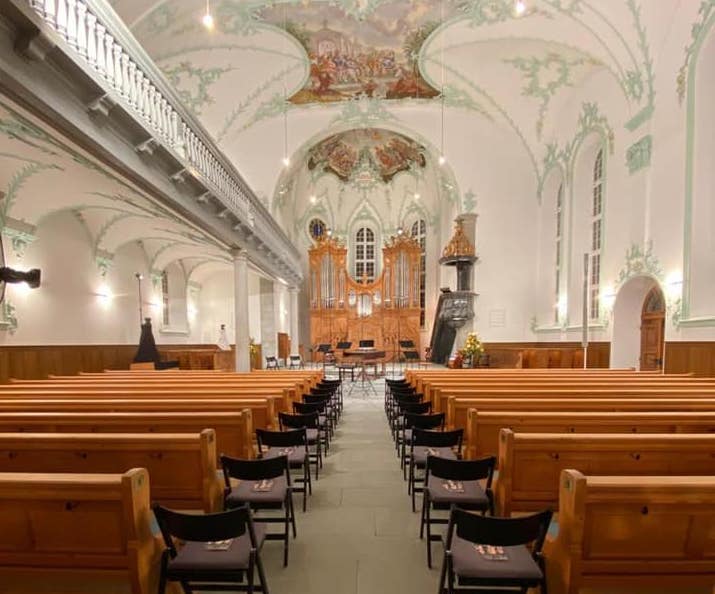
The church in Trogen, Switzerland, where the 15th anniversary concert of the J.S. Bach Foundation was recorded on November 17, 2021. Find it here on YouTube.
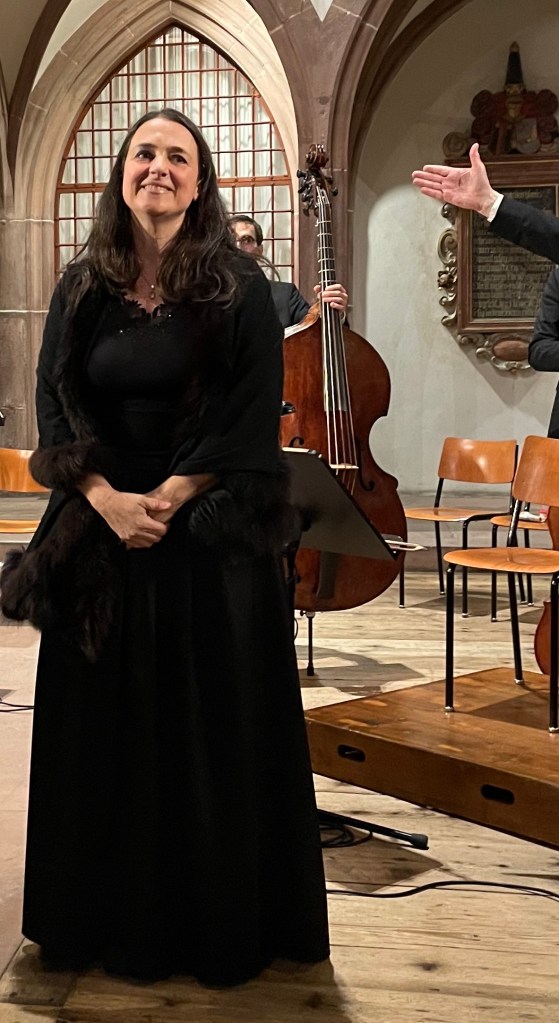
Nuria Rial in Basel
This week, the J.S. Bach Foundation celebrated 15 years of recording Bach cantatas with a special anniversary program in three cities in Switzerland: Basel, Trogen, and Zürich. I am still pinching myself that I got to attend the concert in Basel on Tuesday November 16, sitting only 6 feet (2 meters) from the amazing soprano Nuria Rial, who sang Cantata 199 Mein Herze schwimmt im Blut and Cantata 202 Weichet nur, betrübte Schatten.
Her performance was everything I had been hoping for and more. Her voice pulls you in from the start, and the energy and joy she exudes are just extraordinary. And then there’s her playfulness. I will never forget how special it was to experience that from up-close. I also realized what a true ensemble member she is, always in contact with the instrumentalists.
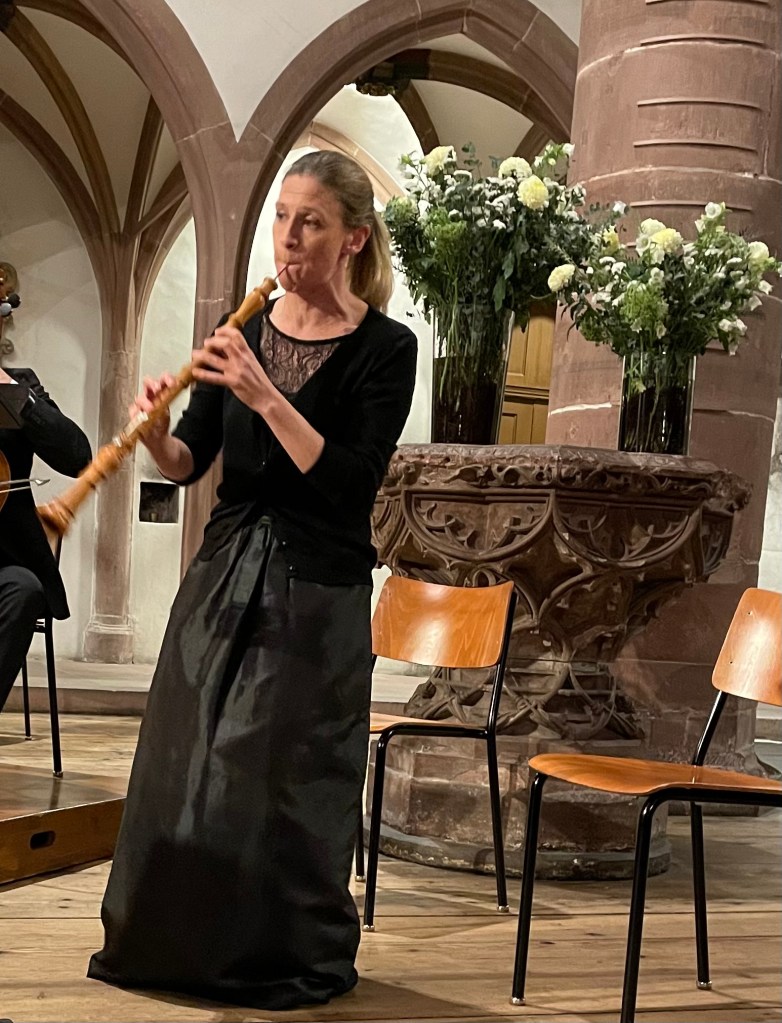
Amy Power in Basel
And those instrumentalists really need to be mentioned! Oboist Amy Power’s playing was lyrical throughout, with beautiful ornamentations in the “da capo” parts of the arias. I especially enjoyed the call-and response between her and Nuria Rial in the first movement of Weichet nur, betrübte Schatten. Her accomplishments were even more impressive knowing that she had been summoned from Graz less than 8 days before the concert, when the J.S. Bach Foundation heard that oboist Andreas Helm had to isolate at home because of contracting Covid-19.
First violinist Eva Borhi’s sensitive playing was especially gorgeous in the “Tief gebückt” aria from Canatata 199 and “Schlummert ein” aria from Cantata 82 with Manuel Walser. But my favorite was her interaction with Nuria Rial in the “Wenn die Frühlingslufte streichen” aria from Cantata 202.
Violist Sonoko Asabuki had an exquisite solo in the Chorale “Ich, dein betrübtes Kind” from Cantata 199, and cellist Daniel Rosin did a great illustration of Phoebus’ speeding horses in the third movement of Cantata 202, which earned a “Bravo” cheer from the audience, as if we were at the opera. (Always better than the audience member who fell asleep during “Schlummert ein,” snoring and all, a few rows behind me).
Last but not least, Rudolf Lutz, who directed the others from the harpsichord, improvised tasteful and effective mini-preludes leading up to the recitatives in Cantata 199, and very sensitively employed the lute register in the da capo of “Schlummert ein,” which formed a beautiful accompaniment to the pianissimo playing strings. He was also his usual witty self, making audience and performers laugh with his short speeches. My sister mentioned that even though we were here together at the concert because of our mother, she was actually strongly reminded of our grandfather. Also a man who always appeared very proper and Calvinist, but would then surprise you with his terrific sense of humor.
Watch this same performance, recorded live in Trogen, a day later than the one I attended in Basel here on YouTube.
As far as we know, Bach wrote two cantatas for this Sunday, the third after Trinity: Cantata 21 Ich hatte viel Bekümmernis and Cantata 135 Ach Herr, mich armen Sünder.
Read my post from 2017 about Cantata 135 here. Since I wrote that post, a beautiful live video recording by the J.S. Bach Foundation has been released on YouTube. Find it here.
But now about Cantata 21. It is one of Bach’s most well-known cantatas and it gets programmed often because it features several exciting choruses. The version most of us know is with three soloists: a soprano, a tenor, and a bass. Bach first wrote it like that in Weimar and later performed a similar version in Leipzig in 1723, as part of his first year there. However, in 1720, he created a different version, which he performed in Köthen as well as in Hamburg. It is likely that this version was created for a special soprano soloist (possibly Anna Magdalena?), because in this version, Bach assigns all three tenor solos to the soprano as well, thus featuring the soprano in every solo movement. The bass joins her for two duets.
Dorothee Mields
It turns out that the J.S. Bach Foundation decided to perform this 1720 version for their live video series, with soprano Dorothee Mields and bass Peter Kooij. If I had been at that concert in person, I would have joined the whooping and clapping at the end, because it is an outstanding performance by both soloists but also by the chorus. I only discovered this video recording by accident tonight. I had completely missed it when it was released earlier this month. I meant to write a very short blog post today, quickly giving you some links to previous posts and then go to sleep, but I was completely mesmerized by Dorothee Mields’ singing and was unable to close my computer.
In my post from 2016 about Cantata 21, I show how similar the duet from this cantata is to the duet from Cantata 172 (also written in Weimar). When I watched the J.S. Bach Foundation video of Cantata 21 and witnessed Mields’ art of being in sync with her duet partner, I remembered there’s another wonderful video I have wanted to share. It is Dorothee Mields and Alex Potter singing the duet from Cantata 172 in this video by the Bach Akademie Stuttgart that came out at the end of May. I enjoy very much how sensitive Mields and Potter both are to the music and the text, and how beautifully and naturally their voices move together.
The Holy Trinity: Son (Jesus), Father (God), and Holy Ghost (depicted by a pigeon) by Hendrick van Balen the Elder (Flemish), 1620s. Sint-Jacobskerk (St. James’ Church), Antwerp, Begium.
In 2018, I was following Bach’s writing in 1725. My last post that year was about this Sunday, Trinity Sunday. Read that post here.
Judging by the cantatas that are left to us, Bach didn’t write any church cantatas during the months of June and July in 1725. Instead, he performed three cantatas by Telemann that summer:
Gelobet sei der Herr, der Gott Israel (TVWV 1:596), on June 24
Der Segen des Herrn machet reich ohne Muhe (TVWV 1:310), on July 1
Wer sich rachet, an dem wird sich der Herr wider rachen (TVWV 1:1600), on July 8
We don’t know why this happened. There are several possibilities:
Bach was exhausted from the 1725 Easter to Trinity season – read more about this in my previous post
Telemann had begged Bach to bring some of his cantatas to the attention of the Leipzig congregations and Bach’s Leipzig orchestra members. Oh, how we all wish that the correspondence between Bach and Telemann had survived! They were good friends since Bach’s Weimar years. Judging from some of Telemann’s letters that did survive, he could make a good pitch.
Bach thought that after two cycles of cantatas in Leipzig (from Trinity 1723 to Trinity 1725) he had created a sufficient amount of music to be used during church services that he didn’t necessarily need to write a new cantata for each Sunday.
I’ll pick up the 1725 thread on August 1st, the 9th Sunday after Trinity, for which Bach finally picked up his pen again, writing Cantata 168 Tue Rechnung! Donnerwort.
Stay tuned for a discussion of this year’s online version of Bachfest Leipzig: “Bach’s Messiah,” which will take place from June 11 to 15.
If you don’t feel like reading a long blog post and just want to learn about this Sunday’s cantatas, please watch Rudolf Lutz’ wonderful lecture/improvisation from 2020 about Cantata 44 and 183here. It is in English. Find my blog post about these same cantatas, highlighting completely different aspects of the pieces, here.
We tend to think that Christmas was the busiest time for Bach in Leipzig, writing cantatas for the three (!) Christmas Days, New Year’s Day, Epiphany, AND all the Sundays that fell in between those days. On the holidays, he would often perform the cantatas twice, once in the St. Nicholas Church, and once in the St. Thomas Church.
While working like this for two weeks in a row does sound crazy to us, we can still relate to it, because the Christmas season is often busy for most of us too.
But especially because of this wanting or needing to relate, I think we often forget that there was another period in the year for Bach in Leipzig that was equally busy: the time from Easter to Trinity. It was perhaps not as non-stop as the Christmas season, but it was much longer in time, and more laden with decision-making, so possibly more draining for the composer. We don’t know.
I would like to go back to my posts from the spring of 2018, when I was following Bach’s writing in the spring of 1725. Going forward, this year, I would like to keep following his cantata compositions from 1725. So let’s look at what this possibly exhausting period looked like for Bach in 1725. All the links in this following list refer to my own blog posts from 2018. The Easter Oratorio was rewritten from a previous work, but every single cantata Bach wrote after that was newly composed that year, 1725.
March 30, Good Friday: The second version of the St. John Passion, with a new opening chorus and several new arias.
April 1, Easter Sunday: First performance of the Easter Oratorio as well as a repeat performance of Cantata 4 Christ lag in Todesbanden (written much earlier in his career)
This Third Sunday after Easter, or “Jubilate” Sunday, was also the start of a three-week-long Trade Fair in Leipzig, lasting until Exaudi Sunday (this Sunday). Leipzig had three such events each year (the others were at Michaelmas and at New Year’s). In the 18th century Leipzig had become the centre for trade with Russia, Poland, and England. During the fairs the population of the city would grow to 30,000. Bach did business himself too during these times. He for example timed the publication of his Clavierübung to coincide with these fairs. In addition to that, I imagine that he would have had visitors in his house, and that he was making time to meet with friends and colleagues who were in town during this time.
April 29: Cantata 108 Es ist euch gut, daß ich hingehe
The Ascension, from the illuminated 15th-century manuscript Les Très Riches Heures du duc de Berry, Folio 184r – Musée Condé, Chantilly, France.
Today was Ascension Day. In Bach’s time this was a very important holiday in the churches. Many countries in Europe have a four-day weekend starting on this Thursday. I did too as a kid growing up in the Netherlands. But we didn’t go to church on this day, and I don’t remember my mother playing the Ascension cantatas or the Ascension Oratorio on the turntable at home on this day. Instead we went for a bike ride, visit grandparents, or go camping. I didn’t know Bach’s music for Ascension Day at all until we performed BWV 11 and 43 with California Bach Society in the early 2000s. The choruses from these compositions are among the most fun I have every sung in a choir. I love the syncopated rhythms.
Here is an overview of Bach’s music for Ascension Day, as far as we know, in order of creation:
In 1724, Bach wrote Cantata 37 Wer da gläubet und getäuft wird (Whoever believes and is baptised). Listen to it here. Soloists in this recording by Ton Koopman/Amsterdam Baroque Orchestra are Sibylla Rubens, soprano; Bernhard Landauer, alto; Christoph Prégardien, tenor; and Klaus Mertens, bass.
In 1725, as part of the series of cantatas on texts by Christiane Mariane von Ziegler, Bach wrote Cantata 128 Auf Christi Himmelfahrt allein (On Christ’s ascension alone). Listen to it here. Soloists on this live recording by John Eliot Gardiner/English Baroque Soloists are Lenneke Ruiten, soprano; Meg Bragle, mezzo soprano; Andrew Tortise, tenor; and Dietrich Henschel, bass. Find my blog post from 2018 about this cantata, which includes a different recording by Gardiner here.
The last Bach cantata we have for this holiday is from 1726: Cantata 43 Gott fähret auf mit Jauchzen (God ascends with shouts of joy). Listen to it here. Soloists in this live recording by Rudolf Lutz/J.S. Bach Foundation are Miriam Feuersinger, soprano; Annekathrin Laabs, alto; Charles Daniels, tenor; and Wolf Matthias Friedrich, bass.
Nine years later, Bach wrote his Ascension Oratorio, BWV 11 Lobet Gott in seinen Reichen (Praise God in His kingdoms), incorrectly labeled as a cantata in the 19th century. Bach might have been inspired by the Christmas Oratorio he had written only five months before that.
On that Ascension Day, Thursday, May 19, 1735, this oratorio was performed in the morning service in the St. Nicholas Church, and again in the afternoon service in the St. Thomas Church. Watch the wonderful opening chorus here in a live performance by Philippe Herreweghe/Collegium Vocale Gent from 2014 from the Chapelle de la Trinité in Lyon, France. Or listen to the entire oratorio by Philippe Herreweghe/Collegium Vocale Gent on a CD recording from 1993 here. Soloists on that 1993 recording are Barbara Schlick, soprano; Catherine Patriasz, alto; Christoph Prégardien, tenor; and Peter Kooij, bass.
The Good Shepherd, mosaic in the Mausoleum of Galla Placidia, Ravenna, 1st half of the 5th century
In the early summer of 2018, my husband, my kids, and me had the good fortune to be able to visit Italy for the first time in our lives. When I was growing up, we usually went to France in the summer vacation, as was normal for families from the Netherlands. I did have Latin in high school, but our class was very small, and trips to Rome where not the norm at that school. In college, I had somehow missed the choir tour to Italy, and had “only” gone on the ones to Spain (three times) and Portugal. So it was a very special treat to me to finally be able to go to Italy, and see several of the art works in real life.
After three relaxing days in the mountains and three wonderful days in Venice, we traveled on to Ravenna. I had gone back and forth about including Ravenna in the itinerary. Would we want yet another stop? Was it worth it to have less time in Umbria as a result of the extra night in Ravenna?
In Venice, we had learned that visiting tourist attractions at 5 pm or later was the best way to avoid the busloads of tourists. So on the morning we left Venice, I emailed the guide in Ravenna I had been corresponding with in the weeks before that we might still want to visit the mosaics with her between 5 and 7 pm, if she was still free. If I could confirm after lunch time? She was fine with that. (Later we learned that the busiest time for the tour guides in Ravenna is the school year, when all the Italian kids come to learn about this important time and place in Italian (art) history, and that most of them are more flexible in the summer).
At 10:30 am, we did a reverse commute on the ferry from the Zattere in Venice’s Dorsoduro neighborhood to Fusina on the mainland, where our rental car had been parked for three nights. We drove to Chioggia and ate a delightful seafood lunch at a no-frills restaurant at the harbor there. Then we confirmed our time with the guide and drove the extremely boring road to Ravenna, still wondering if all this was worth it.
But our visit to the mosaics with the guide was one of the best and most peaceful experiences we had that entire vacation. There was no line at the ticket office, the mosaics were stunningly beautiful, the buildings practically empty that time of day, and our guide was extremely knowledgable and fun to be with (it was hard saying good-bye to her after the two hours). All four of us cherish our memories of that visit.
The most impressive monument to all of us was the Mausoleum of Galla Placidia, because of how well preserved and vibrant the mosaics in that monument are. I had been using the mosaic of Jesus as “The Good Shepherd” already twice on this blog, and it was deeply moving to me to see it there in real life. So I’m featuring it again today.
Jesus as the Good Shepherd is the theme for this Second Sunday after Easter, and it appears in all three cantatas Bach wrote for this Sunday: BWV 104 from 1724, BWV 85 from 1725, and BWV 112 from 1731. I have yet to write about Cantata 112, but have written about Cantata 104 here in 2017, and about Cantata 85 here in 2016.
A little over 22 years ago, my husband and I moved from the Netherlands to California. My husband is a Jazz bass player in his spare time, so for him the music was another aspect to “living in Paradise.” There are many more Jazz performances and festivals here than in Europe, and there are lots of people here to do jam sessions with.
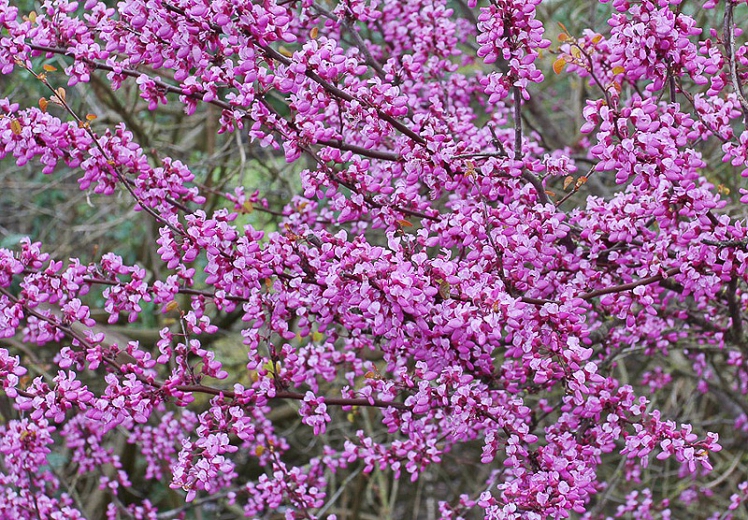
But for me it was a different story. I found a wonderful voice teacher and a good choir to sing in, but I missed the strong Dutch tradition of hearing and performing Bach’s Passions in the weeks before Easter. I used to have my biggest bouts of homesickness around that time of year. The heartache was softened only by it being my most favorite blooming season in California: the few weeks when two native trees, the purple Western Redbud (Cercis Occidentalis) and the blue-violet wild lilac (Ceanothus) bloom at the same time. The photos here don’t really capture how beautiful those colors are and how stunning it is when you see them together in the landscape, but it is something that makes me very happy.
Last year I didn’t have any homesickness, because all Passions in the Netherlands or Belgium I could have attended or participated in were canceled, so I didn’t feel I was missing anything. And while the world locked down, at the same time it became more accessible to me, because performances were now being moved to the internet. This meant I could watch the dress rehearsal of Herreweghe’s St. John Passion without the 11-hour plane ride or the struggle with jet lag. (That video registration is still available: find it here – scroll a bit down to where it says “Passions 2020”).
This year there were so many online St. Matthew or St. John Passion offerings from the Netherlands it was almost overwhelming. I didn’t have time to listen to all of them before writing this today, because most of the videos didn’t go live until yesterday, Good Friday. So I’ll just focus on a few that stood out to me.
Find the English translations of the St. John Passion here; the St. Matthew Passion here.
Cynthia Miller Freivogel
In the category “most interactive creation” I would like to mention the St. John Passion by Zing als vanZelf. An initiative of online singing instructor Bert van de Wetering, this organization invited thousands of singers to record themselves singing the chorales at home in the weeks leading up to Good Friday. They then recorded a performance with professional soloists singing the arias and the choruses with the excellent Combattimento Consort (Cynthia Miller Freivogel, concertmaster) as the orchestra, this all under the direction of Pieter Dirksen. Then they edited all this together into a video where you see the performance from a pretty church in a small town in the Netherlands, but every time there is a chorale you see the “choir” of individual volunteer singers pieced together on the screen. A really clever and touching solution. Watch it here. If you enjoy it, please consider making a donation, similar to what you would have paid if you would have attended this in person. The link for that is right there under the video.
Klaas Stok
For readers who understand Dutch and would like to learn more about the St. Matthew Passion, I highly recommend the video program from the organization that every year brings performances of this masterpiece to the beautiful Bergkerk in the city of Deventer. This year they recorded four arias from the St. Matthew Passion, in the order they appear in the second half of the work: “Erbarme dich” (sung by countertenor Maarten Engeltjes), “Aus Liebe” (sung by soprano Renate Arends), “Komm, süßes Kreuz” (sung by bass Florian Just), and “Mache dich, mein Herze, rein” (sung by bass Marc Pantus). What I liked best about this video is the conversations director Klaas Stok has with each soloist before they sing their aria. Through these conversations, I gained a lot of new insights into the meaning of the different arias. I especially loved what Klaas Stok had to say about the architecture of the piece, the role each aria plays in the overall structure, and how different movements are connected. Of all the talks, I particularly enjoyed bass Marc Pantus’ take on “Mache dich, mein Herze, rein,” the final aria on the program. You can watch this until April 14. Just click here. But please note, it is all in Dutch. Again, a link to donate is right there under the video.
Thomas Hobbs
Last but not least, the most impressive performance I listened to yesterday and today: The St. John Passion (1725 version) by the Netherlands Bach Society under the direction of René Jacobs. This was shown on Dutch television on Good Friday, so if you don’t understand Dutch, you’ll have to sit through a confusing excerpt from the St. Matthew Passion and a few ads at first, but then you can forward the video 14 minutes, to skip the pre-concert interview with René Jacobs. Soloists are Daniel Johannsen, tenor (Evangelist); Johannes Kammler, bass (Christ); Robin Johannsen, soprano; Alberto Miguélez Rouco, countertenor; Thomas Hobbs, tenor; and Arttu Kataja, bass. There is so much fluidity and phrasing in the orchestra, such a good blend in the choir, as well as excellent enunciation from the choir, it is extraordinary. All the choral movements are extremely transparent, I enjoyed that very much. Jacobs takes some risks with considerably slower tempi in the chorales than is usual in the Historical Performance Practice world, stretching out the pauses in the Evangelist’s recitatives, and taking long fermatas on ending notes, but it is never old-fashioned or too Romantic. It makes for a very engaging, one of a kind performance. All soloists are wonderful, but I would like to give a shout-out to the two tenors: Daniel Johannsen for being an excellent Evangelist, and Thomas Hobbs for his fabulous “Zerschmettert mich” aria (one of the arias that is not in the better known, 1724 version). Donate to the Netherlands Bach Society here.
If you don’t feel like listening to any Passion music anymore, please find my three Easter blog posts from previous years through the following links:






 Weekly Cantata