Church interior with the parable of the Pharisee and the Publican by Dutch painters Dirck van Delen (church interior) and Cornelis van Poelenburch (figures), 1653. Oil on panel. The Clark Art Institute, Williamstown, MA, USA, currently not on view.
The reading for this Sunday, the 11th after Trinity, is the parable of the Pharisee and the Publican (or Tax Collector) from the Gospel of Luke. In the parable, these two men come into the temple to pray around the same time, but talk to God in very different ways. While the Pharisee puts on a fake show about how good he is, the tax collector is very humble, “wouldn’t even lift up his eyes to heaven” and asks for forgiveness.
“There’s something with this Sunday,” I wrote three years ago, and I still feel that way when I listen to the cantatas Bach wrote for this Sunday in 1723 and 1724.
In 1723, his first year in Leipzig, Bach performed two cantatas on this Sunday: Cantata 179 Siehe zu, daß deine Gottesfurcht kein Heuchelei sei(See that your fear of God is not hypocrisy) before the sermon, and his solo cantata for soprano Cantata 199 Mein Herze schwimmt in Blut (from his early years in Weimar) afterwards. Cantata 199 is only loosely related to the Gospel story, and was probably never written with this story in mind. Because of its multi-layered history and the many different recordings, I will discuss that composition some other time.
Cantata 179 focuses on the hypocrisy of the Pharisee, and just like cantatas 46 and 102 I discussed last week, it must have been one of Bach’s own favorites, because he re-used three movements in later works. Read all about it in my post from 2016, which I have updated with better images and new video links.
In 1724, Bach wrote cantata 113 Herr Jesu Christ, du höchstes Gut, which, surprise, surprise, focuses on the Publican asking for mercy. The only recording that does this cantata justice and gives me the good kind of stomachache is the one by Bach Collegium Japan. Peter Kooij’s and Robin Blaze’s singing is outstanding, and Yukari Nonoshita and Robin Blaze make the duet into a lovely piece of music, which is–judging from a lot of other recordings–not an easy thing to do. I updated my blog post from 2017 with all the correct links to stream or purchase this recording. Please find it here.
We don’t have any letters in which Bach writes about his own compositions, so we officially don’t know which ones were his own favorites. But when we see which cantatas he gave a “second life” in another work, and which cantatas were performed by his sons, we can make an educated guess.
Two of these cantatas, Cantata 46 Schauet doch und sehet, ob irgend ein Schmerz sei (from 1723) and Cantata 102 Herr, deine Augen sehen nach dem Glauben! (from 1726), were written for this Sunday, the 10th after Trinity.
Bach gave the opening chorus from Cantata 46Schauet doch und sehet, ob irgendein Schmerz sei a second life in the Qui Tollis in his Mass in B minor. Find a YouTube video of just that opening chorus, from Herreweghe’s performance at the 2013 Saintes Festival in France, here. Find my post from 2016 about this cantata, with links to translations, score, and my favorite recording here.
Cantata 102 Herr, deine Augen sehen nach dem Glauben! received even more second lives (see table below), and was performed at least twice in Hamburg by Bach’s second surviving son, Carl Philipp Emmanuel Bach. My favorite performance of this cantata was the one by Herreweghe I attended in January 2018 at the Bruges Bach Festival, with Dorothee Mields, Alex Potter, Thomas Hobbs, and Peter Kooij. Alas there is no recording of this. Of all recordings currently available, my favorite is here on YouTube, by oboist Marcel Ponseele’s Ensemble Il Gardellino, with Damien Guillon, countertenor; Marcus Ullman, tenor; and Lieven Termont, bass. Especially the Aria Weh der Seele, die den Schaden by countertenor Damien Guillon and oboist Marcel Ponseele (both pictured at the top of this post) is to die for, and this combination of singer and oboist is simply unrivaled by any other recordings.
Find the texts & translations of Cantata 102 here, and the score here.
Movement from Cantata 102
Movement in later work
Opening chorus
Opening chorus of the Missa Brevis in g minor, BWV 235
Alto aria
Soprano aria “Qui tollis peccata mundi” of the Missa Brevis in F Major, BWV 233
Tenor aria
Alto aria “Quoniam to solus sanctus” of the Missa Brevis in F Major, BWV 233
A little more about the early “revival” of this cantata by Carl Philipp Emmanuel Bach. In 1768, C.Ph.E. Bach succeeded Telemann as music director of the five largest churches in Hamburg, and remained in that position until his death in 1788. As such, he performed a handful of his father’s cantatas, albeit with adaptations. In 1776 or 1777 as well as in 1781, he performed Cantata 102 Herr, deine Augen sehen nach dem Glauben!
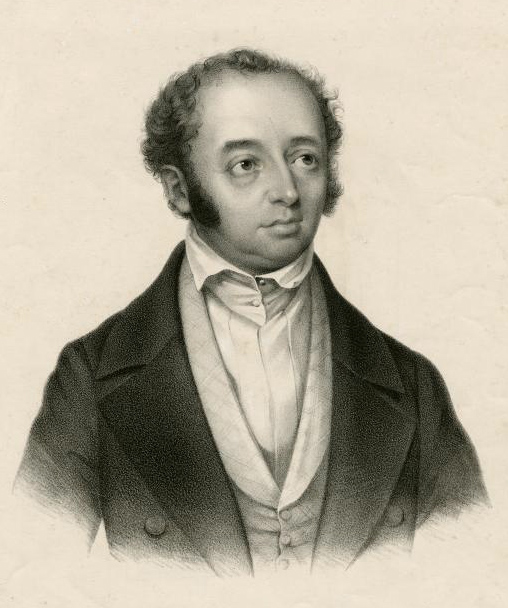
Adolf Bernhard Marx
These early “promotions” of this cantata must have inspired more performances or at least discussions about them, and eventually this composition along with some other cantatas likely reached the circle around Mendelssohn. In 1830, shortly after Mendelssohn’s Berlin revival of Bach’s St. Matthew Passion in 1829, Adolf Bernhard Marx published three Bach cantatas BWV nrs 101, 102, and 103. It was the firsts time since 1709 that a Bach cantata appeared in print.
In my humble opinion, the best cantata Bach wrote for this 9th Sunday after Trinity is Cantata 105 Herr, gehe nicht ins Gericht. This cantata has one of the best opening choruses Bach ever wrote, and I find the soprano aria and the bass arioso very moving. And as far as interpretations and recordings of this cantata go, for me, Herreweghe’s always rises above all others. In my post from 2016 I discuss his 1992 and 2012 recordings of this cantata. Please find that post here. It has all the links for recordings, texts & translations, and score, it tells you what to listen for in the music, and also explains why this Cantata 105 was Bach’s first real Leipzig cantata.
In January 2018, I had the good fortune to attend three Bach cantata concerts by Herreweghe, the first two in Bruges, the third one in Paris.* The program in Paris featured Cantata 105, everyone was in top form, and it was terrific to see Herreweghe conduct this piece that he and his ensemble know so well. It made me wish for a third Herreweghe recording of this cantata, because Dorothee Mields (not singing on the 1992 or 2012 recording), was mesmerizing in the “Wir zittern und wanken” aria and Peter Kooij’s strong rendition of the bass arioso almost brought me to tears.
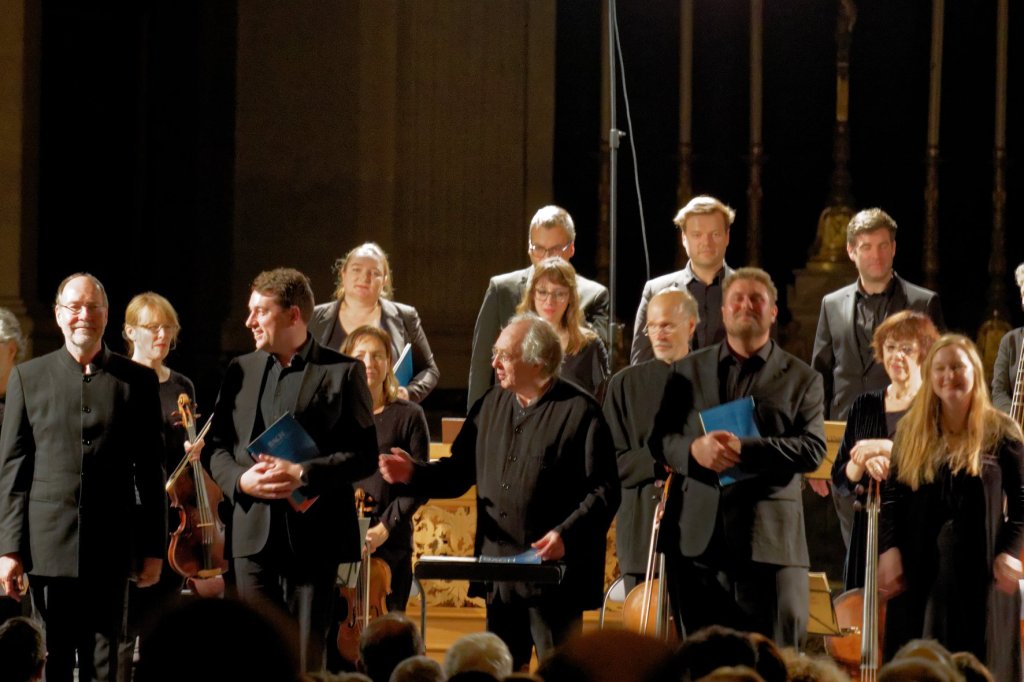
Applause at the end of the concert in the Eglise St. Roch in Paris, January 30, 2018. From left to right in front row: Peter Kooij, Thomas Hobbs, Philippe Herreweghe, Alex Potter, Dorothee Mields. Photo by Aube Neau/Luc Barrière, published with permission.
Wieneke Gorter, August 8, 2020.
*To read more about these concerts in Bruges and Paris, find my posts from January 2018 here and here.
Bach wrote three cantatas for this Sunday, and since my favorite recordings (for now)* of two of those feature my first and second countertenor loves, Gérard Lesne and Kai Wessel, I thought it might be nice to talk a bit about how I came to appreciate these singers.
Because I grew up listening to Bach cantatas from the cantata recording project by Leonhardt and Harnoncourt, hearing these every Sunday from when I was a small child, I was completely used to alto arias being sung by countertenors. I have become better at it, but sometimes I still feel as if I have to consciously switch something in my brain before I can listen to a female alto sing Bach and take it seriously.
However, none of the alto arias from that Leonhardt/Harnoncourt project (1970-1989), stayed with me the way many of the soprano, tenor, and bass arias did. The voices of René Jacobs or Paul Esswood just never blew me away nor did their singing truly move me. I remember enjoying Michael Chance’s singing on recordings of English Baroque composers and in the arias he sang in the live performance of Bach’s St. John Passion with Harnoncourt I mentioned in this post. But still, not blown away.
That all changed the summer of 1988 or 1989. Still a teenager, I had started volunteering for the Utrecht Early Music Festival in 1987. I did that for several years and then was on the summer staff for a few years as well, all this in the team that managed the Exhibition. The booth right around the corner from our own information booth was staffed by the best CD curator I’ve ever met, Joost. He went to all the concerts, and knew all the Early Music recordings, and I LOVED the recordings he recommended. It was through him that I learned about Gérard Lesne. The second or third year I was there, Joost was selling Lesne’s Vivaldi CD from 1988 to everyone with the words “Buy this. Listen to it. If you come back to me, look me in the eye, and can tell me without any sign of emotion that you didn’t like it, I’ll take it back.” (or, as he literally said in Dutch: “Als je me met droge ogen kunt vertellen dat je het niks vond, dan neem ik hem terug.”) I became a fan, and will never forget hearing Lesne live, singing Charpentier, in the Chapelle Royale of Versailles in the Holy Week of 1994.
Gérard Lesne is featured on a live audio recording from 1988 of Cantata 45 Es ist dir gesagt, Mensch, was gut ist which you can find here on YouTube. It is from a concert on October 25, 1988, in the Notre Dame du Travail church in Paris, by La Chapelle Royale (one of Herreweghe’s ensembles), conducted by Gustav Leonhardt. Other soloists are John Elwes, tenor; and Peter Kooij, bass.
Bach wrote this Cantata 45 in 1726 for the 8th Sunday after Trinity. Please find the score here, and the texts & translations here.
The Notre Dame du Travail church, in the Montparnasse neighborhood of Paris, where the 1988 concert took place
My blog post from 2016 about Cantata 136 Erforsche mich, Gott, und erfahre mein Herz spotlights my second countertenor love: Kai Wessel. His voice and interpretation was nothing short of a sensation for me when Ton Koopman’s recording of Bach’s St. Matthew Passion came out in 1993. That a countertenor could also have such a beautiful tenor quality to his voice was new to me, and I found his singing incredibly moving. Thanks to this, I gained new appreciation for the “Erbarme dich” aria. Because of Kai Wessel singing the alto aria, the Bach Collegium Japan recording I recommended in 2016 is still my favorite interpretation of Cantata 136, though the live performance by the J.S. Bach Foundation from 2011 is very well done too, and that video is exciting because you can see the corno da tirarsi** in action in the amazing opening chorus.
Wieneke Gorter, August 2, 2020.
*This might change soon, because Herreweghe recorded this cantata program, including BWV 45, at the end of January 2020. I will let you know when this recording comes out. It is the first time they have recorded BWV 45 and 118, and I can’t wait to hear Alex Potter in BWV 198, and look forward to hearing BWV 78 with Dorothee Mields and Alex Potter in the famous duet, and Thomas Hobbs in the gorgeous but often overlooked tenor aria.
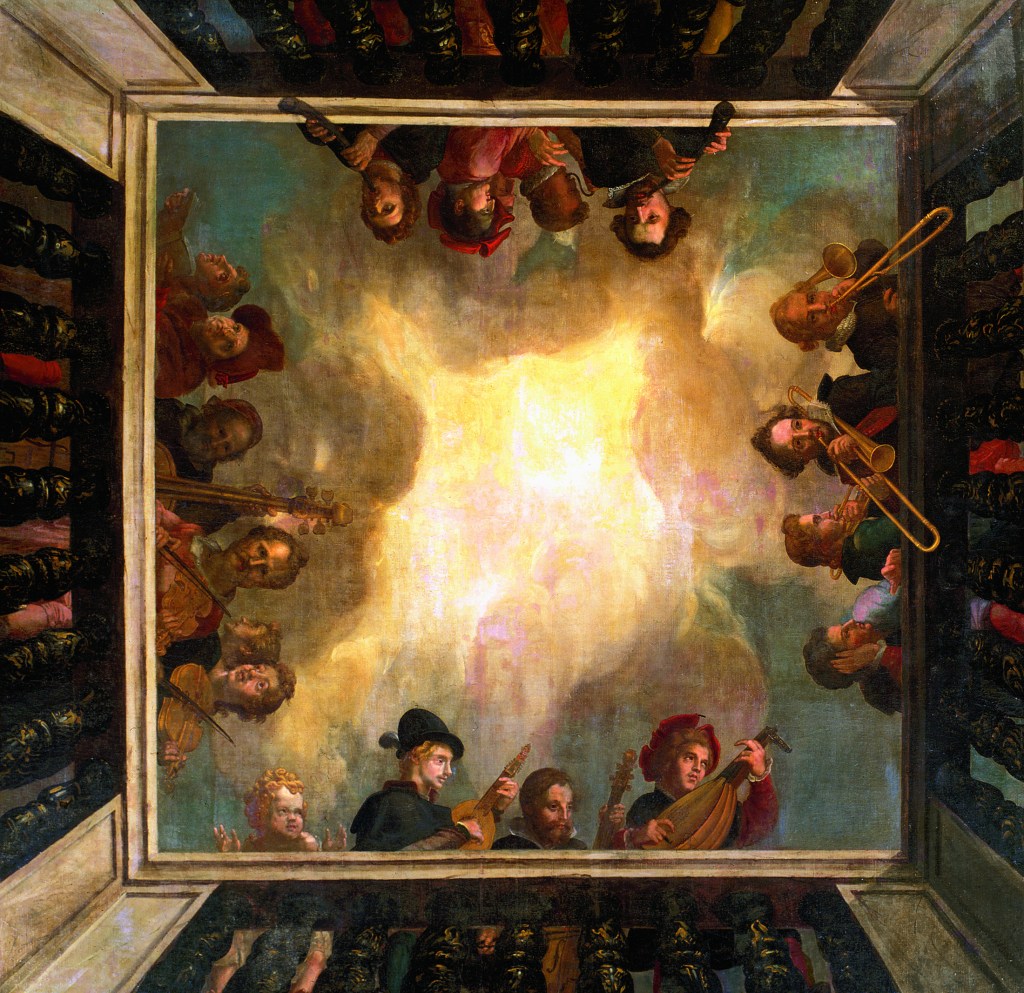
Ceiling painting installed around 1700 in Christian V’s Hall in Rosenborg Castle, Denmark. Possibly by Reinhold Timm, ca. 1620, originally for for a music pavilion in Kongens Have. *
Yesterday, Wednesday March 25, 2020, the J.S. Bach Foundation published their live video recording of Cantata 2 Ach Gott, vom Himmel sieh darein (Please God, look down from Heaven) on their YouTube channel. I thought it might be nice to provide a listening guide to go with this performance.
I love this cantata because it has trombones in the orchestra, doubling the choir parts, and because the altos have the cantus firmus (=they sing the chorale melody in long notes) in the opening chorus, which sounds incredibly good, and is unique within Bach’s writing.
Find the video recording by the J.S. Bach Foundation here on YouTube. Soloists are Alex Potter, alto; Georg Poplutz, tenor; and Markus Volpert, bass.
Find the German texts with English translations here, and the full score here.
This cantata was the second in Bach’s 1724 series of Chorale Cantatas. He most probably intended for the first four cantatas in that series to form a set, or at least to present some kind of order, if you look at the composition form of the opening movement, and which voice has the cantus firmus of the chorale tune in that chorus:
Cantata 20 O Ewigkeit, du Donnerwort: French Overture, with cantus firmus in the soprano (find my blog post about this cantata here)
Cantata 2 Ach Gott, vom Himmel sieh darein: Chorale motet, cantus firmus in alto (the cantata discussed here)
Cantata 7 Christ unser Herr zum Jordan kam: Italian concerto, cantus firmus in tenor. (find my blog post about this cantata here)
Cantata 135 : Ach Herr, mich armen Sünder: Chorale fantasia, cantus firmus in bass. (find my blog post about this cantata here)
We know that Bach liked to use order and symmetry when he wanted to impress other people with a composition. But perhaps he was also thinking of his legacy. When he started composing cantatas at the Weimar court in 1714, albeit on a monthly instead of weekly basis, his first four cantatas formed a similar portfolio of composition styles in the opening choral movements:
Back to this Cantata 2 Ach Gott, vom Himmel sieh darein (Please God, look down from Heaven), and what to listen for.
Opening chorus:
The chorale, based on Psalm 12, is by Luther. For an idea what Luther’s original song would have sounded like, you can watch this video. For readers who understand German: Eduard van Hengel’s website (in Dutch) has a very insightful overview of the original German text of Psalm 12, the text of Luther’s chorale, and how Bach’s librettist changed that into the text for the cantata. You can find it here.
When Bach uses a chorale by Luther in a cantata, he often demonstrates his reverence for the father of his faith by using the archaic form of chorale motet as opening chorus combined with the equally archaic trombone quartet (1 cornetto and 3 trombones) to double the choir parts.**
Giving the cantus firmus to the altos is however not something Bach does very often. If only he had! In this case it is especially wonderfully orchestrated, with doubling by one trombone, two oboes, and all second violins. Both on this video recording by the J.S. Bach Foundation as well on the Herreweghe audio recording I recommended back in 2017, Alex Potter’s voice significantly enhances this winning blend of alto voices and instruments, and on this J.S. Bach Foundation video recording he also sings the beautiful alto aria. It definitely made my day yesterday.
Alto aria:
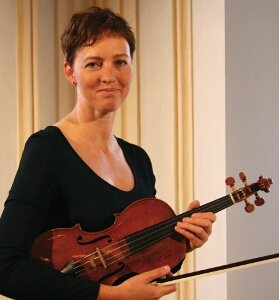
Bach alto and tenor arias are at their prettiest, I find, when they are written as a trio sonata, and the alto ariaTilg, o Gott in this cantata is a beautiful example of that. Wonderful singing and playing by alto Alex Potter and violinist Renate Steinmann. The aria is a plea for help in fighting the “Rottengeister,” or the sectarians amidst the Lutherans. When the alto starts singing the word “Rottengeistern,” we realize we had heard this word already many times in the triplets of the violin part. As Eduard van Hengel says, it is the “popular easy talk of the sectarians, and that is also the reason why the other two parts don’t have this motive” [to further illustrate the schism].
Renate Steinmann, violin and Alex Potter, alto. Photo of Alex Potter by Annelies van der Vegt.
Bass recitative:
Definitely keep the text & translations handy for this one, because this movement contains a wealth of text illustrations in the music. On the word Armen (the poor) sounds a sorrowful diminished seventh, the word seufzend (sighing) has a rest/sigh in the middle of the word, and more such things happening on the words Ach (sighing) and Klagen (complaining). In contrast to this, a few lines later, the chord on the word Gott (God) sounds open and liberating, after which God himself gets to speak, and the music turns to an arioso (similarly to how Bach does that in his much earlier Cantata 18 when God speaks). At the word heller Sonnenschein (bright sunshine) the light gets turned on in the music too: the harmony changes to C Major.
Tenor aria:
Here we have arrived at the solution/salvation part of the cantata, and so this music is more pleasant, easier to listen to. But Bach is still preaching: there are some crossing (!) lines in the music, and in the middle section, which tells the listeners to be patient (sei geduldig) and Bach stresses the words Kreuz und Not.
With many thanks to Eduard van Hengel and Rudolf Lutz for their explanations of this cantata,
Wieneke Gorter, March 26, 2020.
*more information about this painting and the other objects in Christian V’s Hall in Rosenborg Castle can be found here.
**The best examples of this are cantatas 2, 25, 38, and 121.
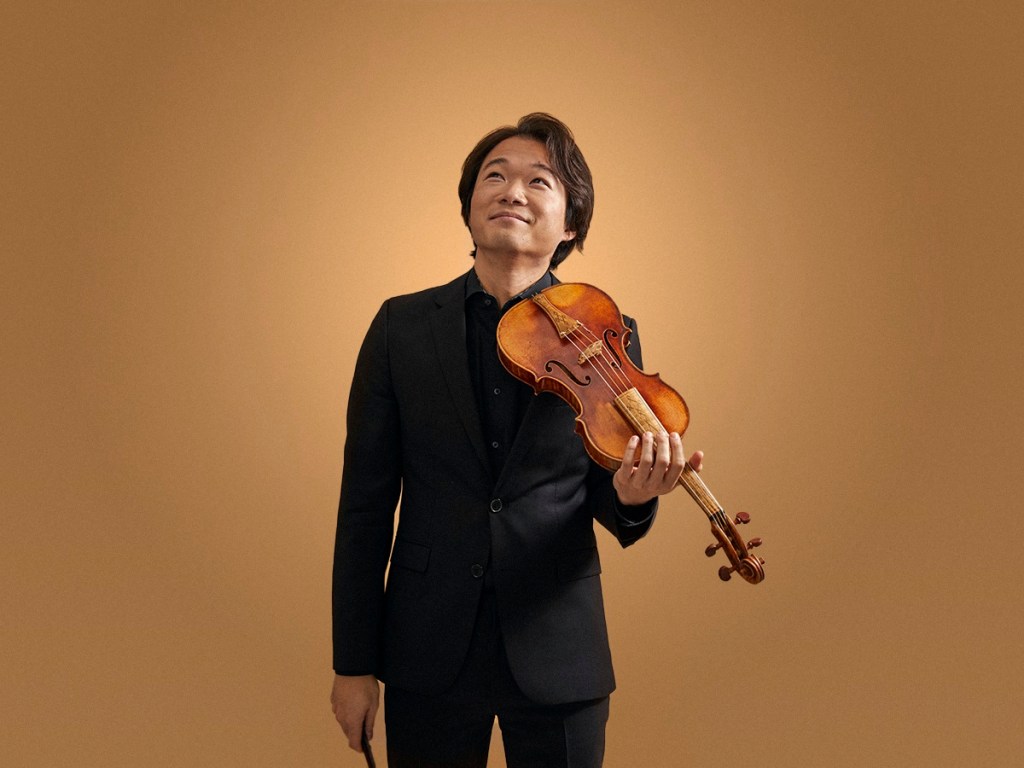
Shunske Sato, concertmaster since 2013 and artistic director since 2018 of the Netherlands Bach Society. Photo by Dana van Leeuwen.
To find the Weekly Cantata Advent Calendar, please click here.
Several people have asked me what made me start writing for this blog again. The answer is simple: Shunske Sato’s violin playing in the “Mein Verlangen” tenor aria from Cantata 161 Komm, du süsse Todesstunde. I had already heard that Sato was “a good one” from people with authority on the matter, and had enjoyed listening to his recordings, but it took these live concerts to experience the magic that happens when he is a soloist in a Bach aria.
During a visit to my home country, the Netherlands, I attended the Netherlands Bach Society’s “All Souls” concerts on October 31 in the Grote Kerk in Naarden and on November 3 in the Nieuwe Kerk in The Hague. I had been unsure how to talk about these concerts in the framework of this blog, especially now that it’s more than a month ago and we’re in Advent already (yes there is Advent music in this post, please keep reading) and there is no recording of these concerts.
Solo sonatas and partitas on All of Bach
But it turns out that this week is the perfect time for a spotlight on Shunske Sato, because this Thursday December 5, 2019, the Netherlands Bach Society will publish the final episode of his series of solo violin sonatas and partitas on All of Bach, their online video archive of Bach performances. Just click on this link and the entire series is right there, under “recently added.”
Sato was appointed concertmaster of the Netherlands Bach Society in 2013, and became their artistic director in June 2018. For the concerts I attended, he was concertmaster only, having invited alto Alex Potter to program and lead this production. (Alex Potter deserves a blog post too, but that will come later). By inviting a different guest director for each program, Sato has breathed fresh air into the he group of musicians I feel.
Instead of the standard biographies, the program booklet featured personal stories from Sato and the four vocal soloists. As a person who’s produced many program books in her lifetime, I felt this was a breath of fresh air too. And as a mom of two teenagers who are finding their way through school and life, I especially liked this part from Sato’s story:
“Things got tricky in my teens: I began spending lots of time away from school playing concerts, and my grades at school were impressively low (except for French and Maths). Giving up on school, I often spent my weekdays at my favorite bookstore instead and read about history, computer programming and linguistics, and composed string quartets. Saturdays always came as a relief: classes and lessons at the Juilliard School in New York, where hung out with my “real” friends.”
Playing Weimar style
Back to what happened in the concert in Naarden on October 31. For this entire program, the violinists were playing one-on-a-part, the same way it was probably done in Weimar, where Bach first performed Cantata 161 on the small organ loft in 1716. This meant that Sato was thus the instrumental soloist in the tenor aria “Mein Verlangen,” and with the rest of the ensemble completely in sync with him, he could truly do his own thing.
And then there was light
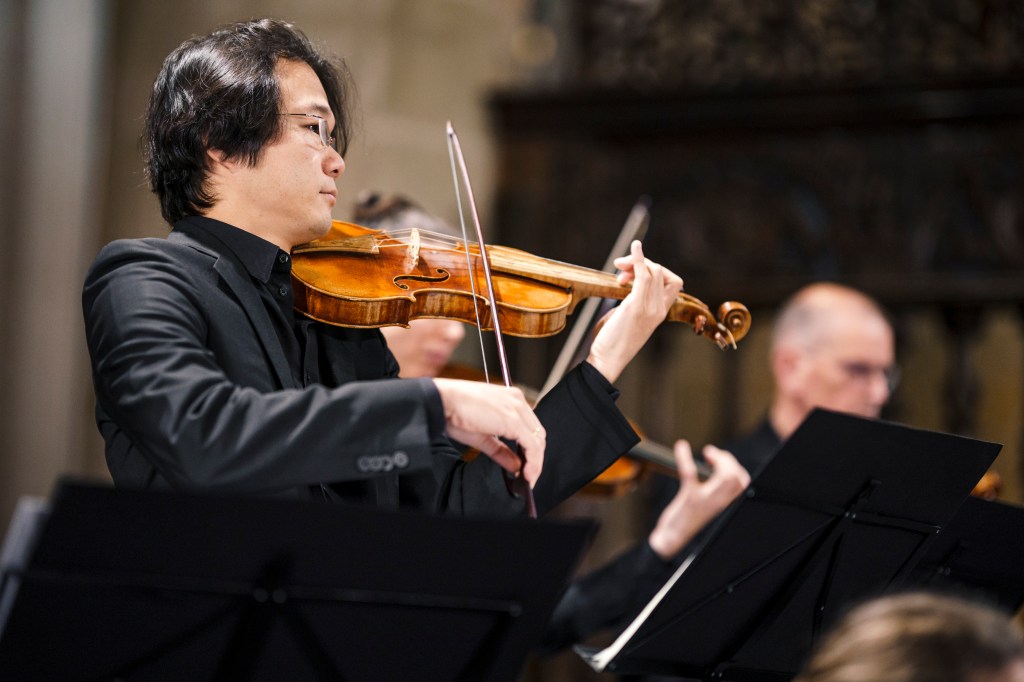
Shunske Sato in Naarden, October 31, 2019. Photo by Hans van der Woerd, courtesy of The Netherlands Bach Society.
And boy, did he do that! Every time he played the “Mein Verlangen” theme, he stretched the tempo just a little bit, every time slightly differently. It created a halo over the entire aria. Even though the tenor wasn’t singing yet, the text was already there: the longing (“Verlangen”) but also the pure radiance (“reiner Schein”) of the soul and the image of angels. He truly brought light into the music, and also for me personally into my heart and mind. It made all my frustrations and worries melt away, and it made the other instrumentalists play and tenor Thomas Hobbs sing with even more inspiration than they already had in this concert.
“The more I let go, the more I risk, the more I dare to really tell the story”
Witnessing Sato communicate the text of the aria before the singing started, I was immediately reminded of this wonderful interview with him for All of Bach. It is specifically about the “Erbarme dich” aria from the St. Matthew Passion, but his message “The more I let go and the more I risk, the more I dare to really tell the story…” applies just as well to this aria that I saw him play.
I went to the “All Souls” concert again three days later in the beautiful concert venue the Nieuwe Kerk has become. Sato’s playing there was possibly even more moving and the effect on those on stage and in the audience possibly stronger too. Several people had tears in their eyes.
Watch for yourself in this Advent aria
See the “Sato magic” happen in the soprano aria from Cantata 36 Schwingt freudig euch empor on All of Bach, with soprano Zsuzsi Tóth. Never did I enjoy a “da capo” this much. To read more about this cantata, the third one Bach wrote (or adapted) for the first Sunday of Advent, read my blog post from 2017 here.
With special thanks to Marloes Biermans and Annelie Bulsing of the Netherlands Bach Society for their generosity in providing photos and copy for me to use,
Wieneke Gorter, December 3, 2019.
To find the Weekly Cantata Advent Calendar, please click here.
The Servant Sending his Fellow Servant to Prison, from The Parable of the Unmerciful Servant, bound in Thesaurus Sacrarum historiarum Veteris et Novi Testamenti, 1585. Anonymous, Netherlandish. Metropolitan Museum of Art, New York (not on view).
I’m back! I’m starting with a small step, but stay tuned … a more considerable post is coming next week.
For this coming Sunday, the 22nd Sunday after Trinity, Bach wrote Cantata 89 in 1723, Cantata 115 in 1724, and Cantata 55 in 1726. Two years ago I wrote about the soprano aria from Cantata 115, not really being able to choose between Susanne Rydén with Bach Collegium Japan or Dorothee Mields with Herreweghe. I also included a link to the soprano aria from Cantata 89. Read that post here.
I still recommend the Herreweghe recording from 2017 for an overall recording of this cantata. However, sometimes it is nice to *see* a performance, and I would like to celebrate an important event in the world of Bach Cantata recordings that happened in the past year: The J.S. Bach Foundation in Switzerland (Bachstiftung) decided to make all their live video recordings of their Bach cantata performances available on YouTube, in full length. Previously, they had only made one movement of each cantata available on YouTube, and one would have to purchase the DVD or buy a live stream subscription in order to see the rest of the cantata.
So in this post I would like to share the Bachstiftung recording of Cantata 115. It was recorded on October 21, 2016, and published to YouTube on October 26, 2018.
Find the German texts with English translations here and the score here.
What is so special about this video recording is that you can see wonderful flutist Marc Hantaï at work in the opening chorus and in the soprano aria. He doesn’t appear on video that often, and they made a good choice to put him in front, so you can see his playing, and of course this way also the microphones pick up his sound better. (to hear more of what I believe is his playing, go to this post).
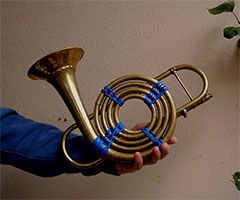
corno da tirarsi
Other instrumentalists to watch in this video: Olivier Picon on corno da tirarsi, and Balázs Máté on violoncello piccolo. Only three cantatas (46, 162, and 67) show the full name corno da tirarsi written in the manuscript, but there are 27 cantatas from Leipzig requiring a corno in which that part is not playable on a natural horn, so must have been written for this corno da tirarsi as well. Cantata 115 is included in that group. Bach is the only composer who ever mentioned this instrument in writing, and most probably his principal brass player Gottfried Reiche was the only one who ever played it. After Reiche’s death in 1734 Bach did not write for this instrument anymore, and for repeat performances of any cantatas containing a corno da tirarsi part, Bach rewrote it for other instruments. Read more about this in Olivier Picon’s article on the “corno da tirarsi” from 2010.The 27 cantatas are mentioned on page 22 of the article.
To find more of the Bachstiftung videos, search their Archive on their Bachipedia.org website. Most of the videos are “unlisted” on YouTube, so you won’t find them by doing a search within YouTube. Or, for the Dutch readers of this blog, you can use Eduard van Hengel’s new website (another terrific event of this past year!) and click on the links for all YouTube recordings he conveniently provides at the top of each page under the header “Beluister” (for an example, see the one for Cantata 115 here).
Jacob Isaacksz van Ruisdael, ‘Landscape with a waterfall’, circa 1668, Rijksmuseum, Amsterdam.
Last week it was the 7th anniversary of my mother’s passing. I wasn’t sure what to write about that, so ended up not posting that day. If you would like to read more about the woman who still is my main inspiration for this blog, you can read my tribute to her here.
But as it turns out, it is not a bad thing to combine the cantatas Bach wrote for Trinity 23 & 24 in 1724 in one and the same blog post, since they both stand out for their bass arias. It is noteworthy that Bach ended both his 1723 and 1724 Trinity seasons in Leipzig with cantatas featuring impressive bass arias*. That the “End of Life/End of Time/Judgement Day” theme was on every Protestant’s mind in the 18th century around this time of year of course had a lot to do with this. Bach often associates the bass voice with this theme, see for example Cantata 20 O Ewigkeit du Donnerwort, discussed here on this blog.
Regarding Cantata 139 Wohl dem, der sich auf seinen Gott, for the 23rd Sunday after Trinity (which was last week), I prefer the recording by the J.S. Bach Foundation (Bachstiftung). Especially the tenor aria is very well done by tenor Johannes Kaleschke and violinists Renate Steinmann and Martin Korrodi. Update from 2019: when I first wrote about this performance in 2017, the cantata was not available on YouTube in full length, but now it is! You can find it here. For those who can understand (a little) German, there is also a terrific explanation by conductor Rudolf Lutz of everything that happens in the cantata available on YouTube here. You can even download the same worksheet (“Lutzogramm”) as the audience is looking at here. Rudolf Lutz is at his best here, very clever, witty, and informative. He spent a lot of time prepping for this workshop, including entering entire orchestrations into his “Lady Yamaha,” which is very effective for understanding Bach’s incredible composition. Soloists are Susanne Frei, soprano; Antonia Frey, alto; Johannes Kaleschke, tenor; Ekkehard Abele, bass.
However, since the subject of this post is bass arias … the best interpretation of the extremely unusual bass aria appears on the Bach Collegium Japan recording. Peter Kooy does a fabulous job bringing out the different character for the 11 (!) different sections of the aria. I created a playlist on Spotify of this Bach Collegium Japan recording here. Soloists are Yukari Nonoshita, soprano; Robin Blaze, countertenor; Makoto Sakurada, tenor (he doesn’t convince me or capture my attention, and I find his pronunciation of the word “getrost” a bit distracting); Peter Kooy, bass.
Find the text of Cantata 139 here, and the score here.
Peter Kooy
Peter Kooy/Bach Collegium Japan again wins “best interpretation of the bass aria” in Cantata 26 Ach wie flüchtig, ach wie nichtig for the 24th Sunday after Trinity in 1724.Listen to Bach Collegium Japan’s recording via a playlist I created here on Spotify. This cantata was released on the same album as Cantata 139, so the soloists are again Soloists are Yukari Nonoshita, soprano; Robin Blaze, countertenor; Makoto Sakurada, tenor; and Peter Kooy, bass.
Find the text of Cantata 26 here, and the score here.
And what a bass aria this is! The calmly babbling brook from the lovely tenor aria earlier in the cantata has become a white water river in this bass aria. And the combination of bass voice with the oboes makes me think of Hades in Monteverdi’s Orfeo. Peter Kooy is great and my mother loved him very much, but in my humble opinion, the luckiest people today are those attending the cantata service in the Kloosterkerk in The Hague, Netherlands, where my good friend and favorite Bach bass Marc Pantus will be singing this aria. The Kloosterkerk was also my mother’s church for the last decade of her life, so I have now successfully circled back to her in this post, and miss her much more today than I did last week.
Wieneke Gorter, November 26, 2017, updated November 21 & 24, 2019.
*The first cantata Bach ever wrote for this particular time of year was Cantata 163 in Weimar. It contains a bass aria accompanied by two cellos, an instrumentation Bach never ever used after that. The last two cantatas of the 1723 Trinity season were Cantatas 90 and 70. Read my post about Cantata 90 for the 25th Sunday after Trinity here and my post about Cantata 70 for the 26th Sunday after Trinity here.
Susanne Rydén. Photo by Elin Ericsson/Sveriges Radio.
About a decade ago, I first heard the soprano aria from Cantata 115 sung live in a concert. It took my breath away. The next day, I started looking for recordings of the aria, and decided that my favorite was the one by Susanne Rydén with Bach Collegium Japan, with Liliko Maeda on transverse flute, and Hidemi Suzuki on violoncello piccolo. I purchased only that movement on iTunes and played it many times. However, I never listened to the rest of the cantata …
It took me until this past week to realize that the entire cantata is beautiful, also contains a fabulous alto aria, and …. that this year, Herreweghe released a recording of it, with Dorothee Mields singing the soprano aria and Damien Guillon singing the alto aria. For those of you who know how much I love Dorothee Mields (read more about that here) you will understand I now had a problem: Susanne Rydén or Dorothee Mields? I feel that within the framework of the rest of the movements of Herreweghe’s recording, Mields’ interpretation of the soprano aria fits perfectly, is very moving, and extremely well done. But as a stand-alone aria, I still love Susanne Rydén’s the best, because of the quality of her voice on that recording, and because her ability to blend so perfectly with the flute.
For the entire cantata, I recommend Herreweghe’s 2017 recording. This recording is not available on YouTube, but you can find it here on Spotify. Please consider supporting the artists by purchasing the entire album here on Amazon.
Find the German texts with English translations here and the score here.
Herreweghe is the best at giving the music direction, always focusing on the phrasing. In addition to all of that, there is a wonderful expansiveness, freedom in the sound and the musical lines present in almost all of the movements. Also, Peter Kooy’s singing in the bass recitative/arioso is much more lively and adventurous than on the Bach Collegium Japan recording, and then there’s of course counter-tenor Damien Guillon. I was smiling the whole time when I first listened to his aria. How he can move from a low, full note to a clear, spot-on high note is just so good.
If you would like to hear more beautiful music for this Sunday, or are wishing for a more upbeat soprano aria, there is a terrific rendition of the soprano aria from cantata 89 Bach wrote for this same Sunday in 1723 here on Youtube, sung by the incomparable Nuria Rial with the J.S. Bach Foundation.
Wieneke Gorter, November 11, 2017, updated November 15, 2019.
Bach’s Calov Bible after Luther, with Bach’s comment in the right margin of 2 Chronicles 5,13: “NB. Bey einer andächtigen Musiq ist allezeit Gott mit seiner Gnaden Gegenwart” (NB. Where there is devotional music, God with his grace is always present.)
This past October 31 marked the 500 anniversary of the Reformation: Luther posting his 95 theses on the door of the church in Wittenberg. Without Luther making the Bible available in German and making music an integral part of faith, Bach would probably not have felt as driven to educate his fellow believers through his music. Without Luther, there might not be any Bach cantatas, and definitely not this special cycle of chorale cantatas I’ve been discussing on this blog since June of this year.
It is interesting to me that when using one of Luther’s original chorales, Bach gives it an “old-fashioned” treatment: he writes the opening chorus in the “old style,” almost like a 16th century motet, and has the equally ancient brass quartet of one cornetto and three sackbutts (early trombones) doubling the vocal parts, as if wanting to confirm the timeless character of Luther’s chorales. A good example of this technique is Cantata 25 from 1723 and Cantata 2 from earlier in 1724, and Cantata 121 for Second Christmas Day 1724. If this was Bach’s preferred way of honoring Luther, he did this also on October 29 in 1724, two days before Reformation day, with this Cantata 38 Aus tiefer Not schrei ich zu dir for the 21st Sunday after Trinity. Aus tiefer Not schrei ich zu dir is on one of Luther’s very first chorales, and was also sung at his funeral.
I prefer Herreweghe’s recording of this cantata. It is available here on YouTube, or please consider supporting the artists by purchasing the entire album “Weinen, Klagen …” here on Amazon. The album also contains my preferred recordings of Cantata 12 (see my post about that here) and Cantata 75 (see my post about that here). Soloists are Carolyn Sampson, soprano; Daniel Taylor, countertenor; Mark Padmore, tenor, and Peter Kooij, bass.
Please find the German text with English translations here, and the score here.
If you have time, it is worth it to first listen to the opening chorus of cantata 2 Ach Gott, vom Himmel sieh darein from June 18, 1724, also based on one of Luther’s own chorales. Make sure you stop after the opening chorus, and then start listening to today’s Cantata 38here, and hear how similar Bach’s setting of the chorale melody is. I don’t think it is a coincidence.
My favorite part of this cantata is the tenor aria: it is a beautiful piece of music, a quartet really, between the two oboe parts, the tenor voice, and the continuo, the way tenor arias often are with Bach, and I appreciate the text “Ich höre mitten in den Leiden ein Trostwort, so mein Jesus spricht” (In the midst of my sufferings I hear a word of consolation spoken by Jesus). I listened to this aria many times in the weeks after my mother passed away (seven years ago this month), Bach’s music being my “Trostwort.”
I also very much like the before-last movement of the cantata, the trio between soprano, countertenor, and bass. Excellent motet writing by Bach, and beautifully sung on the Herreweghe recording. Again this is a nod from Bach to older composition styles, linking back to the opening chorus, and perhaps an additional tribute to Luther.
Wieneke Gorter, November 4, 2017, links updated October 29, 2020.









 Weekly Cantata