Weekly Cantata

Weekly Cantata

Tag Archives: Bach

Season 1, episode 2

04 Saturday Jun 2016

Posted by cantatasonmymind in 1723 Trinity season special series, Bach's life, Cantatas, Leipzig, Trinity

≈ Comments Off on Season 1, episode 2

Tags

according to Lutheran Church year, Bach, cantatas, Harnoncourt, James Gilchrist, John Eliot Gardiner
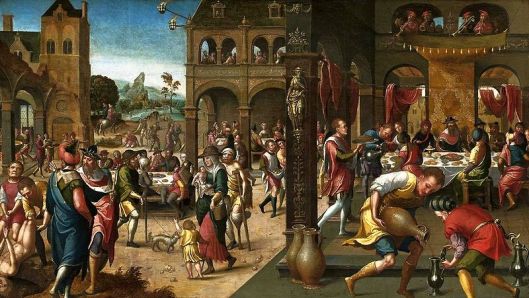
Brunswick_Monogrammist_Great_Banquet

The Parable of the Great Supper / the Great Banquet, by anonymous Dutch painter “the Braunschweig (Brunswick) Monogrammist,” ca. 1525

Trinity season in the Lutheran Church year means no feast days until Christmas, no stories about Jesus’ life in the Gospel texts, and no Vox Christi bass recitatives. To still keep this blog exciting for myself and you loyal readers, I decided to make it into a true weekly series, and will be following all of Bach’s 1723 Leipzig cantatas until Advent, without taking any detours to his Weimar cantatas or later Leipzig cantatas.

A few things that make it irresistible for me to try this: Bach started working  in Leipzig  on the first Sunday after Trinity in 1723 (see last week’s blog post); the dates of the Lutheran Church year in 2016 are practically the same as in 1723 – off by only one day; and I believe that by following this 1723 sequence, we can better imagine how it must have been for the Leipzig audiences (congregation) to hear one cantata after the other, and perhaps get a little insight in how it must have been for Bach himself to write one after the other.

So, here we go with season 1, episode 2:

Previously on Weekly Cantata: Bach arrived in Leipzig on Saturday May 22, 1723,, and made his debut with cantata 75 Die Elenden sollen essen in the Nicolaikirche (St. Nicholas Church) on Sunday May 30, the first Sunday after Trinity.

The second Sunday after Trinity in 1723 marked Bach’s debut in the Thomaskirche (St. Thomas Church). On Sunday June 6, he performed cantata 76 Die Himmel erzählen die Ehre Gottes there, and this one is even more impressive than 75, and includes a festive opening chorus which makes me think of Bach’s later Ascension Oratorio.

There are many similarities between cantata 75 and 76, the most obvious one being that they share the ambitious length of 14 movements in total, divided over two parts. From a superficial point of view, both cantatas start with a psalm text in the opening chorus, have challenging soprano arias, feature bass arias with trumpet, and -never seen again in later cantatas- an instrumental sinfonia at the start of the second part (after the sermon). However there are more (hidden) similarities and cross-references between the two, so that one could almost think about these two first cantatas of the 1723/1724 cycle as a diptych.

I appreciate Gardiner’s interpretation of cantata 76 the most of all recordings I listened to. And the universe will have it that this one was recorded in the Basilique de Saint-Denis (directly north of Paris), which was my subway stop for four fabulous music-filled months in 1994. In his journal from 2000, Gardiner writes that they were very concerned about the enormous size of this Gothic cathedral, and feared that a large audience (needed to balance out the acoustics) wouldn’t show up because it was the night of the France-Italy final in the Euro soccer competition. But everything turned out fine: there were more than 1200 people in the audience, and France won.

Listen to Gardiner’s recording of cantata 76 Die Himmel erzählen die Ehre Gottes on Spotify  or on YouTube, or buy this recording on Amazon.

Cantata 76 starts with a text about heaven: the first and third verse of Psalm 19, Die Himmel erzählen die Ehre Gottes. To illustrate this, the heavenly trumpet (in cantata 75 not introduced until the start of the second half) is heard right away. The fugue on the text “Es ist keine Sprache noch Rede, da man nicht ihre Stimme höre” is fantastic, Bach at his best in my opinion.

After this, the text of the cantata refers to the Gospel reading of the day: the parable of the Great Supper from Luke 14: 16-24 about a man who has invited many guests to a Dinner/Supper/Banquet, receives one cancellation after the other, after which he decides to invite all the beggars and cripples his servant can find, and serves them the dinner instead, not leaving one place open for any of the previously invited guests. All this combined with the “Brotherly love” theme from the Epistle reading of the day: 1 John 3: 13-18.

Another example, though through a completely opposite story as the one from cantata 75, of why it is good to share food and love with others.

Besides the incredible opening chorus, the highlights of this cantata for me are: the soprano aria with violin/cello accompaniment (no. 3), the bass aria with trumpet (no. 5), the incredible sinfonia for oboe d’amore and viola da gamba at the start of the second half (no. 8),  the dramatic, operatic tenor aria (no. 10, fabulously performed by James Gilchrist, including the “shake” Bach wrote on the word “Hasse”), and the alto recitative with viola da gamba (no. 11).

For those who have extra time: listen to the violin/cello duet in the soprano aria accompaniment in an unrivaled (as far as I am concerned) interpretation by Alice and Nikolaus Harnoncourt on their recording from 1976 (scroll to 06:11)
e1712a1a564449d6c9c7a2aad5045250

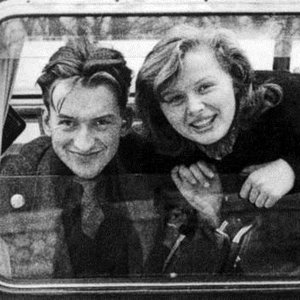
Nikolaus & Alice Harnoncourt, 1951, before they were married, on tour with the Vienna Chamber Orchestra

Read the German text with English translations of this cantata here, and find the score here.

If you don’t want to miss an episode of this 1723 Trinity season series, please consider signing up  to receive an email every time I’ve posted a new story.

Please feel free to share this on Facebook, or forward to anyone you think might enjoy coming along for this ride. Thank you!

Wieneke Gorter, June 4, 2016, links updated June 12, 2021.

The Leipzig Debut

29 Sunday May 2016

Posted by cantatasonmymind in 1723 Trinity season special series, Bach's life, Cantatas, Leipzig, Trinity

≈ Comments Off on The Leipzig Debut

Tags

Bach, cantatas, Carolyn Sampson, Daniel Taylor, John Eliot Gardiner, Mark Padmore, Peter Kooy, Phlippe Herreweghe

Echternach_Lazarus_Dives

Lazarus and the Rich Man / Lazarus and Dives, Codex Aureus of Echternach, 11th century

On this First Sunday after Trinity (for short:Trinity 1), Sunday May 30, 1723, Bach started his first cycle of weekly cantatas in Leipzig. It was two days before his official installation, and one week after he and his family had arrived in the city.

Trinity is also the start of the part of the church year that deals exclusively with issues of faith and doctrine, instead of celebrating events from Jesus’ life, as was done in the period between Advent and Pentecost. This change must have been important to Bach too, because all three surviving cantatas for Trinity 1 are large-scale, musically ambitious works.

The composition with which Bach made his debut in the St. Nicholas Church (he would not perform in the St. Thomas Church until one week later) was cantata 75 Die Elenden sollen essen, a piece of considerable length, containing no less than 14 movements, seven before the sermon, seven after.

I prefer the recording by Herreweghe, which appears on the same CD as cantata 12 Weinen, Klagen, Sorgen, Zagen.

Listen to Herreweghe’s recording of cantata 75 Die Elenden sollen essen (with soloists Carolyn Sampson, Daniel Taylor, Mark Padmore, and Peter Kooy) on YouTube

Purchase Herreweghe’s recording of cantata 75 Die Elenden sollen essen and two other cantatas on Amazon

Find the complete German text with English translation of this cantata here.

The text of the opening chorus is from Psalm 22, but it is strongly related to the Gospel of the day: the story of Lazarus (a poor leper, who lies in front of the door of a rich man’s house, asking the rich man for food every day) and Dives (the rich man, who ends up in hell when he dies because he didn’t share his blessings/wealth with those in need).

When I listen to the opening chorus, I keep wondering if Bach wrote a Kyrie in Köthen which he never finished or which got lost for another reason. This is not backed up by any of the commentary about this cantata, but in these first measures I can’t stop myself from hearing “Ky-ri-e-e-le–”  in my head when the choir sings “Die-ie E-e-le–.” The music accents the second syllable of the word Elenden, while in the spoken language the stress would be on the first syllable. I find it strange that Bach would have ignored word stress in such an important composition, which he spent extra time on, and probably already wrote before he arrived in Leipzig (Gardiner notes that the paper of the manuscript was not from Leipzig, and that the handwriting was extremely neat). So I’m hoping something will turn up in my lifetime to substantiate this hunch I have ….

Wherever the opening chorus originated from, it is beautifully written,  as are all the arias. The soprano aria has a tender, plaintive oboe d’amore accompaniment, the alto aria floats on a rich blanket of strings, and the bass aria is a show-off piece with virtuosic music for the singer as well as the trumpeter.

There is a symmetry to the order in which the recitatives and arias appear in the cantata which is rarely seen in other Bach cantatas.

In the first half:

Bass recitative – Tenor aria – Tenor Recitative – Soprano Aria – Soprano Recitative

in the second half this pattern is mirrored for the remaining voices:

Alto recitative – Alto Aria – Bass recitative – Bass Aria – Tenor Recitative

But of course it is typical for Bach to use mathematical design when wanting to make a lasting  impression with a composition (such as with the St. Matthew Passion and the Mass in B minor). Also the fact that there are 14 movements to this cantata is not a coincidence: it is the sum of the numbers B, A, C, and H in the alphabet.

There is more symmetry in the cantata: The text of the first half refers to the Gospel story from Luke about Lazarus and Dives, and talks about earthly life and material possessions. In contrast to this, the second half of the cantata moves up to a spiritual level, and up to heaven. This change is illustrated by the introduction of the instrument that was associated with heaven: the trumpet. In the opening movement of the second half of this cantata the trumpet plays the chorale tune with which the first half had ended, Was Gott tut, das ist wohlgetan, and then later accompanies the bass in a stand-out virtuosic aria.

There is also more “showing off” in this cantata. As Gardiner points out, Bach seems to have wanted to make it clear that he was a skilled court composer (which he had been at Köthen before he took the position in Leipzig): after the French Ouverture of the opening chorus, all the arias together from a French Suite: The tenor aria is a Polonaise, the soprano aria a Minuet, the alto aria a Passepied, and the Bass aria a Gigue.


Wieneke Gorter, May 29, 2016


Glorious soprano arias and unusual instrumentation

08 Sunday May 2016

Posted by cantatasonmymind in After Easter, Cantatas, Leipzig

≈ Comments Off on Glorious soprano arias and unusual instrumentation

Tags

Bach, BWV 183, bwv 44, Carolyn Sampson, Christiane Mariana von Ziegler, Dorothee Mields, Exaudi, Gerd Türk, Harnoncourt, oboe d'amore, oboe da caccia, Peter Jelosits, Peter Kooy, Phlippe Herreweghe, Robin Blaze, Rudolf Lutz, Thomas Hobbs, violoncello da spalla

BWV183titlepage

The title page of cantata 183 in Bach’s handwriting: Dominica Exaudi // Sie werden eüch in den Bann tun // à 4 Voci, 2 Hautb d’Amore, 2 Hautb da Caccia, 2 Violini, Viola, Violoncello piccolo e Continuo // di Joh. Sebas. Bach. Staatsbibiothek zu Berlin – Preußischer Kulturbesitz

There are two cantatas for this Sunday Exaudi, aka the Sunday after Ascension, or in the practical reality of the man who had to write the music and rehearse the choir: the Sunday in between Ascension and the three-day-long feast of Pentecost. Because they refer to the same Gospel text, the cantatas share the title Sie werden euch in den Bann tun, but except for the fact that they each contain a glorious soprano aria, they have nothing in common.

I discuss both cantatas in this blog post. Keep reading for Cantata 183, but let’s first look at the one Bach wrote in 1724: Cantata 44 Sie werden euch in den Bann tun.

The soprano aria from this cantata, Es ist und bleibt der Christen Trost, sung by the amazing Peter Jelosits on the Harnoncourt recording from 1975 is among the most happiest music memories of my childhood. I suspect my mom loved it so much that she played it more often than just on this Sunday. I didn’t realize how well this aria is engraved in my brain until I surprised myself during a choir carpool, singing the entire thing from memory, illustrating a story about how some of these boy sopranos could sing very complicated arias.

Es ist und bleibt der Christen Trost,
The consolation of Christians is and remains
Dass Gott vor seine Kirche wacht.
God’s watchful care over his church.
Denn wenn sich gleich die Wetter türmen,
For even though at times the clouds gather,
So hat doch nach den Trübsalstürmen
yet after the storms of affliction
Die Freudensonne bald gelacht.
the sun of joy has soon smiled on us.

If you would like to listen to the entire cantata, I recommend Herreweghe’s recording from 2013. The opening tenor/bass duet is the best here, with bass Peter Kooij singing out much more than on their 1993 recording of this same cantata, and his and Thomas Hobbs’ voice matching better than his and Christoph Prégardien’s (as much as I love Prégardien’s voice!).

Also, Herreweghe’s interpretation of the soprano aria on this 2013 recording is the most musical and the most cheerful, not in the least because it has the highest tempo of all recordings I listened to. That this proves a bit of a challenge for the always fabulous soprano Dorothee Mields is only audible in the text: after she comes out of the expertly executed but super tricky long runs, she slips back into the edition she probably studied from, which uses the more modern “für seine Kirche”  instead of the edition they’re performing from, which uses the archaic “vor seine Kirche,” so it ends up being a mix of the two texts. While this bugs me a little bit, a retake of the recording would probably have been at the expense of the magic that happens in this aria, so it is probably a good thing that they left it in.

Purchase the Herreweghe recording of cantata 44 on Amazon or on iTunes. (This album also features the beautiful recording of cantata 73 discussed here).

Find the entire German text of cantata 44 with English translations here, and the score here.

  • Thomas Hobbs, tenor (photo by B Ealovega)
  • Peter Kooij, bass

Cantata 183 from 1725 is noteworthy because it uses a text by Christiane Mariana von Ziegler and features a striking instrumentation: two oboi d’amore and two oboi da caccia in the bass recitative; a violoncello piccolo in the tenor aria; again the two oboe pairs in the alto recitative; two oboi da caccia in the soprano aria; all these instruments in the closing chorale.

My absolute favorite recording of this cantata is the one by Bach Collegium Japan. They struck gold with this recording, thanks to the combination of  Badiarov playing the violoncello piccolo da spalla, fabulous oboe players, and terrific vocal soloists: soprano Carolyn Sampson, countertenor Robin Blaze, tenor Gerd Türk, and bass Peter Kooij. I think the entire album (also featuring the recording of cantata 85 discussed here) is very inspired, and it has become one of my favorite Bach cantata CDs.

Listen to this Bach Collegium Japan recording of cantata 183 on Spotify.

Purchase this Bach Collegium Japan recording of cantata 183 (and 85!) on Amazon or on iTunes.

Find the German text with English translation of Cantata 183 here, and the score here.

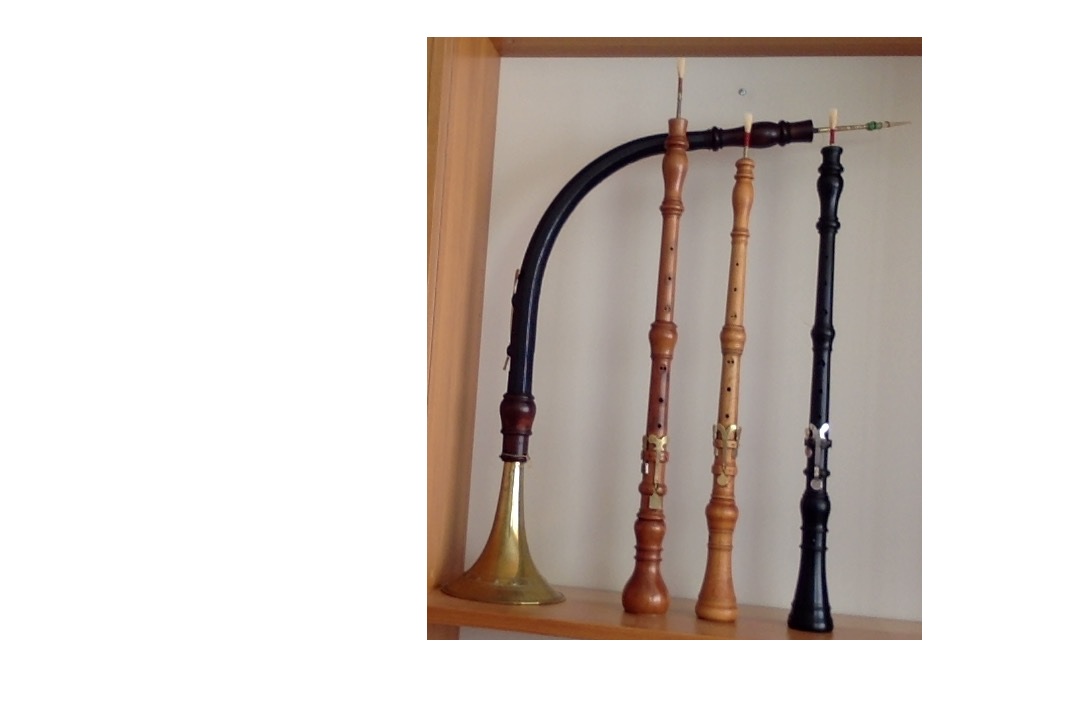
Why is this scoring for the oboes so unusual? In Bach’s time there were “regular” oboes (to the right on this photo), oboes d’amore (with a bell-like widening in the wood at the end, second from left), and oboes da caccia (or “hunting” oboes, completely curved, and with a trumpet-like brass bell at the end, far left).

Oboes
From left to right: oboe da caccia, oboe d’amore, oboes. Photo courtesy of Marianne Richert Pfau; instruments built after 18th century examples by Sand Dalton, Harry van Dias, and Paul van der Linden, respectively.

Bach often used the oboe da caccia, but only on a handful of occasions would he write for two da caccias. And even if he would write for two da caccias or two d’amores and “regular” oboes in the same cantata (or passion) they would not all be playing at the same time. On most occasions there were between one or two oboe players in the orchestra, sometimes three, alternating between the different instruments from one movement to the next. The only times Bach needed four oboists in one cantata, playing two da caccias and two d’amores at the same time, was in cantata 2 of the Christmas Oratorio (1734) and in this cantata 183. So there must have been some good oboe playing visitors in town around this time of Ascension and Pentecost in 1725.

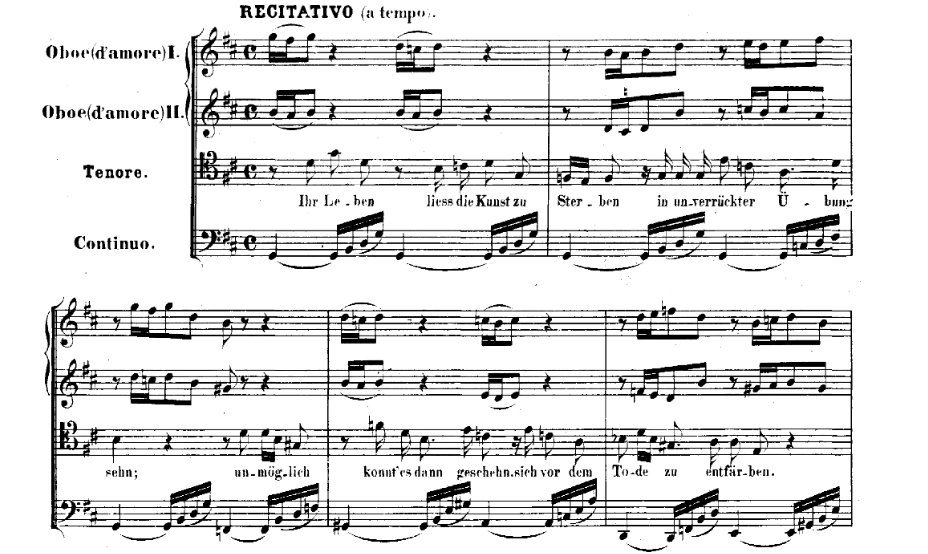
The four oboes can be heard clearly in the alto recitative, where Bach has each of them repeat the four-note theme from the “ich bin bereit”-text in the vocal part:

Screenshot 2016-05-08 10.16.33

When I hear this, I immediately have to think of the tenor recitative in Bach’s beautiful  Trauer Ode, cantata 198, this time reduced to a 3-note theme and without the da caccias:

Screenshot 2016-05-08 10.28.17

Or listen to this recitative from cantata 198 on YouTube

It is of course not exactly the same composition, but I wonder if Bach had to think back of this cantata from 1725 when he wanted to illustrate life  and death in one and the same piece of music in the Trauer Ode of 1727.

After this alto recitative comes the most glorious soprano aria, richly scored with the two oboes da caccia playing the oboe part in unisono, as well as parts for violin 1, violin 2, and viola. Harnoncourt says that even though both da caccia have this aria written in, he says it is “clearly not intended to be chorally played” and on their recording they decide to have this part covered by only one oboe da caccia. Perhaps the original full score was not available to Harnoncourt at the time he made that decision, because it clearly says: “tutti gli Oboi in unisono:”

Screenshot 2016-05-08 12.34.13
excerpt from the soprano aria from cantata 183, with Bach’s indication for “all the oboes in unisono,” Staatsbibiothek zu Berlin, Preußischer Kulturbesitz

One would almost think Bach dreamt of all four oboes playing this, also the d’amores, but when his copyists double-checked with him, he decided that was just silly, it would overpower the poor boy who had to sing this, and they only wrote it into the parts for the da caccias (it says “Arie Tacet” in the parts for the oboi d’amore).

To learn more about Cantata 183, I wholeheartedly recommend you study with Rudolf Lutz of the J.S. Bach Foundation a little bit. Find a link to his fabulous (English spoken!) lecture and improvisation about this cantata in my blog post from May 24, 2020.

Wieneke Gorter, May 8, 2016, updated May 23, 2020.

A female librettist and an inspired recording

01 Sunday May 2016

Posted by cantatasonmymind in After Easter, Cantatas, Leipzig

≈ Comments Off on A female librettist and an inspired recording

Tags

Bach, cantatas, Christiane Mariana von Ziegler, John Eliot Gardiner

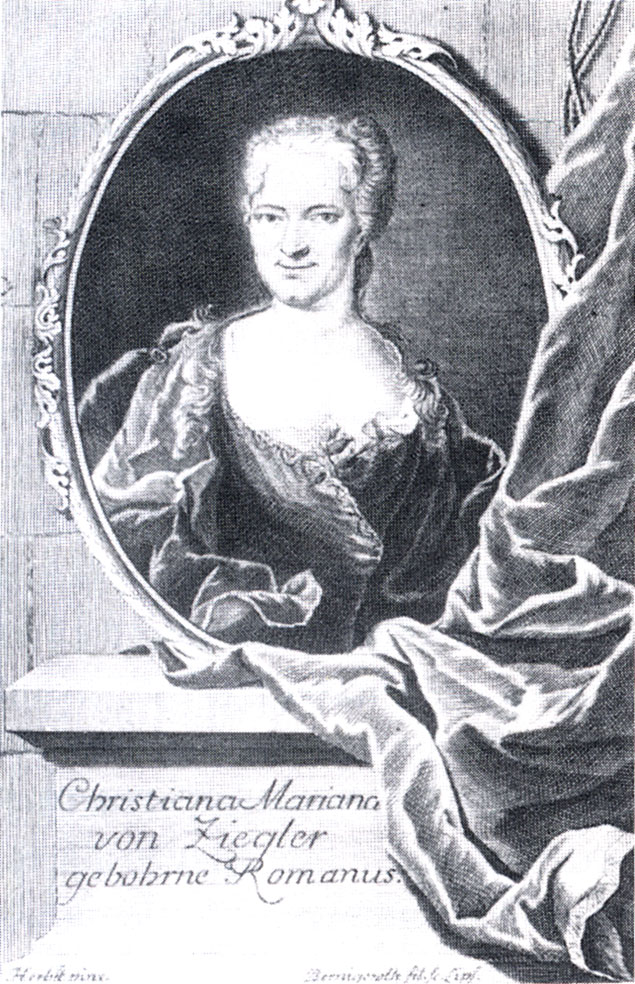
ziegler-christiane-mariane-02

In 1725, between Easter and Pentecost, Bach set nine cantatas in a row to texts by Christiane Mariana von Ziegler (1695–1760). And it is in part thanks to her poetry that I’m favoring the cantata from 1725 over the one from 1724  for this “Rogate” Sunday – the fifth Sunday after Easter.

This cantata 87 from 1725, Bisher habt ihr nichts gebeten in meinem Namen, contains two jewels of arias: the alto aria (no 2) and the tenor aria (no 6). Von Ziegler’s poetry combined with Bach’s sublime scoring in those arias completely knocked me over when I first listened to this cantata this week. I found Gardiner’s recording of this cantata (which I happened upon by accident – read more about this at the very end of this post) the most moving.

Listen to Gardiner’s recording of cantata 87 on Spotify.

Listen to Gardiner’s recording of cantata 87 on YouTube (there might be some ads in here – you can click to skip them after a few seconds).

Buy Gardiner’s live recording of cantata 86 and 87 on Amazon

(This album is absolutely worth purchasing –  cantata 86 is beautiful too, and the violin accompaniment in the alto aria of that cantata 86 on this recording is the best)

About Christiane Mariana von Ziegler: A female librettist, who didn’t have to hide behind a male alias to get recognition or to get her works published? In 18th century Leipzig? When I first heard about this I could not believe it. But it turns out that by unusual circumstances, Christiane Mariane von Ziegler was as “free” as probably no other woman at that time was, at least between 1722 and 1741.

In that time period, there was no husband or other male relative by whose rules she had to live: her father had been in jail since she was 11, she had been twice widowed, and had lost both her children (one from each marriage). Despite all this, she was still in possession of her family’s house and fortune, and was well respected in Leipzig society. She wrote poetry, sang, and played many musical instruments. In 1722 (at age 27) she was appointed the official guardian of her family’s household, a position normally never awarded to a woman. For the next two decades her house served as the salon where many artists and intellectuals could meet. She would promote artists, poets and writers, and introduce them to representatives of the university who also attended her events.

In 1730, Von Ziegler became the first and only female member of Gottsched’s German Literary Society. She was named “poet laureate,” crowned by the emperor in 1733. In 1732 and 1734 she received the poetry prize from the German Literary Society. Her last published work appeared in 1739. In 1741, she married Professor Balthasar von Steinwehr and lived with him in Frankfurt an der Oder until her death in 1760. As far as we know, she did not write anything in this last period of her life.

In 1728, she published Versuch in gebundener Schreib=Art, which contains the texts for the nine 1725 Bach Cantatas (103, 108, 87, 128, 183, 74, 68, 175, 176). In 1729 she published In Gebundener Schreib-Art: Anderer und letzter Theil, which contains the rest of a complete yearly cantata cycle which Bach never set to music.

Since there is no correspondence between Von Ziegler and Bach left to us,  we don’t know why they started working together, we don’t know why the working relationship ended, nor why Bach never used the other texts she had provided for the rest of the cantata cycle. There are some theories that she must have been vexed about Bach altering her texts on several occasions in 1725. However, the only proof we have for what her “original” texts would have been are her publications from several years later. She might have changed them herself between Bach first using them and her later publishing them. We do know that Bach first worked with Picander, the poet with whom he would later collaborate extensively (including for the St. Matthew Passion) in February 1725.

Back to this cantata. It was Bach’s life goal to not only praise God, but also educate “his neighbor” (the congregation, his fellow believers) with his church music, and it seems that Von Ziegler definitely shared this vision. To not make this post too long, I’ll only highlight the alto aria, since it is the piece that impressed me most, but the rest of the cantata is well worth listening to, especially the tenor aria.

The Gospel reading for this Sunday was the last part of Jesus’ speech to his disciples, from John. Note verse 24 (quoted in the bass arioso opening) and the overall stress on speaking in proverbs versus speaking plainly.

23. Und an demselbigen Tage werdet ihr mich nichts fragen. Wahrlich, wahrlich, ich sage euch: So ihr den Vater etwas bitten werdet in meinen Namen,so wird er’s euch geben.

[23] And in that day ye shall ask me nothing. Verily, verily, I say unto you, Whatsoever ye shall ask the Father in my name, he will give it you.

24. Bisher habt ihr nichts gebeten in meinem Namen. Bittet, so werdet ihr nehmen, daß eure Freude vollkommen sei.

[24] Hitherto have ye asked nothing in my name: ask, and ye shall receive, that your joy may be full.

25. Solches hab’ ich zu euch durch Sprichwörter geredet. Es kommt aber die Zeit, daß ich nicht mehr durch Sprichwörter mit euch reden werde, sonderneuch frei heraus verkündigen von meinem Vater.

[25] These things have I spoken unto you in proverbs: but the time cometh, when I shall no more speak unto you in proverbs, but I shall shew you plainly of the Father.

26. An demselbigen Tage werdet ihr bitten in meinem Namen. Und ich sage euch nicht, daß ich den Vater für euch bitten will;

[26] At that day ye shall ask in my name: and I say not unto you, that I will pray the Father for you:

27. denn er selbst, der Vater, hat euch lieb, darum daß ihr mich liebet und glaubet, daß ich von GOtt ausgegangen bin.

[27] For the Father himself loveth you, because ye have loved me, and have believed that I came out from God.

28. Ich bin vom Vater ausgegangen und kommen in die Welt; wiederum verlasse ich die Welt und gehe zum Vater.

[28] I came forth from the Father, and am come into the world: again, I leave the world, and go to the Father.

29. Sprechen zu ihm seine Jünger: Siehe, nun redest du frei heraus und sagest kein Sprichwort.

[29] His disciples said unto him, Lo, now speakest thou plainly, and speakest no proverb.

30. Nun wissen wir, daß du alle Dinge weißt und bedarfst nicht, daß dich jemand frage. Darum glauben wir, daß du von GOtt ausgegangen bist.

[30] Now are we sure that thou knowest all things, and needest not that any man should ask thee: by this we believe that thou camest forth from God.

After the Vox Christi bass arioso opening (beautifully scored as an opening “chorus” for strings, oboes, and bass voice), Von Ziegler doesn’t hold back in communicating what the believers should take away from this lesson, and writes this text for the alto recitative:

O Wort, das Geist und Seel erschreckt!
O word, that terrifies spirit and soul!
Ihr Menschen, merkt den Zuruf, was dahinter steckt!
You people, notice the call hidden behind these words!
Ihr habt Gesetz und Evangelium vorsätzlich übertreten;
You have deliberately transgressed the law and gospel;
Und dies möcht’ ihr ungesäumt in Buß und Andacht beten.
And because of this you should pray without delay in repentance and devotion.

And then gives them the prayer they should be saying in the alto aria, and this is the part that bowled me over, because of the combination of the music, the text, and the humble interpretation of it on the Gardiner recording:

Vergib, o Vater, unsre Schuld
Forgive, O Father, our guilt
Und habe noch mit uns Geduld,
and still have patience with us,
Wenn wird in Andacht beten
when we devoutly pray
Und sagen: Herr, auf dein Geheiß,
and say: Lord, at your command,
Ach, rede nicht mehr sprichwortsweis,
Ah, speak no more proverbs,
Hilf uns vielmehr vertreten.
Instead help us represent ourselves.

Here’s the story of how I happened upon the Gardiner recording of this cantata, and this aria in particular: I was only familiar with cantata 86, not with 87. When comparing several recordings of the alto aria in cantata 86 (because of the stunningly beautiful and very virtuosic violin accompaniment), I decided I liked the violin playing on Gardiner’s recording the best. Satisfied that I had found this and knew what my blog post was going to be about, I took a break while letting the album play, and of course cantata 87 was next. I was on the floor on my yoga mat, just lying there, letting the music wash over me, unable to do anything else.

I am rarely so physically moved by a Gardiner recording, so I went and looked up his journal of the live performances (and recordings) in question, and found this:

“In addition to our habitual position of “bringing coals to Newcastle,” the potential impertinence of interpreting Bach to the Germans, we faced the far pricklier issue of performing Bach in the city [Dresden] whose cultural treasure had been wantonly destroyed by British bombs in one mad night towards the end of the war and with colossal loss of life.”

So there it was: the prayer for forgiveness and better representation had been as meaningful to the British musicians in the German city at the time of this recording as it was to me this week.

Wieneke Gorter, May 1, 2016, links updated May 19, 2024.

When good fortune smiles – beware!

24 Sunday Apr 2016

Posted by cantatasonmymind in After Easter, Cantatas, Leipzig

≈ Comments Off on When good fortune smiles – beware!

Tags

Amsterdam Baroque Choir, Amsterdam Baroque Orchestra, Bach, Bernhard Landauer, cantatas, Crhistoph Prégardien, Ton Koopman

Vanitas

Allegory of Vanity, Antionio de Pereda, between 1632 and 1636

Bach wrote cantata 166 Wo gehest du hin?  in 1724 for the fourth Sunday after Easter, or Cantate Sunday. I recommend listening to Koopman’s recording of the cantata. I appreciate his choices of tempo and his decision to use five voices instead of just one for the soprano chorale. Also, the tenor and alto arias are absolutely marvelous.

We are now much closer to Ascension than to Easter in the Lutheran Church year, so there is definitely some of the despair about Jesus’ imminent departure in text and music. This time the text focuses more than last week on the actual “going away,” and what that means for the disciples / the believers.

However, it is Cantate Sunday, and of course Bach could not leave that alone. He uses several terrific examples of what “singing” can mean in his church music: a Vox Christi (a bass voice representing Jesus) arioso as opening, a beautiful tenor aria, a soprano chorale, and then a piece of opera for the alto. In the cantata he wrote for this same Sunday the next year, he even includes a bit of polyphonic choral motet-writing in the middle. (cantata 108, Est ist euch gut, das ich hingehe).

The bass arioso quotes only the Wo gehest du hin? from the Gospel text (John 16):

5. Nun aber gehe ich hin zu dem, der mich gesandt hat; und niemand unter euch fraget mich: Wo gehest du hin?


[5] But now I go my way to him that sent me; and none of you asketh me, Whither goest thou?

The text of the  tenor aria elaborates on this, focusing on heaven, where Jesus is going, versus world, or life on earth, that man has to do something with. Interestingly, the title of the lost Weimar cantata for this Sunday is Leb ich oder leb ich nicht (To be or not to be, freely translated).

Ich will an den Himmel denken
I want to think of heaven
Und der Welt mein Herz nicht schenken.
and not give away my heart to the world.
Denn ich gehe oder stehe,
For whether I go or stand still
So liegt mir die Frag im Sinn:
I have this question in my mind:
Mensch, ach Mensch, wo gehst du hin?
Man, ah man, where are you going?

I love this aria. It is one of the many examples in Bach cantatas where the tenor aria is a perfect trio sonata,  and I adore this soloist: Christoph Prégardien.

The soprano chorale  answers the last question of the tenor aria (and perhaps also the question asked in the bass arioso) with a firm answer from the Christian(s)  that they want to stay on the path to Christ, to heaven. Koopman’s choice to have this sung by the entire soprano section of the Amsterdam Baroque Choir is brilliant. Not only do the five sopranos (Vera Lansink, Caroline Stam, Francine van der Heijden, Annemieke Rademaker, and Melanie Greve) sound wonderful together, it is also a better balance with the string accompaniment, played unisono by the violins and violas.

Ich bitte dich, Herr Jesu Christ,
I ask you, Lord Jesus Christ,
Halt mich bei den Gedanken
keep me in your thoughts
Und lass mich ja zu keiner Frist
and do not let me at any time
Von dieser Meinung wanken,
falter in this purpose,
Sondern dabei verharren fest,
but instead let me firmly persevere
Bis dass die Seel aus ihrem Nest
until my soul from its nest
Wird in den Himmel kommen.
shall go to heaven.

The bass recitative points out the worthlessness of life on earth and worldly possesions, reminding the congregation that whenever things are going well, life can quickly take a bad turn:

Gleichwie die Regenwasser bald verfließen
Just as rainwater soon flows away
Und manche Farben leicht verschießen,
and many colours easily fade,
So geht es auch der Freude in der Welt,
so is it also with joy in this world,
Auf welche mancher Mensch so viele Stücken hält;
which many people value so highly;
Denn ob man gleich zuweilen sieht,
even though sometimes people are seen
Dass sein gewünschtes Glücke blüht,
to be flourishing with the good fortune for which they longed
So kann doch wohl in besten Tagen,
still even in the best days
Ganz unvermut’ die letzte Stunde schlagen.
quite unexpectedly the last hour may strike.

The alto aria elaborates on this thought, and Bach really shows off his vocal writing in this aria.How the friendly smile of good fortune can quickly turn into satanic laughter of sorrow/bad luck/disaster is brilliantly illustrated in the music, and wonderfully executed by countertenor Bernhard Landauer. Koopman’s and Landauer’s interpretation of this aria is unrivaled by any of the other recordings I listened to.

Man nehme sich in acht,
You should take care
Wenn das Gelücke lacht.
when good fortune smiles.
Denn es kann leicht auf Erden
For easily in this earthly life
Vor abends anders werden,
before evening things can turn out differently
Als man am Morgen nicht gedacht.
from what you thought in the morning.

Wieneke Gorter, April 23, 2016.


Weinen, Klagen, Sorgen, Zagen

16 Saturday Apr 2016

Posted by cantatasonmymind in After Easter, Cantatas, Leipzig, Weimar

≈ Comments Off on Weinen, Klagen, Sorgen, Zagen

Tags

3rd Sunday after Easter, American Bach Soloists, Bach, Benjamin Butterfield, BWV 12, BWV 182, BWV 21, cantatas, Cantus Cölln, Collegium Vocale Gent, Himmelsburg, Jeffrey Thomas, Johanna Koslowsky, John Eliot Gardiner, Konrad Junghänel, Phlippe Herreweghe, Stephen Escher, Vox Luminis, Weimar


WeinenKlagen
Fragment from Bach’s manuscript of cantata 12 in the Staatsbibliothek zu Berlin – Preußischer Kulturbesitz

For this third Sunday after Easter, I’m jumping back in time to Weimar, 1714, and Bach’s monthly cantata cycle there. Cantata 12 Weinen, Klagen, Sorgen, Zagen was the second cantata Bach wrote in Weimar after having been promoted to Konzertmeister in 1714.*

Bach repeated this cantata in Leipzig in 1724.

There are several very good recordings of this cantata, but I would recommend listening to the one by Collegium Vocale/Herreweghe, or to the one by Cantus Cölln/Konrad Junghänel, and then listen again to the tenor aria on the American Bach Soloists recording (keep reading until the end to learn why).

I love the Collegium Vocale/Herreweghe recording for the excellent timing and phrasing, the sound of the alto section in the choir, and Marcel Ponseele’s oboe playing. Listen to cantata 12 by Herreweghe on YouTube

2020 update:  if you can afford to financially support the artists (especially important now, while they have no income from performances!) please consider purchasing their recordings instead of just listening on YouTube.

Buy this recording on Amazon or on iTunes.

Cantus Cölln/Konrad Junghänel’s recording is one on a part, more similar to what it would have sounded like from the small organ loft in the Himmelsburg, and soprano Johanna Koslowsky’s singing always gives me goose bumps, no matter how many times I’ve listened to it. Listen to cantata 12 by Cantus Cölln.

Buy this recording on Amazon or on iTunes

Find the German texts with English translation of this cantata here and the score here.

The beautiful but sad opening sinfonia would probably have served as an “entrada” for the Duke and his entourage. It is very similar to the one of cantata 21 Ich hatte viel bekümmernis, also written in Weimar.

Several of Bach’s Weimar cantatas were lost when the castle’s chapel burnt down in 1774. Most of the Weimar cantatas we still have today survived only because Bach performed those again in Leipzig, sometimes several times. If he did this because he was proud of these cantatas, then Weinen, Klagen, Sorgen, Zagen must have been his greatest pride, since he later transformed its opening chorus into the Crucifixus for his Mass in B Minor.

Both the sinfonia and opening chorus convey enormous sadness, while it is “Jubilate” Sunday, and only three weeks after Easter. This has to do with the Gospel reading for this Sunday: Jesus’ speech to his disciples explaining that he will leave them, that they will go through immense suffering, but that their sorrow will turn into joy, comparing it to a woman going through childbirth.

So this cantata first conveys the feelings of the disciples, knowing they will soon be without Jesus, and the “tribulations” Jesus predicts for them. But then it explores the journey “from sadness to joy.”

First of all, the entire score can be seen as  uplifting, even though the general atmosphere is downcast. As many scholars have pointed out, the score ascends, movement by movement, in intervals of a third, alternating a minor key with its relative major: f, A flat, c, E flat, g, B flat. Gardiner says that this is the “escape ladder” Bach lowers into the pit of sorrow.

The “sorrow to joy”-theme is also cleverly portrayed in the texts, thanks to Salomo Franck, the Duke’s librarian, acting as librettist for all cantatas Bach wrote in Weimar. Many consider Franck’s poetry superior to most of the texts Bach had to work with in his Leipzig years. The alto aria is a good example: after the Gospel quote in the recitative “Wir müssen durch viel Trübsal” (we have to go through tribulation) comes an upbeat aria illuminating how “Kreuz und Krone” (cross and crown) and “Kampf and Kleinod” (conflict and jewel) are always connected.

While I love everything about this cantata, my absolute favorite part is the tenor aria Sei getreu.

The text of the tenor part refers to the Gospel text “A little while, and ye shall not see me: and again, a little while, and ye shall see me, because I go to the Father” and plays on that concept of “little while” – Franck decided it was not any longer than a period of rainy weather (which in Germany can be a few weeks in a row of course) …

Sei getreu, alle Pein
Be faithful, all pain
Wird doch nur ein Kleines sein.
will only be a little while.
Nach dem Regen
After the rain
Blüht der Segen,
blessing blossoms,
Alles Wetter geht vorbei.
all bad weather passes by.
Sei getreu, sei getreu!
Be faithful, be faithful!

And it gets better! Bach offers additional consolation by way of his music: through this aria, a trumpet plays the melody of “Jesu, meine Freude.” Everyone in attendance in the Himmelsburg would immediately have recognized the melody, and would have heard these words in their head:

Jesu, meine Freude,
Jesus, my joy,
Meines Herzens Weide,
My heart’s delight
Jesu, meine Zier,

Jesus, my treasure
Ach wie lang, ach lange
Ah how long,ah how long
Ist dem Herzen bange
must my heart be anxious
Und verlangt nach dir!
And full of longing for you!
Gottes Lamm, mein Bräutigam,
Lamb of God, my bridegroom
Außer dir soll mir auf Erden,
Besides you there is in on earth
Nichts sonst Liebers werden.
Nothing else that is dearer to me.

My all-time favorite recording of this particular aria is the one by American Bach Soloists, with Benjamin Butterfield singing tenor, and Stephen Escher playing the chorale melody on a cornetto. On most recordings (Herreweghe, Cantus Cölln, Gardiner) the part is played on a Baroque trumpet, on some (Koopman) on a Baroque oboe. The softer, more human sound of the cornetto combined with Escher’s fabulous playing makes this the most moving interpretation of this aria I’ve ever heard. Listen for yourself: find American Bach Soloists’ recording of Sei getreu on YouTube.

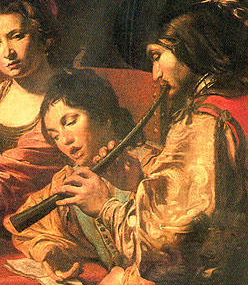
cornettplayer with singer
singer with cornetto player, anonymous, 16th century

2020 update: Since I wrote this in 2016, Vox Luminis released a wonderful recording of this cantata. They use a slide trumpet in the tenor aria, which is a beautiful middle between the Baroque trumpets of the Herreweghe, Cantus Cölln, and Gardiner recordings and the cornetto of the American Bach Soloists recording.

Find Vox Luminis’ recording of Cantata 12 on YouTube, on Amazon, or on iTunes.

Wieneke Gorter, April 16, 2016, updated April 27, 2020.

*The first cantata Bach wrote in Weimar was cantata 182 Himmelskönig, sei wilkommen for Palm Sunday.

A good shepherd, a violoncello piccolo da spalla, and a bit of St. Matthew Passion

09 Saturday Apr 2016

Posted by cantatasonmymind in After Easter, Cantatas, Leipzig

≈ Comments Off on A good shepherd, a violoncello piccolo da spalla, and a bit of St. Matthew Passion

Tags

2nd Sunday after Easter, Atsuko Ozaki, Bach, Bach Collegium Japan, BWV 42, BWV 6, BWV 85, cantatas, Caroyn Sampson, Dmitry Badiarov, Georg Poplutz, Gerd Türk, Gerlinde Säman, Harnoncourt, J.S. Bach Foundation, John Eliot Gardiner, Kurt Equiluz, Markus Volpert, Martin Zeller, Peter Kooij, Peter Kooy, Robin Blaze, Rudolf Lutz, St. Matthew Passion, Terry Wey, violoncello da spalla, violoncello piccolo

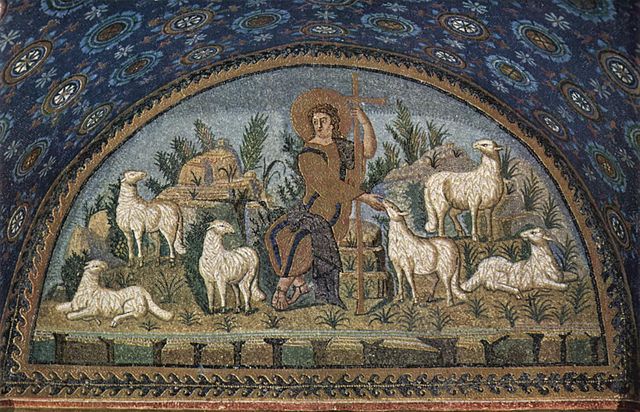
640px-meister_des_mausoleums_der_galla_placidia_in_ravenna_002
The Good Shepherd, mosaic in the Mausoleum of Galla Placidia, Ravenna, 1st half of the 5th century

There are three beautiful cantatas for this second Sunday after Easter, or “Misericordias Domini” Sunday: BWV 104, 85, and 112. Illustrating the “good shepherd” scripture for this Sunday (John 10, verse 12-16), Bach incorporated pastoral themes or orchestration in each of these cantatas.*

I’ve decided to focus on cantata 85 Ich bin ein guter Hirt, written for April 15, 1725. Of all three cantatas, this is the one I remember the best from my childhood, because of the  tenor aria “Seht, was die Liebe tut.” Also: Last week, I already mentioned the similarities between cantata 6 (for Easter Monday 1725), and cantata 42 (for the first Sunday after Easter 1725). This cantata 85 is the culmination of that “sub group” within the cantatas from 1725.

Which recording to listen to?

While I have good memories of hearing Kurth Equiluz sing the tenor aria on the Harnoncourt recording from 1977, I am enamored by Bach Collegium Japan’s recording of this cantata, and I think this is the best “overall” recording, featuring fabulous soloists Carolyn Sampson, Robin Blaze, Gerd Türk, and Peter Kooij. It is also one of the most noteworthy because of the use of a  violoncello da spalla, played by Dmitry Badiarov.

Listen to Bach Collegium Japan’s recording of cantata 85 Ich bin ein guter Hirt on Spotify. Or better yet, if you can afford to financially support the artists (especially important now, while they have no income from performances!) please consider purchasing the digital versions of Bach Collegium Japan’s recording of cantata 85 on Amazon or on iTunes.

If you prefer to watch a live recording, there is a wonderful recording available on YouTube by the J.S. Bach Foundation. Soloists are Gerlinde Sämann, soprano; Terry Wey, alto; Georg Poplutz, tenor; Markus Volpert, bass; and Martin Zeller, violoncello piccolo.

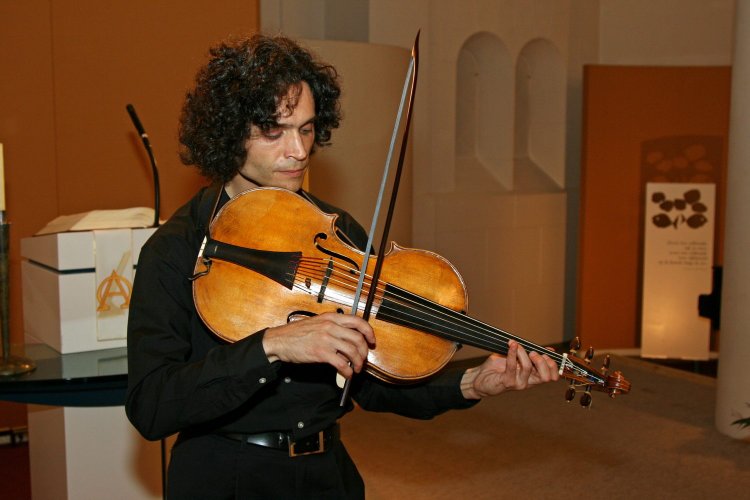
Back to the Bach Collegium Japan recording: After lovely and convincing singing by bass Peter Kooij in the opening arioso (Jesus saying “I am a good shepherd”), we get a sublime performance by countertenor Robin Blaze of the alto aria “Jesus ist ein guter Hirt,” which also features the unusual violoncello piccolo da spalla. Someone could probably write an entire PhD thesis on the difference between the  violoncello piccolo  “da spalla” (held on the shoulder, like a violin),  and the violoncello piccolo “da gamba”  (held between the legs,  like a cello), and whether Bach meant the one or the other when he wrote a part for “violoncello piccolo.”  Most recordings (Harnoncourt, Gardiner, Coin, Koopman, and J.S. Bach Foundation) feature the one held between the legs, but Bach Collegium Japan’s recording features the “da spalla” variety, played by the same person who built it in 2004, Dmitry Badiarov.

Badiarov-Dmitry-04
Dmitry Badiarov demonstrating the violoncello piccolo da spalla

Following this, we hear a radiant soprano solo chorale with oboe accompaniment (which makes me think back to the soprano solo chorale from cantata 6, in that case with the violoncello piccolo “da gamba”), beautifully sung by soprano Carolyn Sampson and expertly played by oboists Masamitsu San’nomiya and Atsuko Ozaki.

And when you didn’t think it could get any better, here comes a tenor recitative which in text and string accompaniment strongly refers to Jesus’ recitative from the St. Matthew Passion “Ich werde den Hirten schlagen, und die Schafe der Herde werden sich zerstreuen.” (Christ, having arrived at the Mount of Olives, reminds his disciples of the prophecy that the shepherd will be slain and the sheep will scatter).

With this only recitative in cantata 85, Bach has gotten everyone’s attention, so now we’re ready for the jewel in the crown of this cantata: the tenor aria “Seht, was die Liebe tut.” It is one of the most lyrical and lovely among all Bach’s tenor arias.

Seht, was die Liebe tut.
See, what love does.
Mein Jesus hält in guter Hut
My Jesus in his own safekeeping
Die Seinen feste eingeschlossen
keeps those who are his own firmly enclosed
Und hat am Kreuzesstamm vergossen
and on the beam of the cross he has shed
Für sie sein teures Blut.
for them his own precious blood.

Again there is a strong association with the St. Matthew Passion both in text and music. In his book Bach: Music in the Castle of Heaven Gardiner makes a very convincing case for his theory that Bach had wanted to perform the St. Matthew Passion on Good Friday 1725, only one year after the St. John Pasion. This didn’t happen because either the council disapproved, or Bach wasn’t ready composing the piece. If Bach had indeed been working on the St. Matthew Passion before Easter 1725, it is no wonder we’re getting glimpses of that monumental work in his cantatas after Easter 1725.

Wieneke Gorter, April 9, 2016, updated April 26, 2020

*I wrote about Cantata 104 for the Second Sunday after Easter in 1724 in this blog post.

R.I.P. Nikolaus Harnoncourt

06 Sunday Mar 2016

Posted by cantatasonmymind in Cantatas, Leipzig

≈ Comments Off on R.I.P. Nikolaus Harnoncourt

Tags

Bach, chorales, Concentus Musicus Wien, Harnoncourt, Kurt Equiluz, Robert Holl, St. John Passion

harnoncourt

Yesterday evening, Saturday March 5, 2016, conductor and cellist Nikolaus Harnoncourt left this world. He was an important part of the Sunday Bach cantata tradition my mother started in our family, and she was a great admirer of him. Even though my mother passed away more than five years ago, I feel she died a little more for me today, now that I know Harnoncourt is gone.

Sometime in the late 1980s, with my parents and my sister, I attended a performance of Bach’s Passion according to St. John which Harnoncourt directed in the Concertgebouw in Amsterdam. We had seats in the section behind the orchestra and choir, so that we could watch him communicate with the players and singers. I will never forget that. Afterwards, my mother–who was singing in a Bach choir herself at the time–said that it would mean the world to her if she could ever sing in a choir conducted by Harnoncourt. It never happened for her, but the combination of her saying this and me seeing Harnoncourt at work inspired me to join a Bach choir in my first year of college.

Even though Harnoncourt made an incredible amount of recordings (see his timeline for a list of all of them), there is nothing like seeing (an) excellent artist(s) live on stage. To see them work, interact, and to feel their energy is an experience you’ll never forget and which is worth so much more than earthly possessions. So if there is someone you admire but only know from recordings, go hear and see them live while they’re still alive! Make the effort. You will be glad you did.

Watch Harnoncourt conduct Bach’s Passion according to St. John on this video recorded in Graz, Austria, in 1985. It is a terrific example of the world class conductor he was. Don’t be put off by  the 30-year-old sound quality, especially noticeable in the oboes in the opening chorus. It is only that bad in the beginning, the rest of the recording is a feast for the ears and eyes, not in the least because of the excellent performance (and singing technique!) by Kurt Equiluz as evangelist.

Listening to the Passion according to St. John is also appropriate in the order of things on this blog, since Bach was working on this passion during Lent in 1724, and revising it in 1725. And this way, come Good Friday (March 25, 2016), I can perhaps talk about the other passion 🙂

Wieneke Gorter, Sunday March 6, 2016.

Dutch memories, Dutch discoveries

06 Saturday Feb 2016

Posted by cantatasonmymind in Cantatas, Leipzig, Septuagesima

≈ Comments Off on Dutch memories, Dutch discoveries

Tags

Bach, BWV 144, cantatas, English Baroque Soloists, J.S. Bach Foundation, John Eliot Gardiner, Miah Persson, Nuria Rial, Septuagesima, Wilke te Brummelstoete

Opnamedatum:  2012-04-06
Parabel of the Laborers in the Vineyard by Jan Luyken, print, 1703

A number of Dutch things converged for me when writing this post. Whenever I think about the parable of the Laborers in the Vineyard, the Bible story for this Septuagesima Sunday, or the third Sunday before Lent, I see the windows of my 3rd or 4th grade classroom.* I also have to think of my late grandfather reading this story from the Bible.  Quickly summarized, this story is: A landlord pays all his laborers equally, no matter how many hours they worked. Those that worked all day object.

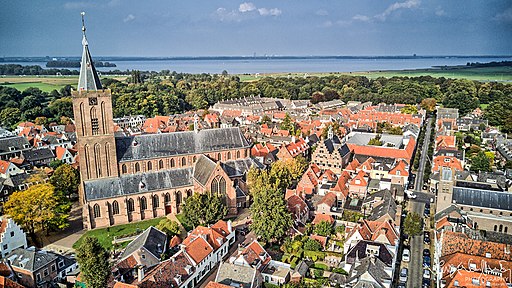
My favorite recording of cantata 144 Nimm, was dein ist, und gehe hin (first performed on Sunday February 6, 1724) turns out to have two connections to my home country: It was recorded in the Grote Kerk in Naarden, during the Bach Pilgrimage tour of Gardiner/English Baroque Soloists, and it features Dutch singer Wilke te Brummelstoete as alto soloist. Counter-tenor fan that I am, I can safely state that I will mention no more than a handful of female altos on this blog each year, so this is pretty special.

Naarden, The Netherlands

The icing on the cake is the illustration I discovered when searching for a good picture to go with this blog post: an etching by Haarlem artist Jan Luyken as published in the Amsterdam Mortierbijbel (Bible published by Pieter Mortier) in 1703, from the collection of the Rijksmuseum in Amsterdam.

Listen to John Eliot Gardiner’s recording of cantata 144 on Spotify

Listen to John Eliot Gardiner’s recording of cantata 144 on Youtube

Soloists: Miah Persson, soprano; Wilke te Brummelstroete, alto;
James Oxley, tenor; Jonathan Brown, bass.

As I’m updating this post on February 8, 2020, the J.S. Bach Foundation has just released their entire live video recording of this cantata, and that one is wonderful too, especially because Nuria Rial sings the soprano aria. Find that video here on YouTube. Soloists are Nuria Rial, soprano; Markus Forster, alto; Raphael Höhn, tenor.

Read the German text with English translation of cantata 144

Find the score of cantata 144 here

What to listen for in cantata 144 Nimm, was dein ist, und gehe hin:

In the opening chorus: the illustration of the text gehe hin, gehe hin! (off you go!) with ascending figures, each gehe hin “retaken” so that the text really leaps off the page, more on the Gardiner recording than on other ones. Also listen how beautifully the sopranos and violins enhance each other’s sound in this movement. That happens too on the J.S. Bach Foundation recording.

In the alto aria:  The illustration of the grumbling workers by the repeated 8th-notes in the strings. The music on the text “Murre nicht” (Don’t grumble) is always low, the music with the text “Lieber Christ” (please note that this means “dear Christian,” not “dear Christ”) always goes up. Very well done in an appropriate style by Wilke te Brummelstoete on the Gardiner recording.

In the soprano aria: the glorification of the “Genügsamkeit” (being satisfied with what you have, a concept that must have been very important to Bach), and the wonderful voice of soprano Miah Persson on the Gardiner recording or the always radiant Nuria Rial on the J.S. Bach Foundation recording. Read more about Miah Persson in my blog post about cantata 179 and those about cantatas 186 and 186a. Read more about Nuria Rial in my posts about Cantata 36 and Cantata 89.

Thank you for reading! Please leave your email address in the “follow this blog” section on the left side of this blog post. You will receive an email by WordPress whenever I have posted a new story. Please note that the choice of words and spelling in their confirmation email is by WordPress, not me. My apologies for that, and many thanks to you for your patience while I work on a more elegant solution!

To support this blog, please consider purchasing Gardiner’s album featuring cantata 144 on Amazon. I receive a small percentage of every sale made through this link. And it would be so fun if someone would actually buy a CD through this link. So far (February 13, 2020), it hasn’t happened 😉 Thank you!

Wieneke Gorter, February 6, 2016, updated January 27, 2024.

*Though a protestant school, it was pretty moderate in its teachings, and I don’t really remember Bible reading in the classroom. However, we learned a hymn every week and the reason I have to think of the classroom when reading this parable probably has to do with the hymn “De eersten zijn de laatsten” (The first will be the last) which is based on this same story.

To the Opera!

31 Sunday Jan 2016

Posted by cantatasonmymind in Cantatas, Epiphany, Leipzig

≈ Comments Off on To the Opera!

Tags

Bach, Bach and opera, Bach Collegium Japan, cantatas, Harnoncourt, John Eliot Gardiner, Kurt Equiluz, Paul Agnew, Paul Esswood, Peter Kooy, Robin Blaze, Ruud van der Meer

Rembrandt_Christ_in_the_Storm_on_the_Lake_of_Galilee
The Storm on the Sea of Galilee by Rembrandt van Rijn, 1633. Formerly at the Isabella Stuart Gardner Museum, Boston, USA. Stolen in 1990.

Cantata 81 Jesus schläft, was soll ich hoffen? from 1724 closely follows the reading for the 4th Sunday after Epiphany: the story of Jesus calming the storm on the sea of Galilee.

In combining masterful text illustration with his theology, Bach presents a powerful drama rivaling a Handel opera. And I was lucky to find two conductors especially not shy of the opera-element in this cantata: Harnoncourt and Gardiner. The recording from 1978 directed by Harnoncourt has a great sense of drama as well as good singing in all the movements. For me it is the most “overall” satisfying recording of this cantata. It was not an easy decision though this week, and the fact that I grew up with the Harnoncourt recording might of course have influenced my choice. Soloists: Paul Esswood, counter-tenor; Kurt Equiluz, tenor; Ruud van der Meer, bass.

Listen to Harnoncourt’s recording of cantata 81 on Spotify

Listen to Harnoncourt’s recording of cantata 81 on YouTube

Read the full German text with English translation of cantata 81

Find the score of cantata 81 here

If you have time to listen some more: The absolute best rendition of the spectacular tenor aria in my opinion appears on the Gardiner recording, with very convincing “waves” in the orchestra (at an even higher tempo than Harnoncourt) and truly marvelous singing by Paul Agnew. Listen to this aria on Spotify.

What to keep in mind when listening:

The reading for this 4th Sunday after Epiphany, from Matthew 8:

23. Und er trat in das Schiff, und seine Jünger folgeten ihm.

[23] And when he entered into a ship, his disciples followed him.

24. Und siehe, da erhub sich ein groß Ungestüm im Meer, also daß auch das Schifflein mit Wellen bedeckt ward; und er schlief.

[24] And, behold, there arose a great tempest in the sea, insomuch that the ship was covered with the waves: but he was asleep.

25. Und die Jünger traten zu ihm und weckten ihn auf und sprachen: HERR, hilf uns, wir verderben!

[25] And his disciples came to him, and awoke him, saying, Lord, save us: we perish.

26. Da sagte er zu ihnen: Ihr Kleingläubigen, warum seid ihr so furchtsam? Und stund auf und bedräuete den Wind und das Meer; da ward es ganz stille.

[26] And he saith unto them, Why are ye fearful, O ye of little faith? Then he arose, and rebuked the winds and the sea; and there was a great calm.

27. Die Menschen aber verwunderten sich und sprachen: Was ist das für ein Mann, daß ihm Wind und Meer gehorsam ist?

[27] But the men marvelled, saying, What manner of man is this, that even the winds and the sea obey him!

In Western Europe at Bach’s time, there was probably no insight yet that the “sea” in this bible story was actually a large sweet-water lake. Bach’s Lutheran bible talked of a sea, not a lake, and most paintings from the 16th and 17th centuries depict seagulls, cliffs, or port cities in the distance. Of course a storm can also develop on a large lake, but we have to assume that Bach and his librettist had a full-blown storm at sea in mind when writing this. Bach probably never witnessed one, but Gardiner says that one of the theologian books in Bach’s library featured a vivid commentary on this part of the gospel. That book’s author, Heinrich Müller, lived in Rostock, on the Baltic sea. And who knows what interpretations of a “tempesta di mare” by other composers Bach had heard at the opera in Hamburg or seen on copied music which traveling colleagues and students might have brought with them.

Already in the opening aria Bach combines opera with theology. The recorders illustrate the “sleeping” Jesus, but also the loneliness of a life without Jesus/without faith (Bach uses recorders for this purpose more often, for example in the O Schmerz tenor-aria from the St. Matthew Passion (when for a moment Jesus feels he has lost faith), as well as in the Sanfte soll mein Todeskummer tenor-aria from the Easter Oratorio). There is also some hint in the orchestra of the calm before the storm, underlining the anxiety of the question “Was soll ich hoffen?”

The big storm at sea manifests in the tenor aria, equal to a “rage” aria by Handel, with the orchestra and the singer imitating the rolling waves and wind.

Then enters Jesus in the bass arioso, asking his disciples, but also the believers in general, why they didn’t have faith. Dürr remarks that the music is like an “Invention” and is practically a bass duet, with the other “singer” being the continuo. This is also a pivotal point in the cantata, moving from the part without Jesus/faith (nos 1-3) to the part with Jesus/faith.

Another “storm aria” follows, sung by the bass, but this time the storm is somewhat quieting down, and the oboe lines paint a quieter mood. All this to illustrate that Jesus is calming the storm. The alto recitative states/confirms that Jesus has calmed the storm, and is with us, and the chorale (second verse of the beautiful Jesu meine Freude) is the final affirmation:

Unter deinen Schirmen
Beneath your protection
Bin ich für den Stürmen
I am free from storms
Aller Feinde frei.
and all enemies.
Laß den Satan wittern,
Let Satan sniff around,
Laß den Feind erbittern,
let the enemy be exasperated
Mir steht Jesus bei.
Jesus stands by me.
Ob es itzt gleich kracht und blitzt,
Though there is thunder and lightning,
Ob gleich Sünd und Hölle schrecken,
though sin and hell terrify,
Jesus will mich decken.
Jesus will protect me.

Thank you for reading! Please leave your email address in the “follow this blog” section on the left side of this blog post. You will receive an email by WordPress whenever I have posted a new story. Please note that the choice of words and spelling in their confirmation email is by WordPress, not me. My apologies for that, and many thanks to you for your patience while I work on a more elegant solution!

Wieneke Gorter, January 31, 2016, links updated February 2, 2020

← Older posts
Newer posts →

Recent Posts

  • Three Listening Guides – First Sunday of Advent
  • The End of Times and Christmas Combined – Cantata 116 for Trinity 25
  • From the Archives, with a New Recording – Cantatas 60 and 26 for Trinity 24
  • A Controversy and a Coin Collection – Cantata 163 for Trinity 23
  • Giving the Choir a Breather? – Cantata 89 for Trinity 22

Archives

  • November 2026
  • October 2026
  • September 2026
  • August 2026
  • August 2025
  • July 2025
  • December 2024
  • November 2024
  • June 2024
  • January 2024
  • December 2023
  • October 2023
  • September 2023
  • August 2023
  • April 2022
  • February 2022
  • January 2022
  • December 2021
  • November 2021
  • June 2021
  • May 2021
  • April 2021
  • February 2021
  • January 2021
  • December 2020
  • November 2020
  • October 2020
  • September 2020
  • August 2020
  • July 2020
  • May 2020
  • April 2020
  • March 2020
  • February 2020
  • January 2020
  • December 2019
  • November 2019
  • May 2018
  • April 2018
  • March 2018
  • February 2018
  • January 2018
  • December 2017
  • November 2017
  • October 2017
  • September 2017
  • August 2017
  • July 2017
  • June 2017
  • May 2017
  • April 2017
  • March 2017
  • February 2017
  • January 2017
  • December 2016
  • November 2016
  • October 2016
  • September 2016
  • August 2016
  • July 2016
  • June 2016
  • May 2016
  • April 2016
  • March 2016
  • February 2016
  • January 2016

Enter your email address to follow this blog and receive notifications of new posts by email.

Join 338 other subscribers

Categories

  • 1723 Trinity season special series
  • Advent
  • After Easter
  • Ascension
  • Bach's life
  • Cantatas
  • Chorale cantatas 1724/1725
  • Christmas
  • Easter
  • Epiphany
  • Following Bach in 1725
  • Köthen
  • Leipzig
  • Leipzig 1726/1727
  • Septuagesima
  • Travel
  • Trinity
  • Weimar

Meta

  • Create account
  • Log in
  • Entries feed
  • Comments feed
  • WordPress.com

Website Built with WordPress.com.

  • Subscribe Subscribed
    Weekly Cantata
    Join 158 other subscribers

    Have a WordPress.com account? Log in now.

  • Weekly Cantata
    View site in Reader
    Manage subscriptionsSign upLog in
    Report this content
    Collapse this bar
Loading Comments...