Church interior with the parable of the Pharisee and the Publican by Dutch painters Dirck van Delen (church interior) and Cornelis van Poelenburch (figures), 1653. Oil on panel. The Clark Art Institute, Williamstown, MA, USA, currently not on view.
The reading for this Sunday, the 11th after Trinity, is the parable of the Pharisee and the Publican (or Tax Collector) from the Gospel of Luke. In the parable, these two men come into the temple to pray around the same time, but talk to God in very different ways. While the Pharisee puts on a fake show about how good he is, the tax collector is very humble, “wouldn’t even lift up his eyes to heaven” and asks for forgiveness.
“There’s something with this Sunday,” I wrote three years ago, and I still feel that way when I listen to the cantatas Bach wrote for this Sunday in 1723 and 1724.
In 1723, his first year in Leipzig, Bach performed two cantatas on this Sunday: Cantata 179 Siehe zu, daß deine Gottesfurcht kein Heuchelei sei(See that your fear of God is not hypocrisy) before the sermon, and his solo cantata for soprano Cantata 199 Mein Herze schwimmt in Blut (from his early years in Weimar) afterwards. Cantata 199 is only loosely related to the Gospel story, and was probably never written with this story in mind. Because of its multi-layered history and the many different recordings, I will discuss that composition some other time.
Cantata 179 focuses on the hypocrisy of the Pharisee, and just like cantatas 46 and 102 I discussed last week, it must have been one of Bach’s own favorites, because he re-used three movements in later works. Read all about it in my post from 2016, which I have updated with better images and new video links.
In 1724, Bach wrote cantata 113 Herr Jesu Christ, du höchstes Gut, which, surprise, surprise, focuses on the Publican asking for mercy. The only recording that does this cantata justice and gives me the good kind of stomachache is the one by Bach Collegium Japan. Peter Kooij’s and Robin Blaze’s singing is outstanding, and Yukari Nonoshita and Robin Blaze make the duet into a lovely piece of music, which is–judging from a lot of other recordings–not an easy thing to do. I updated my blog post from 2017 with all the correct links to stream or purchase this recording. Please find it here.
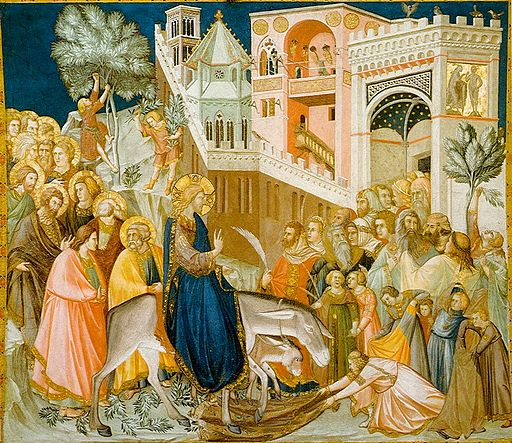
Jesus Entrance into Jerusalem. First picture is Lorenzetti’s version, in the Basilica of Assisi, 1320. Second picture is Giotto’s version from 1305, in the Capella Scrovengni in Padua, third is Duccio’s, created between 1308 and 1311, as part of an altar piece, currently in the Museo dell’Opera Metropolitana del Duomo in Siena. The first two are frescoes, the last one is tempera on wood.
We’re on Day 20 of “shelter in place” here in the San Francisco Bay Area. We’re counting our blessings, trying to figure out how we can be most helpful to others while also taking good care of ourselves, and trying to wean ourselves off spending too much time on social media. I definitely need my “church” of regular check-ins with family and friends, daily mindfulness exercises, and lots of yoga classes to stay sane through all of this.
Back to Bach’s church. Today is Palm Sunday! Bach never officially wrote a cantata for this Sunday, since no music was to be performed in the churches during Lent. However, in 1714, Palm Sunday fell on the same day as the feast of the Annunciation of Mary, March 25. This way, while specifying “for the feast of the Annunciation of Mary” on the title page of the cantata manuscript, Bach could still write music for Palm Sunday with cantata 182 Himmelskönig, sei wilkommen! (Welcome, King of Heaven!)
If you’re not in the mood for a long story and would just like to listen to a short piece of calming music, I recommend the live performance of the opening sinfonia of this cantata on the YouTube channel of Voices of Music, with two fabulous soloists: Hanneke van Proosdij on recorder and Rachel Podger on violin. You can find that video here.
Many of Bach’s Weimar cantatas start with an elaborate instrumental ouverture or sinfonia.* There are two possible reasons for this. First of all, it was in Weimar that Bach studied lots of French and Italian compositions, and he might have wanted to “show off” that he could also write such a fashionable ouverture. But there might have also been a more practical reason: such an opening movement was the perfect piece of music during which the Duke and his entourage would slowly walk into the chapel and take their seats, and not miss anything of the cantata itself.
For the entire cantata, my all-time favorite still is the recording by Montreal Baroque. Listen here on Spotify, or here on YouTube. Their one-on-a-part performance is similar to how this would have sounded from the small organ loft in Weimar, and features fabulous singing all around (soprano Monika Mauch, countertenor Matthew White, tenor Charles Daniels, bass Harry van der Kamp).
Find the text of cantata 182 here, and the score here.
If you would like to learn more about Bach’s time in Weimar, please visit my post about Bach in Weimar I wrote in 2016. I’ve just updated it with some new photos, including a picture of the organ loft, and it has all the same links for the recording, text, and score as mentioned here.
In Leipzig in 1724, Bach performed this cantata again, on the feast of the Annunciation of Mary, which that year fell eight days before Palm Sunday.
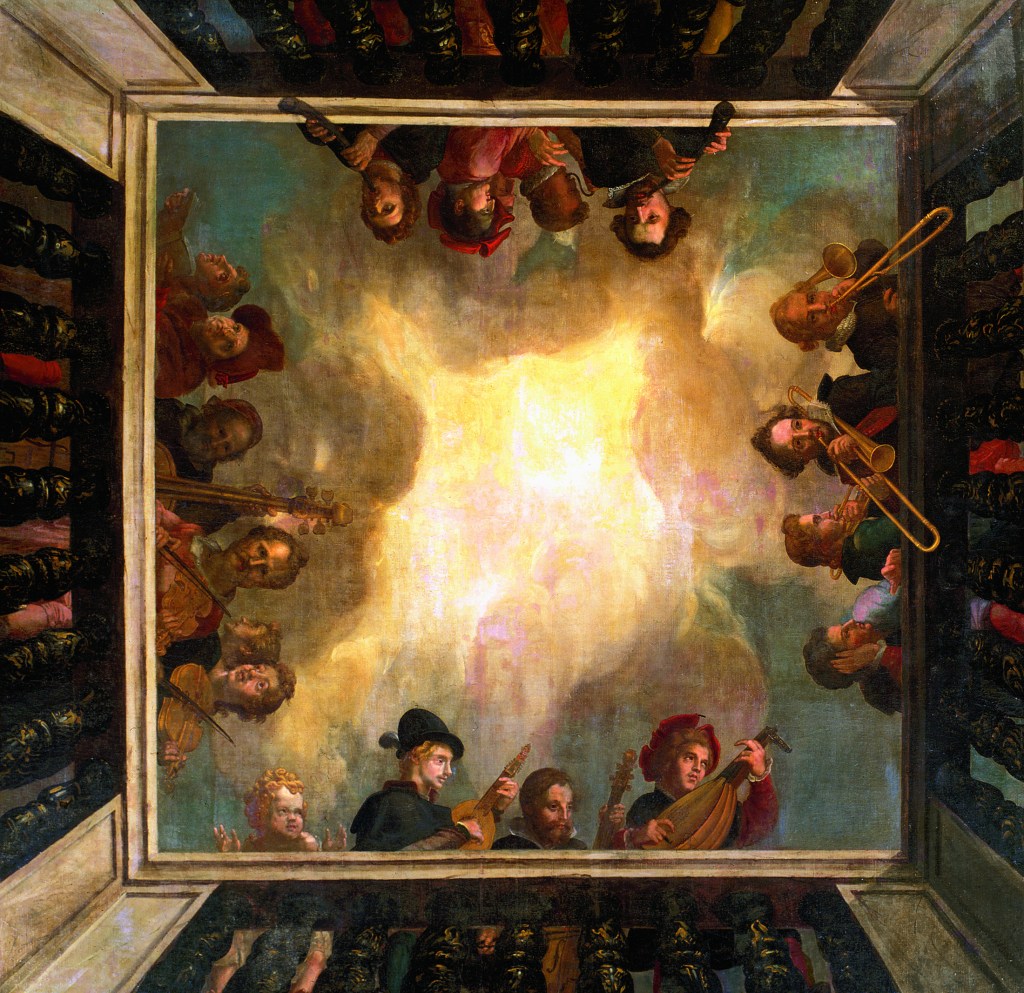
Ceiling painting installed around 1700 in Christian V’s Hall in Rosenborg Castle, Denmark. Possibly by Reinhold Timm, ca. 1620, originally for for a music pavilion in Kongens Have. *
Yesterday, Wednesday March 25, 2020, the J.S. Bach Foundation published their live video recording of Cantata 2 Ach Gott, vom Himmel sieh darein (Please God, look down from Heaven) on their YouTube channel. I thought it might be nice to provide a listening guide to go with this performance.
I love this cantata because it has trombones in the orchestra, doubling the choir parts, and because the altos have the cantus firmus (=they sing the chorale melody in long notes) in the opening chorus, which sounds incredibly good, and is unique within Bach’s writing.
Find the video recording by the J.S. Bach Foundation here on YouTube. Soloists are Alex Potter, alto; Georg Poplutz, tenor; and Markus Volpert, bass.
Find the German texts with English translations here, and the full score here.
This cantata was the second in Bach’s 1724 series of Chorale Cantatas. He most probably intended for the first four cantatas in that series to form a set, or at least to present some kind of order, if you look at the composition form of the opening movement, and which voice has the cantus firmus of the chorale tune in that chorus:
Cantata 20 O Ewigkeit, du Donnerwort: French Overture, with cantus firmus in the soprano (find my blog post about this cantata here)
Cantata 2 Ach Gott, vom Himmel sieh darein: Chorale motet, cantus firmus in alto (the cantata discussed here)
Cantata 7 Christ unser Herr zum Jordan kam: Italian concerto, cantus firmus in tenor. (find my blog post about this cantata here)
Cantata 135 : Ach Herr, mich armen Sünder: Chorale fantasia, cantus firmus in bass. (find my blog post about this cantata here)
We know that Bach liked to use order and symmetry when he wanted to impress other people with a composition. But perhaps he was also thinking of his legacy. When he started composing cantatas at the Weimar court in 1714, albeit on a monthly instead of weekly basis, his first four cantatas formed a similar portfolio of composition styles in the opening choral movements:
Back to this Cantata 2 Ach Gott, vom Himmel sieh darein (Please God, look down from Heaven), and what to listen for.
Opening chorus:
The chorale, based on Psalm 12, is by Luther. For an idea what Luther’s original song would have sounded like, you can watch this video. For readers who understand German: Eduard van Hengel’s website (in Dutch) has a very insightful overview of the original German text of Psalm 12, the text of Luther’s chorale, and how Bach’s librettist changed that into the text for the cantata. You can find it here.
When Bach uses a chorale by Luther in a cantata, he often demonstrates his reverence for the father of his faith by using the archaic form of chorale motet as opening chorus combined with the equally archaic trombone quartet (1 cornetto and 3 trombones) to double the choir parts.**
Giving the cantus firmus to the altos is however not something Bach does very often. If only he had! In this case it is especially wonderfully orchestrated, with doubling by one trombone, two oboes, and all second violins. Both on this video recording by the J.S. Bach Foundation as well on the Herreweghe audio recording I recommended back in 2017, Alex Potter’s voice significantly enhances this winning blend of alto voices and instruments, and on this J.S. Bach Foundation video recording he also sings the beautiful alto aria. It definitely made my day yesterday.
Alto aria:
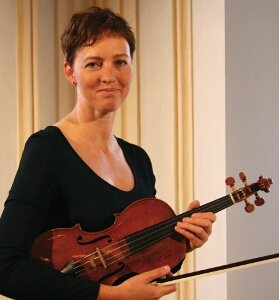
Bach alto and tenor arias are at their prettiest, I find, when they are written as a trio sonata, and the alto ariaTilg, o Gott in this cantata is a beautiful example of that. Wonderful singing and playing by alto Alex Potter and violinist Renate Steinmann. The aria is a plea for help in fighting the “Rottengeister,” or the sectarians amidst the Lutherans. When the alto starts singing the word “Rottengeistern,” we realize we had heard this word already many times in the triplets of the violin part. As Eduard van Hengel says, it is the “popular easy talk of the sectarians, and that is also the reason why the other two parts don’t have this motive” [to further illustrate the schism].
Renate Steinmann, violin and Alex Potter, alto. Photo of Alex Potter by Annelies van der Vegt.
Bass recitative:
Definitely keep the text & translations handy for this one, because this movement contains a wealth of text illustrations in the music. On the word Armen (the poor) sounds a sorrowful diminished seventh, the word seufzend (sighing) has a rest/sigh in the middle of the word, and more such things happening on the words Ach (sighing) and Klagen (complaining). In contrast to this, a few lines later, the chord on the word Gott (God) sounds open and liberating, after which God himself gets to speak, and the music turns to an arioso (similarly to how Bach does that in his much earlier Cantata 18 when God speaks). At the word heller Sonnenschein (bright sunshine) the light gets turned on in the music too: the harmony changes to C Major.
Tenor aria:
Here we have arrived at the solution/salvation part of the cantata, and so this music is more pleasant, easier to listen to. But Bach is still preaching: there are some crossing (!) lines in the music, and in the middle section, which tells the listeners to be patient (sei geduldig) and Bach stresses the words Kreuz und Not.
With many thanks to Eduard van Hengel and Rudolf Lutz for their explanations of this cantata,
Wieneke Gorter, March 26, 2020.
*more information about this painting and the other objects in Christian V’s Hall in Rosenborg Castle can be found here.
**The best examples of this are cantatas 2, 25, 38, and 121.
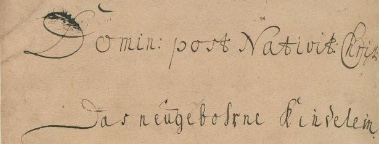
Cantata 122 for the Sunday after Christmas Das neugeborne Kindelein. Part of the title page of the manuscript. The handwriting is by J.A. Kuhnau, one of Bach’s most important copyists.
Since I most recently wrote about Bach’s cantatas for Christmas Day (Cantata 110), and the Third Day of Christmas (Cantata 151) from 1725, I had thought it would be nice to write about the two cantatas Bach performed directly after that: Cantata 28 for the Sunday after Christmas 1725, and Cantata 16 for New Year’s Day 1726.
But I don’t like them. I was listening to them yesterday and today together with my adolescent daughter, who’s pretty well versed in Baroque composers, and she said: “the first one doesn’t even sound like Bach!” I agree with her. Or at least it doesn’t sound that inspired to me. I hope this doesn’t come as a shock to you, but sometimes I don’t like what Bach wrote.
So, for this Sunday after Christmas in 2019, I’m again playing Cantata 122 Das neugeborne Kindelein, which I’ve already discussed twice on this blog, most elaborately in 2017. You can find that post here.
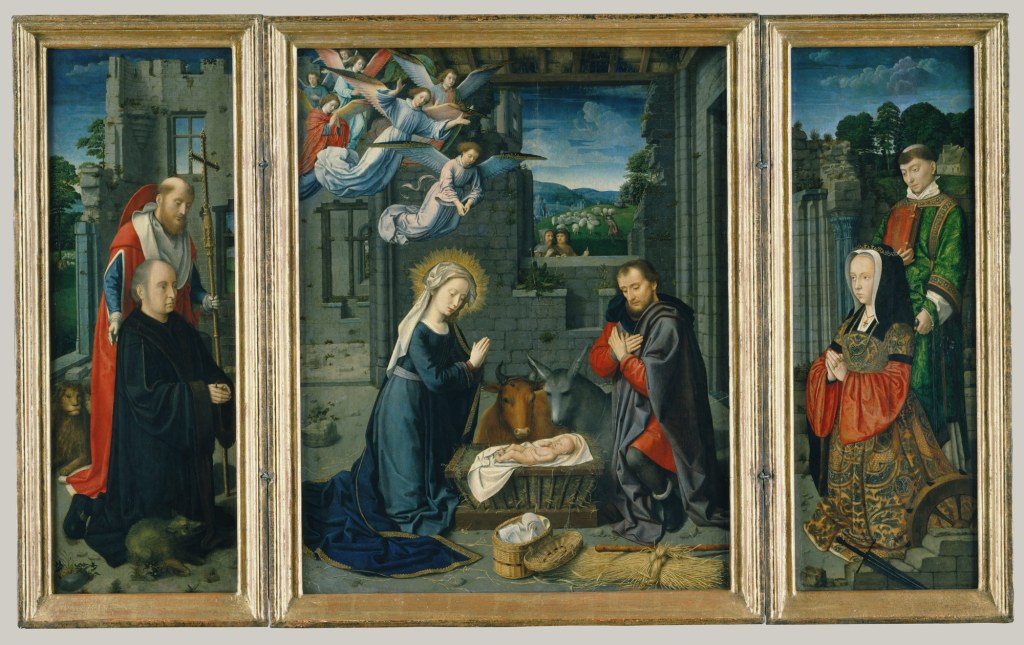
The Nativity with Donors and Saints Jerome and Leonard, by Gerard David, ca. 1510-15. Metropolitan Museum of Art, New York. More information about this painting can be found here.
On this blog I have shared only two of Bach’s compositions for Christmas Day so far: Cantata 91 from 1724 here, and of course the first cantata from the Christmas Oratorio (our family’s “wake-up call” on Christmas morning) from 1734 here. But Bach wrote at least three more cantatas for this day, as well as his Magnificat.
Today I’d love to share Cantata 110 Unser Mund sei voll Lachens (May our mouth be full of laughter) from 1725. Find The Netherlands Bach Society’s live recording of this cantata here on YouTube.
Find the text with English translations here, and the score here.
This live video registration has an abundance of Christmas presents for me: the festive setting of the Grote Kerk in Naarden; soprano Maria Keohane in a Scandinavian Christmas dress and truly enjoying herself; tenor Charles Daniels, always a delight; a promising new young bass, Matthias Winckhler, who can actually sing every note of the enormously challenging bass aria in this cantata; and the best gift of all: Alex Potter singing the alto aria, which to me is the most moving part of this cantata, and also the core message Bach wanted to communicate to his fellow believers on this Christmas Day in 1725.
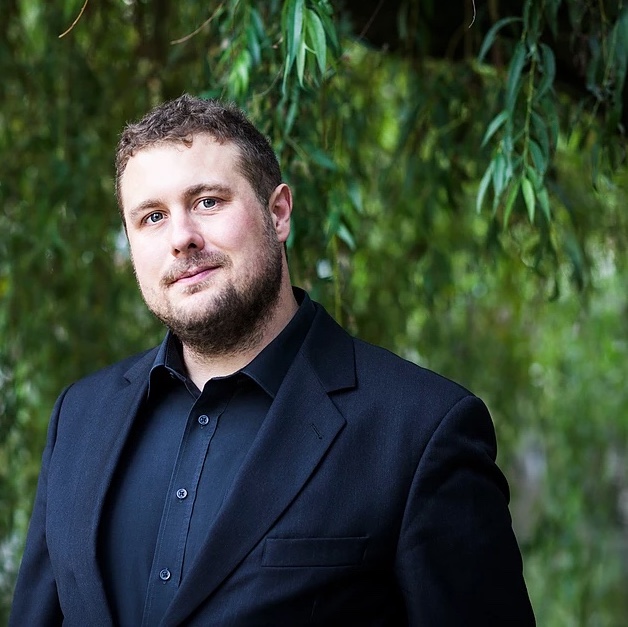
Alex Potter. Photo by Annelies van der Vegt.
For the joyous opening of this cantata, Bach re-uses his Orchestral Suite no. 4 in D major (BWV 1069) to grandly illustrate the “arrival” of Jesus. In the center of the cantata, after the festivities of the opening chorus, but before the very pretty Christmas-y “Glory to God in the highest” soprano-tenor duet, and an impressive bass aria with trumpet, the music goes into a minor key, and also turns inward, in the alto aria. The text of that alto aria is as follows:
Ach Herr, was ist ein Menschenkind, Ah, Lord, what is a child of man Dass du sein Heil so schmerzlich suchest? that you should seek his salvation with so much pain? Ein Wurm, den du verfluchest, A worm whom you curse Wenn Höll und Satan um ihn sind; when hell and Satan are around him; Doch auch dein Sohn, den Seel und Geist but also your son, whom soul and spirit Aus Liebe seinen Erben heißt. Through love call their inheritance.
Of course this text refers to the believers in general, that on the one hand they are worms, and on the other hand will be saved by Jesus. but I feel the choice of the word “Menschenkind” is not a coincidence. It definitely also refers to the the fact that Jesus can’t just stay in the godly realm, but in order to be a true savior, he has to come to earth, become man, and go through all the rotten reality that might imply. This theme appears more or less prominently in all Bach’s cantatas for Christmas Day, and in this cantata 110 it is already announced in the tenor aria:
Er wird Mensch, und dies allein, He has become man, and this only Dass wir Himmels Kinder sein. so that we may become children of heaven.
Nine years later, in the first cantata of his Christmas Oratorio, Bach also stresses this “coming to earth” and “becoming man” of Jesus on this first Christmas Day, in what is also the most moving and inward-looking part of that particular cantata: the soprano-bass duet. The text Bach gives to the bass in that duet is as follows. Note the last line.
Wer will die Liebe recht erhöhn, Who will rightly extol the love Die unser Heiland vor uns hegt? that our Saviour cherishes for us? Ja, wer vermag es einzusehen, Indeed, who is able to realise Wie ihn der Menschen Leid bewegt? how he is moved by human suffering? Des Höchsten Sohn kömmt in die Welt, The highest’s son came into the world Weil ihm ihr Heil so wohl gefällt, because its salvation pleases him so well So will er selbst als Mensch geboren werden. that he himself is willing to be born as a man.
For the fourth Sunday of Advent, Bach wrote two cantatas in Weimar: Cantata 132 Bereitet die Wege, bereitet die Bahn in 1715, and Cantata 147a Herz und Mund und Tat und Leben in 1716.
Bach rewrote Cantata 147, the same way he did that with cantatas 70 and 186, into a cantata for another time of the year in Leipzig, in this case the feast of the Visitation on July 2, 1723. Read more about that here in my post from 2016. I have now updated that post with a link to the wonderful live performance of Cantata 147 by the J.S. Bach Foundation, with with Hana Blažiková, soprano; Margot Oitzinger, alto; Jakob Pilgram, tenor; and Wolf Matthias Friedrich, bass.
Cantata 132 was not transformed into a cantata for another time in the church year in Leipzig, so today’s performances of this cantata still reflect the Advent cantata from Weimar. Watch a beautiful live performance of this cantata by the Netherlands Bach Society here on YouTube. Soloists are Julia Doyle, soprano; Tim Mead, alto; Jan Kobow, tenor; and Dominik Wörner, bass.
Find the German text with English translations here, and the score here.
As I already pointed out in my Advent Calendar earlier this week, the text of the joyful opening aria refers to the story of John the Baptist, who was believed to have come to prepare the way for Jesus, and includes the Isaiah quote as it appears in the scripture: “Messias kömmt an!” (The Messiah is coming). Bach gives this text to the soprano three times, and to give it extra emphasis, each time omits all instrumental accompaniment on those three words.
The rest of the cantata stays close to the story of John the Baptist. The bass aria refers to the Pharisees interrogating John, but then Bach’s text writer (Salomo Franck, who was also the Weimar court librarian) projects the question “Wer bist du?” (Who are you?) onto the believer: ask your conscience: are you a true person or a false person?
As a child, I was enormously impressed by this bass aria, even more than by the wonderful soprano aria at the beginning of the piece. I loved how Max van Egmond sings the “Wer bist du?” text on the Leonhardt recording from 1983. You can find that recording, and read more about those childhood memories, in this blog post from 2016. I had no idea at the time that in those very cool opening notes Bach is quoting this organ piece by Buxtehude. I only learned that this week, by watching the “extra videos” the Netherlands Bach Society provides along with their live recordings on All of Bach.
If you are not following this blog yet, please consider signing up (on the left of this text if you are on a desktop computer, at the bottom of this post when you are reading on a smartphone). This way you won’t miss any posts about the many cantatas Bach wrote for all three Christmas Days (yes there were three in his time), New Year’s Day, and the Sundays after those feast days.
To find the Weekly Cantata Advent Calendar, please click here.
As I mentioned last week, when Bach worked in Weimar, he wrote a cantata for each of the 4 Sundays in Advent. For Sunday December 13, 1716, the third Sunday of Advent, he wrote the one listed in the BWV catalog as Cantata 186a, Ärgre dich, o Seele, nicht. No original music score is left of this cantata. However, thanks to Bach’s librettist, Weimar court poet Salomo Franck, who published the full libretto for this cantata in a poetry volume in 1717, we do have the original text of 186a.
And, it is not hard to make an educated guess as to what the music would have been. Read all about it in my blog post from 2016 and 2017.
To listen to a beautiful soprano/alto duet that appeared for sure in the Weimar and the Leipzig versions of this cantata, click here. Katharine Fuge, soprano, and Richard Wyn Roberts, alto, with the English Baroque Soloists, John Eliot Gardiner (Live recording. Ansbach, 2000).
Wieneke Gorter, December 11, 2019.
To find the Weekly Cantata Advent Calendar, please click here.
When Bach worked in Weimar, he wrote a cantata for each of the 4 Sundays in Advent. However in Leipzig, music (other than chorale singing) was not allowed in the churches in the period between the first Sunday of Advent and Christmas Day. In order to still use (and show off?) the Weimar Advent cantatas in Leipzig he reworked and expanded most of them for other times of the church year in Leipzig.
He truly mastered this rewriting process with cantata 70, Wachet! betet! betet! wachet!, originally written for 2nd Advent in Weimar in 1716, but now dramatically expanded for the 26th Sunday after Trinity, November 21, 1723.
Read much more about the reworking process and about this particular cantata in this Weekly Cantata post from 2016, which now includes a new link to the excellent live video performance by the J.S. Bach Foundation.
I created an Advent Calendar for you, so you can easily find my posts about Bach’s Advent cantatas, enjoy some more videos that have come out since I originally wrote these posts, and get recommendations for Christmas gifts.
The three Marys at the Empty Tomb by Jan van Eyck or Hubert van Eyck, ca. 1425-1435. Museum Boijmans-Van Beuningen, Rotterdam, The Netherlands.
I’m in movie script mode again today. While I don’t know this for sure at all, I think that early in 1725, Bach had probably already decided to not to let things get as crazy as the previous year (in 1724) around Easter. That year, he had seriously run out of time, and had to adjust many of his plans. Gardiner thinks this happened because the writing, rehearsing, and performing of his Passion according to St. John had taken Bach much more time than he thought, and had forced him to make several shortcuts in the weeks ahead. Read more about all this in my post about Easter 1724 and subsequent posts.
So I imagine that this year, in 1725, Bach must have been planning ahead. Without any more “old” Easter cantatas in his portfolio, he had to have something else ready for the choir and orchestra to rehearse alongside the Passion for Good Friday, whatever that Passion was going to be.
So when the friendly Duke Christian von Sachsen-Weissenfels asked for some Tafelmusik to be performed for his 44th birthday on February 23, 1725, Bach might very well have thought from the beginning: perfect, that music can double as an Oratorio for Easter Sunday.
Listen to Herreweghe’s recording of the Easter Oratorio here on YouTube. Soloists are Barbara Schlick, soprano; Kai Wessel, alto; James Taylor, tenor; and Peter Kooy, bass.
The Tafelmusik for Duke Christian became Entfliehet, verschwindet, entweichet, ihr Sorgen, also known as Schäferkantate, BWV 249a. When recycling this into the Easter Oratorio, Kommt, eilet und laufet BWV 249, Bach kept the cheerful opening sinfonia and the exquisite, plaintive adagio, two instrumental movements that were probably originally from a concerto he wrote in Köthen. He also kept the music of the opening and closing chorus, and of all the arias, only changing the text.
Here you can see how little he did change the text in this table, courtesy of Eduard van Hengel:
Schäferkantate (BWV 249a, 23/2/25)
Oster-oratorium (BWV 249, 1/4/1725)
3.
Entfliehet, verschwindet, entweichet, ihr Sorgen
verwirret die lustigen Regungen nicht!
Lachen und Scherzen
erfüllet die Herzen
die Freude malet das Gesicht.
5. Hunderttausend Schmeicheleien
wallen jetzt in meiner Brust.
Und die Lust
so die Zärtlichkeiten zeigen,
kann die Zunge nicht verschweigen.
7. Wieget euch, ihr satten Schafe,
in dem Schlafe
unterdessen selber ein!
Dort in jenen tiefen Gründen,
wo schon junge Rasen sein,
werden/wollen wir euch wieder finden.
9. Komm doch, Flora, komm geschwinde,
hauche mit dem Westenwinde
unsre Felder lieblich an!
Daß ein treuer Untertan
seinem milden Christian
Pflicht und Schuld bezahlen kann.
11. Glück und Heil
bleibe dein beständig Teil!
Großer Herzog, dein Vergnügen
müsse wie die Palmen stehn,
die sich niemals niederbiegen,
sondern bis zum Wolken gehn!
So werden sich künftig
bei stetem Gedeihen
die deinen mit Lachen
und Scherzen erfreuen.
Kommt, eilet und laufet, ihr flüchtigen Füße,
Erreichet die Höhle, die Jesum bedeckt!
Lachen und Scherzen
Begleitet die Herzen,
Denn unser Heil ist auferweckt.
Seele, deine Spezereien
Sollen nicht mehr Myrrhen sein.
Denn allein
Mit dem Lorbeerkranze prangen,
Stillt dein ängstliches Verlangen.
Sanfte soll mein Todeskummer,
Nur ein Schlummer,
Jesu, durch dein Schweißtuch sein.
Ja, das wird mich dort erfrischen
Und die Zähren meiner Pein
Von den Wangen tröstlich wischen.
Saget, saget mir geschwinde,
Saget, wo ich Jesum finde,
Welchen meine Seele liebt!
Komm doch, komm, umfasse mich;
Denn mein Herz ist ohne dich
Ganz verwaiset und betrübt.
Preis und Dank
Bleibe, Herr, dein Lobgesang.
Höll und Teufel sind bezwungen,
Ihre Pforten sind zerstört.
Jauchzet, ihr erlösten Zungen,
Dass man es im Himmel hört.
Eröffnet, ihr Himmel,
die prächtigen Bogen,
Der Löwe von Juda
kommt siegend gezogen!
In order to tell the story of two Marys (yes I realize the painting I use here has three Marys – each Gospel has a different version of this story), Peter, and John finding the empty tomb, Bach added recitatives in between the arias. Note that he doesn’t write a part for an evangelist, the way he did that in his Passions and in his Christmas Oratorio.






 Weekly Cantata