Merry Christmas! My sincere apologies if you are somewhere in the world where it is not Christmas Morning anymore.
I have two new videos for you today, that will last you until January 6, just in case I don’t manage to write another blog post between now and then.
The J.S. Bach Foundation has released all six cantatas of Bach’s Christmas Oratorio to YouTube. They released these on CD and DVD for purchase last year, but have now made them available to everyone. You can find that video recording here.
What is even better: they also made the effort to provide English subtitles for Rudolf Lutz’ lecture about Part I of the Oratorio, for Christmas Day. You can find that video here. I highly recommend watching this to better understand the meaning of the music, to learn how Bach reworked some of his secular cantatas into this Oratorio, and that he perhaps planned to do that all along.
There is also a good video of parts I, II, III, and VI of Bach’s Christmas Oratorio by Bach Akademie Stuttgart. The setting in which they perform is less festive looking than the beautiful Baroque church of the J.S. Bach Foundation, but it’s also well done. You can find it here.
If you would like to read and listen more, here’s an overview of my previous blog posts for this First Christmas Day:
Our Christmas Morning, from 2016, talks about how my mother used to wake my sister and me up with Bach’s Christmas Oratorio.
Three Days of Christmas, from 2017, gives you the three cantatas Bach wrote in 1724, all three brand-new, no reworking there.
In German-speaking countries, people wish each other either a “schönen” (beautiful, pleasant), “lieblichen” (lovely, love-filled), or a “besinnlichen” (thoughtful, contemplative) Advent. I wish you all of that: beauty, love, and contemplation for the next four weeks.
On this first Sunday of Advent, I present to you again the J.S. Bach Foundation (J.S. Bachstiftung) with soprano Núria Rial, this time in Cantata 36 Schwingt freudig euch empor. In 1731, Bach transformed a secular birthday cantata from 1725 into this work for Advent. Enjoy watching these two videos by the J.S. Bach Foundation to get better acquainted with this composition:
If you would like to read, listen, or watch more, here’s a little overview of my previous posts for the first Sunday of Advent:
In Weimar, in 1714, Bach wrote Cantata 61 Nun komm, der Heiden Heiland. This one I remember the best from my childhood, because my mother loved Seppi Kronwitter’s singing of the soprano aria on the Harnoncourt recording. Read about it here. More about Bach’s prolific Advent cantata writing in Weimar next week.
In Leipzig, in 1724, Bach wrote Cantata 62 Nun komm, der Heiden Heiland. My most recent writing about this cantata is from 2020, not for this blog, but for that of California Bach Society. Find it here. My post from 2017 about this cantata is here.
Read my post about Cantata 36 Schwingt freudig euch emporhere.
Wieneke Gorter, November 28, 2021.
By the way: the video of the J.S. Bach Foundation’s 15th Anniversary concert with Núria Rial is still available here on YouTube. It is a registration of the performance in Trogen, held one day after the one I attended in Basel.
As far as we know, Bach wrote two cantatas for this Sunday, the third after Trinity: Cantata 21 Ich hatte viel Bekümmernis and Cantata 135 Ach Herr, mich armen Sünder.
Read my post from 2017 about Cantata 135 here. Since I wrote that post, a beautiful live video recording by the J.S. Bach Foundation has been released on YouTube. Find it here.
But now about Cantata 21. It is one of Bach’s most well-known cantatas and it gets programmed often because it features several exciting choruses. The version most of us know is with three soloists: a soprano, a tenor, and a bass. Bach first wrote it like that in Weimar and later performed a similar version in Leipzig in 1723, as part of his first year there. However, in 1720, he created a different version, which he performed in Köthen as well as in Hamburg. It is likely that this version was created for a special soprano soloist (possibly Anna Magdalena?), because in this version, Bach assigns all three tenor solos to the soprano as well, thus featuring the soprano in every solo movement. The bass joins her for two duets.
Dorothee Mields
It turns out that the J.S. Bach Foundation decided to perform this 1720 version for their live video series, with soprano Dorothee Mields and bass Peter Kooij. If I had been at that concert in person, I would have joined the whooping and clapping at the end, because it is an outstanding performance by both soloists but also by the chorus. I only discovered this video recording by accident tonight. I had completely missed it when it was released earlier this month. I meant to write a very short blog post today, quickly giving you some links to previous posts and then go to sleep, but I was completely mesmerized by Dorothee Mields’ singing and was unable to close my computer.
In my post from 2016 about Cantata 21, I show how similar the duet from this cantata is to the duet from Cantata 172 (also written in Weimar). When I watched the J.S. Bach Foundation video of Cantata 21 and witnessed Mields’ art of being in sync with her duet partner, I remembered there’s another wonderful video I have wanted to share. It is Dorothee Mields and Alex Potter singing the duet from Cantata 172 in this video by the Bach Akademie Stuttgart that came out at the end of May. I enjoy very much how sensitive Mields and Potter both are to the music and the text, and how beautifully and naturally their voices move together.
The Good Shepherd, mosaic in the Mausoleum of Galla Placidia, Ravenna, 1st half of the 5th century
In the early summer of 2018, my husband, my kids, and me had the good fortune to be able to visit Italy for the first time in our lives. When I was growing up, we usually went to France in the summer vacation, as was normal for families from the Netherlands. I did have Latin in high school, but our class was very small, and trips to Rome where not the norm at that school. In college, I had somehow missed the choir tour to Italy, and had “only” gone on the ones to Spain (three times) and Portugal. So it was a very special treat to me to finally be able to go to Italy, and see several of the art works in real life.
After three relaxing days in the mountains and three wonderful days in Venice, we traveled on to Ravenna. I had gone back and forth about including Ravenna in the itinerary. Would we want yet another stop? Was it worth it to have less time in Umbria as a result of the extra night in Ravenna?
In Venice, we had learned that visiting tourist attractions at 5 pm or later was the best way to avoid the busloads of tourists. So on the morning we left Venice, I emailed the guide in Ravenna I had been corresponding with in the weeks before that we might still want to visit the mosaics with her between 5 and 7 pm, if she was still free. If I could confirm after lunch time? She was fine with that. (Later we learned that the busiest time for the tour guides in Ravenna is the school year, when all the Italian kids come to learn about this important time and place in Italian (art) history, and that most of them are more flexible in the summer).
At 10:30 am, we did a reverse commute on the ferry from the Zattere in Venice’s Dorsoduro neighborhood to Fusina on the mainland, where our rental car had been parked for three nights. We drove to Chioggia and ate a delightful seafood lunch at a no-frills restaurant at the harbor there. Then we confirmed our time with the guide and drove the extremely boring road to Ravenna, still wondering if all this was worth it.
But our visit to the mosaics with the guide was one of the best and most peaceful experiences we had that entire vacation. There was no line at the ticket office, the mosaics were stunningly beautiful, the buildings practically empty that time of day, and our guide was extremely knowledgable and fun to be with (it was hard saying good-bye to her after the two hours). All four of us cherish our memories of that visit.
The most impressive monument to all of us was the Mausoleum of Galla Placidia, because of how well preserved and vibrant the mosaics in that monument are. I had been using the mosaic of Jesus as “The Good Shepherd” already twice on this blog, and it was deeply moving to me to see it there in real life. So I’m featuring it again today.
Jesus as the Good Shepherd is the theme for this Second Sunday after Easter, and it appears in all three cantatas Bach wrote for this Sunday: BWV 104 from 1724, BWV 85 from 1725, and BWV 112 from 1731. I have yet to write about Cantata 112, but have written about Cantata 104 here in 2017, and about Cantata 85 here in 2016.
Philippe Herreweghe at the Bach Academy Bruges, photo by M.Hendrickx
On January 31, 2021, Philippe Herreweghe and his Collegium Vocale Gent performed three cantatas at the beautiful concert hall “De Singel” in Antwerp, Belgium. In my humble opinion, this was a very moving and inspired performance, and my hat is off to everyone on stage, that they were able to find this energy and inspiration in Bach’s music, in the texts, and in making music together, because they were performing without an audience. Please find the live video recording here on YouTube. Soloists are Dorothee Mields, soprano; Alex Potter, alto; Guy Cutting, tenor; and Peter Kooij, bass.
I provide a bit of a review and a bit of a listening guide here, with links to my blog posts from previous years about these three cantatas. I did not grow up with any of these cantatas, they weren’t part of the repertoire my mother played on the turntable at home. I learned about them in the process of doing research and writing for this blog (and through other people, in the case of Cantata 127).
Cantata 127 Herr Jesu Christ, wahr’ Mensch und Gott
This cantata, written for today, the last Sunday before Lent, is a great choice for the start of a concert, because it immediately grabs you and draws you in. I already hold a special place in my heart for this music because of the soprano aria (beautifully sung here by Dorothee Mields) being performed at my mother’s funeral service in The Hague in 2010. But even without that, the work is in my all-time top 10. And I am not alone: Bach biographer Spitta called it “perhaps the most important” cantata, and it received “the most beautiful” qualification by Arnold Schering as well as Ton Koopman.
The cantata is part of Bach’s 1724/1725 cycle of chorale cantatas, and compared to all previous compositions in that cycle, this opening chorus is the most complex and intricate. Click on the link at the end of this paragraph to read why. I love hearing Collegium Vocale sing this. Dorothee Mields and Peter Kooij are fabulous in their arias, and I enjoy hearing and watching tenor Guy Cutting sing. He’s a new star in the Herreweghe firmament. The soprano aria is of course stunning, but what about that bass aria? Whether a foreshadowing of the St. Matthew Passion or a dramatic end to the series of chorale cantatas, Bach had clearly made “studies” for it in his previous three cantatas of that year. Read all about it in my blog post from 2018.
Cantata 138 Warum betrübst du dich, mein Herz
I am so happy with the video recording from January 31, because it eliminates a dilemma for me. When I first wrote about this cantata (written for the 15th Sunday after Trinity in 1723), I wasn’t able to choose between Herreweghe’s recordings from 1992 and 2013, but I feel the video recording from this year is the clear winner! I love the inspired singing by all four soloists, but find Alex Potter’s singing in this cantata especially stunning. In his recitative (starting at 26:23), the combination of his understanding of the text and what he can do with his voice moves me deeply. So much that when the choir basses then follow with their beautiful entrance, I am close to tears. If you feel I’m getting too sentimental here, don’t worry. My blog post from 2016 is about completely different things: a European children’s animation, a possible, “movie script scenario,” explanation of the relatively simple text in this cantata, and Bach’s recycling of the bass aria.
Cantata 161 Komm, du süße Todesstunde
What a wonderful surprise that Herreweghe included this cantata (written for the 16th Sunday after Trinity but also for the Purification of Mary/Presentation of Jesus at the Temple, which was February 2) in this program. It is such a beautiful and moving composition. In my blog post from this past fall I could only describe how in 2019, when programming the All Souls program for the Netherlands Bach Society, Alex Potter had the brilliant idea to combine the recorders from the Weimar version of this cantata with the sung chorale Herzlich tut mich verlangen nach einem sel’gen End from the Leipzig version. What a delight to see that Herreweghe had adopted this exact idea for this performance in Antwerp, and that we can thus hear and see Alex Potter and Dorothee Mields perform this opening movement together. I love all the singing and playing in this cantata very much, but for me, the tenor aria can’t rival the magic of Shunske Sato accompanying Thomas Hobbs in those All Souls concerts by the Netherlands Bach Society in 2019 (as described here).
Winter on the Holterberg, the “local hill” in the region where I lived from age 6 to 16.
For me, December 27 is always the Third ChristmasDay , whether it falls on that other cantata day, the Sunday after Christmas, or not. In the Netherlands, where I grew up, there are two days on which people celebrate Christmas: December 25 and 26. Special meals are eaten on both days. And because the country is so small, you can visit one part of your family on the 25th and then see the other part on the 26th. Most relatives expect you to do this. So, when I was a child, Third Christmas Day was always our first “free” day during the Christmas break, without church visits, meal prep, having to dress up (even though I liked that), or commitments to family.
We had a standing arrangement with friends for this day: if there was enough snow on the ground, and if we were in town, we would go cross-country skiing together on the only hill in our region. It was a half-joke, because the Netherlands isn’t very snowy, and it would take an extraordinary winter for there to be enough snow on the ground for cross-country skiing. When I was 16 we moved away from that region, so it maybe happened only once that we actually did this together with the other family, but just the idea was fun, and it didn’t feel like something we “had” to do to any of us.
This was a long introduction to justify why I am sharing a cantata for Third Christmas Day on this blog today, when I should be sharing cantatas for the Sunday after Christmas instead, as that day officially overrides the other.
Ever since I found out this video of Cantata 133 Ich freue mich in dir(I rejoice in you) existed, on November 1st of this year, I had been planning to share it today. It features two absolutely gorgeous tender arias by some of my favorite soloists and the wonderful ambiance Concerto Copenhagen always manages to convey in their Christmas videos. So here your are: Cantata 133 Ich freue mich in dir, written in 1724, by Concerto Copenhagen, from their 2011 Christmas concert, starring Alex Potter in the alto aria and Maria Keohane and her beautiful berry-red dress in the soprano aria. Find the video here, the text and translations here, and the score here.
Cantatas for Third Christmas Day have all been discoveries for me since I started writing this blog. None of these were cantatas my mother played on the turn table at home, probably for two reasons: 1. It was the day for the third cantata from the Christmas Oratorio (and this one was my sister’s favorite); 2. After playing the one cantata, we were usually off doing other things afterwards (see above), and my mother must have felt the “freedom” of this day too.
I will take a break for the next two weeks, and not post again until Sunday, January 17. Our first-born is flying the nest exactly two weeks from today, to go live on a college campus on the other side of the country, and we won’t see him in person again until May. So I would like to spend my time these next two weeks cooking, hiking, and laughing with the family, and helping my son get ready.
Here are some links for further reading and listening during those two weeks:
More cantatas for today:
Cantata 151 Süsser Trost, mein Jesus kömmt, written for Third Christmas Day in 1725. I recommended the performance by Maria Keohane (wearing a white and gold Christmas dress) with the Netherlands Bach Society in my post from 2019. Find it here.
Cantata Cantata 122 Das neugeborne Kindelein, written for the Sunday after Christmas in 1724. In addition to recommending the Herreweghe recording, in my blog post from 2017 I share my research as to why the word “Jubeljahr” (Jubilee) appears in this cantata.
Cantata 64 Sehet, welch eine Liebe hat uns der Vater erzeiget, written for Third Christmas Day in 1723. I recommended the recording by Harnoncourt and Bach Collegium Japan in my post from 2016. Find that here.
Or watch the cantata for the Third Christmas Day from Bach’s Christmas Oratorio following my links in this post.
Cantatas for New Year’s Day:
Watch the fourth cantata of Bach’s Christmas Oratorio by the J.S. Bach Foundation. You can find it here. The fourth cantata is my favorite part of the Christmas Oratorio, and soprano Miriam Feuersinger is absolutely fabulous in this performance.
Read my blog post from 2017 about Cantata 41 Jesu, nun sei gepreiset. Or explore on your own: Bach wrote several other cantatas for this day which I haven’t discussed on this blog yet: BWV 190 in 1724, BWV 16 in 1726, and BWV 171 in 1729.
Cantatas for Epiphany:
Read my very first post on this blog, from 2016 (apologies if some of the links don’t work anymore), my post from 2018, Or watch the last (6th) cantata from Bach’s Christmas Oratorio following my links in this post.
Thank you for following this blog! “See” you in three weeks.
Hugo van der Goes, Portinari Altarpiece, detail of the center panel foreground, c. 1476, oil on wood. Uffizi galleries, Florence, Italy.
It has been hard to read the newspapers this week and not be touched or even completely floored by human suffering. That’s why Cantata 91 Gelobet seist du, Jesu Christ (from 1724) is like a warm bath to me. The two horns in the orchestra already make my day, but there is also a strong presence of angels in the text and music of this cantata.
Watch a wonderful live registration of this cantata on YouTube by the J.S. Bach Foundation, with Monika Mauch, soprano; Margot Oitzinger, alto; Bernhard Berchtold, tenor; and Peter Kooij, bass.
Find the text and translations here, and the score here.
In the opening chorus (with the ascending scale of fast notes), Bach illustrates the “host of angels” singing, or, as Eduard van Hengel says, even “flapping their wings.”
Last year I already talked about how in most of his cantatas for Christmas Day, Bach focuses on Jesus’ journey from the godly realm, the heavenly glory, to being a struggling man on earth. It is very moving then to hear this following text in the bass solo. And it is a true Christmas present to me that it is Peter Kooij who is singing this on the J.S. Bach Foundation video, because he is one of the best to interpret texts like these. Note how Bach illustrates the “Jammertal” (vale of sorrow) at the end.
O Christenheit! Wohlan, so mache die bereit, Bei dir den Schöpfer zu empfangen. Der grosse Gottessohn Kömmt als ein Gast zu dir gegangen. Ach, lass dein Herz durch diese Liebe rühren; Er kömmt zu dir, um dich for seinen Thron Durch dieses Jammertal zu führen.
O Christendom! Come now, prepare yourself to welcome the creator amongst you. The mighty Son of God has descended and comes to you as a guest. Ah, let your heart be moved by this love; He comes to you, in order to lead you through this vale of sorrow to his throne.
In the beautiful soprano-alto duet (arguably the best part of this cantata), Bach brilliantly illustrates the contrast between the human suffering and the heavenly angels. He sets the suffering parts of the text to chromatic lines, similar to those just introduced on that word “Jammertal” in the bass solo. To the heavenly angels he gives happy, dotted rhythms.
While I grew up waking up to Bach’s Christmas Oratorio on Christmas Day (read more about this tradition here), these days I much prefer listening to all the other, earlier cantatas Bach wrote for the period between from December 25 to January 6. However, there are two new video projects of the Christmas Oratorio just out or about to be launched this year that I don’t wish to ignore, so for those of you eager to watch and listen to any of that, here’s my one-paragraph overview:
Bach never intended this oratorio to be performed on one day. The Christmas Oratorio consists of six cantatas that were each meant to be performed on a different Sunday or holiday: First Christmas Day, Second Christmas Day, Third Christmas Day, New Year’s Day, Sunday after New Year, and Epiphany. The J.S. Bach Foundation in Switzerland recently released all six cantatas for free on their YouTube channel. You can find the list of videos, one for each cantata, here. If you enjoy watching these videos, please consider donating to the organization so they can continue to pay their musicians and produce these wonderful registrations. Voces8’s excellent “Live from London Christmas” paid programming features all six cantatas performed by The Gabrieli Consort & Players under the direction of Paul McCreesh. Appropriately, each cantata will go live on the day for which it was intended. You can purchase this series here.
Today is the Third Sunday of Advent. I continue to recommend La Festa Musicale’s beautiful series of Advent Chorales on YouTube. Their offering for this Sunday is Johann Crüger’s 1640 setting of Wie schön leuchtet der Morgenstern (How beautifully shines the morning star). With an almost overwhelming number of performances appearing online over the past weeks, I really wanted to offer some new writing today. There is so much to tell about this particular chorale and all the ways Bach used it in his cantatas. And it helps that today is a rainy Sunday here in the San Francisco Bay Area.
When Crüger wrote his setting in 1640, the chorale melody already existed. The chorale is generally attributed to Philipp Nicolai (1556–1608), but the melody of Nicolai’s hymn might have been based on an existing hymn (with different text) from Wolff Köphel’s 1538 Psalter hymnal. Nicolai wrote the hymn in 1597, when the town where he preached was ravaged by the plague. During that time, as Eduard van Hengel suggests, Nicolai must have had to bury dozens of members of his congregation each day. He published it two years later, as part of a hymnal meant to provide comfort in those trying times, called Freudenspiegel des ewigen Lebens (Mirror of Joy of the Life Everlasting). This publication also featured the famous Wachet auf ruft uns die Stimme (Wake up, the voice calls us).
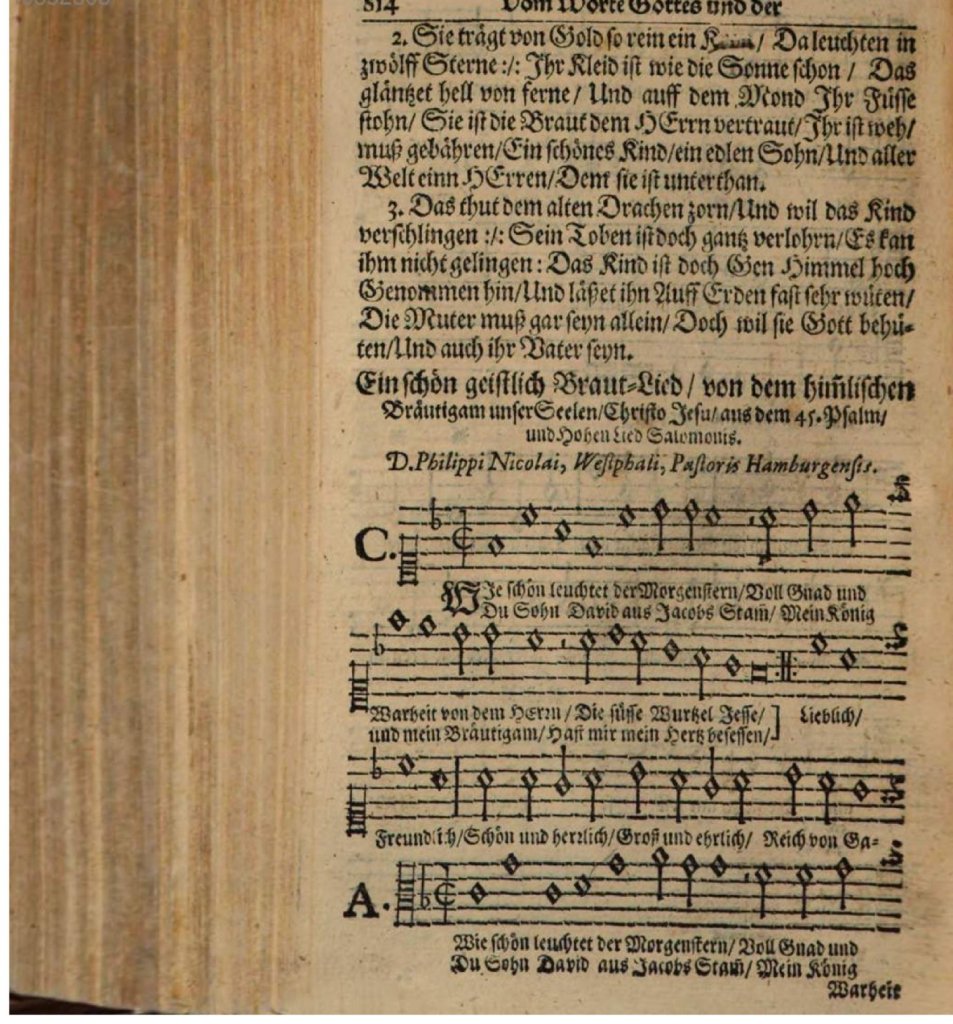
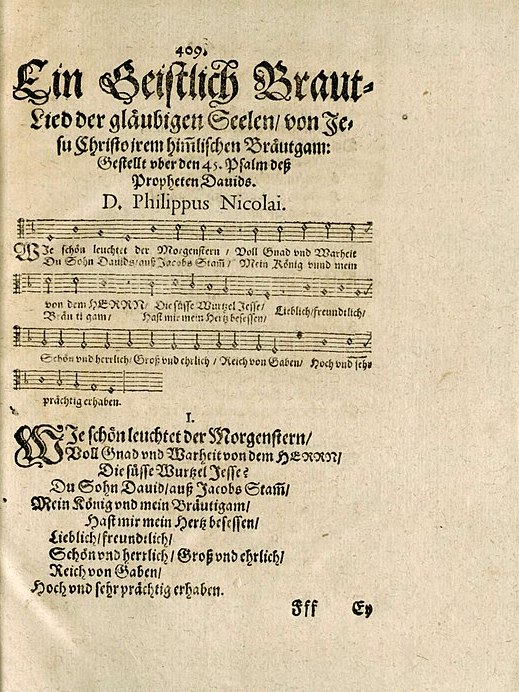
Wie schön leuchtet der Morgenstern in Nicolai’s hymnal from 1599
Nicolai’s hymn in a later hymnal which Bach might have used
Wie schön leuchtet der Morgenstern was most likely a compelling chorale for Bach. He used it in many cantatas (see below), but the melody first appears in an organ work. In fact, the score of this organ fantasia on Wie schön leuchtet der Morgenstern (BWV 739) is the oldest surviving manuscript by Bach. Paper analysis has shown that the piece must have been notated between 1703 and 1709. (Thanks to the Netherlands Bach Society for providing this information on their website).
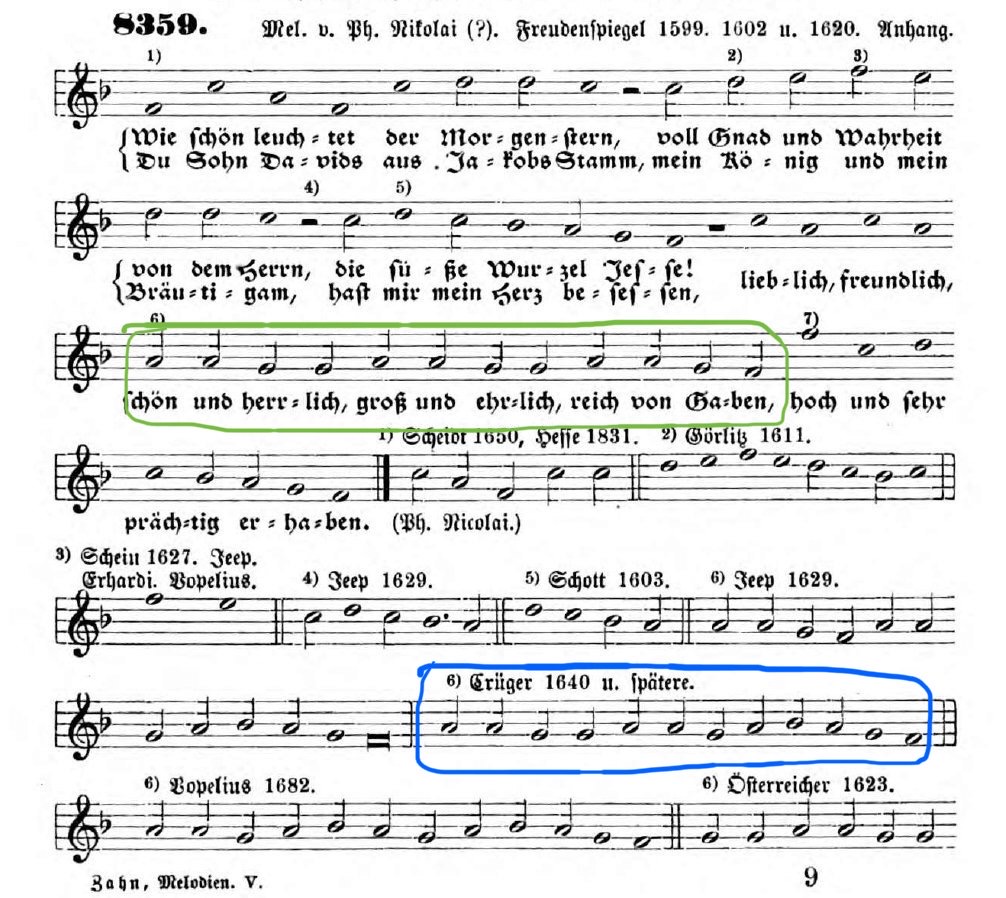
After that, in cantata movements, Bach would either use the original melody (Nicolai’s, see picture above), or Crüger’s version of it. The difference appears in the third line of text, and can be seen in this image, at superscript number 6. Green is Nicolai’s version, blue is Crüger’s.
In these two cantatas, Bach used Crüger’s version:
Cantata 1 Wie schön leuchtet der Morgenstern, written for the Annunciation of Mary, March 25, in 1725. It is one of my favorites because of the two French horns in the opening chorus. This was the last of Bach’s 1724/1725 continuous series of chorale cantatas, and to me, it communicates a similar Advent sparkle as Cantata 62 from that same series.* Per the standard format for these cantatas, Bach featured the first verse of the chorale in the opening movement, and the last verse in the final movement. Watch a live performance of this cantata by the J.S. Bach Foundation here. Soloists are Eva Oltiványi, soprano; Makoto Sakurada, tenor; and Manuel Walser, bass. To understand why it might make sense that the theme of Advent is celebrated on the feast of the Annunciation, please find my blog post from 2018 about Cantata 1 here.
Cantata 36 Schwingt freudig euch empor (Soar joyfully up), an extra-long cantata in two parts, written for the first Sunday of Advent in 1731. The cantata was based on a secular cantata from 1725** but for this First Advent occasion, Bach included several movements based on two Advent chorales: Nun komm, der Heiden Heiland (Come now, Savior of the Gentiles) in the soprano-alto duet, the second tenor aria, and the closing chorale; and the sixth verse of Wie schön leuchtet der Morgenstern in the chorale at the end of Part I of the cantata.
Bach used Nicolai’s version of Wie schön leuchtet der Morgenstern in the following cantata movements, each time in a different way:
The penultimate movement of Cantata 172 Erschallet, ihr Lieder, erklinget, ihr Saiten! (Ring out, you songs, resound, you strings!) for Pentecost in 1714 (verse 4)
The closing chorus from Cantata 61 Nun komm, der Heiden Heiland for the First Sunday of Advent in 1714 (last 4 lines of verse 7)
The chorale for soprano and alto (3rd movement) from Cantata BWV 37 Wer da gläubet und getauft wird (Whoever believes and is baptized) for the feast of Ascension in 1724 (verse 5)
The aria for bass with chorale for soprano (6th movement) from Cantata 49 Ich geh und suche mit Verlangen for the 20th Sunday after Trinity in 1726 (verse 7)
As far as we know, Bach wrote only one cantata for this Third Sunday of Advent. It is the one listed in the BWV catalog as Cantata 186a, Ärgre dich, o Seele, nicht, first performed in Weimar on Sunday December 13, 1716. Read my blog post from 2016 and 2017 about this cantata here.
Wieneke Gorter, December 13, 2020.
*Find my first blog post about Cantata 62 here and a more detailed explanation of how it fits into the series of chorale cantatas here.
**Read more about the history of Cantata 36 in my post from 2017 here.
Hello everyone. I hope you are all safe and well. Thank you for reading this blog, and a warm welcome to all of you who started following recently. Bach wrote three cantatas for this Sunday:
In Weimar, in 1714, Bach wrote Cantata 61 Nun komm, der Heiden Heiland. This one I remember the best from my childhood, because my mother loved Seppi Kronwitter’s singing of the soprano aria on the Harnoncourt recording. Read about it here.
In Leipzig, in 1724, Bach wrote Cantata 62 Nun komm, der Heiden Heiland. My most recent writing about this cantata is from last week, not for this blog, but for that of California Bach Society. Find it here.
Since the release of Herreweghe’s recording in 1997 I have been in love with the opening chorus of Cantata 62. For me, nothing says “Christmas is coming” more strongly to me than this music. And yes, Bach wrote two Advent cantatas with the same title. You better not mix them up when you have been engaged to sing the bass solos. Read a story about that here. If you would like to learn more about this opening chorus, or even sing along to it yourself, I encourage you to sign up for California Bach Society’s free workshop on this cantata this coming Saturday, December 5, at 11 am Pacific Time, on Zoom.
Nuria Rial
In 1731, Bach transformed a secular birthday cantata from 1725 into Cantata 36 Schwingt freudig euch empor. Read about it here. My favorite interpretation of the soprano aria is by Nuria Rial. I first heard Nuria Rial sing on the German radio station WDR3, exactly one month after my mother passed away in 2010. I was staying at my parents’ house in the Netherlands with my kids. My mother had always preferred the German classical music station over the Dutch one, especially for their Early music programming, so WDR3 was pre-programmed into my parents’ fancy equipment. The radio host played a piece from this album, and I was mesmerized. After it was over I went on Facebook and told all my singer friends (that’s why I still know what day it was). But I didn’t find out about her live recording of the soprano aria from Cantata 36 with the J.S. Bach Foundation until 2014.