Weekly Cantata

Weekly Cantata

Tag Archives: Philippe Herreweghe

Bach looking back (Belated 2nd Sunday after Epiphany)

01 Saturday Feb 2020

Posted by cantatasonmymind in Cantatas, Epiphany, Leipzig

≈ Leave a comment

Tags

Bart Coen, Benny Aghassi, BWV 106, BWV 13, BWV 155, BWV 161, BWV 244, BWV 249, BWV 3, BWV 46, Colin Balzer, Collegium Vocale Gent, Easter Oratorio, Epiphany 2, Heiko ter Schegget, Herman Stinders, J.S. Bach Foundation, Jakob Pilgram, Jan Börner, Julius Pfeifer, Margot Oitzinger, Mark Padmore, Matthew White, Netherlands Bach Society, Philippe Herreweghe, recorders, Rudolf Lutz, St. Matthew Passion, Susanne Seitter, Wolf Matthias Friedrich

Wedding at Cana by Duccio di Buoninsegna, tempera on wood, between 1308 and 1311. Museo dell’ Opera dell’ Duomo, Siena, Italy. The “scene” from this story that Bach and his librettists prefer to focus on in all his cantatas for this Sunday, is also illustrated here: Jesus telling his anxious mother “Mine hour is not yet come.”

Two weeks ago I ran out of time writing this post, but I had discovered so much about Cantata 13 Meine Seufzer, meine Tränen (1726), that I would still very much like to share that cantata here. So I hope you don’t mind going back in time a little bit, to the Second Sunday after Epiphany, which fell on January 19 this year (2020), and on January 20 in 1726.

Before I prepare a new post, I always like to revisit previous posts I wrote about this same Sunday, and listen to those cantatas again. And it always thrills me when during this process I discover that Bach must have done this too: going back, either in his memory or in the physical stack of manuscripts, to the music he previously wrote for this same Sunday. Sometimes I only get a feeling that he did this, but other times, there’s an obvious quote either in the text or in the music.

This time I was excited to find Bach quoting music from Cantata 155 Mein Gott, wie lang, ach lange? in Cantata 13 Meine Seufzer, meine Tränen. Bach had written Cantata 155 already in Weimar in 1716, but performed it again in Leipzig in 1724, also on the Second Sunday after Epiphany.

I invite you to listen to/watch the wonderful alto-tenor duet with bassoon from Cantata 155 Mein Gott, wie lang, ach lange? here, in a performance by the J.S. Bach Foundation, with alto Margot Oitzinger and tenor Julius Pfeifer. Note this theme in the voices:
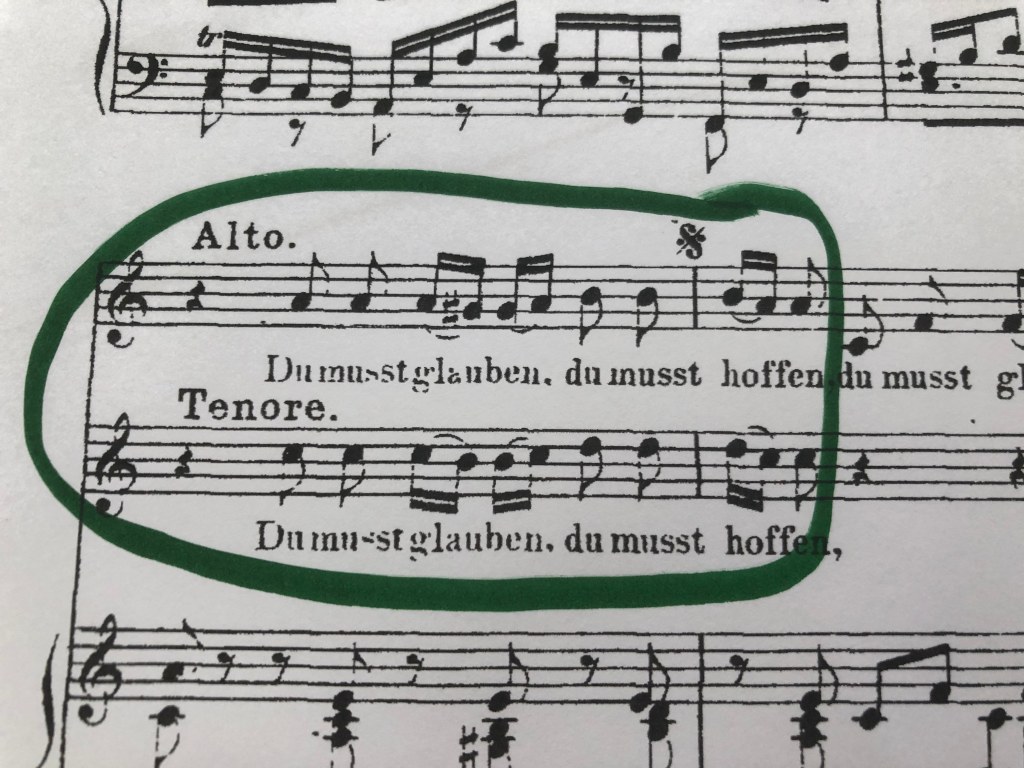
After that duet is over, I would suggest turning off that recording for now. *

Now listen to/watch the entire recording of Cantata 13 Meine Seufzer, meine Tränen, also by the J.S. Bach Foundation here, with soprano Susanne Seitter, alto Jan Börner, tenor Jakob Pilgram, and bass Wolf Matthias Friedrich.

Find the German text with English translations here, and the score here. Please note that the English translation of the bass aria’s first line is incorrect: the translation of the German word “Sorgen” should be “worries” or “worrying”, not “care.” The correct translation is something like this:

Groaning and pitiful weeping
are no help to the sickness of worrying

Pay attention to the recorder parts in the opening movement. The music has a slower tempo, and a more drawn out rhythm, but the theme is the same as in that duet from Cantata 155 you just heard:
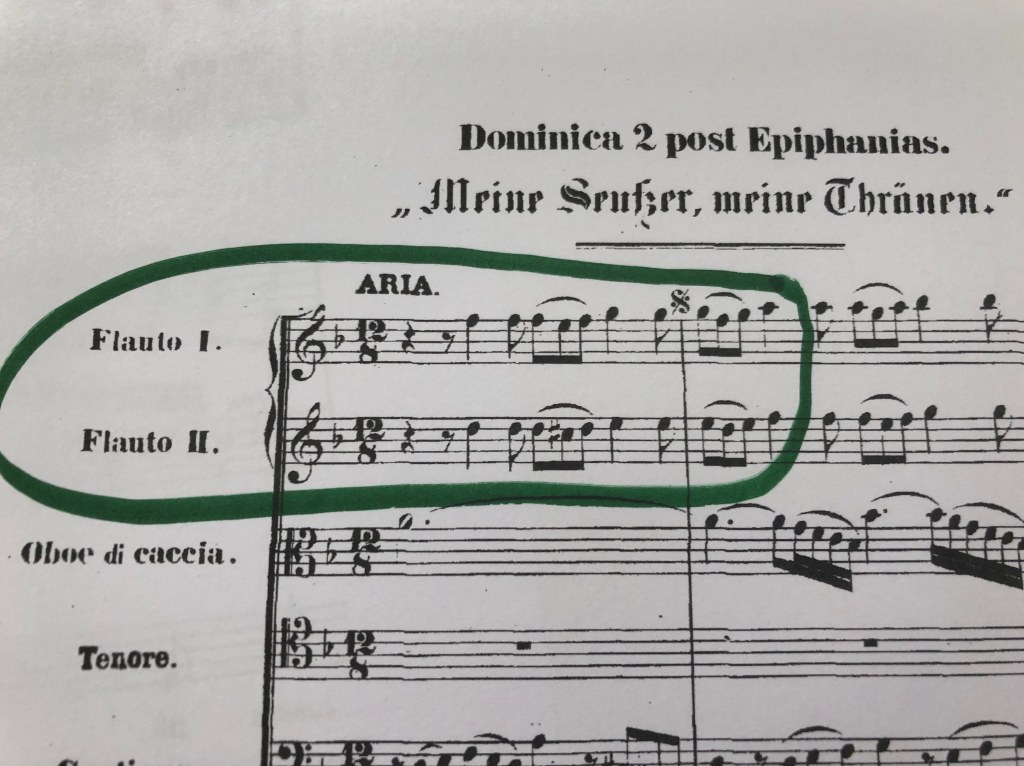
There is more in this opening chorus of Cantata 13 that gives us a peek into Bach’s referencing process. Bach often uses recorders to introduce sorrow. Early in his career he had done this in the opening movements of Cantata 106 Gottes Zeit ist die allerbeste Zeit (written in 1707) and Cantata 161 Komm, du süße Todesstunde (1716). Even during his first year in Leipzig, in 1723, he used this “tool” in the opening chorus of Cantata 46 Schauet doch und sehet, ob irgendein Schmerz sei (which would later form the basis for the Qui tollis from the Mass in B minor). And while from the mid 1720s most Baroque composers, including Bach himself, favored the more fashionable French transverse flutes over recorders, Bach still uses recorders to illustrate impending sorrow or death’s slumber in his Easter Oratorio (1725) and his St. Matthew Passion (1727). Click on the links to hear/watch recordings of all these examples on YouTube. Names of performers in all these are listed at the very end of this post.**

If, after listening to / watching Cantata 13 in its entirety, you are wondering why Bach’s illustration of a miracle (Jesus turning water into wine at the Wedding at Cana) is so incredibly sorrowful, read my blog post about Cantata 3 here.

Wieneke Gorter, January 31, 2020, updated January 16, 2021.

* read my blog post about Cantata 155, which now includes a link to the J.S. Bach Foundation recording, here.

** Performers in the YouTube recordings of cantata/oratorio movements with recorders are:

Credits for YouTube recordings linked above:

Opening movement of Cantata 106: Netherlands Bach Society; Jos van Veldhoven, conductor; Heiko ter Schegget and Benny Aghassi, recorders; Dorothee Mields, soprano; Alex Potter, alto; Charles Daniels, tenor; Tobias Berndt, bass.

Opening movement of Cantata 161: Collegium Vocale Gent; Philippe Herreweghe, conductor; Bart Coen and Koen Dieltiens, recorders; Matthew White, alto; Herman Stinders, organ.

Opening movement of Cantata 46: Collegium Vocale Gent; Philippe Herreweghe, conductor. Live recording from the Festival of Saintes, France, July 15, 2013. Recorder players not specified.

Tenor aria “Sanfte soll mein Todeskummer” from Easter Oratorio, BWV 249: Collegium Vocale Gent; Philippe Herreweghe, conductor. Mark Padmore, tenor.

Tenor recitative with choir “O Schmerz, hier zittert das gequälte Herz” from St. Matthew Passion, BWV 244: Collegium Vocale Gent; Philippe Herreweghe, conductor. Colin Balzer, tenor.

Third Sunday after Easter, 1725

22 Sunday Apr 2018

Posted by cantatasonmymind in After Easter, Cantatas, Leipzig

≈ Leave a comment

Tags

3rd Sunday after Easter, Bach, BWV 1, BWV 103, BWV 12, BWV 96, Christiane Mariana von Ziegler, Damien Guillon, Easter, flauto piccolo, Il Gardellino, John Eliot Gardiner, Marcel Ponseele, Mark Padmore, Philippe Herreweghe, Robin Blaze, sopranino recorder

christ_taking_leave_of_the_apostles
Christ Taking Leave of the Apostles by Duccio di Buoninsegna, between 1308 and 1311. Tempera on wood. Museo dell’Opera del Duomo, Siena, Italy.

2020 update:  If you can afford to financially support the artists, please consider purchasing your favorite recording. Just click on the Amazon or iTunes link at the end of the paragraph that describes the recording.

In 1725, between Easter and Pentecost, Bach set nine cantatas in a row to beautiful poetry by Christiane Mariana von Ziegler: Cantatas 103, 108, 87, 128, 183, 74, 68, 175, and 176. Read more about this multi-talented female librettist, arts benefactor, and fellow Lutheran “preacher” in this post.

The first cantata in this series is Cantata 103: Ihr werdet weinen und heulen, for the third Sunday after Easter in 1725.

My favorite overall recording of this cantata is by Herreweghe, with vocal soloists Damien Guillon, Thomas Hobbs, and Peter Kooij, and Jan Van Hoecke on flauto piccolo. Listen to their opening chorus here on YouTube. Listen to the entire recording by Herreweghe here on Spotify. If you like this recording, please purchase it on Amazon or iTunes.

However for the best energy and intensity in the tenor aria, I prefer Mark Padmore on the Gardiner recording. Listen to their interpretation of the tenor aria here on Spotify. If you like this recording, please purchase it on Amazon or iTunes.

Robin Blaze’s singing and Dan Laurin’s playing in the alto aria on the Bach Collegium Japan recording is exceptional, and perhaps more moving than Damien Guillon’s on the Herreweghe recording. Listen to that aria here on Spotify. And it is a good problem for me, not being able to choose between countertenors 🙂 If you like this recording, please purchase it on Amazon or iTunes.

Find the texts & translations here, and the score here.

Two noteworthy things about this cantata are the dramatic change from sadness to joy, and the use of the sopranino recorder, or “flauto piccolo” in the opening chorus and the alto aria.

The sadness on this “Jubilate” Sunday is because of the Gospel story for this Sunday: Jesus announces to his disciples that he is going to leave them, and that they will go through a period of hardship during which the rest of the world will mock them. Other cantatas Bach wrote for this Sunday are Cantata 12 Weinen, Klagen, Sorgen, Zagen and Cantata 146 Wir müssen durch viel Trübsal. But in the alto recitative (fourth movement), the turning point is announced: “dass meine Traurigkeit in Freude soll verkehret werden” (that my sorrow will be turned to joy). Bach makes a big deal here of illustrating the word “Freude” and then does that again, even more exuberantly in the tenor aria that follows: there the illustration of the word “Freude” is six measures and almost 100 notes long.

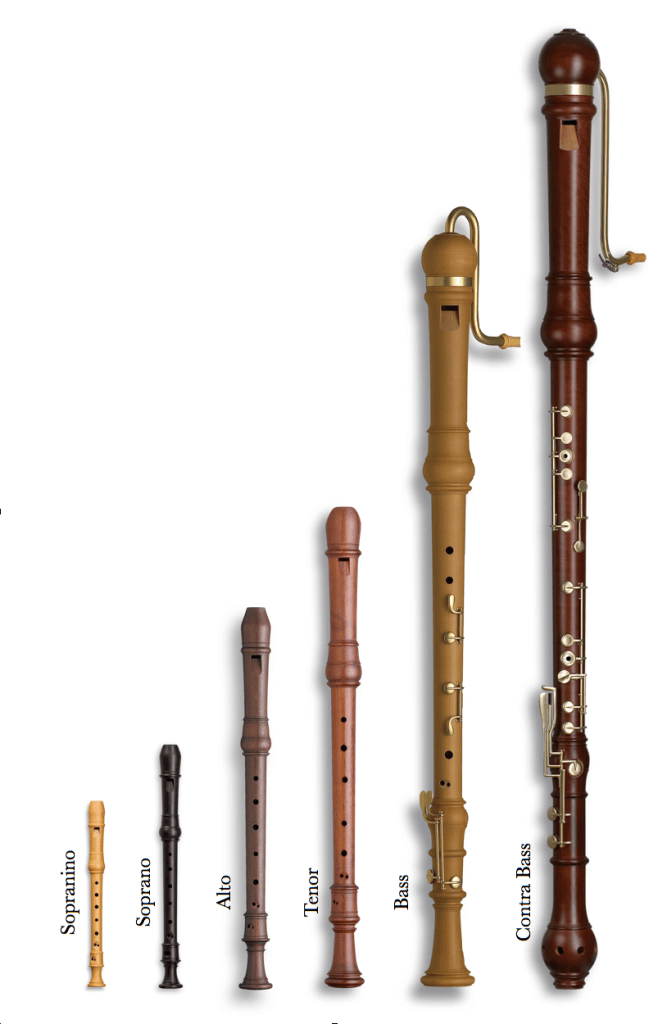
Since his arrival in Leipzig, Bach had used recorders in cantatas quite often see this image by Nik Tarasov, but this is only the third time he writes for sopranino recorder, or “flauto piccolo.” The first time was on October 8, 1724, in Cantata 96 Herr Christ der einige Gottessohn, and the second time on March 25, 1725, in Cantata 1 Wie schön leuchtet der Morgenstern.

In both cases, Bach used the sopranino part to illustrate the word “Morgenstern” (Morning Star) in the text, creating an extra constellation over the highest notes of the sopranos with the even higher notes of the recorder. It is not completely clear why Bach uses the sopranino this time, in Cantata 103. There are theories that the instrument is meant to illustrate the “mocking” of the outside world. But, as Bach always paints the entire story of a cantata already in the opening chorus, I think he perhaps might have used the recorder to convey the message of “there will be joy at the end” in the otherwise very sad opening chorus. But who knows, his reason for using the instrument might simply have been that the virtuoso player was in town again, since it was around the time of the big Easter Trade Fair that Bach was writing this music.

Whatever the reason, it is very likely that there was only one person in 1725 among Bach’s colleagues who could play this. When Bach performed the piece again in later years, he changed the accompanying instrument in the alto aria to violin. There are also parts for a transverse flute. Herreweghe, Koopman, and Suzuki use a sopranino recorder in the alto aria, while Gardiner uses violin, and Ponseele (on the Il Gardellino recording) uses transverse flute.

To learn more about this cantata, you can now (2020) watch the excellent introduction (“Workshop”) by Rudolf Lutz of the J.S. Bach Foundation here on YouTube. The J.S. Bach Foundation just added English subtitles this video, so it is now also accessible to those who don’t understand German.

To read more about Bach’s use of recorders, I recommend this article in two parts by Nik Tarasov: Part I, about Bach in Mühlhausen, Weimar, and Köthen, and Part II, about Bach in Leipzig.

Wieneke Gorter, April 22, 2018, updated April 27 & May 2, 2020.

Easter Monday 1725

02 Monday Apr 2018

Posted by cantatasonmymind in After Easter, Cantatas, Leipzig

≈ Leave a comment

Tags

Bach, Damien Guillon, Dorothee Mields, Easter Monday, Emmaus, Peter Kooij, Philippe Herreweghe

1024px-Duccio_di_Buoninsegna_Emaus

On the Road to Emmaus by Duccio, 1308-1311. Museo del’Opera del Duomo, Siena, Italy.

After the rewritten St. John Passion on Good Friday (read more about this in my post from this past Friday) and the “recycled” birthday cantata with new recitatives for the Easter-Oratorio (read more about this in yesterday’s post), Bach was now, in 1725, getting ready for performances of three new cantatas that form a beautiful sub-group within the cantatas of the 1724/1725 cycle.

Cantata 6 Bleib bei uns, denn es will Abend werden for Easter Monday (Bible story: Jesus appeared before two of his disciples while they were walking on the road to Emmaus).

Cantata 42 Am Abend aber desselbigen Sabbats, for the first Sunday after Easter (Bible story: while a small group of his disciples are inside a house in Jerusalem, with all the doors and windows locked, Jesus appears in their midst).

Cantata 85 Ich bin ein guter Hirt, for the second Sunday after Easter (Bible story: The Good Shepherd).

Gardiner believes that in Bach’s ideal plan, these cantatas were actually meant for the Easter season in 1724, not in 1725.  In his book “Bach: Music in the Castle of Heaven,” he explains why cantata 6, 42, 67 and 85 share more characteristics with other 1724 cantatas, and were thus probably planned for that year. When Bach got behind with cantata composing because of the Passion according to St. John in 1724, he must have tabled the ideas for 6, 42, and 85 for 1725, and only wrote 67 in 1724.

My favorite recording of Cantata 6 Bleib bei uns, denn es will Abend werden is by Herreweghe, recorded live at a concert on June 12, 2014 in the Eglise Saint-Roch in Paris. Find the recording (audio only) here on YouTube.

Soloists are Dorothee Mields (soprano), Damien Guillon (countertenor), and Peter Kooij (bass).

Wieneke Gorter, April 2, 2018.

Lessons learned from last year

01 Sunday Apr 2018

Posted by cantatasonmymind in Bach's life, Cantatas, Easter, Leipzig

≈ 1 Comment

Tags

Barbara Schlick, Easter, Easter Oratorio, James Taylor, Kai Wessel, Peter Kooij, Philippe Herreweghe

hubert_van_eyck_-_the_three_marys_at_the_tomb_-_wga7586

The three Marys at the Empty Tomb by Jan van Eyck or Hubert van Eyck, ca. 1425-1435. Museum Boijmans-Van Beuningen, Rotterdam, The Netherlands.

I’m in movie script mode again today. While I don’t know this for sure at all, I think that early in 1725, Bach had probably already decided to not to let things get as crazy as the previous year (in 1724) around Easter. That year, he had seriously run out of time, and had to adjust many of his plans. Gardiner thinks this happened because the writing, rehearsing, and performing of his Passion according to St. John had taken Bach much more time than he thought, and had forced him to make several shortcuts in the weeks ahead. Read more about all this in my post about Easter 1724 and subsequent posts.

So I imagine that this year, in 1725, Bach must have been planning ahead. Without any more “old” Easter cantatas in his portfolio, he had to have something else ready for the choir and orchestra to rehearse alongside the Passion for Good Friday, whatever that Passion was going to be.

So when the friendly Duke Christian von Sachsen-Weissenfels asked for some Tafelmusik to be performed for his 44th birthday on February 23, 1725, Bach might very well have thought from the beginning: perfect, that music can double as an Oratorio for Easter Sunday.

Listen to Herreweghe’s recording of the Easter Oratorio here on YouTube. Soloists are Barbara Schlick, soprano; Kai Wessel, alto; James Taylor, tenor; and Peter Kooy, bass.

Find the text here, and the score here.

The Tafelmusik for Duke Christian became Entfliehet, verschwindet, entweichet, ihr Sorgen, also known as Schäferkantate, BWV 249a. When recycling this into the Easter Oratorio, Kommt, eilet und laufet BWV 249, Bach kept the  cheerful opening sinfonia and the exquisite, plaintive adagio, two instrumental movements that were probably originally from a concerto he wrote in Köthen. He also kept the music of the opening and closing chorus, and of all the arias, only changing the text.

Here you can see how little he did change the text in this table, courtesy of Eduard van Hengel:

Schäferkantate (BWV 249a, 23/2/25) Oster-oratorium (BWV 249, 1/4/1725)
3.
Entfliehet, verschwindet, entweichet, ihr Sorgen
verwirret die lustigen Regungen nicht!
Lachen und Scherzen
erfüllet die Herzen
die Freude malet das Gesicht.

5. Hunderttausend Schmeicheleien
wallen jetzt in meiner Brust.
Und die Lust
so die Zärtlichkeiten zeigen,
kann die Zunge nicht verschweigen.

7. Wieget euch, ihr satten Schafe,
in dem Schlafe
unterdessen selber ein!
Dort in jenen tiefen Gründen,
wo schon junge Rasen sein,
werden/wollen wir euch wieder finden.

9. Komm doch, Flora, komm geschwinde,
hauche mit dem Westenwinde
unsre Felder lieblich an!
Daß ein treuer Untertan
seinem milden Christian
Pflicht und Schuld bezahlen kann.

11. Glück und Heil
bleibe dein beständig Teil!
Großer Herzog, dein Vergnügen
müsse wie die Palmen stehn,
die sich niemals niederbiegen,
sondern bis zum Wolken gehn!
So werden sich künftig
bei stetem Gedeihen
die deinen mit Lachen
und Scherzen erfreuen.


Kommt, eilet und laufet, ihr flüchtigen Füße,
Erreichet die Höhle, die Jesum bedeckt!
Lachen und Scherzen
Begleitet die Herzen,
Denn unser Heil ist auferweckt.

Seele, deine Spezereien
Sollen nicht mehr Myrrhen sein.
Denn allein
Mit dem Lorbeerkranze prangen,
Stillt dein ängstliches Verlangen.

Sanfte soll mein Todeskummer,
Nur ein Schlummer,
Jesu, durch dein Schweißtuch sein.
Ja, das wird mich dort erfrischen
Und die Zähren meiner Pein
Von den Wangen tröstlich wischen.

Saget, saget mir geschwinde,
Saget, wo ich Jesum finde,
Welchen meine Seele liebt!
Komm doch, komm, umfasse mich;
Denn mein Herz ist ohne dich
Ganz verwaiset und betrübt.

Preis und Dank
Bleibe, Herr, dein Lobgesang.
Höll und Teufel sind bezwungen,
Ihre Pforten sind zerstört.
Jauchzet, ihr erlösten Zungen,
Dass man es im Himmel hört.
Eröffnet, ihr Himmel,
die prächtigen Bogen,
Der Löwe von Juda
kommt siegend gezogen!

In order to tell the story of two Marys (yes I realize the painting I use here has three Marys – each Gospel has a different version of this story), Peter, and John finding the empty tomb, Bach added recitatives in between the arias. Note that he doesn’t write a part for an evangelist, the way he did that in his Passions and in his Christmas Oratorio.

Wieneke Gorter, April 1, 2018.

Good Friday in 1725

30 Friday Mar 2018

Posted by cantatasonmymind in Bach's life, Cantatas, Chorale cantatas 1724/1725, Leipzig

≈ Leave a comment

Tags

Andreas Scholl, Cecile Kempenaers, Collegium Vocale Gent, Dominik Wörner, Malcolm Bennett, Mark Padmore, Michael Volle, Philippe Herreweghe, Sebastian Noack, Sibylla Rubens, St. John Passion, St. Matthew Passion

IMG-4407

Detail of The Arrest of Christ by Hieronymus Bosch, ca. 1515. San Diego Museum of Art.

As I’ve mentioned over the past few months, Bach might have initially been planning to perform a St. Matthew Passion on Good Friday in 1725 in Leipzig.

If he was indeed planning that, he didn’t finish it in time. Did he run out of time, did he have a conflict with the Leipzig City Council, or did he change his mind? We don’t know. Fact is that on Good Friday 1725 he performed a new version of his St. John Passion from the year before. The most notable difference is the new opening chorus: O, Mensch, bewein dein Sünden groß instead of the Herr, unser Herrscher from the year before.

Find Herreweghe’s recording from 2001 of that 1725 St. John Passion here on YouTube.

Soloists are: Tenor [Evangelist, Arias]: Mark Padmore; Bass [Jesus]: Michael Volle; Soprano: Sibylla Rubens; Counter-tenor: Andreas Scholl; Bass [Arias, Pilatus]: Sebastian Noack; Bass [Petrus]: Dominik Wörner; Tenor [Servus]: Malcolm Bennett; Soprano [Ancilla]: Cecile Kempenaers

But let’s just leave the St. Matthew / St. John discussion for what it is, and just look at that opening chorus. Having followed Bach’s 1724/1725 chorale cantatas in the order he wrote and performed them, it is not a stretch to consider that Bach might have been working up to this elaborate chorale fantasia since February 2. I mentioned in my post for that day that it felt as if something new was coming.

When you look at Cantatas 125, 126, 127, and 1, the four cantatas Bach wrote and performed between February 2 and March 25, you see a beautiful line-up of chorale fantasias, one even more special than the other. So perhaps there was no stress or doubt at all in Bach’s mind about what to write for Good Friday 1725, at least not as far as the opening chorus was concerned. He might have been planning for O, Mensch to open his Good Friday passion since the end of January, and might have been doing studies for it in Cantatas 125, 126, 127, and 1.

Wieneke Gorter, March 30, 2018

Cantata movements in organ works

17 Saturday Feb 2018

Posted by cantatasonmymind in Bach's life, Cantatas, Chorale cantatas 1724/1725, Leipzig

≈ Leave a comment

Tags

Bach, BWV 140, BWV 549, BWV 6, BWV 645, BWV 647, BWV 93, chorales, Dorothee Mields, Freiberg, Groningen, Ignace Bossuyt, J.S. Bach Foundation, Jan Hage, Kloosterkerk, Martini Church, Michael Schultheis, organ, Philippe Herreweghe, Schübler, Schnitger-Hinsz, Seligenstadt, Silbermann, The Netherlands, Ton Koopman, Wim van Beek

bach-schubler-titelblad
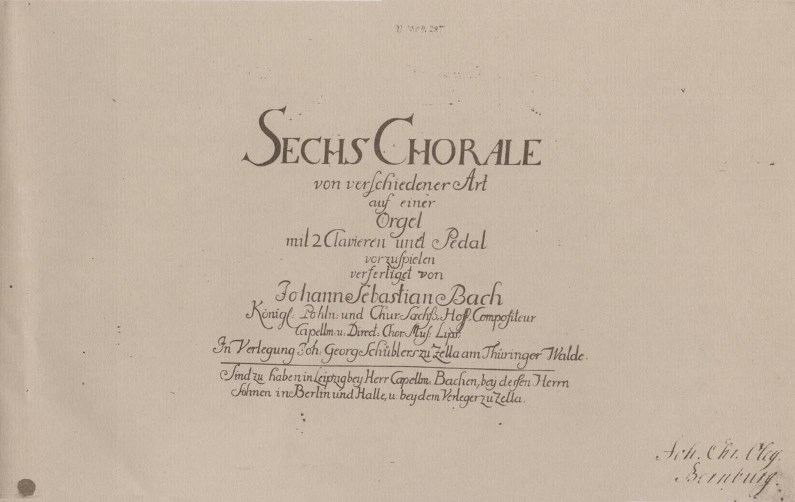
Title page of Schübler’s edition of six of Bach’s organ chorales based on cantata movements, known nowadays as the “Schübler Chorales.” The two last lines are instructions on where to purchase more of these: in Leipzig from Bach himself, from his sons in Berlin and Halle, and from the publisher [Schübler] in Zella.

There is no cantata for this Sunday, as no figural music was allowed in Leipzig in the 40 days before Easter, with the exception of the feast of the Annunciation (March 25).

For me this means I now finally have time to share some of what I learned during the Bach Festival in Bruges. On Friday January 26 I attended an all-day lecture by Professor Ignace Bossuyt about how Bach “reworked” his own music and the music of others in his compositions. The biggest eye-opener for me was that all Bach’s “Schübler Chorales” for organ (named after their publisher, Johann Georg Schübler) from 1747/1748 are actually arrangements of movements from Bach’s 1724/1725 cycle of cantatas I have been discussing on this blog since June 2017.

While I am not an organist at all, I did grow up in the land of organs and miss hearing them. My mother comes from a family of organists on her mother’s side. When other little boys dreamed of cars, my father dreamed of being an organist and built organ keyboards from blocks at home and would pretend to play them (sadly because of class perception his parents didn’t deem it appropriate to send him for lessons). Thus my parents were extremely picky where we went to church – there had to be a good organist. So I heard my share of Bach chorale preludes and Schübler Chorales, even before I knew what they were.

Because of the funeral service for my mother in the Kloosterkerk in The Hague I already referred to last week, I also have a soft spot for Bach’s “Schübler Chorale” BWV 645, Wachet auf, ruft uns die Stimme, because the incomparable Jan Hage (now organist at the Dom Church in Utrecht) played this at the end of the service, as we were walking out behind the coffin. This music, together with smiles of dear friends we passed by, gave me great comfort at a moment that could otherwise have been unbearable. Listen to this chorale, played by Jan Hage on that same organ of the Kloosterkerk in The Hague, here on YouTube. Another wonderful, and historically significant, performance of this chorale by Ton Koopman, on the Silbermann organ* (1714) in the Freiberg Cathedral, Germany, can be found here on YouTube. Bach and Silbermann knew each other, and Bach might have played on this organ too.

What I didn’t know until Professor Bossuyt’s lecture is that this piece of music was taken from the fourth movement of Cantata 140 with the same title. This cantata is officially not part of the 1724/1725 cycle, but in Bach’s head in 1747 it probably was. Bach wrote Cantata 140 Wachet auf, ruft uns die Stimme in 1731, most likely in an attempt to leave a complete chorale cantata cycle for posterity. During the chorale cantata cycle of 1724/1725, there had been no 26th or 27th Sunday after Trinity (by that time it was already Advent and it is of course no coincidence that Bach uses an Advent chorale in this cantata). Watch the tenor solo from this Cantata 140 Wachet auf, ruft uns die Stimme by all the tenors and baritones of the Amsterdam Baroque Choir (on a live recording conducted by Ton Koopman) here on YouTube.

I have two more beautiful examples of how Bach arranged an existing chorale cantata movements into his “Schübler Chorales”:

Bach turned the fourth movement of Cantata 93 Wer nur den lieben Gott lässt walten into the Schübler Chorale with the same title, BWV 647. Watch the duet from Cantata 93 by the J.S. Bach Foundation with soprano Miriam Feuersinger and alto Jan Börner here on Youtube. Watch the Schübler chorale played by Michael Schultheis on the organ of the Basilica in Seligenstadt, Germany, here on YouTube.

The last example is from a cantata that is nowadays not considered a true chorale cantata, but if Bach used it for the Schübler chorales, we can assume that he himself did regard it as such. It is Cantata 6 Bleib bei uns, denn es will Abend werden for Easter Monday in 1725. Hear Dorothee Mields sing the third movement from Cantata 6 live here on YouTube. Then listen here on YouTube to Dutch organist Wim van Beek play the Schübler Chorale with the same title, BWV 549, on the historic Schnitger-Hinsz organ (1740) in the Martini church in Groningen, The Netherlands.

Wieneke Gorter, February 17, 2018, links updated December 2, 2019

*learn more about the Silbermann organ here.

Bach’s “most beautiful cantata” connected to a dear memory

11 Sunday Feb 2018

Posted by cantatasonmymind in Bach's life, Cantatas, Chorale cantatas 1724/1725, Leipzig

≈ Leave a comment

Tags

bwv 127, Caroline Stam, Collegium Vocale Gent, Dorothee Mields, Eduard van Hengel, Estomihi, Jan Kobow, Peter Kooij, Philippe Herreweghe, St. Matthew Passion

kloosterkerk
Kloosterkerk, The Hague, The Netherlands, where Caroline Stam sang the aria from Cantata 127 during my mother’s funeral service in 2010. This church is also the site of the monthly cantata services performed by the Residentie Bach Ensembles.

What are your five favorite cantatas? This question was asked this week on Facebook by the Residentie Bach Ensembles, the choirs and orchestra of the monthly cantata services in the Kloosterkerk in The Hague, the Netherlands. A hard question to answer, and I would probably have a different Top Five every month. However, Cantata 127 Herr Jesu Christ, wahr’ Mensch und Gott, today’s cantata from 1725, will probably always be in it. The soprano aria from this cantata is forever linked in my heart and mind with the funeral service for my mother in this same Kloosterkerk in The Hague (read a bit more about that in this post), but having carefully listened to about 120 cantatas over the past two years I am struck by how special this cantata is within Bach’s oeuvre.

I’m not alone in my appreciation of Cantata 127 Herr Jesu Christ, wahr’ Mensch und Gott. Eduard van Hengel calls it an “exceptionally inspired cantata,” 19th century Bach biographer Spitta called it “perhaps the most important” cantata, and it received “the most beautiful” qualification by Arnold Schering as well as Ton Koopman.  

My favorite recording of this cantata is now [update from 2021] Herreweghe’s live recording from January 31, 2021. Find it here on YouTube.

Find the text of Cantata 127 here, and the score here.

There are several reasons why this last Sunday before Lent, or Quinquagesima Sunday or Estomihi Sunday, was such an important day for Bach, and maybe especially in 1725:

  1. This was the day, in 1723, on which he had auditioned for his job in Leipzig, with Cantatas 22 and 23, his first performance ever for the Leipzig congregation and city council. In 1724 he would repeat the same cantatas on this same Sunday.
  2. After this Sunday, his audience (=the Leipzig congregations of the St. Thomas and St. Nicholas churches) would not hear any of Bach’s music until March 25, on the feast of the Annunciation of Mary. No figural music (only chorale singing) was allowed in the Lutheran churches in Leipzig during Lent (the approximately 40 days before Easter), with the exception of the Annunciation. In 1724 this period was 33 days, but in 1725 it was 41 days (from February 11 to March 25). So Bach might have wished to leave his audience with something special, something they would remember for 41 days.
  3. If it is true that Andreas Stübel had been Bach’s librettist for his entire chorale cantata cycle, Bach would have now known that this was the last regular chorale cantata of the cycle for now: Stübel died on January 31, 1725. So perhaps Bach wanted to “go out with a bang” for that reason. It is striking to me that he chooses a bass recitative/arioso with trumpet talking about the Day of Judgement, a similar combination of voice, instrument, and subject matter he uses at the end of the Trinity period in 1723, and again (though less dramatically) at the end of the Trinity period in 1724. Is this Bach’s way of saying: this is the end of an important series?

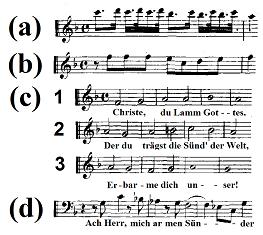
Compared to all opening choruses that had come before, this opening chorus is the most complex and intricate. It is the same as chorale fantasias in previous chorale cantatas in the sense that the six lines of text of the chorale Herr Jesu Christ, wahr’ Mensch und Gott appear in six sections, with the chorale melody (the cantus firmus) in the soprano and trumpet part.  However the orchestra greatly enhances the meaning of Bach’s message by referring to this chorale plus two others. The instrumental groups (recorders, oboes, strings, and continuo) represent four musical themes referring to these chorales. Eduard van Hengel illustrates this extremely well with two diagrams on his website, which I am copying here with his permission:

127-VHengel

(a) The recorders play a dotted rhythm which in both the St. John and St. Matthew Passions illustrates punishment and suffering.
(b) The oboes introduce the “Leitmotiv” that will sound 78 times throughout the entire movement, and stands for the Herr Jesu Christ, wahr Mensch und Gott chorale. Jesus was a true (“wahr”) man and God. Probably Bach’s most important message here.
(c) The strings quote the chorale Christe, du Lamm Gottes, or Luther’s Agnus Dei. It would show up again in the opening chorus of the St. Matthew Passion, which Bach might already have been working on around this time, see my post about Cantata 125 last week.
(d) In the continuo we hear six times the first seven notes of Ach Herr mich armen Sünder, nowadays better known as O Haupt voll Blut und Wunden, one of the main building stones of the St. Matthew Passion. In the seventh section of the opening chorus, when the sopranos are already done singing the chorale melody, Bach repeats this particular theme in the vocal bass line in the choir, as if to make sure that even those who might have missed the quotation earlier would now hear it loud and clear.

Van Hengel adds this extra diagram to show in which measures of the opening chorus the different themes appear:

127-schemaVHengel

At this point Bach might still have been planning to prepare his audiences for a first St. Matthew Passion, not abandoning that plan until much closer to March 30, Good Friday, 1725. Not only are the references in this opening chorus a striking example of that, but also in the extraordinary bass recitative/aria do we see the theme of the Sind Blitze, sind Donner chorus from the St. Matthew Passion appear on the text “Ich breche mit starker und helfender Hand.”

Regular followers of this blog will notice that Bach had been making a study for this bass recitative/aria in the previous three cantatas: combining lines of the chorale text with “free” text in the bass solo of Cantatas 92 and 125, and then using Sind Blitze, sind Donner material and trumpet accompaniment in the bass solo in Cantata 126.

Wieneke Gorter, February 10, 2018, updated February 22, 2020 and February 13, 2021.

* Herreweghe’s album “Jesu, deine Passion” features cantatas 22, 23, 127, and 159. Cantata 23 has exceptionally beautiful choruses and Cantata 22 represents the first introduction of Bach’s version of the “Vox Christi”(voice of Christ) to the Leipzig congregations, considered by some as an intentional preparation for the listeners of what would be to come in the Passions. Cantata 159 on this album is fantastic too, with an unrivaled interpretation by Peter Kooij of the fourth movement, the bass aria “Es ist vollbracht.”

Paintings, praises, and a possible prelude to the St. Matthew Passion

03 Saturday Feb 2018

Posted by cantatasonmymind in Bach's life, Cantatas, Chorale cantatas 1724/1725, Leipzig

≈ Leave a comment

Tags

Alex Potter, Bruges Bach Academy, BWV 105, BWV 125, BWV 234, BWV 46, Candle Mass, cello, Collegium Vocale Gent, Dorothee Mields, Eglise St. Roch, floating aria, flute, Ingeborg Danz, oboe da caccia, organ, Peter Kooij, Philippe Herreweghe, Presentation at the Temple, Purification of Mary, strings, Thomas Hobbs

triptych-of-jan-floreins-1479

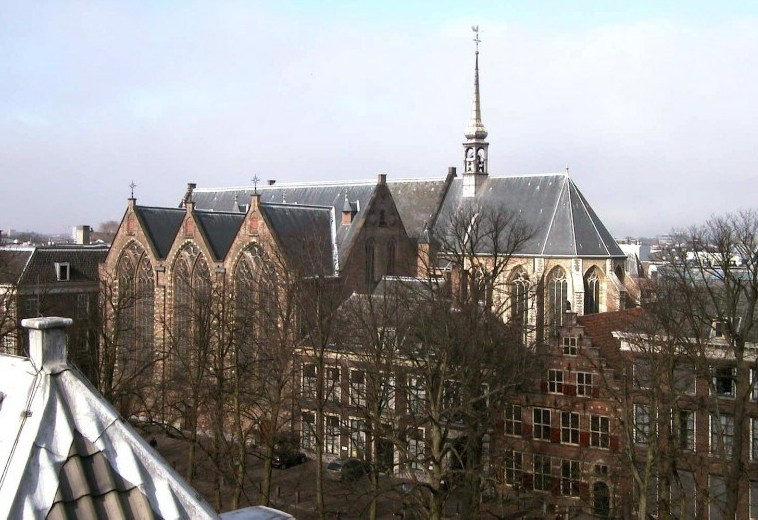
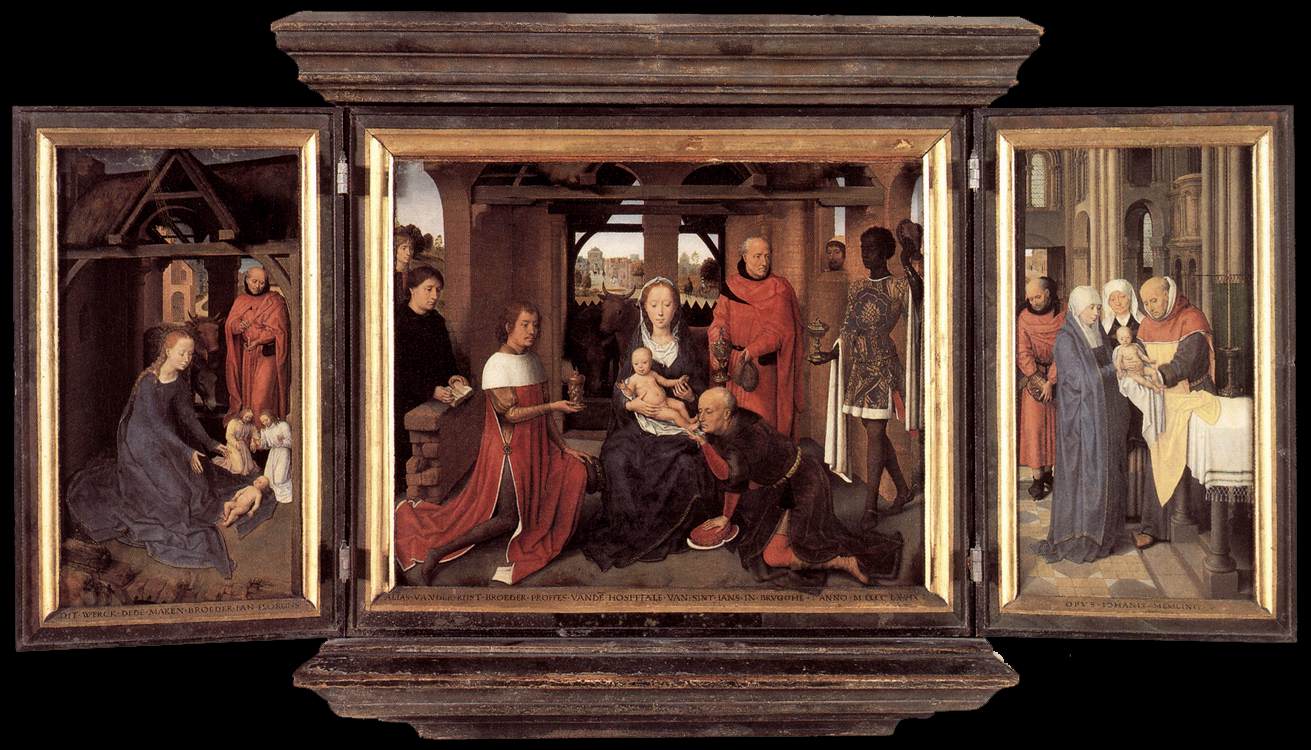
“Adoration of the Magi” triptych of Jan Floreins by Hans Memling, 1479. Memling Museum (Old St. John’s Hospital), Bruges, Belgium. The right-hand panel features “The Presentation at the Temple,” with the Temple really being the former St. Donaas church in Bruges.

If you are reading this in the email you received from WordPress, please click on the title of this post to enjoy the paintings and the formatting 🙂

This post is almost two days late, as it was for Friday February 2, the feast of the Purification of Mary, or Candle Mass, or Presentation at the Temple. If you have time, please read how this holiday was strongly connected to folk culture in my post from last year. In Lutheran reality, this was the day when Simeon’s song of praise Herr, nun lässest du deinen Diener in Friede fahren  or Nunc Dimittis was celebrated. With his chorale Mit Fried und Freud ich fahr dahin Luther turned Simeon’s song of praise into a message of “Now I can die in peace.” This is why all five cantatas (The famous Ich habe genug 82, 83, 125, 157, and 158) Bach wrote for this holiday are mostly about the joy of dying.

Since I’m following Bach’s chorale cantata writing in Leipzig in 1725, I’m featuring Cantata 125 Mit Fried und Freud ich fahr dahin, written for February 2 of that year, and based on that same chorale by Luther.

My favorite overall recording of this cantata is Herreweghe’s recording from 1998, with Ingeborg Dantz, alto; Mark Padmore, tenor; and Peter Kooij, bass. You can find it here on YouTube. Please consider supporting the artists by purchasing the album on Amazon or on iTunes. It also includes the stunning Cantata 8 (Herreweghe’s personal favorite!) and the beautiful Cantata 138.

Please find the German text with English translations of this cantata here, and the score here.

There are some similarities with last week’s cantata, such as the bass solo that is made up of bits of recitative and bits of chorale melody, but already in the opening chorus a new day is dawning. If you read the history of today’s holiday in my post from last year, you know that Candle Mass was a natural time of year to start with something new.

Could the new inspiration in Bach’s brain be the St. Matthew Passion? It is not unlikely at all. Van Hengel suggests that the opening chorus has elements of the St. Matthew opening chorus, but then argues that that piece was not written yet in 1725. However, Gardiner (in his book Music in the Castle of Heaven) makes a strong case that Bach might have initially planned to have the St. Matthew Passion ready for Good Friday 1725. I’ve pointed out before that we can find preludes to the “Great Passion” in Bach’s cantatas as far back as the fall of 1723 (see posts about cantatas 105 and 46), so it is not unlikely that Bach was working on this in January 1725.

Keeping all this in mind, it is striking that the first aria after the opening chorus is an alto aria in St. Matthew style, full of pietism. Watch Alex Potter (keep reading to find out more about him) sing this aria with the J.S. Bach Foundation here on YouTube. The instrumentation resembles the “Aus Liebe” soprano aria from the St. Matthew Passion: there are no organ chords in the bass, only repeated cello notes, and for the rest it is just flute and oboe da caccia, an unusual combination.

Because of the  many connections with this Cantata 125 I’m now going to sneak in a mini review of the Herreweghe/Collegium Vocale concerts I attended in Europe this past week.

paris_1-30_concert

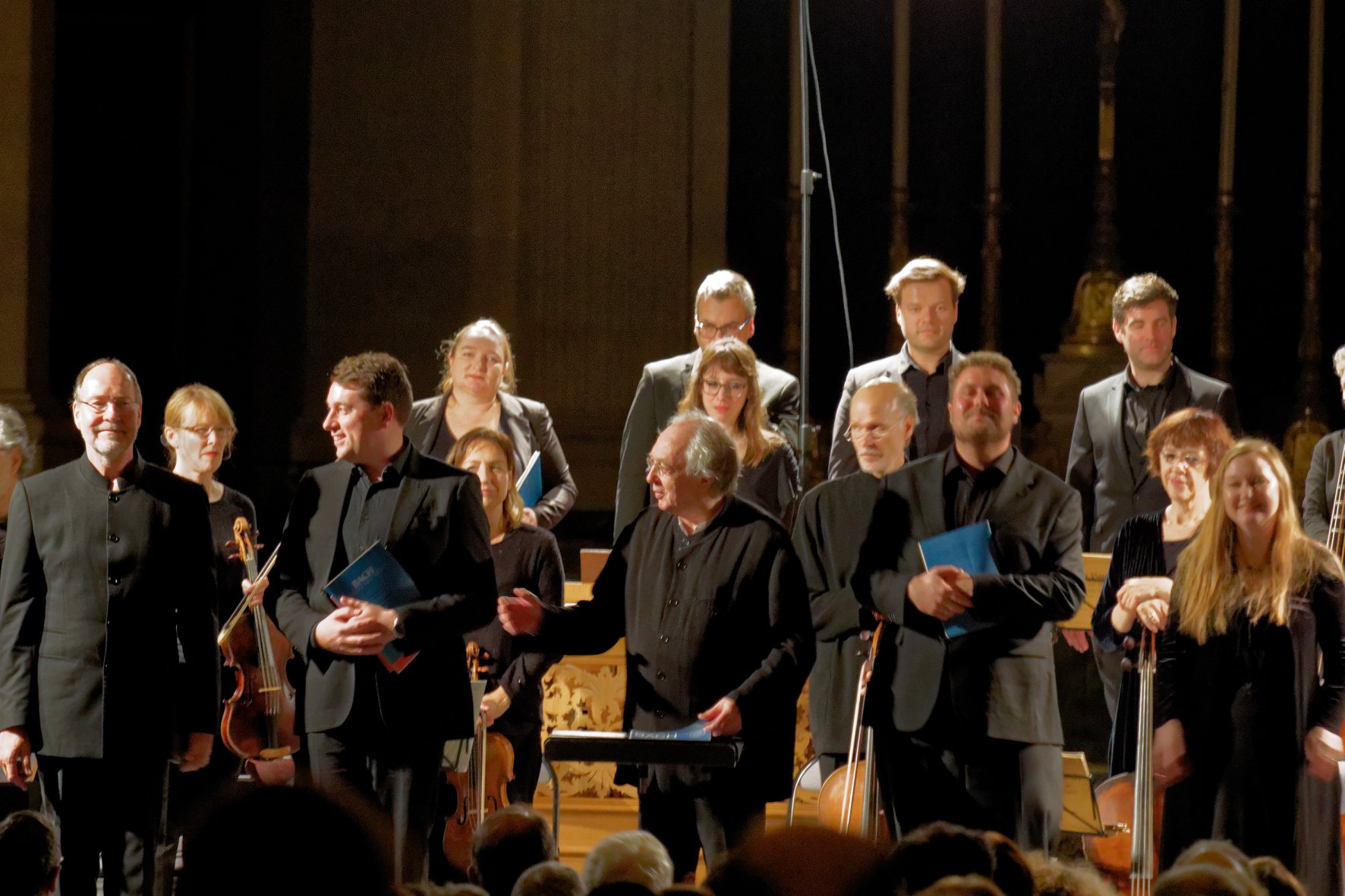
Applause at the end of the concert in the Eglise St. Roch in Paris, January 30, 2018. From left to right in front row: Peter Kooij, Thomas Hobbs, Philippe Herreweghe, Alex Potter, Dorothee Mields. Photo by Aube Neau/Luc Barrière, published with permission.

Let’s take the alto aria from Cantata 125. I call this type of aria a “floating aria” because it has no real basso continuo: there is no melodic line in the cello or chords in the organ, i.e. no foundation for the singer to stand on. These floating arias are incredibly beautiful and the stuff of goose bumps, but also incredibly challenging for the vocal soloist. In the terrific concert in Paris on Tuesday January 30, soprano Dorothee Mields had two such arias: the “Qui tollis” from the Mass in A Major (BWV 234)* and the “Wir zittern und wanken” from Cantata 105. She did an absolutely marvelous job in both of them, but her singing was the most mesmerizing in the “Wir zittern und wanken” aria. Cantata 105 stood out during that Paris performance anyway in my humble opinion. It simply has the best opening chorus of all cantatas Collegium Vocale performed in the three concerts I attended. On top of that, the group (including soloists Thomas Hobbs and Peter Kooij) recorded this in 2012, and you could tell it was still in everyone’s bones and it was a pleasure to see Herreweghe direct the strings as well as the soloists. One of my favorite bass ariosos occurs in that cantata (it makes me think of the “Am Abend da es kühle war” from the St. Matthew) and Peter Kooij’s strong rendition almost made me cry.

memling_presentation_temple_floreins

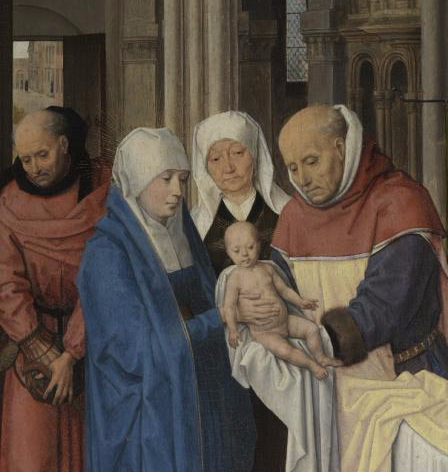
Detail of right-hand wing of the “Adoration of the Magi” Jan  Floreins triptych by Hans Memling, showing the Presentation at the Temple, or Mary presenting Jesus to Simeon

And then on to countertenor Alex Potter. It was in Bruges’ St. John’s Hospital museum that I saw the Memling painting featured in this post, and this is also where I ran into Alex Potter and was able to tell him how much I enjoyed his singing on Friday January 26. During the concert in Paris on January 30 his most impressive performance was the “Quoniam” aria from the Mass in A Major (BWV 234)**, which I heard in Bruges on Sunday January 28 and again in Paris on Tuesday January 30. He had a clear understanding of the text, made the music soar, and seemed to passionately enjoy what he was doing. It was a joy to watch and listen to.

Wieneke Gorter, February 3, 2018.

*originally from Cantata 179 from August 8, 1723.

**originally from Cantata 79 from October 31, 1725.

A modest Reformation Day in 1724

04 Saturday Nov 2017

Posted by cantatasonmymind in Cantatas, Chorale cantatas 1724/1725, Leipzig, Trinity

≈ Leave a comment

Tags

21st Sunday after Trinity, BWV 2, BWV 25, BWV 38, Calov Bible, Carolyn Sampson, chorales, Collegium Vocale Gent, Daniel Taylor, Luther, Mark Padmore, oboe, Peter Kooij, Peter Kooy, Philippe Herreweghe, tenor, Trinity 21

Bachs-Calov1

Bach’s Calov Bible after Luther, with Bach’s comment in the right margin of 2 Chronicles 5,13: “NB. Bey einer andächtigen Musiq ist allezeit Gott mit seiner Gnaden Gegenwart” (NB. Where there is devotional music, God with his grace is always present.)

This past October 31 marked the 500 anniversary of the Reformation: Luther posting his 95 theses on the door of the church in Wittenberg. Without Luther making the Bible available in German and making music an integral part of faith, Bach would probably not have felt as driven to educate his fellow believers through his music. Without Luther, there might not be any Bach cantatas, and definitely not this special cycle of chorale cantatas I’ve been discussing on this blog since June of this year.

It is interesting to me that when using one of Luther’s original chorales, Bach gives it an “old-fashioned” treatment: he writes the opening chorus in the “old style,” almost like a 16th century motet, and has the equally ancient brass quartet of one cornetto and three sackbutts (early trombones) doubling the vocal parts, as if wanting to confirm the timeless character of Luther’s chorales. A good example of this technique is Cantata 25 from 1723 and Cantata 2 from earlier in 1724, and Cantata 121 for Second Christmas Day 1724. If this was Bach’s preferred way of honoring Luther, he did this also on October 29 in 1724, two days before Reformation day, with this Cantata 38 Aus tiefer Not schrei ich zu dir for the 21st Sunday after Trinity. Aus tiefer Not schrei ich zu dir is on one of Luther’s very first chorales, and was also sung at his funeral.

I prefer Herreweghe’s recording of this cantata. It is available here on YouTube, or please consider supporting the artists by purchasing the entire album “Weinen, Klagen …” here on Amazon. The album also contains my preferred recordings of Cantata 12 (see my post about that here) and Cantata 75 (see my post about that here). Soloists are Carolyn Sampson, soprano; Daniel Taylor, countertenor; Mark Padmore, tenor, and Peter Kooij, bass.

Please find the German text with English translations here, and the score here.

If you have time, it is worth it to first listen to the opening chorus of cantata 2 Ach Gott, vom Himmel sieh darein from June 18, 1724, also based on one of Luther’s own chorales. Make sure you stop after the opening chorus, and then start listening to today’s Cantata 38 here, and hear how similar Bach’s setting of the chorale melody is. I don’t think it is a coincidence.

My favorite part of this cantata is the tenor aria: it is a beautiful piece of music, a quartet really, between the two oboe parts, the tenor voice, and the continuo, the way tenor arias often are with Bach, and I appreciate the text “Ich höre mitten in den Leiden ein Trostwort, so mein Jesus spricht” (In the midst of my sufferings I hear a word of consolation spoken by Jesus). I listened to this aria many times in the weeks after my mother passed away (seven years ago this month), Bach’s music being my “Trostwort.”

I also very much like the before-last movement of the cantata, the trio between soprano, countertenor, and bass. Excellent motet writing by Bach, and beautifully sung on the Herreweghe recording. Again this is a nod from Bach to older composition styles, linking back to the opening chorus, and perhaps an additional tribute to Luther.

Wieneke Gorter, November 4, 2017, links updated October 29, 2020.

Inspired by Telemann? Cantatas 99 and 8

01 Sunday Oct 2017

Posted by cantatasonmymind in Cantatas, Leipzig, Trinity

≈ Leave a comment

Tags

BWV 130, BWV 148, BWV 245, BWV 8, BWV 99, Charles Daniels, Damien Guillon, Deborah York, Gerlinde Säman, Ingeborg Danz, Mark Padmore, Netherlands Bach Society, Peter Kooij, Philippe Herreweghe, St. John Passion, Telemann, Trinity 15, Trinity 16

redpalaceweimar

The Rote Schloss (Red Palace) of Duke Ernst August in Weimar, where Bach and Telemann probably first met, while Telemann was working in Eisenach and Bach was working in Weimar

This is a double post: for today, and also for last Sunday. But before I discuss Cantata 99 Was Gott tut das ist wohlgetan (Trinity 15, Sept 17, 1724) and Cantata 8 Liebster Gott, wenn wird ich sterben (Trinity 16, Sept 24, 1724), I would like to introduce you to a Telemann cantata: Du Daniel gehe hin.

Telemann’s beautiful cantata is not widely known today, but must have been rather famous among Telemann’s colleagues in the first half of the 18th century. The Kantor of the St. Nicholas Church in Berlin performed it in 1757, and I just realized this week that it must have been on Bach’s mind in 1724. While Bach and Telemann worked in the same region only from about 1708 to 1712, they were good friends, and it is generally assumed that they would have seen each other in Hamburg and Köthen a few times in the early 1720s.

I don’t know whether Bach’s “Ruht wohl, ihr heiligen Gebeine” closing chorus of the St. John Passion had anything to do with Telemann’s “Schlaft wohl, ihr seligen Gebeine” closing chorus in Du Daniel gehe hin, but it does look to me as if Bach borrowed the music of the soprano aria from Du Daniel gehe hin for the duet of  Cantata 99. If that is indeed what happened, then it seems very likely that, one week later, Bach was inspired by Telemann’s use of pizzicato strings as “funeral bells” in Du Daniel gehe hin when writing the opening chorus and tenor aria of Cantata 8.

For Cantata 99 Was Gott tut das ist wohlgetan I prefer the live video registration by the Netherlands Bach Society. Watch this recording on YouTube. Soloists are Gerlinde Sämann, soprano; Damien Guillon, alto; Charles Daniels, tenor; Peter Kooij, bass.

Find the text and translation  of Cantata 99 here, and the score here.

For Cantata 8 Liebster Gott, wenn wird ich sterben there is no other choice than Herreweghe. Soloists are Deborah York, soprano; Ingeborg Danz, alto; Mark Padmore, tenor; Peter Kooij, bass. This is definitely in my top five cantata recordings ever because of the combination of Bach’s music and Herreweghe’s interpretation. Listen to the incredibly beautiful oboe playing at the start of the tenor aria, and the horn in the opening and closing chorus. Peter Kooij does a fabulous job in the bass aria, which is so difficult it is on par with bass arias from the Christmas Oratorio and the end of the Trinity season of 1723. I wonder if Bach had an exceptional bass visiting for Michaelmas that year (Sept 29, for which he wrote this dramatic bass aria about the Archangel Michael slaying the dragon*).

Find the text and translation of Cantata 8 here, and the score here.

A striking element in both Cantatas 99 and 8 is Bach’s use of the flute. In cantata 99 Bach uses the instrument in two solo movements, the tenor aria as well as the soprano-alto duet. There could be a simple reason for this unusual choice: showing off his flute player (read more about him in this post). However, it is more likely that Bach wanted to point out the references to the cross in the text of both these movements, and what better instrument to bring out those harrowing chromatic lines than the flute? Using the flute to reinforce the image of the cross makes even more sense when you see what Bach does in the opening chorus of cantata 8. If you believe that his use of staccato flutes in the “Crucifixus” of the Mass in B Minor serves as image of hammering nails into the cross, then it is pretty clear what Bach’s hidden message is here.

Wieneke Gorter, October 1, 2017, links updated September 22, 2023.

*St. Michael’s Fair was a huge event in Leipzig, drawing visitors from as far as England and Poland, increasing the city’s population to 30,000. Read more about musicians visiting for this feast in my post about cantata 148, written for this same Sunday in 1723 or 1725.

← Older posts
Newer posts →

Recent Posts

  • “Missa Miniatura” by CONTINUUM/Elina Albach Even More Moving in 2025
  • Bachfest Leipzig 2025
  • Bach Cantatas for Christmas – 1724 and 1734 editions
  • Fourth Sunday of Advent – more insight into Cantata 62 helped me better understand Bach’s Christmas Oratorio
  • Saint Ambrose and Luther in Milan – Second Sunday of Advent

Archives

  • August 2025
  • July 2025
  • December 2024
  • November 2024
  • June 2024
  • January 2024
  • December 2023
  • October 2023
  • September 2023
  • August 2023
  • April 2022
  • February 2022
  • January 2022
  • December 2021
  • November 2021
  • June 2021
  • May 2021
  • April 2021
  • February 2021
  • January 2021
  • December 2020
  • November 2020
  • October 2020
  • September 2020
  • August 2020
  • July 2020
  • May 2020
  • April 2020
  • March 2020
  • February 2020
  • January 2020
  • December 2019
  • November 2019
  • May 2018
  • April 2018
  • March 2018
  • February 2018
  • January 2018
  • December 2017
  • November 2017
  • October 2017
  • September 2017
  • August 2017
  • July 2017
  • June 2017
  • May 2017
  • April 2017
  • March 2017
  • February 2017
  • January 2017
  • December 2016
  • November 2016
  • October 2016
  • September 2016
  • August 2016
  • July 2016
  • June 2016
  • May 2016
  • April 2016
  • March 2016
  • February 2016
  • January 2016

Enter your email address to follow this blog and receive notifications of new posts by email.

Join 338 other subscribers

Categories

  • 1723 Trinity season special series
  • Advent
  • After Easter
  • Ascension
  • Bach's life
  • Cantatas
  • Chorale cantatas 1724/1725
  • Christmas
  • Easter
  • Epiphany
  • Following Bach in 1725
  • Köthen
  • Leipzig
  • Septuagesima
  • Travel
  • Trinity
  • Weimar

Meta

  • Create account
  • Log in
  • Entries feed
  • Comments feed
  • WordPress.com

Website Built with WordPress.com.

  • Subscribe Subscribed
    • Weekly Cantata
    • Join 158 other subscribers
    • Already have a WordPress.com account? Log in now.
    • Weekly Cantata
    • Subscribe Subscribed
    • Sign up
    • Log in
    • Report this content
    • View site in Reader
    • Manage subscriptions
    • Collapse this bar
 

Loading Comments...